
A large ship can be far from shore, but its exhaust is never out of sight for long. As it approaches a port, crosses a busy shipping lane, or operates in a protected coastal area, the sulfur content of its fuel becomes an environmental and operational concern.
For many vessels, the practical question is not simply whether sulfur oxides can be reduced. It is whether the reduction can be achieved reliably while the main engine is carrying the ship, the auxiliary engines are supplying hotel load, and the crew is managing a complex plant at sea.
Marine exhaust gas scrubbers—also called exhaust gas cleaning systems, or EGCS—are one answer. They do not prevent sulfur from entering the engine; instead, they treat the exhaust after combustion and remove sulfur oxides before the gases leave the funnel.
Understanding a scrubber means following the path of both gas and water, then seeing how chemistry, machinery, sensors, controls, and regulations fit together. The system is often described simply as a “filter,” but its real operation is much more like a tightly controlled chemical washing process.
⚓ The emissions problem a scrubber is designed to solve
Marine fuels can contain sulfur. When that fuel burns, most of the sulfur becomes sulfur dioxide, or SO2, with a smaller amount becoming sulfur trioxide, SO3. Together, these are commonly called sulfur oxides or SOx.
In the atmosphere, sulfur oxides can contribute to acid deposition and fine particulate matter. Near ports and coasts, where ships operate close to populated areas, reducing these emissions is especially relevant.
A scrubber is designed chiefly to reduce SOx. It is not a universal exhaust-cleaning device: its effect on carbon dioxide, nitrogen oxides, soot, and other pollutants is different and must be considered separately.
🧭 Why sulfur limits changed ship operations
The International Maritime Organization’s global fuel-sulfur limit has been 0.50% by mass since 2020. In designated Emission Control Areas, the fuel-sulfur limit is 0.10% by mass.
Ships can comply by using fuel that meets the applicable sulfur limit, by using an accepted alternative arrangement such as an exhaust gas cleaning system, or by using another approved method that achieves equivalent SOx performance.
This is why scrubbers became a major engineering decision. They can allow a vessel to operate on higher-sulfur fuel while demonstrating emissions equivalent to operation on compliant low-sulfur fuel, subject to the rules and approvals that apply.
🔥 Where sulfur oxides originate in the engine
Combustion releases the chemical energy of fuel, but it also transforms fuel impurities. Sulfur is not normally burned away into nothing; it is oxidized as oxygen is consumed in the cylinder.
The amount of SOx formed is therefore closely connected to the sulfur content of the fuel and the amount of fuel burned. Engine tuning can affect many emissions, but it cannot remove the basic sulfur input carried in the fuel.
That distinction explains the scrubber’s location. It sits downstream of the engine, boiler, or incinerator exhaust source, where it can contact the gases after sulfur oxides have formed.
🏭 The basic layout of a marine scrubber plant
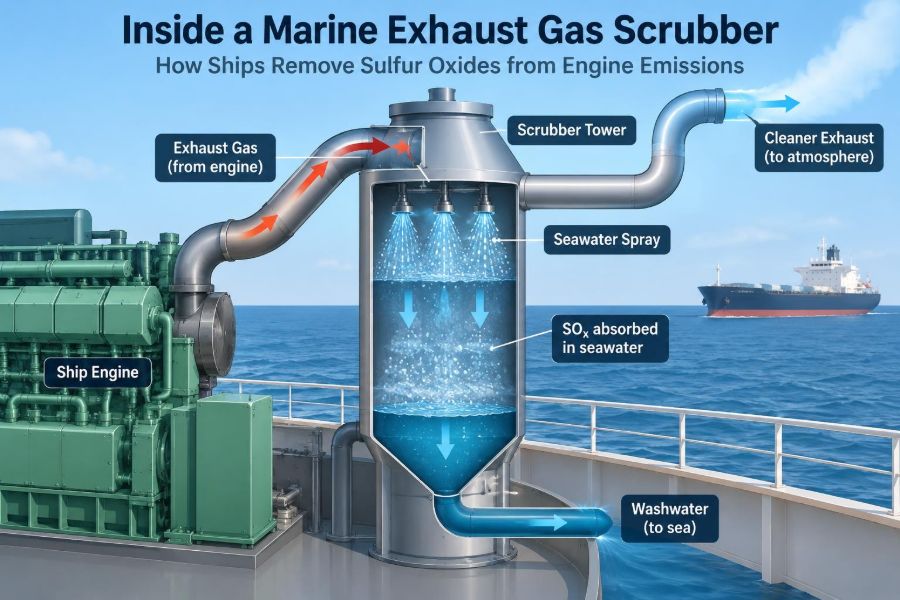
A typical installation includes an exhaust inlet, a scrubber tower or reactor, washwater pumps, spray nozzles, a droplet separator, instruments, a control system, and a discharge or treatment arrangement.
The exhaust enters the tower and meets water distributed through spray nozzles. The cleaned gas passes through a mist eliminator before reaching the funnel, while the used water follows a route determined by the system type.
On a large vessel, the scrubber may serve one main engine, several auxiliary engines, boilers, or a combination. A multi-inlet design can save space, but it also makes gas-flow control and maintenance planning more demanding.
🌫️ Following the exhaust gas through the tower
Exhaust gas usually enters near the lower part of a vertical tower and flows upward. Washwater is sprayed above it and falls downward, creating a counter-current contact pattern.
This opposing flow increases the opportunity for gas and liquid to meet. It is similar in principle to washing a contaminated air stream with a very large, constantly renewed wet surface.
Good contact matters more than simply using more water. Poor spray coverage, blocked nozzles, channeling through packing, or uneven gas distribution can create untreated paths through the tower.
💧 The chemistry behind sulfur removal
When SO2 dissolves in water, it forms acidic sulfur-containing species. If the water has sufficient alkalinity, those acidic products are neutralized, allowing more SO2 to dissolve and be removed.
Seawater contains natural alkalinity, largely associated with bicarbonate ions. Freshwater does not provide the same buffering capacity, so a closed-loop scrubber commonly adds an alkaline chemical such as sodium hydroxide to maintain the required pH.
The key mechanism is absorption followed by neutralization. The water absorbs the gas, and its alkalinity prevents the washwater from becoming acidic so quickly that sulfur removal falls away.
🌊 Open-loop scrubbers and seawater alkalinity
An open-loop system uses seawater once as washwater. After treatment and monitoring, the water is normally discharged overboard in accordance with the system’s approval conditions and applicable local requirements.
Its attraction is straightforward: no large recirculating process tank and generally no routine chemical dosing are required. In sufficiently alkaline seawater, the sea itself supplies much of the neutralizing capacity.
Performance can vary with water chemistry, temperature, salinity, and operating conditions. An open-loop system therefore relies on sound control logic and on operation in areas where discharge is permitted.
🔄 Closed-loop scrubbers and recirculated water
A closed-loop system recirculates a limited volume of washwater. The water is cooled, cleaned of solids, and chemically conditioned before being returned to the scrubber tower.
An alkaline reagent is dosed to restore neutralizing capacity. A small bleed-off stream is removed to prevent dissolved salts and contaminants from accumulating in the loop; this bleed-off is treated and handled according to the vessel’s arrangement.
Closed-loop operation is useful where overboard washwater discharge is restricted or where seawater alkalinity is unsuitable. Its trade-off is greater equipment complexity, chemical handling, and sludge management.
🔀 Hybrid systems and operating flexibility
A hybrid scrubber is designed to operate in both open-loop and closed-loop modes. At sea it may use seawater in open loop; in a port or jurisdiction with discharge restrictions, it can change to recirculating closed-loop operation.
This flexibility is valuable, but it is not automatic permission to discharge everywhere. The crew must know local rules, the vessel’s approved operating envelope, tank capacities, chemical inventory, and any reporting obligations.
A hybrid system also introduces more valves, routing choices, and failure modes. Flexible hardware only delivers flexible compliance when procedures and crew competence are equally strong.
🧪 Why pH is continuously measured
Washwater pH is an indication of acidity. In an open-loop system, a significant pH change between the incoming seawater and the discharge can indicate how much acidic material the water has absorbed.
In closed loop, pH helps control chemical dosing and protects the process from becoming too acidic. It is not the only measure of scrubber performance, but it is a critical process variable.
pH sensors need careful maintenance. Fouling, damaged reference elements, poor calibration, air bubbles, and incorrect sample flow can all produce misleading readings—an important lesson for any instrument exposed to dirty seawater.
📊 The SO₂/CO₂ ratio as a compliance indicator
Many approved scrubber arrangements monitor the ratio of SO2 to CO2 in exhaust gas. CO2 acts as a useful reference because it broadly follows fuel consumption, while SO2 follows the sulfur entering and leaving the system.
The measured ratio can be compared with an equivalent fuel-sulfur limit. This allows compliance to be demonstrated from the exhaust itself rather than relying only on fuel documentation.
Gas analysis is technically demanding. Sampling probes, heated lines, conditioning equipment, analyzer calibration, zero checks, span checks, and data logging all influence whether the reading is trustworthy.
🧹 Particulate matter and the side benefits of washing
Water sprays can capture some particulate matter from exhaust, especially particles that are water-soluble or become attached to droplets. The degree of reduction depends on the engine, fuel, scrubber design, operating mode, and particle characteristics.
This effect should not be confused with complete particulate control. Very fine particles and black carbon-related emissions are complex, and a scrubber is primarily designed and approved for SOx equivalency.
Captured material does not disappear. It moves into washwater and, in closed-loop plants, may be concentrated into sludge. That transfer is one reason waste handling is central to responsible scrubber operation.
💨 What scrubbers do not solve
A marine scrubber does not eliminate carbon dioxide produced by fuel combustion. Fuel use, engine efficiency, vessel speed, route planning, propulsion technology, and alternative fuels remain central to greenhouse-gas reduction.
It also is not normally a substitute for a nitrogen oxides control strategy. NOx formation is strongly linked to combustion temperature and oxygen conditions, and may require engine measures, exhaust gas recirculation, selective catalytic reduction, or other approved solutions.
Keeping these issues separate prevents a common misunderstanding: a visibly cleaner exhaust plume does not describe every component of a ship’s emissions.
🧱 The scrubber tower, nozzles, and packing
The tower must tolerate hot, wet, corrosive gases and salt-bearing water. Materials may include suitable stainless steels, high-alloy materials, coatings, or composite structures, selected for the exact operating environment.
Spray nozzles create droplets and distribute water across the gas path. Some towers also use packing, which provides a larger wetted surface area and can improve contact between gas and liquid.
Nozzle condition matters. A partially blocked nozzle can leave a dry zone; an eroded nozzle can alter its spray pattern. Both problems can reduce removal efficiency without immediately producing an obvious mechanical alarm.
🌀 Droplet separators protect the funnel
After gas has passed through the washing zone, it contains entrained water droplets. A droplet separator, often called a demister, removes much of this moisture before the gas exits the tower.
Without effective droplet removal, washwater can be carried toward the funnel. This may increase corrosion, cause deposits, create visible carryover, and distort downstream gas measurements.
Demisters can foul with soot, salt, and solids. Their pressure drop should be watched because excessive restriction raises backpressure and can affect engine operation.
⚙️ Backpressure is an engine-protection issue
Every exhaust treatment device adds resistance to gas flow. If scrubber pressure drop becomes excessive, the engine may struggle to expel exhaust gases efficiently, with possible consequences for turbocharger performance, combustion, temperature margins, and power capability.
Scrubber design must remain within the engine maker’s allowable backpressure limits across the operating range. This is especially important during rapid load changes and when several exhaust sources share a common system.
Pressure sensors, bypass arrangements where fitted, alarm logic, and operating procedures are not optional refinements. They protect the propulsion plant as well as the emissions function.
🚰 Washwater treatment and sludge handling
Closed-loop systems typically remove solids from recirculating washwater using separators, filters, hydrocyclones, or combinations of these. The collected material becomes sludge for onboard storage and later transfer to a suitable reception facility.
Sludge can contain soot, oil residues, and captured contaminants. It should be handled as a managed waste stream, with segregation, records, storage capacity, and transfer planning considered before the vessel reaches port.
A separator that is poorly maintained can allow solids to build up in the circulation loop. The result may be nozzle fouling, unstable pH control, reduced cooling, and increased cleaning work.
🧊 Cooling the recirculating process water
Exhaust transfers heat to washwater. In closed-loop mode, the recirculating water must be cooled so that pump seals, instruments, chemical reactions, and scrubber performance remain within their intended ranges.
Cooling may use a dedicated cooler connected to seawater or central cooling systems. This creates an engineering connection between emissions control and the ship’s overall heat-rejection capacity.
Fouled cooler surfaces can gradually reduce heat transfer. Operators may first notice rising process-water temperature, more frequent alarms, or a narrowing margin during high engine load rather than a sudden failure.
🧠 Automation, alarms, and data recording
A scrubber plant is controlled by a combination of flow, pressure, temperature, pH, turbidity, polycyclic aromatic hydrocarbon indicators where required, and gas-analysis signals. The exact instrument set depends on the approved system and operating mode.
Automation adjusts pumps, valves, chemical dosing, and mode selection. But automatic control cannot compensate forever for a blocked sea chest, depleted reagent tank, drifting analyzer, or poor maintenance practice.
Data recording is part of compliance. Logged information can show operating mode, key measurements, alarms, and events over time, helping inspectors and operators verify that the system was functioning as intended.
🗺️ Port restrictions and voyage planning
Some ports, coastal states, and local authorities restrict or prohibit the discharge of scrubber washwater within their waters. Requirements can change, differ between jurisdictions, and apply under specific geographical or operational conditions.
For a vessel using an open-loop or hybrid system, voyage planning must include more than fuel and arrival time. The team needs to identify restricted areas, determine when closed-loop mode is needed, and confirm adequate tank, chemical, and sludge capacity.
Never assume a rule based on a previous port call. Current official notices, chartering instructions, company procedures, and the vessel’s approved documentation should be checked for the intended voyage.
📝 The approved operating manual matters
Each scrubber installation has documentation describing its approved configuration, operating limits, monitoring arrangements, maintenance expectations, and compliance demonstration method. This documentation is specific to the vessel and system.
Engineers should treat it as an operational document, not paperwork for an inspection day. It tells the crew which readings matter, how mode changes are made, what contingency actions are permitted, and what must be recorded.
A scrubber is compliant only when its approved equipment, operating method, monitoring, and records work together. Hardware alone does not establish equivalency.
🔧 Routine maintenance that prevents trouble
Effective maintenance is mostly unglamorous: clean strainers, inspect nozzles, verify pump condition, calibrate sensors, test alarms, check sample lines, inspect demisters, and maintain chemical dosing equipment.
A practical routine should trend values rather than waiting for an alarm. Rising pump current, slowly increasing tower differential pressure, declining washwater flow, or drifting pH response may reveal deterioration before emissions performance is affected.
- Check for leaks, corrosion, vibration, and abnormal pump noise.
- Verify analyzer calibration and sample-conditioning performance.
- Inspect washwater quality equipment and clean sensor housings.
- Confirm reagent inventory, sludge capacity, and valve line-up before restricted waters.
⚠️ Common operational failures and their causes
Low washwater flow may result from clogged strainers, pump wear, air ingress, closed valves, blocked sea chests, or control faults. Its effect is often reduced gas-liquid contact and weaker sulfur removal.
Unstable pH in closed loop can point to inadequate reagent dosing, a failed dosing pump, poor mixing, faulty measurement, or excessive contaminant loading. Treating it only as an instrument problem can waste valuable time.
High pressure drop can result from demister fouling, soot deposits, damaged internals, or excessive water carryover. The correct response is to protect engine limits first, then investigate the source systematically.
🚨 Contingency operation when the scrubber fails
A failure does not remove the vessel’s obligation to meet applicable sulfur requirements. The immediate response depends on location, available fuel, the nature of the fault, safety considerations, and the vessel’s approved contingency procedures.
Where necessary and possible, the vessel may change to compliant fuel while repairs are made. The crew should record the event accurately, notify the appropriate parties through established channels, and preserve relevant monitoring data.
Trying to conceal a fault, defeat an alarm, or continue in a non-compliant mode creates legal, commercial, and safety risk. Clear decisions and honest records are far more defensible than improvised shortcuts.
👷 Crew competence is part of the equipment
Scrubber systems cross departmental boundaries. Engine-room personnel manage pumps, chemistry, cooling, and machinery protection; deck and environmental staff may support records, waste transfers, and port requirements; bridge teams need reliable mode-change information.
Training should include normal operation and abnormal scenarios: chemical spills, low alkalinity, sensor failure, washwater discharge restrictions, alarm response, and fuel-change contingency.
A useful drill is to ask a watchkeeper to explain the entire flow path—from exhaust inlet to funnel, and from seawater intake or process tank to discharge or sludge tank. Gaps in that explanation often reveal gaps in readiness.
💰 The operational trade-offs behind installation
A scrubber can make commercial sense for some vessels, particularly those with high fuel consumption and operating profiles that support its use. The decision depends on fuel-price differences, time in restricted waters, capital cost, maintenance, energy use, financing, and regulatory uncertainty.
It also carries space and weight penalties. Pumps, tanks, treatment units, piping, controls, and structural changes compete with other shipboard needs, especially on existing vessels being retrofitted.
No single answer fits every ship. A vessel spending long periods in ports with discharge restrictions may value closed-loop capability differently from a vessel trading predominantly on long ocean passages.
🌍 The environmental debate around washwater discharge
Scrubbers reduce sulfur oxides released to air, but open-loop operation transfers captured material to washwater. The acceptability of that trade-off has been debated by regulators, ports, environmental groups, shipowners, and researchers.
The impact depends on discharge characteristics, local water conditions, traffic density, dilution, and the contaminants present. This is why local restrictions and monitoring requirements exist, and why a broad statement that scrubbers are either entirely good or entirely bad is too simple.
Sound engineering means recognizing both sides: atmospheric SOx reduction is real, while water-discharge management and waste handling require equally serious attention.
🔍 How inspectors and operators verify performance
Verification may involve reviewing the approval certificate, operating manual, monitoring records, calibration evidence, maintenance records, alarms, fuel records, and the physical condition of equipment. Inspectors may also examine whether the operating mode matches the vessel’s location and reported status.
For the crew, the best preparation is ordinary disciplined operation. Complete records, believable trends, clean sampling systems, known chemical inventory, and a clear explanation of the plant are more useful than a last-minute effort to make the system look presentable.
Consistency is powerful evidence. A set of logs that matches fuel use, engine load, washwater flow, gas readings, and voyage events is easier to trust and easier to troubleshoot.
🧩 A practical troubleshooting sequence
When a key value moves out of range, start by protecting the engine and maintaining compliant operation. Then distinguish between a genuine process change and a bad measurement.
- Confirm the alarm, compare redundant indications, and check recent operating changes.
- Verify flow paths, valve positions, pump status, tank levels, and power supplies.
- Inspect sampling and sensor condition before making major process adjustments.
- Check likely physical causes such as fouling, blockage, air ingress, or reagent depletion.
- Record actions, results, and any change of operating mode.
This sequence avoids a common mistake: repeatedly changing set points before confirming whether the plant or the instrument is actually at fault.
📚 What marine engineering students should notice
Scrubbers are valuable case studies because they combine thermodynamics, fluid mechanics, corrosion, chemistry, automation, environmental compliance, machinery maintenance, and human factors in one plant.
The design question is rarely just “Can it remove SO2?” A marine engineer must ask whether it will do so at varying load, in cold or warm seawater, with limited maintenance time, under backpressure limits, and during real port operations.
That systems perspective is transferable. Many shipboard technologies succeed or fail not because one component is clever, but because interfaces between components, people, and procedures are managed well.
✅ The core principle: controlled transfer, not disappearance
A marine exhaust gas scrubber removes sulfur oxides by bringing exhaust gas into close contact with alkaline washwater. The sulfur compounds are absorbed and neutralized, while the cleaned gas is released through a carefully managed exhaust path.
Its effectiveness depends on much more than a tower in the funnel: adequate water flow, correct chemistry, clean internals, acceptable backpressure, reliable sensors, valid records, competent crew, and lawful handling of washwater and sludge are all essential.
The most useful way to think about the technology is as a controlled transfer process. It moves sulfur-related pollution from an exhaust stream into a managed liquid or waste stream, with compliance and environmental responsibility depending on how well that entire process is operated.
A scrubber is not simply an emissions add-on; it is a continuously managed marine process plant whose performance depends on chemistry, machinery, monitoring, and disciplined operation working together. 🚢🌊⚙️