
A ship leaves port at low speed, turns in a confined channel, accelerates into open water, slows for a pilot transfer, and may spend hours holding position outside a berth. The engine, gearbox, shaft, and propeller must handle every one of those conditions.
That is where the propeller choice becomes more than a detail on a machinery drawing. A fixed-pitch propeller may be extremely efficient at its design condition, while a controllable-pitch propeller can adapt its blade angle as the vessel’s operating condition changes.
The difficult question is not simply which propeller is “more efficient.” Efficiency depends on whether the vessel normally runs one steady route and speed, or repeatedly changes speed, direction, load, and required thrust.
For marine engineers, the comparison connects hydrodynamics with machinery operation, fuel use, maintenance planning, redundancy, and safe maneuvering. Understanding the trade-off helps explain why both propeller types remain common.
⚙️ Start with the Meaning of Propeller Efficiency
Propeller efficiency describes how effectively shaft power becomes useful thrust. The propeller takes rotating mechanical power from the shaft and accelerates water aft; the reaction produces forward thrust.
Not all shaft power becomes useful motion. Some is lost through blade drag, tip vortices, swirl in the slipstream, hull interaction, cavitation, and friction in the machinery between engine and propeller.
A useful distinction is between open-water efficiency, measured for a propeller operating away from a hull, and propulsive efficiency, which considers the real vessel, including hull wake and transmission losses. A propeller that performs well in open water is not automatically the best installation for every hull.
🧭 Fixed Pitch and Controllable Pitch in Simple Terms
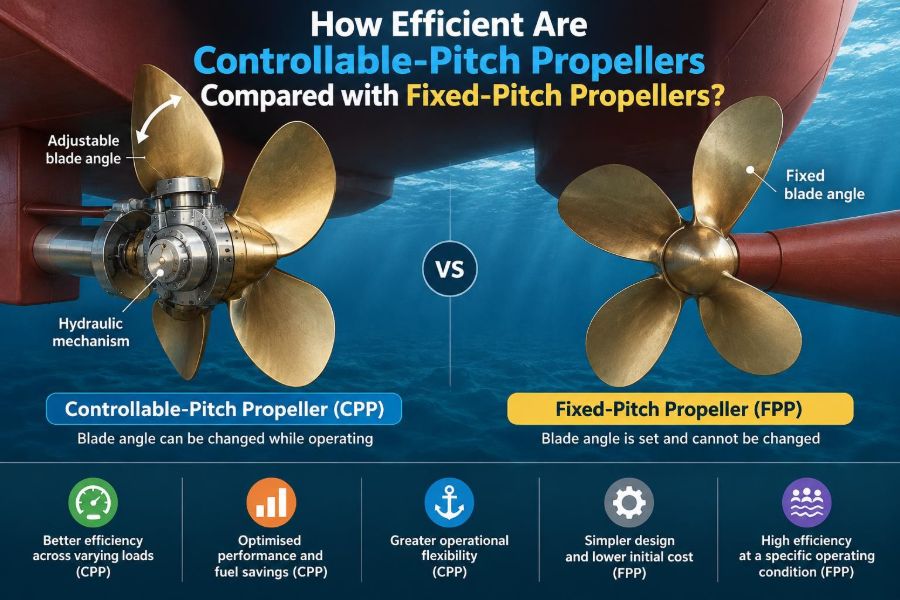
A fixed-pitch propeller, usually called an FPP, has blades permanently set at one geometric pitch. Its pitch is built into the propeller and cannot be altered during service.
A controllable-pitch propeller, or CPP, has blades that rotate about their own radial axes inside the hub. A hydraulic mechanism changes blade angle while the propeller continues to turn.
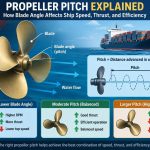
Pitch is comparable to the lead of a screw. A coarser pitch tries to move farther forward during each revolution, while a finer pitch produces less advance per revolution. Water is not solid, so the actual advance is always less than the theoretical value.
🔩 What Actually Changes Inside a CPP Hub
In a CPP system, hydraulic oil moves a servo piston within or near the propeller hub. Through a mechanical linkage, often including a crosshead and blade carriers, piston movement turns every blade by the same commanded angle.
The control system receives a pitch order from the bridge or propulsion control system. It compares the requested pitch with feedback from the hub mechanism and positions the blades accordingly.
This arrangement gives useful flexibility, but it introduces components that an FPP does not need: seals, hydraulic passages, a pitch-actuating mechanism, feedback equipment, and control valves. Those parts affect both lifecycle cost and failure planning.
📐 Why Blade Angle Has Such a Large Effect
Each propeller blade section meets water at an angle determined by blade pitch, rotational speed, vessel speed, and the wake flowing into the propeller. The local flow direction changes from root to tip because blade speed rises with radius.
Blade angle must create lift-like hydrodynamic force in a useful direction without producing excessive drag. If the angle of attack becomes unsuitable, the blade can lose efficiency, generate unsteady forces, or contribute to cavitation.
Changing CPP pitch lets the operator place the blade at a more suitable angle for a changed loading condition. An FPP cannot change its geometry, so it must change engine speed, vessel speed, or both to respond.
🌊 The Design Point Advantage of Fixed-Pitch Propellers
An FPP can be designed very closely around a vessel’s principal operating condition. For example, a vessel making long passages at a consistent service speed and draft can use a propeller optimized for that narrow range.
The FPP hub is generally more hydrodynamically streamlined and mechanically simpler than a CPP hub. It has no blade-root pitching mechanism inside the rotating hub, and this can reduce hub size, mechanical losses, and complexity.
At or close to its intended design point, a well-matched FPP installation can therefore achieve very strong propulsive performance. This is why it remains a logical choice for many deep-sea cargo vessels with predictable voyages.
🔄 Where Controllable Pitch Gains Ground
A CPP is most valuable when the vessel spends substantial time away from one ideal speed and loading condition. Rather than forcing a single blade pitch to suit every task, the operator can adjust pitch to match the thrust demand.
A tug, ferry, offshore support vessel, dredger, fishing vessel, and some naval or research ships may accelerate, tow, loiter, maneuver, and run at varied speeds in one operating day. In these cases, average voyage efficiency can matter more than peak efficiency at one speed.
The relevant comparison is therefore efficiency across the operating profile, not merely efficiency during a steady trial run.
📊 A Practical Comparison at Different Operating Conditions
| Operating condition | Typical FPP position | Typical CPP position |
|---|---|---|
| Steady service speed near design condition | Often highly efficient when correctly matched | Can be efficient, but hub and mechanism may impose a small penalty |
| Frequent speed changes | May operate away from optimum pitch and engine load | Pitch can be adapted to the required thrust |
| Low-speed maneuvering | Usually needs engine-speed changes or reversing arrangements | Fine pitch, zero pitch, and reverse pitch are directly available |
| Variable draft or towing load | Compromise pitch may limit operating flexibility | Pitch adjustment helps maintain suitable loading |
| Mechanical simplicity | Strong advantage | More components, controls, and maintenance requirements |
These are tendencies, not universal rules. Hull form, engine type, gearbox ratio, ducting, operating route, and control strategy can change the final result.
🚢 The Engine and Propeller Must Be Matched
Propellers do not work independently of engines. A fixed-pitch propeller has a characteristic torque demand that rises strongly as rotational speed increases. The engine must be selected so that its available torque and power match this propeller curve safely.
With a CPP, shaft speed and blade pitch can be controlled separately within system limits. This allows a designer to keep an engine or electric motor nearer a preferred speed while varying delivered thrust through pitch.
That flexibility is especially useful when machinery has a narrow efficient operating range. It does not remove the need for correct matching; poor pitch programming can still overload an engine or waste fuel.
🔥 Part-Load Operation Is Often the Deciding Issue
Marine engines are commonly most efficient within a favorable band of load and speed, rather than at every possible operating point. A vessel that frequently runs at reduced speed may face a different optimum from the same vessel at full service speed.
With an FPP, reducing ship speed normally means reducing propeller revolutions. Depending on the engine arrangement, this can move the engine to a less favorable operating point.
A CPP may allow the shaft to remain at a more suitable rotational speed while pitch is reduced to absorb the available power. Whether this saves fuel in practice depends on the engine’s fuel map, gearbox losses, propeller behavior, and the vessel’s actual duty cycle.
🛞 Constant-Speed Drives and Electric Propulsion
Controllable pitch is particularly compatible with machinery that prefers a nearly constant shaft speed. Examples include some generator-driven propulsion arrangements and installations where shaft-driven auxiliaries benefit from stable revolutions.
Instead of varying shaft speed for every thrust change, the propulsion system can hold speed and alter pitch. This can simplify coordination in certain plant designs.
Modern variable-speed electric drives also provide another route to flexible propulsion. They can vary motor speed effectively, so CPP is not automatically required in electric ships. The best arrangement depends on the complete power plant, not on the propeller alone.
🧊 Zero Pitch Is Useful but Not the Same as Stopping
At zero pitch, CPP blades are set so that their average thrust is close to zero while the shaft may continue rotating. This allows the main engine or drive train to remain engaged while the vessel is not making propulsion thrust.
That feature can be useful for maneuvering, rapid changes in demand, and machinery arrangements that do not benefit from frequent stopping and restarting. However, a rotating propeller at zero pitch still creates drag and consumes some power.
Zero pitch is also not a substitute for every emergency action. Stopping distance and crash-stop behavior depend on vessel mass, speed, pitch response, available reverse thrust, machinery limits, and bridge procedure.
↩️ Reversing Thrust Changes Maneuvering Practice
A CPP can create astern thrust by moving blade pitch through zero to a negative angle while shaft rotation remains in the same direction. This offers rapid, direct thrust reversal without reversing the main engine.
For a directly coupled FPP with a reversible low-speed diesel engine, astern movement normally requires slowing, stopping, reversing the engine, and building astern revolutions. That process is well established but has different response characteristics.
Vessels that make frequent harbor maneuvers may value CPP response even if its peak transit efficiency is slightly lower. The operational value includes control, timing, and reduced dependence on repeated engine reversals.
⚓ Bollard Pull and Towing Loads
Tugs and workboats must often generate high thrust at very low vessel speed. This is a demanding propeller condition because advance speed is low and blade loading can become high.
A CPP lets the operator select pitch appropriate to towing resistance, available engine power, and desired shaft speed. It can help keep the propulsion plant loaded productively while conditions evolve.
That does not mean every tug needs a CPP. Some tug designs use FPP systems very successfully, often with nozzles and carefully chosen engines or gearboxes. The decision also depends on the towing profile, maneuvering method, redundancy needs, and owner maintenance capability.
🛳️ Ferries Benefit from Repeatable Control
A ferry may perform dozens of departures, arrivals, turns, and speed changes on a regular route. Its propulsion system is judged not only by passage fuel use but also by schedule reliability and predictable low-speed response.
CPPs can give fine increments of thrust without constantly changing engine speed. This can make docking and speed control easier for the bridge team, particularly when combined with suitable automation.
Still, ferry operators must weigh these advantages against hub maintenance and downtime risk. A route with long, steady legs and limited maneuvering may justify a different solution from a short shuttle route with frequent berthing.
🐟 Fishing Vessels Face a Particularly Variable Duty Cycle
Fishing vessels may steam to grounds, tow gear at low speed, haul equipment, and return at another loading condition. Towing resistance can vary significantly with gear type, sea state, and catch operations.
CPP control allows the vessel to adapt thrust without treating every change as an engine-speed change. It can make it easier to manage propulsion while preserving an engine operating condition appropriate to the task.
For this reason, CPPs have long been associated with vessels that combine transit and working modes. The exact fuel outcome remains installation-specific, especially where auxiliary loads and hydraulic equipment are significant.
🧱 Hull Wake Can Change the Answer
The propeller does not receive uniform water flow behind a real ship. The hull boundary layer and stern shape create a wake field in which water velocity varies around the propeller disc.
Designers use wake information to select diameter, blade area, pitch distribution, skew, and number of blades. A propeller must be suited to the vessel’s stern, not simply selected from a generic efficiency chart.
CPP blade geometry has practical constraints because the blades must rotate within the hub mechanism. FPP designs may sometimes offer greater freedom to optimize detailed blade shape for one intended condition, although modern CPP design is also highly developed.
💨 Cavitation Can Erase Theoretical Benefits
Cavitation occurs when local pressure on a blade falls sufficiently for vapor cavities to form. Their collapse can cause noise, vibration, erosion, and reduced propeller performance.
Both FPPs and CPPs can cavitate. With CPPs, an inappropriate pitch command at a given shaft speed can create excessive blade loading; with FPPs, operation far from design condition can create similar problems.
Propeller selection must therefore consider cavitation margins across expected operation. A configuration that looks efficient on a simplified power calculation may be unacceptable if it creates damaging or uncomfortable vibration.
🔊 Noise and Vibration Matter Beyond Comfort
Pressure pulses from a propeller can excite vibration in the stern structure. Noise and vibration affect passenger comfort, crew fatigue, equipment reliability, and, for specialized vessels, acoustic signature.
Blade loading, wake non-uniformity, blade count, shaft speed, clearance to the hull, and cavitation all influence these effects. Pitch control can help avoid certain unfavorable conditions, but it can also create them if incorrectly scheduled.
A marine engineer should avoid evaluating propeller efficiency as a fuel-only matter. A modest power saving is not valuable if it is accompanied by unacceptable vibration, erosion, or maintenance burden.
🧰 The Mechanical Simplicity of an FPP
The major strength of an FPP is simplicity. Its solid hub contains no pitch-changing hydraulic mechanism, reducing the number of seals, moving parts, control components, and potential fault paths.
Fewer components generally make inspection, troubleshooting, and spare-parts management simpler. For ships operating far from specialist service support, this can be a significant practical advantage.
An FPP installation can still have substantial machinery complexity elsewhere, particularly if it uses a reversible main engine or sophisticated gearbox. But at the propeller itself, the arrangement is comparatively robust and straightforward.
🛢️ CPP Maintenance Is a System Responsibility
A CPP needs disciplined attention to hydraulic oil cleanliness, pressure stability, seal condition, pitch feedback, control-valve performance, and hub inspections. Contaminated oil or deteriorated seals can affect the precision and reliability of pitch movement.
Hub seal problems deserve particular attention because oil leakage may create environmental concerns, while water ingress can compromise lubricant condition and internal components. Monitoring systems and regular oil analysis can help identify developing issues.
This does not make CPPs unreliable by definition. It means their reliability depends more directly on maintenance quality, commissioning, and correct control-system care than a simple fixed hub does.
🧯 Failure Modes Must Be Considered Early
Every propulsion system needs a defined response to faults. For CPPs, engineers consider what happens if hydraulic pressure falls, feedback is lost, a control signal fails, or the blades do not move as commanded.
Many systems have a designed fail position, but the appropriate position depends on vessel function and class requirements. Safe behavior can involve holding pitch, moving toward a chosen setting, or relying on independent emergency arrangements.
Clear alarm logic, local control capability, bridge-engine-room communication, and crew drills are essential. A flexible propulsion system is only as safe as the operators’ understanding of its degraded modes.
🎛️ Control Logic Can Affect Fuel Consumption
CPP efficiency is not determined solely by blade hardware. The pitch schedule, engine governor response, shaft-speed setpoint, and power-limitation logic determine how the system behaves in daily service.
If pitch is increased too aggressively, engine torque or exhaust-temperature limits may be exceeded. If pitch is held too fine at unnecessarily high revolutions, wasted rotational losses and poor engine loading may result.
Good control logic coordinates pitch and speed so the plant meets thrust demand without crossing machinery limits. After modifications, dry docking, or control-system updates, validation under real operating conditions is valuable.
📈 Fuel Savings Must Be Calculated Over a Voyage
A claim that one propeller type “saves fuel” is incomplete without a duty profile. Fuel use should be assessed across transit, maneuvering, waiting, towing, dynamic operating modes, seasonal drafts, and expected weather allowances.
Consider a hypothetical harbor vessel that spends much of the day shifting between low-speed work and short transits. CPP flexibility may reduce inefficient off-design operation enough to outweigh its mechanical losses.
Now consider a hypothetical bulk carrier operating long ocean passages at a stable service speed. A carefully optimized FPP may offer the better result because the ship remains close to its design point for much of the voyage.
🧮 A Useful Way to Compare Alternatives
Design teams commonly begin with a propulsion operating envelope rather than a single point. This maps required thrust or power against vessel speed, draft, resistance condition, and intended operational modes.
- Define annual hours in each mode, including maneuvering and standby.
- Estimate resistance and thrust demand at representative drafts and speeds.
- Check engine, gearbox, shaft, and propeller operating limits.
- Compare fuel use, maintenance, capital cost, availability, and maneuvering needs.
- Review cavitation, noise, vibration, and emergency stopping behavior.
This whole-system comparison is more useful than selecting a propeller solely from a peak-efficiency figure.
💰 Capital Cost and Lifecycle Cost Are Different Questions
A CPP system commonly costs more initially because of its hub mechanism, hydraulic equipment, controls, and integration requirements. Installation and commissioning can also demand more specialist work.
Its lifecycle value may nevertheless be favorable where operating flexibility reduces fuel consumption, improves task performance, or avoids machinery arrangements that would otherwise be required. Conversely, additional maintenance and spare-parts costs can outweigh those gains in a stable operating profile.
Owners should separate purchase cost from total cost of ownership. Neither an inexpensive FPP nor a flexible CPP is automatically the lowest-cost choice over the vessel’s working life.
🧪 Sea Trials Need More Than a Top-Speed Check
Sea trials often focus on speed, power, and maneuvering performance under defined conditions. These tests are valuable, but they cannot fully represent every draft, sea state, fouling level, cargo condition, and operational pattern encountered over years.
For CPP installations, trials should also verify pitch indication, ahead and astern response, engine protection, alarm behavior, and control transfer between bridge and local stations where applicable.
Long-term onboard trend data can reveal whether actual operation follows the intended pitch and power envelope. Rising fuel use may indicate hull fouling, propeller damage, control drift, machinery degradation, or simply a changed operating profile.
🧼 Hull and Propeller Condition Still Dominate Performance
Even a well-selected propeller cannot compensate for a heavily fouled hull or damaged blade edges. Increased hull resistance raises power demand, while roughness and marine growth disturb flow into and over the propeller.
CPP blades also need accurate pitch calibration and smooth movement. If commanded and actual pitch differ, performance predictions and engine-loading assumptions no longer match reality.
Routine underwater inspections, performance monitoring, and careful repair practices protect the benefit of either design. Propeller choice is not a one-time decision; its performance must be maintained.
⚠️ Common Mistakes When Comparing CPP and FPP
The most frequent error is comparing peak propeller efficiency numbers without asking how the ship actually operates. That approach may favor an FPP for a vessel that rarely reaches its design condition, or favor a CPP without accounting for its maintenance demands.
- Assuming variable pitch always means lower fuel use.
- Ignoring gearbox, hydraulic, and control-system losses.
- Using a single design draft for a vessel that operates widely loaded and in ballast.
- Overlooking cavitation and vibration limits at low-speed, high-thrust conditions.
- Treating bridge control response as separate from propulsion efficiency and safety.
A sound evaluation makes assumptions visible and tests them against actual operating data.
🧑🔧 Operating Practices That Help CPP Installations
Operators should understand the approved relationship between pitch, shaft speed, and engine load. The objective is not to make frequent manual adjustments without purpose, but to avoid settings that create poor engine loading or excessive blade stress.
Engine-room teams should monitor hydraulic pressures, oil condition, pitch feedback, and unusual response times. A change in pitch movement can be an early clue to valve, seal, oil, or linkage problems.
Bridge teams need clear awareness that rapid pitch changes affect thrust and machinery load. Manufacturer guidance and vessel-specific procedures should govern normal maneuvering and emergency use.
🧑🏫 What Students Should Remember About Propeller Curves
For an FPP, propeller demand is strongly tied to shaft speed. In basic terms, absorbed power rises approximately with the cube of rotational speed for a given propeller operating condition, though real ship behavior adds complications.
A CPP adds pitch as another variable. At the same revolutions, fine pitch absorbs less power and coarse pitch absorbs more. This is why pitch control can keep an engine within its permissible operating envelope.
The key lesson is that a propeller curve is not just a graph for exams. It describes the physical connection between blade geometry, water flow, torque demand, and engine survival.
🌐 Environmental Performance Is Not Only Fuel Burn
Fuel consumption affects emissions, so choosing a system that performs efficiently over its actual operating profile can support environmental goals. But environmental evaluation should also include lubricant management, leakage prevention, underwater noise, and maintenance-related waste.
CPP hubs require careful sealing and oil-handling practices. FPPs avoid hub actuation oil but may require different machinery choices elsewhere in the propulsion train.
A balanced decision avoids narrow claims. The lower-impact option is the one that delivers its transport or working task efficiently, reliably, and with well-managed maintenance throughout service.
🧭 Selecting the Right Propeller for the Vessel Mission
Choose an FPP when the vessel has a relatively consistent operating speed and load, when maximum efficiency near a defined design point is the priority, and when mechanical simplicity offers strong value.
Choose a CPP when operating conditions vary substantially, when rapid reversible thrust and fine low-speed control are central to the mission, or when pitch flexibility improves machinery matching.
Many real projects sit between those descriptions. Designers may also compare nozzles, ducted propulsors, hybrid arrangements, variable-speed drives, reduction gears, and alternative propulsor types before reaching a final decision.
✅ The Core Principle: Optimize the Whole Operating Profile
Controllable-pitch propellers are not inherently more efficient than fixed-pitch propellers in every condition. An FPP can be exceptionally effective at its intended design point because it is simple and can be closely optimized for steady service.
A CPP earns its place by adapting blade pitch to changing thrust demands and by offering valuable maneuvering and machinery-control flexibility. Its efficiency advantage is most likely to appear when the vessel regularly operates away from one stable condition.
The correct engineering question is therefore: which propulsion system delivers the required thrust, control, reliability, and lifecycle value across the vessel’s real mission? That question produces a more useful answer than any universal claim about CPPs or FPPs.
A fixed-pitch propeller is often best for a well-defined steady duty, while a controllable-pitch propeller can be the better overall performer when the ship’s work is varied. The vessel’s operating profile—not the label on the propeller—should guide the choice. 🚢⚙️🌊