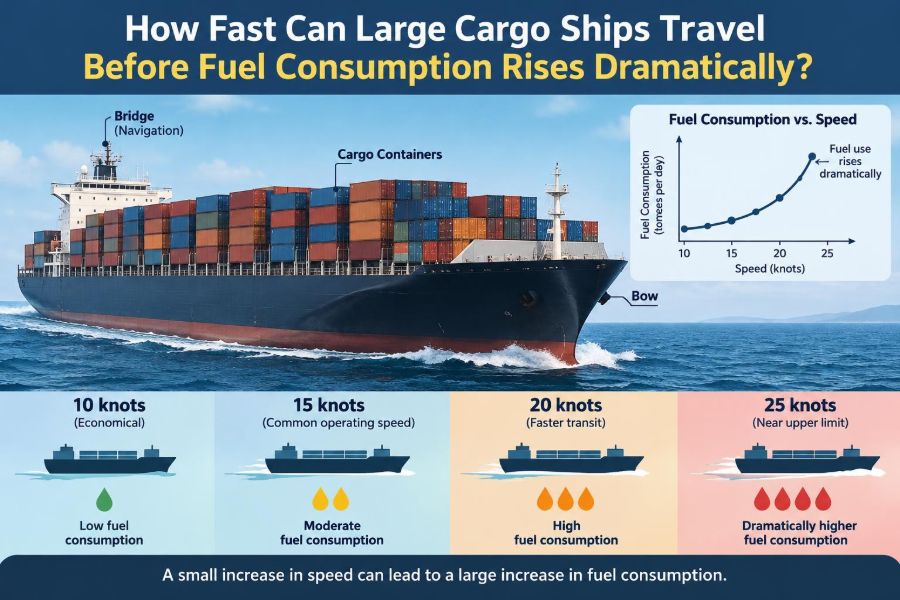

A container ship leaving port may have a schedule measured in days, not minutes. Yet a difference of only a few knots can decide whether it arrives on time, burns far more fuel than planned, or must change its route to avoid rough weather.
That trade-off is easy to miss from shore. A large cargo ship can look steady and slow even when it is moving at 18 or 20 knots. But pushing a hull through water becomes progressively harder as speed rises, and the machinery required to overcome that resistance consumes fuel at a sharply increasing rate.
For ship operators, speed is not simply a matter of “faster is better.” It affects charter commitments, engine condition, emissions, port windows, cargo reliability, and voyage cost. For marine engineers, it is a practical example of how hull hydrodynamics, propellers, machinery, and operations interact.
So how fast can a large cargo ship travel before fuel consumption rises dramatically? There is no single universal speed. The useful answer lies in understanding the curve behind the question.
🧭 Start With the Meaning of “Large Cargo Ship”
Large cargo ships include several very different vessel types: container ships, bulk carriers, crude-oil tankers, product tankers, vehicle carriers, and liquefied-gas carriers. Their hull forms, cargo priorities, installed power, and usual service speeds differ substantially.
A fast container ship may historically have been designed for service speeds above 20 knots. A large bulk carrier or tanker commonly operates more slowly, often in the low-to-mid teens when conditions and commercial requirements allow. Comparing their speeds without considering vessel type can be misleading.
In shipping, speed is normally stated in knots, with one knot equal to one nautical mile per hour. A nautical mile is based on Earth’s geometry and is slightly longer than a statute mile.
📈 The Core Rule: Power Rises Faster Than Speed
For a conventional displacement ship, the power needed to propel the vessel is often approximated as increasing with roughly the cube of speed. This is a rule of thumb, not an exact law for every hull and sea condition, but it captures the operational reality very well.
If speed increases by 10%, required propulsive power may rise by roughly 33% under comparable conditions. Since fuel consumption broadly follows engine power output, fuel use can rise steeply too.
This is why a modest-looking change from 14 to 16 knots is not a modest fuel decision. The ship does not merely cover the distance a little faster; it begins climbing a much steeper part of the resistance-and-power curve.
🌊 Where the Extra Resistance Comes From
A ship moving through water must overcome total resistance. The two major components are frictional resistance, created by water flowing along the wetted hull surface, and residual resistance, which includes wave-making effects and flow separation around the hull.
At lower speeds, friction is a dominant concern, especially for large vessels with extensive wetted area. As speed increases, wave-making resistance becomes increasingly significant. The ship spends more energy generating and carrying its own wave system.
Air resistance, appendage drag from rudders and bilge keels, and resistance from fouling also matter. Each may appear secondary, but together they can shift the real fuel-performance curve away from the clean-water prediction.
🌐 Why Waves Make Speed So Expensive
A displacement hull does not normally climb over the water in the way a planing craft does. Instead, it displaces water and creates waves. As the ship goes faster, the relationship between hull length, speed, and wave pattern becomes more demanding.
Engineers often use the Froude number, a dimensionless ratio involving speed, gravity, and waterline length, to examine this behavior. It helps explain why a hull designed for one operating range may become disproportionately inefficient beyond it.
Large cargo ships are not generally operated near the extreme “hull-speed” idea sometimes applied to small boats. Still, wave-making resistance is one reason a ship cannot simply add power indefinitely and expect proportional gains in speed.
⚙️ From Shaft Power to Fuel Burn
The engine does not deliver all of its chemical fuel energy directly to useful forward motion. Fuel energy passes through combustion, engine components, the shaft line, propeller action, and the surrounding water. Losses occur at every stage.
A main engine’s fuel rate is often discussed using specific fuel oil consumption, or SFOC: the mass of fuel consumed for each unit of energy produced. An engine may have a most efficient load range, but the ship’s total fuel use still rises when the demanded power rises.
Auxiliary engines, boilers, pumps, cooling systems, cargo equipment, and hotel loads also consume energy. On an ocean passage, main propulsion is usually the central fuel consumer, but it is not the only one.
🔢 A Simple Hypothetical Speed Comparison
Consider a hypothetical vessel requiring 10 units of propulsive power at 14 knots in calm water. Using a simple cubic approximation, increasing speed to 15 knots would require about 12.3 units, while 16 knots would require about 14.9 units.
That means a 14% speed increase from 14 to 16 knots could require close to 50% more power in this simplified example. Actual results vary with hull shape, draft, trim, weather, propeller behavior, and engine characteristics.
| Hypothetical speed | Relative power demand | What it illustrates |
|---|---|---|
| 14 knots | 10.0 units | Reference operating point |
| 15 knots | About 12.3 units | A small speed gain needs noticeably more power |
| 16 knots | About 14.9 units | Fuel exposure increases rapidly |
The table is not a performance guarantee for a real ship. It shows why voyage planners treat speed changes as an economic and engineering decision rather than a simple throttle adjustment.
🚢 Typical Service Speeds Are Not Maximum Speeds
A vessel’s service speed is the practical speed used for planning under stated conditions, often associated with a particular draft and engine condition. It is not necessarily the highest speed the ship can achieve.
Maximum speed may be limited by installed power, machinery operating limits, propeller cavitation, vessel vibration, weather, draft, or contractual restrictions. Running near maximum output for prolonged periods can also increase maintenance exposure.
For this reason, a ship capable of a higher trial or occasional operational speed may be scheduled at a lower speed for most voyages. The commercially sensible speed often sits well below the technically possible one.
🛢️ Why Container Ships and Bulk Carriers Differ
Container shipping usually places a high value on schedule regularity because containers may connect with rail, trucks, terminals, and other ships. That has historically supported comparatively higher service speeds on some routes.
Bulk carriers transport commodities such as iron ore, grain, coal, or minerals. Their cargoes are often less time-sensitive, and their operating economics commonly favor lower speeds. Tankers may follow a similar logic, although market conditions and charter terms can change the calculation.
The key point is not that one ship type is always fast or slow. It is that the value of arriving earlier must justify the disproportionate energy needed to do so.
🐢 Slow Steaming Changed the Operating Mindset
Slow steaming means deliberately operating below a vessel’s former or nominal service speed to reduce fuel use and emissions. It became a prominent operating strategy as fuel costs, environmental pressure, and excess fleet capacity reshaped shipping decisions.
Because of the nonlinear power relationship, reducing speed can produce a large reduction in daily fuel consumption. The journey takes longer, so total voyage fuel savings are not identical to daily savings, but they can still be significant.
Slow steaming is not merely “going slowly.” It requires engine operating guidance, route planning, schedule coordination, and an understanding of how low-load operation affects the plant.
⏱️ The Catch: A Longer Voyage Has Its Own Costs
Slower speed reduces fuel burned per day, but it also increases days at sea. A ship earns or serves fewer voyage cycles over a period, and cargo may arrive later. Crew time, insurance exposure, port commitments, and inventory costs can all enter the decision.
For a liner service, extra vessels may be needed to maintain weekly departures if transit time grows. For a chartered vessel, the charter-party terms may establish speed and consumption expectations that shape the acceptable operating range.
Therefore, the lowest fuel speed is not automatically the best business speed. Operators seek an optimum that balances fuel, time, asset utilization, emissions, and reliability.
📍 “Just in Time” Arrival Avoids Wasteful Sprinting
A common inefficiency occurs when a ship races toward a port only to wait at anchorage because a berth, pilot, tug, cargo gang, or terminal slot is unavailable. The fuel burned to gain those hours may provide no useful benefit.
Just-in-time arrival aims to share better operational information so the vessel can adjust speed and arrive when it can proceed with fewer delays. It is not always possible, since port conditions and commercial instructions can change, but the principle is straightforward.
Reliable communication between vessel, operator, charterer, agent, and terminal turns schedule visibility into energy savings. A carefully planned 13-knot passage can be more effective than a fast passage followed by two days at anchor.
🌦️ Weather Can Overrule the Calm-Water Curve
Published speed-power curves are commonly based on defined conditions, often calm water and a clean hull. Real seas are less cooperative. Head waves, wind, swell, current, and slamming can raise resistance substantially.
In rough weather, maintaining a planned speed may require a sharp increase in engine power. At some point, maintaining speed is neither economical nor prudent. The master may reduce speed for safety, hull protection, cargo security, crew welfare, or machinery limits.
Weather routing seeks a route and speed profile that considers these trade-offs. The shortest geographical route is not always the fastest, safest, or lowest-fuel route.
🧭 Current Changes Speed Over Ground, Not Water Resistance
A ship’s speed through water is closely related to the resistance it experiences. Its speed over ground is the progress measured relative to the seabed or charted position. Current creates the difference.
A favorable current can improve arrival time without increasing propulsion power. An adverse current can reduce progress even if the engine load remains unchanged. This is why a voyage plan must not treat speed as a single number.
Engineers monitor machinery performance, while navigators assess position, current, and safe routing. Efficient operation depends on combining both perspectives.
🧽 Hull Fouling Quietly Raises the Fuel Bill
Marine growth, slime, algae, barnacles, and other fouling make the hull rougher. A rougher surface increases frictional resistance, meaning more power is needed to maintain the same speed.
Fouling can develop gradually, so the penalty may not be obvious from one day’s observation. Trending shaft power, fuel consumption, speed, weather, draft, and trim over time helps identify a deteriorating hull-propeller condition.
Coatings, cleaning strategies, dry-docking plans, and propeller polishing are therefore fuel-management measures, not cosmetic tasks. Their timing must also consider environmental rules and local restrictions on in-water cleaning.
🌀 Propeller Efficiency Has a Major Role
The propeller converts shaft power into thrust, but it does so imperfectly. Its performance depends on diameter, pitch, rotational speed, blade geometry, wake field, draft, and the condition of the propeller surface.
If the propeller is poorly matched to the operating point, more shaft power may be required for the same speed. Excessive loading can contribute to cavitation: local pressure falls enough for vapor bubbles to form and collapse, potentially causing noise, vibration, efficiency loss, and erosion.
Modern designs may use devices such as pre-swirl stators, ducts, fins, or optimized propeller shapes. These do not remove the basic speed-power penalty, but they can improve the vessel’s baseline efficiency.
🧱 Draft and Trim Change the Hull’s Appetite for Power
A ship’s draft changes with cargo, ballast, fuel, and water. More displacement generally means more wetted surface and altered wave behavior, so the same vessel can require different power at the same speed on different voyages.
Trim is the difference between draft forward and aft. A small trim adjustment can change how water flows around the hull and propeller. The beneficial condition depends on the specific hull, loading condition, and speed.
Ballast management is constrained by stability, structural loads, propeller immersion, visibility, and safe handling. Fuel efficiency is only one factor, but it can be considered within those necessary limits.
🔧 Engine Load Is More Than a Fuel Number
Large two-stroke marine diesel engines are designed for sustained propulsion, but their operation at very low load requires care. Combustion quality, turbocharger performance, exhaust temperature, cylinder lubrication, and deposit formation may behave differently from operation nearer the engine’s intended range.
Slow steaming can therefore require manufacturer guidance and ship-specific operating procedures. Measures may include adjusted maintenance practices, engine tuning arrangements, or operational limits designed to protect the plant.
Conversely, consistently demanding high power can increase thermal and mechanical stress. Good fuel economy does not justify operation outside approved machinery limits, and schedule pressure does not justify ignoring alarms or protective margins.
🧰 Derating Can Make Lower-Speed Operation More Efficient
Engine derating is the practice of selecting or configuring an engine to deliver a lower maximum continuous rating than its full potential. In suitable designs, this can improve efficiency at the lower power levels where a vessel actually spends most of its time.
A “slow-steaming optimized” propulsion plant may use different engine settings, propeller selection, or shaft arrangements from one intended for higher service speeds. The goal is to align engine, propeller, and hull performance around the expected duty point.
Derating is a design and approval issue, not an onboard shortcut. It must follow manufacturer, class, and operational requirements.
💨 Wind and Air Drag Matter More Than They Seem
Container stacks, deck cranes, accommodation blocks, and large exposed superstructures present substantial area to the wind. A strong headwind can add resistance even when wave conditions are moderate.
This effect is especially relevant for high-sided container ships and vehicle carriers. The vessel’s loading condition changes its projected area, so air resistance is not constant from voyage to voyage.
Wind also affects maneuvering, route choice, and safe speed near port. An accurate performance assessment should recognize that fuel differences are not always caused by the engine or hull alone.
📊 Performance Monitoring Turns Theory Into Decisions
Engineers and operators use noon reports, automated sensor data, shaft power measurements, fuel-flow readings, weather information, and voyage records to assess performance. The purpose is not simply to collect numbers; it is to compare actual behavior against a meaningful baseline.
Raw fuel per day can be deceptive. A useful analysis accounts for speed through water, displacement, wind, waves, current, draft, trim, and machinery condition where data quality permits.
A trend showing more power needed for the same corrected speed can prompt investigation. Possible causes include fouling, propeller damage, sensor error, engine performance changes, or an unusual operating environment.
🧮 Fuel per Mile and Fuel per Day Tell Different Stories
At higher speed, daily fuel consumption rises because the engine is producing more power. But the ship also travels more miles per day. This means operators should examine both fuel per day and fuel per nautical mile.
Fuel per nautical mile often worsens as speed rises, particularly once the vessel moves beyond its economical range. Fuel per day may be lower at slow speed, but the vessel spends more days completing the passage.
The correct metric depends on the question. Is the goal to reduce total voyage emissions, meet an arrival time, manage a daily bunker budget, or compare charter performance? One number cannot answer every question.
📜 Regulations Encourage Efficiency but Do Not Set One Speed
International and regional environmental requirements increasingly encourage ships to improve energy efficiency and reduce greenhouse-gas intensity. Compliance frameworks can influence design choices, technical upgrades, fuel selection, and operational planning.
However, regulations do not create one universal “green speed” for every vessel. Safe navigation, contractual obligations, traffic separation, weather, engine condition, and cargo requirements still govern actual operation.
For professionals, the practical lesson is to understand the intended metric and boundary conditions. A change that improves one reported measure may introduce operational trade-offs elsewhere.
🌱 Lower Speed Usually Cuts Emissions, With Boundaries
When a ship burns less fossil fuel over a voyage, its carbon dioxide emissions from that fuel use are generally lower. This is a principal reason speed reduction is widely considered in decarbonization strategies.
But the full operational picture can be more complex. Longer voyages may require schedule changes, additional vessels in a service loop, or different port arrangements. Alternative fuels also have lifecycle considerations beyond what leaves the funnel.
The sound engineering conclusion is not that speed reduction solves every environmental problem. It is that avoiding unnecessary power demand is one of the most direct levers available to a conventional ship.
🚨 Safety Sets a Non-Negotiable Boundary
A fuel-efficient speed is never an excuse to compromise safety. The master must retain the ability to respond to traffic, weather, restricted waters, machinery limitations, and emergency situations.
Very low speed can create concerns in heavy weather, strong current, congested channels, or situations requiring adequate steerageway. Excessive speed can worsen slamming, propeller racing, vibration, structural loading, and stopping distance.
Safe speed is therefore a navigational judgment made within legal and operational responsibilities. Fuel optimization belongs inside that framework, not above it.
🗺️ Voyage Planning Is Better Than Mid-Voyage Guesswork
The most effective speed decision is made before departure and updated as conditions change. A sound plan considers required arrival time, likely weather, currents, draft, machinery limits, fuel margin, port readiness, and navigation constraints.
Rather than asking, “What is the fastest speed we can hold?” a better question is, “What speed profile delivers the required arrival safely with the least avoidable energy?” The answer may include faster and slower legs rather than one constant setting.
This approach also gives the engine department realistic expectations. Planned load changes can be managed more effectively than last-minute demands for maximum power.
🧑🔧 The Engine Room and Bridge Need the Same Picture
Fuel-efficient navigation depends on close bridge-engine cooperation. The bridge understands route, traffic, weather, port timing, and speed over ground. The engine department understands plant condition, fuel use, power limits, and the consequences of prolonged low or high loading.
Clear communication helps prevent an avoidable pattern: the bridge requests extra speed to recover a schedule delay, then learns later that the ship will wait for a berth. Shared voyage objectives make such mismatches less likely.
For students, this is a useful reminder that marine engineering is operational as well as mechanical. The best machinery decision often depends on information that originates outside the engine room.
❌ Common Mistakes When Discussing Ship Speed
Several shortcuts produce poor conclusions about fuel consumption:
- Assuming fuel use rises in a straight line with speed.
- Comparing ships of different types, sizes, or loading conditions as if their speed curves were identical.
- Using speed over ground to judge hull performance without considering current.
- Ignoring weather, fouling, draft, trim, and propeller condition.
- Treating maximum speed as a normal, economical operating target.
- Assuming slow steaming is harmless at any engine load without following approved guidance.
A useful analysis states its assumptions. Calm-water trial data, for example, cannot fully predict a laden vessel’s fuel use in winter head seas.
🏁 So When Does Consumption Rise “Dramatically”?
Fuel consumption begins rising disproportionately as soon as speed increases, because the resistance-power relationship is nonlinear. There is no universal knot value at which every large cargo ship suddenly becomes inefficient.
In practice, the rise becomes commercially dramatic when a requested speed increase moves the vessel far enough up its particular speed-power curve that the added fuel cost, emissions, and machinery demand exceed the value of earlier arrival. For many cargo ships, this happens well before maximum speed.
The threshold varies with hull design, vessel age, displacement, weather, fouling, propulsion arrangement, fuel price, contractual timing, and port readiness. A performance model built from the ship’s own data is more valuable than a generic rule.
✅ The Core Principle for Efficient Ship Operation
Large cargo ships can travel at speeds that look modest but require enormous propulsion power. The final few knots are often the most expensive because water resistance and required power rise much faster than speed itself.
Efficient operation means selecting the lowest safe speed that meets the real voyage requirement, then supporting that choice with a clean hull, efficient propeller, suitable engine loading, accurate weather and port information, and disciplined performance monitoring.
That principle applies whether the vessel is a container ship protecting a schedule or a bulk carrier crossing an ocean with flexible timing. Do not ask only how fast a ship can go; ask what each additional knot truly costs.
For large cargo ships, speed is a powerful but expensive tool: use only as much of it as the voyage genuinely needs. 🚢⚙️🌊