
A container ship can look almost motionless from shore. Yet beneath its decks, a propulsion plant may be turning fuel into enough sustained force to move tens of thousands of tonnes of steel, cargo, machinery, stores, and water through open ocean.
That apparent contradiction is where marine engineering becomes fascinating. A ship does not need to leap forward like a car; it needs to overcome water resistance continuously, reliably, and efficiently for days or weeks at a time.
For crews, engineers, port planners, and anyone watching a ship leave berth, engine power affects much more than speed. It shapes fuel use, emissions, maintenance work, schedule resilience, manoeuvring ability, and ultimately the cost of moving global trade.
Modern marine engines are extraordinarily powerful, but their real achievement is not simply producing a huge number. It is converting power into useful thrust at the propeller while keeping a very large vessel controllable in a demanding environment.
⚓ Start With the Difference Between Power and Thrust
Power is the rate at which an engine can do work, usually stated in kilowatts (kW) or megawatts (MW). Thrust is the pushing force created by the propeller as it accelerates water backward.
Those are related but not interchangeable. An engine delivers rotating power to a shaft; the propeller converts that rotation into thrust; the hull turns thrust into forward motion. Losses occur at every step.
A useful comparison is cycling uphill. Strong legs provide power, but the actual forward force at the tyre depends on gearing and grip. On a ship, the propeller and its interaction with the hull play a similarly decisive role.
📏 Why Cargo Ships Need So Much Energy
A loaded cargo ship must overcome several forms of resistance. The largest share at normal service speed is usually frictional resistance: water dragging along the wetted surface of the hull.
The ship also creates waves, pushes air aside, experiences turbulence around appendages, and may face wind, currents, swell, or fouled hull surfaces. Every extra unit of resistance requires more propeller thrust.
Displacement matters, but it is not the whole story. A broad, slow bulk carrier can carry a great mass with comparatively modest installed power, while a faster container ship may need much more power because resistance rises rapidly as speed increases.
🌊 The Speed Penalty Is Steeper Than It Looks
For a displacement vessel, required propulsive power commonly rises roughly with the cube of speed over a useful operating range. This is a rule of thumb, not a universal law, because hull form and sea state change the result.
Still, the operational implication is clear: a modest speed increase can demand a disproportionately large increase in fuel. Reducing speed by a few knots can therefore cut daily fuel consumption substantially, which is one reason slow steaming became common on many trades.
A ship cannot simply slow forever, however. Schedules, cargo condition, charter commitments, weather avoidance, and engine operating limits all influence the practical speed choice.
🔢 What “Powerful” Means in Marine Terms
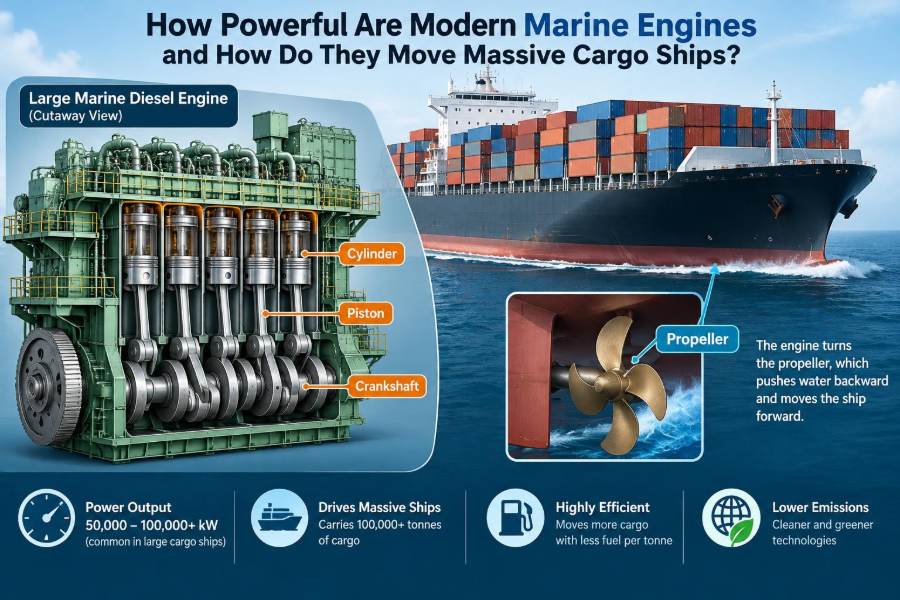
Large ocean-going ships often have main propulsion ratings measured in tens of megawatts. The biggest low-speed diesel engines can produce power on a scale comparable with a small power station, but they deliver it as slow, high torque rotation rather than electricity for a grid.
One well-known class of large two-stroke marine diesel engine has been rated at around 80 MW in certain configurations. Many merchant ships need far less: installed propulsion power is selected for the vessel’s size, hull, route, required service speed, and safety margins.
Engine nameplate rating is not the same as everyday operating output. Vessels are commonly operated below maximum continuous rating to manage fuel consumption, machinery wear, and reserve capacity for difficult conditions.
🛢️ The Low-Speed Two-Stroke Diesel Engine
The dominant prime mover for large, deep-sea cargo ships has long been the low-speed two-stroke diesel engine. It is called low-speed because its crankshaft may turn at roughly the same low rotational range suitable for a large fixed-pitch propeller.
In a two-stroke engine, each cylinder has a power stroke every crankshaft revolution. Large cylinders, long strokes, turbocharging, and slow rotational speed allow very high torque.
Its direct drive arrangement is especially attractive: the engine can connect directly to the propeller shaft without the large reduction gearbox that a higher-speed engine would require.
🔩 Why Enormous Torque Matters
Torque is twisting force. A ship propeller needs tremendous torque because it is large, heavily loaded, and turns in dense water rather than air.
At a given power, a lower shaft speed means higher torque. That is exactly what a slow-speed engine provides. Instead of spinning a small propeller extremely fast, a cargo ship can turn a large propeller slowly and move a larger mass of water more gently.
This usually improves propulsive efficiency and reduces the risk of damaging cavitation, although propeller design must still balance efficiency, vibration, draught constraints, and manoeuvring needs.
🌀 How a Propeller Produces Forward Motion
Propeller blades are shaped like rotating hydrofoils. As they turn, they develop pressure differences and impart momentum to the water, producing a rearward slipstream. The reaction force pushes the ship ahead.
The propeller does not screw through water as though water were a solid nut. Water flows around the blades, and some of the theoretical advance is lost as slip. That is normal; a propeller requires a change in water momentum to create thrust.
Good design aims to create the required thrust with as little wasted rotational energy, turbulence, noise, and cavitation as practical.
💧 Propeller Diameter Is an Efficiency Tool
All else equal, a larger propeller can accelerate a greater mass of water by a smaller amount. This is usually more efficient than accelerating a smaller mass of water violently.
That principle explains the distinctive large, slow-turning propellers fitted to many cargo ships. Their diameter is limited by the ship’s draught, hull geometry, structural clearances, and the need to avoid contact with the seabed in shallow water.
Propeller tip speed also matters. Excessive tip speed can encourage cavitation and vibration, making a larger diameter and lower rotational speed especially valuable.
🫧 Cavitation: The Invisible Limit
Cavitation occurs when local pressure near a propeller blade falls low enough for vapour bubbles to form. When those bubbles collapse in higher-pressure regions, they can create noise, vibration, reduced efficiency, and erosion of metal surfaces.
It is not simply a sign that a propeller is “too powerful.” Blade shape, loading, rotational speed, wake quality, immersion depth, and sea conditions all influence it.
Engineers use hydrodynamic modelling, model testing, and increasingly sophisticated numerical tools to design propellers that perform effectively while keeping cavitation within acceptable limits.
🧭 The Hull and Propeller Work as a System
A propeller never works in undisturbed water. The ship’s hull changes the flow arriving at the propeller, called the wake field. In turn, the propeller alters pressure and flow around the stern.
Hull lines, rudder arrangement, shaft brackets, boss cap fins, ducts, and other appendages can be designed to improve this interaction. A device that looks small may affect fuel consumption meaningfully over a ship’s long operating life.
This is why comparing engines alone can be misleading. A less powerful engine on a well-optimised hull-propeller system may achieve the same voyage speed with less fuel.
⚙️ Direct Drive Versus Geared Propulsion
In direct drive, a low-speed main engine turns the propeller shaft directly. The arrangement is mechanically straightforward and well suited to large ships with a single large propeller.
Medium-speed four-stroke engines rotate much faster. They commonly drive a propeller through a reduction gearbox, which lowers the shaft speed while multiplying torque. Such plants can offer layout flexibility and may use multiple engines.
| Arrangement | Typical strength | Common application |
|---|---|---|
| Low-speed direct-drive diesel | High efficiency at steady ocean passages | Large tankers, bulk carriers, container ships |
| Medium-speed diesel with gearbox | Flexible machinery arrangement | Smaller cargo ships, ferries, specialist vessels |
| Diesel-electric propulsion | Flexible power distribution and redundancy | Cruise ships, offshore vessels, ice-capable ships |
No arrangement is automatically best. The right choice follows the vessel’s duty cycle, space constraints, route, electrical demand, and maintenance strategy.
⚡ Diesel-Electric Propulsion Changes the Layout
In diesel-electric propulsion, diesel engines drive generators rather than connecting mechanically to the propeller. Electric motors then turn the propellers or azimuthing thrusters.
This separates engine location from propeller location and allows generating sets to be started or stopped according to demand. It can be particularly useful where hotel loads, cranes, dynamic positioning, or ice operations create variable electrical needs.
Energy passes through additional conversion stages, so a diesel-electric system is not automatically more efficient for a ship spending most of its life at one steady ocean speed. Its advantages often lie in flexibility, redundancy, and operational control.
🔌 Shaft Generators and Power Take-In Systems
A modern main engine may support more than propulsion. A shaft generator can use shaft rotation to supply electrical power during passage, reducing the need to run separate auxiliary generator engines.
Some arrangements can work in reverse: an electric machine assists the shaft using electrical energy from onboard generators or other sources. This is often described as power take-in, while generator operation is power take-off.
These hybrid arrangements allow operators to match machinery use to weather, loading, and electrical demand, but they add control complexity and require careful protection systems.
🔥 Fuel Becomes Cylinder Pressure
In a large diesel engine, air is compressed in the cylinder until it becomes hot enough for injected fuel to ignite. Combustion raises pressure, forcing the piston downward and turning the crankshaft through the connecting rod.
The engine does not convert all fuel energy into shaft power. Heat leaves through exhaust gases, cooling systems, lubricating oil, and radiation. The goal is to capture as much useful work as possible while protecting components from excessive temperatures and stresses.
Modern fuel-injection controls can adjust injection timing and quantity with great precision. That helps engines operate efficiently across changing loads while meeting applicable emissions requirements.
🌬️ Turbochargers Help Engines Breathe
Exhaust gas from the engine spins a turbine connected to a compressor. The compressor forces more air into the cylinders, enabling more complete combustion and higher power density. This is turbocharging.
Because the turbocharger recovers some energy that would otherwise leave in the exhaust, it is central to the efficiency of large marine diesels. Air coolers reduce the temperature of compressed air before it enters the cylinders, increasing its density.
At very low engine loads, available exhaust energy falls. Engine control systems and auxiliary blowers may be needed to maintain sufficient scavenging air and stable combustion.
♨️ Waste Heat Is a Valuable Resource
Even an efficient main engine rejects a large amount of heat. Ships can recover part of that energy from exhaust gas or cooling circuits to make steam, heat fuel tanks, supply accommodation services, or generate additional electrical power.
Waste-heat recovery systems work best when the ship has a suitable, relatively steady operating profile. Their added equipment brings cost, space requirements, maintenance needs, and operational complexity.
The broader lesson is simple: fuel efficiency is not only about the engine’s brake output. It also depends on how intelligently the ship uses energy that would otherwise be discarded.
⛽ Fuels Are Changing the Engine Room
Traditional marine fuel oils remain widely used, but fuel choices are broadening in response to air-pollution rules, greenhouse-gas targets, availability, and commercial risk. Distillate fuels, liquefied natural gas, methanol, bio-derived blends, and other options may be considered depending on vessel type and trade.
Different fuels change tank arrangements, fuel treatment, safety procedures, engine settings, bunkering operations, and emissions characteristics. A fuel with lower carbon intensity in one part of its supply chain may still require careful lifecycle assessment.
There is no single transition pathway for every ship. Newbuild choices must account for route infrastructure and the possibility that fuel availability evolves during the vessel’s service life.
🌱 Efficiency Is Often the First Emissions Lever
Using less energy per tonne of cargo moved generally reduces fuel use and associated emissions, whatever fuel is onboard. Slow steaming, hull cleaning, propeller polishing, weather routing, trim optimisation, and machinery tuning can all contribute.
These measures are not interchangeable. For example, reducing speed saves energy but may require more vessels to maintain a service frequency. Cleaning a hull can improve performance, yet timing must fit dry-dock plans, coating condition, and biofouling controls.
The most effective approach is usually a package of operational and technical measures, measured against the ship’s actual route and cargo commitments.
🧼 A Dirty Hull Can Waste Engine Power
Marine growth and roughness increase frictional resistance. A hull that was efficient when freshly coated can demand more shaft power after months in water, especially in warm regions or during long idle periods.
Propeller roughness and damage also matter because they directly affect the device creating thrust. Even a small performance loss can be expensive when repeated over thousands of operating hours.
Performance monitoring helps crews and shore teams distinguish likely fouling from changes in weather, cargo load, engine condition, or sensor quality. Good decisions require comparable data, not a single daily observation.
📐 Draft, Trim, and Loading Affect Resistance
Draft is how deeply a ship sits in the water, while trim is the difference between its forward and aft draft. Both influence wetted area, wave-making, propeller immersion, and the flow into the stern.
Ships are designed for a range of loading conditions, not one perfect condition. Ballast voyages can be especially challenging because a lightly loaded ship has a different waterline and may need ballast to maintain safe propeller immersion and stability.
Trim optimisation uses loading and operational data to identify conditions that reduce resistance without compromising safety, visibility, structural limits, or cargo requirements.
🛞 Fixed-Pitch and Controllable-Pitch Propellers
A fixed-pitch propeller has blades with a permanent angle. Speed and thrust are adjusted mainly by changing shaft speed, making it a natural fit for direct-drive low-speed engines.
A controllable-pitch propeller can rotate its blades about their own axes to alter pitch while the shaft keeps turning. This can provide responsive thrust control and allow the prime mover to run in a preferred speed range.
Controllable-pitch systems add hubs, hydraulics, controls, and maintenance considerations. Their value is strongest where manoeuvrability and varying operating modes outweigh the advantages of the simplest possible propeller system.
↩️ Stopping and Reversing Are Different Problems
A large ship has enormous momentum. Stopping distance depends on speed, displacement, propeller response, water depth, wind, current, and available room; it is not comparable to applying brakes on a road vehicle.
Many direct-drive two-stroke engines can reverse direction, allowing the propeller to produce astern thrust. Reversal is a controlled sequence involving fuel, air, timing, and shaft rotation, not an instant switch.
In restricted waters, tugs, thrusters, pilots, rudders, and careful speed management are as important as main-engine power. More power does not eliminate the need for planning.
🧯 Reliability Is Part of Propulsion Power
An engine’s useful power is the power it can deliver safely and dependably. Marine propulsion plants are designed with alarms, trips, cooling, lubrication, filtration, emergency systems, and planned maintenance to protect against damage and loss of propulsion.
Common risk areas include contaminated fuel, poor lubrication, cooling-water leaks, turbocharger faults, bearing distress, and control-system failures. Early trends in temperature, pressure, vibration, and drain-oil condition can provide warning before a fault becomes severe.
Engine-room watchkeeping is therefore not merely about reading gauges. It is about understanding what normal operation looks and sounds like for that particular machinery.
🧪 Lubrication Separates Surfaces Under Extreme Load
Large marine engines rely on carefully managed lubricating oil systems. Journal bearings support rotating shafts on a film of oil, while cylinder lubrication protects liners and piston rings in a harsh, high-temperature environment.
Oil choice and feed rate must suit the engine design and fuel used. Too little lubrication risks wear and scuffing; too much can increase deposits, cost, and emissions-related complications.
Regular oil analysis can reveal contamination, wear metals, water ingress, or degradation. It is a diagnostic tool, not a substitute for inspections and sound engineering judgement.
📊 Sea Trials Do Not End the Performance Story
Before delivery, ships undergo trials to demonstrate performance under defined conditions. These results are valuable, but real voyages include weather variation, fouling, changing drafts, traffic constraints, and equipment aging.
Continuous performance monitoring compares speed, power, fuel flow, weather data, draft, and other variables over time. The aim is to identify trends rather than to claim that any single voyage proves a change in efficiency.
Data quality matters. Incorrect shaft-power calibration, unreliable fuel-flow measurements, or poorly recorded weather can lead to confident-looking but misleading conclusions.
🧠 Automation Supports, but Does Not Replace, Engineers
Electronic engine controls can optimise injection, manage cylinder balancing, log events, and respond quickly to abnormal conditions. Condition-monitoring systems can make maintenance more targeted by highlighting developing issues.
However, automation operates within the limits of its sensors, programming, and assumptions. A sensor may drift, a process may behave unusually, or a maintenance action may introduce a new fault.
Competent engineers need both digital literacy and practical understanding: why a temperature changes, what a sound suggests, and when a trend requires verification rather than blind acceptance.
🏗️ The Engine Is Only One Part of the Ship’s Energy System
Propulsion competes with other loads for energy. Refrigerated containers, cargo pumps, deck machinery, ventilation, navigation systems, accommodation services, and emissions-control equipment all consume power in different operating modes.
A tanker discharging cargo and a container ship at sea may have very different electrical demands even if their propulsion outputs are similar. The machinery plant must be sized and controlled for the whole mission, not just a headline top speed.
This systems perspective explains why marine engineers think in terms of power balance, redundancy, fuel treatment, heat flows, and operational scenarios rather than simply engine horsepower.
🚧 Common Misunderstandings About Giant Ship Engines
- “A bigger engine always makes a ship much faster.” Hull resistance rises sharply, so added power can produce only a modest speed increase near the top of the operating range.
- “The engine pushes the ship directly.” The engine turns a shaft; the propeller creates thrust by changing water momentum.
- “Maximum power is normal operating power.” Ships often operate below maximum rating for efficiency, reliability, and operational reserve.
- “Fuel efficiency belongs to the engine alone.” Hull condition, propeller condition, loading, weather, and voyage planning can be equally influential.
🧰 Practical Questions for Students and Professionals
When assessing a propulsion system, ask what duty it must perform. Is the vessel mainly crossing oceans at constant speed, making frequent port calls, holding station offshore, operating in ice, or supplying large electrical loads?
Then examine the full chain: fuel energy, combustion, shaft power, gearbox or electrical conversion if present, propeller thrust, hull resistance, and real operating conditions. A weakness anywhere in that chain reduces voyage performance.
Also separate design intent from measured reality. A specification tells you what a system was built to do; trend data and inspections show how it is actually performing.
🔮 What Future Propulsion May Look Like
Future cargo ships are likely to combine several approaches rather than depend on one breakthrough. More efficient hulls and propellers, wind-assist devices, batteries for selected duties, improved route optimisation, alternative fuels, shore power, and waste-heat systems can all play roles.
The practical mix will vary. A short-sea vessel with predictable charging opportunities faces different choices from an ocean-going bulk carrier travelling between ports with uncertain fuel infrastructure.
Marine engineering will remain a discipline of trade-offs: energy density, safety, cost, maintainability, cargo capacity, emissions, and reliability must be evaluated together.
🏁 The Core Principle Behind Moving a Massive Ship
Modern marine engines are powerful because they must supply sustained energy against continuous water resistance, often for long periods far from shore. Their remarkable torque is useful only when it is matched to an efficient shaft, propeller, hull, and operating plan.
The biggest gains do not always come from installing a larger engine. They often come from reducing resistance, recovering energy, selecting suitable machinery, keeping surfaces clean, operating at sensible speeds, and maintaining equipment before small losses become large ones.
That is the central engineering lesson: propulsion is a system, and the ship moves efficiently when every part of that system works together.
A cargo ship crosses oceans not because its engine simply overwhelms the sea, but because carefully managed power is converted into steady, efficient thrust. 🚢⚙️🌊