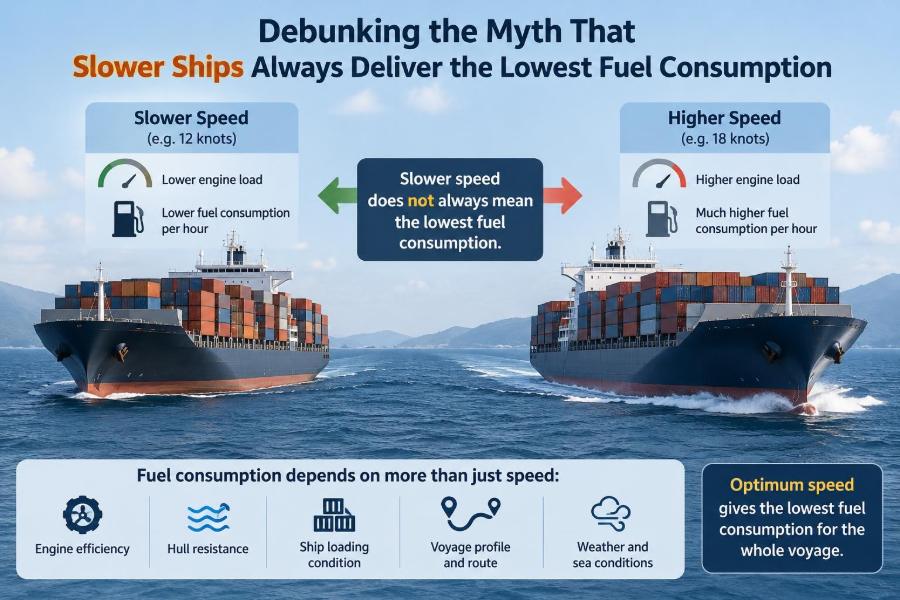

A voyage manager sees rising bunker costs and gives what sounds like obvious instruction: reduce speed. On the next passage, the ship arrives later, burns less fuel per day, and everyone assumes the decision was correct.
But the commercial result can be more complicated. The vessel may have spent extra days at sea, missed a berth window, waited at anchor, operated auxiliary machinery longer, or required a recovery period at higher power. Fuel saved on the main engine is not always fuel saved by the voyage.
For engineers, officers, chartering teams, and students, this distinction matters because speed is one of the strongest operational levers available. It is also one of the easiest to oversimplify.
Slower steaming is often highly effective. The myth is the word always. Finding the lowest fuel consumption requires defining what is being measured, understanding the machinery and hull, and looking at the whole operating schedule rather than a single speed-power curve.
⚓ Start by Defining “Lowest Fuel Consumption”
The phrase can refer to several different measures. A ship may use fewer tonnes of fuel per day at low speed, while using more fuel for the complete port-to-port voyage because the voyage takes much longer.
Common measures include fuel per day, fuel per nautical mile, fuel per tonne-mile of cargo, and total fuel for a voyage. These answer different questions, so they can point to different “best” speeds.
- Fuel per day helps assess daily operating expenditure.
- Fuel per nautical mile is useful when distance is fixed.
- Fuel per tonne-mile reflects transport efficiency for cargo moved.
- Total voyage fuel includes the time needed to cover the route and often auxiliary loads.
📈 Why Propulsion Power Rises So Quickly
At ordinary service speeds, the power needed to push a displacement ship through water commonly rises roughly with the cube of speed. This is a practical rule of thumb, not a universal law: hull form, loading condition, weather, and propeller characteristics all affect the actual curve.
The consequence is still clear. A modest speed reduction can produce a much larger reduction in required propulsion power. This is the engineering foundation of slow steaming.
Resistance includes friction along the wetted hull, wave-making resistance, air resistance, and losses around appendages. At higher speeds, wave-making effects can become especially costly, which is why an extra knot near service speed may demand disproportionately more power.
🔄 Power Is Not the Same as Fuel Rate
Brake power is the mechanical power delivered by the engine crankshaft. Fuel rate is the mass of fuel burned to produce that power. They are connected, but they are not interchangeable.
Engine fuel efficiency is normally expressed through specific fuel oil consumption (SFOC), often stated as grams of fuel per kilowatt-hour. An engine can require less total power at a lower speed but operate at a less favorable SFOC.
Therefore, reducing power does not necessarily reduce fuel use in direct proportion. The propulsion power curve and the engine efficiency curve must be considered together.
🧭 The Difference Between Daily and Voyage Fuel
Imagine a hypothetical ship sailing a fixed route. At a lower speed, its main engine fuel per day falls sharply, but the passage takes additional days. The total may still fall, yet the saving may be far smaller than the daily figures suggest.
At very low speed, the additional time can become decisive. The ship continues to need electrical power, crew accommodation services, cooling, pumps, treatment systems, and other hotel loads whether it is moving quickly or slowly.
The relevant calculation is simple in principle: add all fuel consumed from departure to arrival, not only the main-engine fuel reported at noon.
⚙️ The Engine’s Efficient Operating Zone
Large marine diesel engines do not have identical efficiency at every load. Their fuel maps show how SFOC varies with engine speed, torque, and, for electronically controlled engines, injection and valve settings.
Many engines are efficient over a broad middle-to-high load range. At very low load, combustion quality, turbocharger matching, exhaust temperature, and auxiliary blower operation can change the result.
Manufacturers provide approved operating envelopes and guidance for prolonged low-load operation. Those limits matter more than a generic belief that “less rpm is always better.”
🔥 Low Load Can Change Combustion Conditions
When load is greatly reduced, cylinder pressure and exhaust-gas temperature generally decline. Lower temperatures may impair combustion quality and reduce the energy available to drive the turbocharger.
Depending on engine design and settings, this can lead to poorer air supply, deposits, fouling, or operational concerns that need active management. The outcome is not identical for every engine, fuel, ambient condition, or maintenance state.
Slow steaming should therefore be supported by the engine maker’s instructions, including any recommendations for periodic operation at higher load or procedures for avoiding prolonged harmful conditions.
🌬️ Turbochargers Do Not Behave Like Fixed-Speed Fans
A turbocharger depends on exhaust energy. As engine load falls, the turbine receives less energy and compressor delivery may reduce. The engine’s air-fuel balance can then move away from its preferred condition.
Modern engines may use variable turbine geometry, waste-gate arrangements, auxiliary blowers, or other measures to improve low-load performance. These systems expand flexibility, but they do not remove the need to follow approved operating guidance.
An engineer assessing low-speed fuel performance should look at more than shaft rpm: scavenge-air pressure, exhaust temperatures, turbocharger behavior, smoke, and cylinder condition provide useful context.
🛢️ Fuel System Limits Still Apply
Fuel injection equipment has design limits for pressure, timing, atomization, and minimum stable delivery. At very low load, the engine control system may modify settings to keep combustion stable and protect components.
Those changes can affect SFOC. They may also influence cylinder lubrication requirements and deposit formation, particularly where the engine spends long periods outside its originally expected service profile.
Fuel quality adds another variable. Residual fuels, distillates, and alternative fuels have different handling and combustion characteristics, so the same speed instruction should not be assumed to have identical consequences across fuels.
🌀 Propeller Efficiency Has Its Own Curve
Propellers work best within particular combinations of rpm, pitch, inflow velocity, and load. A fixed-pitch propeller driven directly by a slow-speed two-stroke engine behaves differently from a controllable-pitch propeller connected through a gearbox.
For a fixed-pitch propeller, reducing rpm usually reduces ship speed and absorbed power in a predictable general pattern. Yet the propeller’s open-water efficiency, wake interaction, and cavitation margin still vary across the operating range.
With a controllable-pitch propeller, a poor rpm-and-pitch combination can waste energy. Running high rpm with low pitch, for example, may not be the most efficient answer unless maneuvering or machinery constraints require it.
🚢 Hull Resistance Is Never a Constant
A clean hull in calm water is the basis of most theoretical speed-power discussions. Real ships operate with roughened coatings, marine growth, dented surfaces, draft changes, trim changes, and variable seawater temperatures.
Hull fouling raises frictional resistance. A vessel that once achieved a certain speed at a given rpm may later require noticeably more power for the same speed, making an old speed-fuel table misleading.
Slowing down reduces resistance-related demand, but it does not cure fouling. In some cases, cleaning the hull or propeller produces a more reliable efficiency gain than pushing the operating point ever lower.
⚖️ Draft, Trim, and Displacement Shift the Answer
A laden bulk carrier, a partly loaded tanker, and a ballast containership do not share the same resistance curve. Displacement changes wetted surface and wave pattern, while trim can change how the hull meets the water.
The optimum trim is not necessarily the same at all speeds. A trim condition that minimizes resistance at one draft and speed may be less favorable at another.
This is why voyage planning should avoid applying a single “economic speed” to every leg. The useful target should be updated for loading condition and verified performance.
🌊 Weather Can Erase a Planned Saving
Head seas, wind, swell, current, and shallow-water effects can radically alter the power required to maintain speed. A speed command is therefore not a fuel command.
In adverse weather, maintaining a planned speed may require high power and heavy slamming, while a temporary reduction can protect the ship, cargo, and machinery. In favorable current, the same over-ground speed may need far less through-water speed.
Safe navigation always has priority. The most economical plan is irrelevant if it compromises weather routing, stability, fatigue management, or sufficient power for maneuvering.
🗺️ Speed Through Water and Speed Over Ground
Fuel consumption is driven largely by speed through water, whereas schedule performance is usually judged by speed over ground. Current creates the difference.
A ship steaming into a current can burn substantial fuel while making disappointing progress over the seabed. A route or departure-time change that finds a more favorable current may save fuel without changing engine settings.
Accurate analysis separates these quantities. Treating GPS speed as though it were the hull’s speed through water can produce incorrect conclusions about both hull performance and engine economy.
⚡ Auxiliary Loads Become More Visible at Low Speed
The main engine usually dominates propulsion fuel, but auxiliary generators consume fuel throughout the voyage. Their loads can include accommodation, navigation equipment, cargo systems, pumps, cooling, compressed air, fuel treatment, and deck machinery.
When passage time increases, these “time-dependent” loads accumulate. The longer voyage may also involve more boiler firing or thermal-oil heating, depending on vessel type and cargo operations.
At a sufficiently low propulsion load, auxiliary fuel becomes a meaningful share of the total. Ignoring it gives an incomplete picture of voyage fuel consumption.
❄️ Refrigerated and Specialized Cargoes Add Constraints
Reefer containers, refrigerated holds, tank heating, gas handling, and other cargo-related systems can make time at sea energetically expensive. Their exact loads depend on cargo, weather, machinery arrangement, and operating procedures.
A slower passage may lower main-engine fuel but increase generator running hours and cargo-system energy use. It can also affect cargo schedules and contractual delivery requirements.
The correct decision is not automatically faster or slower; it is a comparison of the complete energy and operational consequences for that vessel and cargo.
⏳ Port Windows Turn Time into Fuel
Arrival timing can change the result completely. A ship that arrives before berth availability may anchor, drift, or wait outside port, consuming auxiliary fuel and sometimes main-engine fuel for maneuvering.
This is the logic behind just-in-time arrival: adjust passage speed so the vessel reaches the port when it can proceed efficiently. It is not simply “go slowly”; it is “avoid unnecessary steaming and waiting.”
It depends on dependable information sharing among ship, operator, charterer, terminal, agent, and port. An inaccurate berth forecast can undermine an otherwise sound speed plan.
🏗️ A Missed Berth Can Cause Speed Recovery
There is an opposite risk. If a vessel slows too much and misses an agreed arrival window, it may lose its berth sequence, face delay, or be instructed to recover time on a later leg.
Time recovery often means operating at a high power where the speed-power relationship becomes expensive. A small earlier saving can then be partly or fully offset by a short period of fast steaming.
Schedule margins should be explicit. A sensible plan distinguishes between deliberate speed reduction and an uncontrolled late-voyage scramble.
📦 Cargo Economics Are Not the Same as Bunker Economics
For a shipowner or operator, lower fuel use is valuable, but it is only one cost and performance element. Cargo availability, charter-party terms, inventory timing, vessel utilization, and customer commitments can all influence the chosen speed.
These commercial considerations do not invalidate fuel-efficiency work. They explain why the fuel-minimizing speed may not be the selected operational speed.
Engineers contribute best by providing credible performance data and machinery constraints. The final decision should make its trade-offs visible rather than pretending that one number captures the whole voyage.
📊 A Simple Comparison Framework
A practical voyage comparison should use several candidate speeds, not only today’s speed and one lower alternative. For each option, estimate duration, main-engine fuel, auxiliary fuel, expected weather effect, arrival status, and any required operational margin.
| Question | Why it changes the decision |
|---|---|
| What is the fixed arrival requirement? | It determines whether slower steaming creates useful time or only delay. |
| What is the expected power-speed curve? | It estimates propulsion demand for the actual draft and hull condition. |
| What is engine SFOC at each load? | It converts required power into realistic main-engine fuel. |
| What auxiliaries run during the passage? | It captures fuel that rises with time at sea. |
| What weather and current are expected? | They affect power demand, safety margins, and arrival time. |
The output should be treated as an operational forecast, not false precision. Weather, traffic, port readiness, and machinery condition will change during a real passage.
🧮 The Basic Calculation Behind a Decision
At its simplest, main-engine fuel for a passage can be estimated from required shaft power, SFOC, and operating hours. Auxiliary fuel is estimated separately from generator load, generator SFOC, and the same passage duration.
A conceptual expression is: total fuel = main-engine fuel + auxiliary fuel + other fuel used during the voyage. “Other” may include boilers or cargo-related equipment where applicable.
Because required power varies with sea state and speed, a good calculation divides the route into realistic legs rather than assuming perfectly calm, uniform conditions from berth to berth.
📏 Data Quality Determines Whether the Curve Is Useful
Speed-power models are only as good as the data used to build them. Noon reports can contain uncertainty in drafts, fuel figures, weather observations, distance, and speed definitions.
Higher-quality performance work attempts to normalize data for loading condition, wind, waves, current, water depth, and hull condition. It also checks that reported engine power and fuel measurements are credible.
A model should be reviewed when the hull is cleaned, propeller condition changes, an engine is tuned, or a major operational pattern shifts. Yesterday’s curve is not permanently valid.
🧪 Sea Trials Are Not Everyday Service
Contract speed and consumption figures are generally associated with controlled trial conditions. They provide a useful reference point, but they should not be treated as a guarantee for all seasons, drafts, and seas.
Service performance includes fouling, weather, loading variation, traffic restrictions, and machinery aging. Comparing an ordinary voyage directly with an idealized trial point can lead to unfair or technically weak conclusions.
Use trials to understand design capability; use corrected operational data to manage actual fuel performance.
🔧 Maintenance Can Beat Another Knot of Speed Reduction
Propeller polishing, hull coating management, engine tuning, clean air coolers, correctly maintained fuel equipment, and sound generator management all influence fuel consumption. Some measures reduce the power needed; others improve the conversion of fuel into useful work.
The best priority depends on the vessel’s condition. If a ship has heavy propeller roughness, reducing speed may mask the underlying loss instead of addressing it.
A useful question is: does the vessel need to operate slower, or does it need to regain the efficiency it should already have?
🛠️ Shaft Generators and Power Management Matter
On ships fitted with shaft generators, some electrical demand may be met through the main propulsion plant. The fuel comparison then depends on generator efficiency, main-engine loading, power-take-in or power-take-off arrangements, and operating mode.
Conversely, operating several lightly loaded auxiliary generators can waste fuel compared with using the appropriate number of units at healthier load. Redundancy, maintenance, and safety requirements still govern the arrangement.
Speed optimization is most reliable when integrated with electrical load management, not performed in isolation by looking only at the main engine.
🧑✈️ Bridge and Engine Room Coordination Is Essential
The bridge needs a speed plan that supports safe navigation, traffic situations, weather avoidance, and arrival constraints. The engine department needs sufficient notice to configure machinery safely and monitor low-load operation.
Clear communication should cover target rpm or power, expected changes, minimum safe margins, generator configuration, and any maker-recommended restrictions. A vague order to “steam economically” is not enough.
Feedback matters as well. If actual consumption or speed differs materially from the prediction, the plan should be revised rather than defended.
⚠️ Common Mistake: Using One Fixed Economic Speed
One fixed number is appealing because it is easy to communicate. It is rarely robust across ballast and laden voyages, clean and fouled hulls, calm and rough seasons, or different port schedules.
A better approach is an economic speed range with defined assumptions. The range can be narrowed by current conditions and by a clear arrival requirement.
This preserves practical simplicity without pretending that a ship has one permanently optimal speed.
⚠️ Common Mistake: Counting Only Main-Engine Tonnes
A main-engine noon consumption figure is useful, but it is not the voyage total. It misses generator fuel, boiler fuel, port waiting, maneuvering, and, in some operations, cargo-related energy.
It can also hide a counterproductive pattern in which a ship slow steams for days and then burns heavily to regain schedule. A full accounting period should cover the operational decision from start to finish.
For learning purposes, this is the central correction to the simplistic slow-steaming story: measure the system you are actually trying to optimize.
⚠️ Common Mistake: Ignoring Machinery Health
Operating at very low load without regard to the engine maker’s limits can create maintenance and reliability risks. The appropriate response is not to avoid slow steaming categorically, but to set an approved operating strategy.
That strategy may include monitoring temperatures and scavenge condition, adjusting cylinder lubrication where approved, maintaining air-side equipment, and following any periodic high-load guidance.
Condition trends, inspections, and manufacturer advice should outweigh a generic rule extracted from another vessel’s experience.
🌱 Emissions Follow Fuel, but the Boundary Matters
For conventional marine fuels, burning less fuel generally reduces carbon dioxide emissions from that fuel use. Slow steaming can therefore be a valuable emissions-reduction measure when it truly lowers total voyage consumption.
Other emissions depend on engine technology, fuel, after-treatment, load, and operational settings. It is not safe to assume that every pollutant changes in the same proportion as fuel consumption.
The most defensible environmental claim is usually the most direct one: reduce verified total fuel burned while maintaining safe, compliant operation.
🧠 The Better Question to Ask Before Reducing Speed
Instead of asking, “How slowly can we go?” ask, “What speed minimizes total fuel for this safe, feasible voyage and arrival plan?” That wording immediately includes the condition of the hull, engine, weather, schedule, and onboard electrical demand.
It also makes room for cases where the answer is a moderate reduction, a just-in-time arrival plan, a route adjustment, maintenance action, or no reduction at all.
Good fuel management is not a single throttle setting. It is a disciplined process of prediction, measurement, correction, and communication.
🏁 The Core Principle: Optimize the Voyage, Not the Slogan
Slow steaming remains one of shipping’s most powerful efficiency tools because ship resistance rises rapidly with speed. In many circumstances, reducing speed substantially cuts propulsion power and total fuel use.
Yet the lowest-speed option can be undermined by low-load engine behavior, growing auxiliary consumption, poor propeller operating conditions, adverse weather, prolonged waiting, missed port windows, or later speed recovery. Each factor changes the system boundary and the real result.
The most fuel-efficient ship is not automatically the slowest ship; it is the ship operated at the best verified speed for its machinery, condition, route, weather, cargo, and schedule.
That is a more demanding answer than “slow down,” but it is the one that turns fuel efficiency from a slogan into sound marine engineering. 🚢⚙️🌊