
A ship’s fuel choice is rarely visible from shore. Cargo still arrives, ferries still keep their schedules, and a vessel’s engine room may look much the same at first glance. Yet behind that routine is a major engineering decision: what energy source can move a heavy ship safely, reliably, and with lower environmental impact?
For decades, marine diesel engines have set the practical baseline. They can run for long periods, fuel is widely available, crews understand the machinery, and the energy stored in each tank supports long voyages. Replacing that system is not simply a matter of filling the same tank with a greener product.
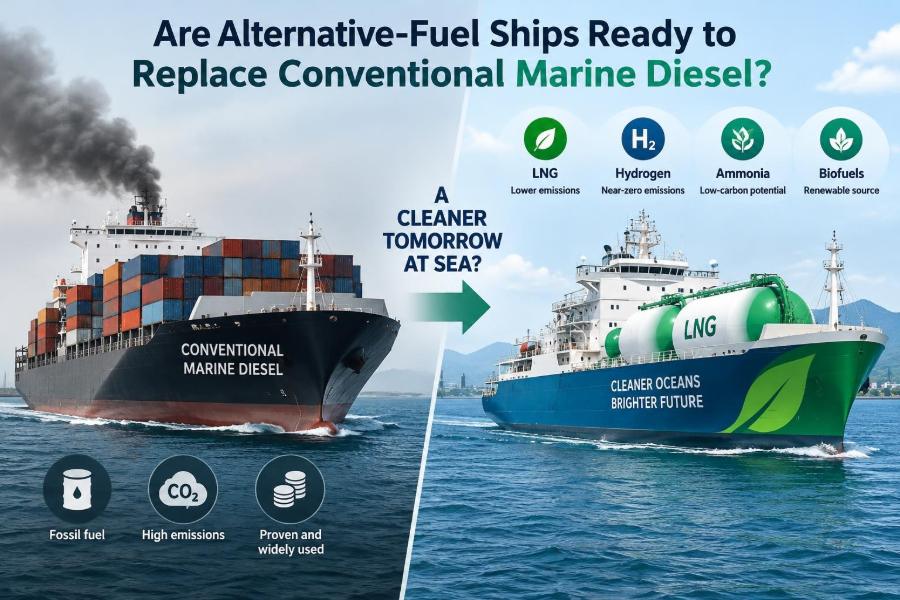
Alternative-fuel ships are already operating. Some use liquefied natural gas, methanol, batteries, biofuels, or liquefied petroleum gas; others are being designed around ammonia or hydrogen. Their progress is real, but their readiness differs sharply by ship type, route, port, and operating profile.
The useful question is therefore not whether one fuel will suddenly replace marine diesel everywhere. It is whether a particular fuel can perform a particular job without transferring risk, cost, or emissions somewhere else in the transport chain.
⚓ What “Marine Diesel” Means in Practice
In everyday discussion, “marine diesel” often refers to conventional petroleum-based marine fuels used in compression-ignition engines. This can include distillate fuels such as marine gas oil and heavier residual fuels used by large ocean-going ships.
Modern vessels may also use very-low-sulphur fuel oil to meet air-pollution requirements. These fuels are not identical, but they share a major advantage: a large amount of usable energy can be stored in a relatively compact tank at ordinary temperatures.
That storage advantage shapes ship design, voyage planning, bunkering, and global trade. Any alternative must be judged against it honestly.
🧭 Why Fuel Change Has Become a Marine Engineering Issue
Shipping needs to reduce its climate impact while continuing to transport bulk cargo, manufactured goods, passengers, and offshore supplies. Air-quality rules have already pushed the industry to reduce sulphur-related emissions, while climate goals create pressure to reduce greenhouse-gas emissions over a fuel’s full life cycle.
For engineers, this is not a distant policy topic. Fuel selection affects tank layout, fire boundaries, ventilation, electrical systems, machinery redundancy, maintenance routines, crew competence, and emergency response.
A fuel can look attractive at the exhaust outlet yet create difficult upstream emissions or onboard hazards. Good fuel decisions consider the whole system, not only the engine.
📏 The Energy-Density Constraint
Energy density describes how much energy is stored by mass or volume. Ships are especially sensitive to volumetric energy density because fuel tanks occupy valuable hull space that might otherwise carry cargo, ballast, stores, or equipment.
Liquid petroleum fuels are compact compared with many alternatives. Batteries require far more volume and mass for the same stored energy, while hydrogen generally needs very large or highly specialized tanks. Methanol and ammonia are liquid under manageable conditions, but both require more tank volume than conventional marine fuel for comparable energy.
This does not make alternatives unusable. It means route length and payload become central design variables.
🔄 Tank-to-Wake Versus Well-to-Wake Emissions
Tank-to-wake emissions occur onboard, from the fuel tank through combustion or conversion to the vessel’s wake. Well-to-wake emissions also include extraction, production, processing, transport, and delivery of the fuel.
For example, a fuel may produce little or no carbon dioxide at the ship’s exhaust, yet its production may rely on fossil energy. Conversely, a fuel with carbon content may offer a lower life-cycle impact if made from renewable feedstocks or captured carbon using low-carbon energy.
Life-cycle assessments depend on production pathways and assumptions. Engineers should ask where the fuel comes from, how electricity is generated, and how methane leakage or other losses are handled.
🌍 Why One “Green Fuel” Label Is Not Enough
Terms such as green, renewable, low-carbon, and zero-emission are useful only when their boundaries are clear. A molecule’s name does not reveal its climate performance.
Hydrogen made with electricity from low-carbon sources can have a very different footprint from hydrogen made from natural gas without effective carbon management. The same applies to ammonia, methanol, and synthetic fuels, which are energy carriers whose impact depends heavily on how they are made.
Procurement teams and ship operators increasingly need traceable fuel information. This is less glamorous than an engine launch, but it determines whether emissions reductions are genuine.
🛢️ Why Conventional Fuel Remains Hard to Displace
Conventional marine fuel benefits from an established global ecosystem. Ports have storage and transfer practices, suppliers understand quality control, engines are mature, and crews have familiar troubleshooting methods.
It is also forgiving from an operational perspective. A ship can bunker in many regions and complete a long voyage without frequent refuelling. For deep-sea shipping, this combination remains a serious benchmark.
Alternative fuels must compete not only with the fuel itself, but with decades of infrastructure, standards, spares, training, and operating experience.
🔌 Battery-Electric Propulsion and Its Best Fit
Batteries convert stored electrical energy into propulsion with high onboard efficiency and no exhaust emissions during operation. They are particularly suited to short, predictable routes where charging can occur regularly.
Examples include harbor craft, short ferries, inland vessels, and some service vessels. A ferry that returns to the same terminals on a known timetable can use shore charging in a way that an ocean-going bulk carrier cannot.
The key limitation is stored energy. Battery systems can also add weight, require cooling and monitoring, and need careful fire-safety design. Their environmental benefit depends partly on the electricity used for charging.
⚡ Shore Charging Is Part of the Vessel Design
A battery vessel is only as practical as its charging arrangement. Power must be available at the berth, delivered safely, and transferred quickly enough not to disrupt turnaround time.
Ports may need upgraded substations, cables, connectors, and control systems. Peak demand can be substantial when several vessels charge on short schedules, so energy-storage systems or smart charging may be useful.
For a fixed route, this integration can be manageable. For irregular operations across many ports, it becomes much harder.
🔥 LNG: A Transitional Option With Trade-Offs
Liquefied natural gas, or LNG, is natural gas cooled to a liquid state for storage. It can reduce certain air pollutants compared with conventional heavy fuel use and can lower carbon dioxide emissions at the point of combustion relative to some petroleum fuels.
However, methane is a potent greenhouse gas, and unburned methane released through engine slip, venting, or the supply chain can weaken the climate case. The result varies with engine technology and fuel pathway.
LNG has established a meaningful place in parts of the fleet, but it is not automatically a long-term climate solution. Its value depends on controlling methane emissions and on whether future low-carbon methane supplies become credible and available.
❄️ Cryogenic Storage Changes Everyday Operations
LNG tanks are insulated cryogenic tanks, not ordinary fuel tanks. Heat entering the tank creates boil-off gas, which must be managed through fuel use, controlled handling, or other approved arrangements.
The fuel system needs double-wall piping in relevant areas, gas detection, ventilation, hazardous-area controls, and procedures for bunkering. These are manageable engineering tasks, but they add complexity and space requirements.
Crews must understand that cold-related hazards are as real as fire hazards. Contact with cryogenic liquid can cause severe injury and damage unsuitable materials.
🍶 Methanol’s Practical Appeal
Methanol is a liquid at ambient conditions, which makes storage and transfer more familiar than cryogenic fuels. It can be used in adapted engines and is increasingly considered for newbuildings because tank arrangements are comparatively straightforward.
Its lower energy density means more fuel volume is required. On a vessel with limited tank capacity, that can reduce range or cargo space unless the ship is designed around the fuel from the outset.
Methanol is also toxic and flammable. Safe adoption depends on enclosed-space protection, leak detection, compatible materials, drainage arrangements, and clear bunkering discipline.
🧪 The Carbon Source Behind Methanol Matters
Methanol can be produced from fossil feedstocks, biomass-derived sources, or combinations of captured carbon and hydrogen. These pathways can have very different life-cycle emissions.
Using methanol does not by itself establish a low-carbon voyage. Operators need to distinguish between the onboard fuel-handling benefits of methanol and the emissions profile of the specific supply contract.
That distinction is likely to remain important as availability grows unevenly among ports and producers.
☣️ Ammonia Offers Carbon-Free Molecules, Not Zero Risk
Ammonia contains no carbon, so it does not produce carbon dioxide from the fuel molecule when used onboard. This makes it an important candidate for long-range low-carbon shipping, especially if produced using low-carbon hydrogen.
Its central challenge is toxicity. An ammonia release can endanger crew, port workers, and nearby communities, so containment, detection, ventilation, escape arrangements, personal protective equipment, and emergency planning are fundamental.
Combustion also requires careful control because nitrogen-containing emissions, including nitrogen oxides and potentially nitrous oxide, must be managed. The engineering case is promising, but it is not simple.
🧯 Why Ammonia Safety Is a System Problem
Safe ammonia use cannot rest on one valve or one alarm. It relies on layered protection: tank location, segregated spaces, redundant detection, shutdown logic, ventilation, materials selection, crew drills, and coordination with the port.
A useful analogy is a watertight ship. One bulkhead helps, but safety comes from multiple compartments and damage-control capability. Fuel safety follows the same principle.
Early projects will need disciplined feedback from real operations. Design assumptions must be tested against maintenance activities, abnormal conditions, and human factors.
💨 Hydrogen Works Best Where Its Limits Are Accepted
Hydrogen can power fuel cells or, in some applications, combustion engines. When used in a fuel cell, it can produce electricity with water as the principal local exhaust product.
But hydrogen has low volumetric energy density. It may be stored compressed, liquefied at very low temperature, or chemically carried in another fuel. Each route brings a different tank, energy, cost, and safety challenge.
Hydrogen is therefore most compelling where range is moderate, refuelling is controlled, and local zero-exhaust-emission operation has high value. Small craft, port equipment, and selected short-sea applications may fit better than long ocean crossings.
🧱 Fuel Cells Are Not Drop-In Main Engines
Fuel cells generate electricity electrochemically rather than through combustion. They can be efficient and quiet, but marine integration requires power electronics, cooling, electrical protection, control systems, and redundancy suitable for the vessel’s duty.
Fuel purity requirements, response to changing loads, maintenance support, and replacement costs must all be considered. A hybrid arrangement with batteries can help handle rapid load changes while fuel cells provide steadier power.
For engineers, the lesson is clear: replacing an engine may mean redesigning the vessel’s entire energy architecture.
🌱 Biofuels Can Use Existing Assets, With Care
Some bio-derived marine fuels can be blended with or substituted for conventional fuels with limited changes to existing machinery. This makes them attractive for reducing emissions in ships that cannot easily be rebuilt.
However, fuel quality, storage stability, compatibility, feedstock origin, and scalability require close attention. A biofuel pathway can create land-use, waste-stream, or supply-chain concerns depending on how it is produced.
Biofuels may be especially useful as a bridge for existing fleets, but they are not a reason to ignore efficiency improvements or long-term fuel planning.
🛠️ Retrofitting Is Different From Building New
A newbuild can place fuel tanks, cofferdams, piping routes, ventilation trunks, and machinery spaces around the chosen fuel from the beginning. A retrofit must work around existing structure, stability margins, cargo arrangements, and equipment.
Installing larger tanks may displace payload or require structural changes. Converting machinery can affect downtime, certification, and maintenance support. Some ships are simply better candidates than others.
A practical fleet strategy may combine selective retrofits, fuel-flexible newbuildings, operational improvements, and eventual replacement of unsuitable vessels.
🔀 Dual-Fuel Engines Reduce One Risk but Add Others
Dual-fuel engines can operate on a conventional fuel and an alternative fuel, offering flexibility where alternative-fuel supply is uncertain. They can reduce the risk of a vessel being unable to trade because fuel is unavailable at a planned port.
Yet dual-fuel capability adds equipment, controls, and maintenance requirements. It may also preserve dependence on fossil fuel if operators routinely choose the easier or cheaper option.
Flexibility has value, especially during transition, but it should not be confused with guaranteed emissions reduction.
🏗️ Ports Are the Missing Half of the Transition
A ship cannot adopt a fuel in isolation. Bunkering requires storage, transfer equipment, trained personnel, exclusion zones where appropriate, emergency procedures, and a reliable supply chain.
Ports face difficult choices because supporting every fuel at every berth is unlikely to be economical. Their investments will often follow local traffic patterns: battery charging for frequent ferries, particular liquid fuels for regular cargo services, or specialized hubs for larger vessels.
Shipowners and ports need coordinated planning. A technically capable vessel without dependable bunkering has limited commercial usefulness.
👷 Crew Competence Cannot Be Added at the Last Minute
Alternative fuels change the skills needed in the engine room and during bunkering. Crews may need to understand toxic exposure, cryogenic handling, gas detection, electrical isolation, fuel-cell systems, or new emergency-response sequences.
Training must go beyond a checklist. Personnel need repeated practice in realistic abnormal situations: a detector alarm, a leak during transfer, loss of ventilation, a failed valve position, or a blackout while fuel systems are isolated.
The safest design can still fail if its operators do not understand its limits.
🧰 Maintenance Becomes More Specialized
Alternative-fuel systems introduce components that may be unfamiliar to conventional diesel maintenance teams: vaporisers, double-wall piping, gas valves, high-voltage equipment, fuel-cell stacks, specialized seals, and advanced sensors.
Condition monitoring and preventive maintenance become particularly important because a small leak, damaged insulation layer, or drifting gas sensor can have serious consequences. Spare-parts support may also be less mature in some regions.
Operators should plan lifecycle support before selecting technology, not after the vessel enters service.
📜 Rules and Class Requirements Guide the Design
International and national rules, flag-state requirements, port rules, and classification-society standards shape what can be installed and how it must be operated. Requirements evolve as experience with new fuels develops.
Early engagement with class, flag, engine makers, fuel suppliers, and port authorities helps identify design constraints before expensive decisions become fixed. This is especially important for first-of-a-kind arrangements.
Regulatory compliance is not merely paperwork. It turns hazard analysis into physical design features, test procedures, training requirements, and operating limits.
💰 The Economic Question Is More Than Fuel Price
Comparing fuel prices alone can be misleading. A complete assessment includes tank volume, lost cargo capacity, machinery cost, port fees, bunkering availability, energy efficiency, maintenance, financing, downtime, and compliance exposure.
Consider a hypothetical coastal vessel choosing between batteries and a liquid fuel. Batteries may cost more upfront, but regular shore charging and lower maintenance could be favorable on a short repetitive route. The same answer would not necessarily apply to a vessel operating irregularly over long distances.
Economic viability is route-specific, not universal.
📊 Matching Fuels to Operating Profiles
| Operating profile | Potentially suitable options | Main engineering consideration |
|---|---|---|
| Short, fixed ferry route | Batteries, hybrid systems, hydrogen in selected cases | Charging or refuelling time at both terminals |
| Harbor tug or port craft | Batteries, hybrids, hydrogen, methanol in some designs | High peak loads and frequent duty cycles |
| Regional cargo service | Methanol, batteries on limited routes, biofuel blends, LNG in some cases | Port network and tank-volume penalty |
| Deep-sea cargo vessel | Methanol, ammonia, LNG, biofuels, future synthetic fuels | Range, fuel availability, lifecycle emissions, safety case |
This comparison is not a prescription. Vessel age, cargo, schedule, trading area, regulations, and fuel supply can change the preferred answer.
🚫 The Mistake of Looking Only at Exhaust Smoke
Visible smoke and local air pollutants matter, particularly near ports and populated coastlines. But climate assessment cannot stop at what is visible from the funnel.
Methane leakage, electricity generation, hydrogen production, carbon-source accounting, and feedstock sourcing can all alter the real outcome. The same vessel technology can perform very differently under different fuel-supply arrangements.
When evaluating claims, ask: What is the production pathway, what emissions boundary is being used, and what assumptions sit behind the result?
🧮 Efficiency Remains the First Fuel
Before changing fuel, operators can often reduce energy demand through hull cleaning, propeller maintenance, weather routing, speed management, trim optimization, waste-heat recovery where suitable, and efficient auxiliary systems.
These measures reduce fuel consumption regardless of the fuel chosen. They can also make an alternative fuel more practical by lowering required tank size or extending range.
Efficiency does not replace decarbonized energy, but it reduces the scale of the challenge. A ship that needs less energy gives designers more options.
🧠 Fuel Flexibility Needs a Clear Strategy
Ordering a “future-ready” ship can be sensible, but the phrase should be tested carefully. Does it mean reserved tank space, a dual-fuel engine, strengthened foundations, compatible materials, electrical capacity, or merely an intention to convert later?
Each level of readiness has a different cost and value. A vague claim can lead to a vessel that is expensive now but still difficult to convert later.
Owners should define the intended fuel pathway, likely ports, conversion window, and design provisions in practical engineering terms.
🤝 No Single Technology Will Serve Every Ship
The marine sector is too varied for one universal replacement fuel. A high-speed passenger ferry, an offshore vessel, a coastal tanker, and an ultra-large bulk carrier operate under very different constraints.
This likely means a mixed-energy future: batteries where shore power is practical, renewable liquid fuels for some existing vessels, methanol or ammonia for selected longer-range trades, and other solutions where their infrastructure and safety case are strong.
That diversity can be inconvenient, but it is a rational response to diverse marine duties.
🔍 Questions Engineers Should Ask Before Choosing a Fuel
- What route, range, reserve margin, and annual operating pattern must the vessel meet?
- How much tank volume, weight, and cargo capacity can the design sacrifice?
- Which ports can supply or recharge the fuel reliably and safely?
- What is the fuel’s likely life-cycle emissions pathway, not just its onboard exhaust profile?
- What hazards does the fuel introduce, and what layered safeguards are required?
- Can crews, maintainers, emergency responders, and suppliers support the system throughout its life?
- What happens if fuel supply, charging, or a key subsystem is unavailable?
These questions turn an abstract decarbonization target into an engineering decision that can be tested and managed.
🧭 Are Alternative-Fuel Ships Ready to Replace Diesel?
They are ready in some applications, partly ready in others, and not yet ready as a universal substitute for conventional marine diesel. Short, predictable routes already provide strong opportunities for batteries and other tightly integrated systems. Several liquid and gaseous fuels are viable or emerging options for broader trades, but their supply, safety arrangements, cost, and life-cycle emissions remain decisive.
The transition will be gradual because ships have long service lives and global bunkering networks take time to build. It will also be uneven: some ports and vessel segments will move quickly, while others will require fuels with higher energy density and more mature supply chains.
The core principle is simple: the best marine fuel is not the newest molecule, but the option that delivers verified emissions reductions, safe operation, dependable energy supply, and workable vessel performance for a specific service.
Alternative-fuel shipping is no longer a distant concept, but replacing conventional diesel is a route-by-route engineering challenge rather than a single switch. The vessels that succeed will pair realistic fuel choices with efficient design, trained people, and infrastructure built to support them. 🚢⚡🌍