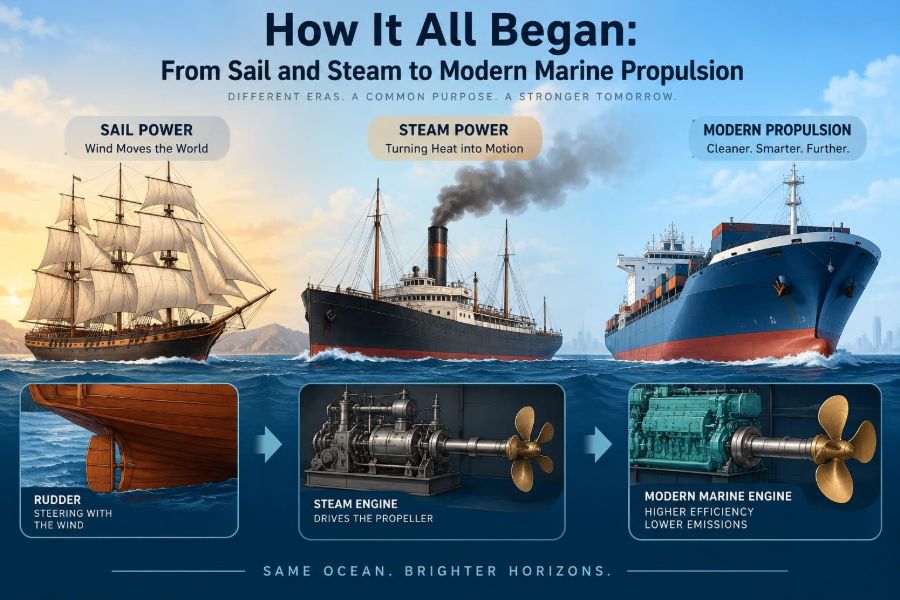

A ship leaving port can appear effortless from shore. A container vessel gathers way without visible sails, a ferry holds its schedule against a headwind, and a tug pivots a much larger hull with remarkable control. Behind that smooth movement is a long engineering story: the effort to turn stored energy into reliable thrust.
Marine propulsion affects far more than speed. It determines cargo capacity, fuel consumption, crew workload, machinery layout, maintenance routines, manoeuvrability, and a vessel’s environmental footprint. The same basic question has followed seafarers for centuries: how can a ship move safely and predictably through water?
The answer has changed from wind acting on canvas to steam expanding in cylinders, oil engines turning shafts, and electric motors supplied by increasingly flexible power systems. Each transition solved real operating problems while creating new design challenges.
Understanding this progression helps students connect historical machinery with the engines, propellers, controls, and alternative fuels found in modern engine rooms.
🌊 Propulsion Means Creating Useful Thrust
Marine propulsion is the system that produces the force needed to move a vessel through water. It includes the energy source, prime mover, transmission equipment, propulsor, controls, and supporting systems—not simply the engine.
A diesel engine, for example, releases fuel energy and produces rotational power. A shaft transmits that power to a propeller, which accelerates water aft. The resulting reaction force drives the ship forward.
The engineering task is complicated because a vessel must overcome hull resistance, waves, wind, current, and sometimes ice. Propulsion must also work efficiently at the ship’s intended speed and loading condition.
🧭 Before Engines, Wind Was the Main Power Plant
For much of maritime history, sails were the principal means of long-distance propulsion. Wind energy was free and available at sea, but it was variable, directional, and difficult to predict with precision.
Sailing vessels used different rig arrangements to manage this limitation. Square sails worked well with following winds, while fore-and-aft sails allowed vessels to sail closer to the wind through a zigzag manoeuvre called tacking.
Skill in sail handling was therefore part of propulsion engineering. Crew numbers, mast strength, rigging condition, hull form, and voyage planning all influenced how effectively a vessel could convert wind into forward motion.
⛵ Why Sail Could Not Solve Every Operating Need
Sailing ships could cross oceans efficiently, but they could not guarantee arrival times. Calm weather could leave a vessel nearly motionless, while storms could damage sails, spars, and rigging or force a ship far off its intended route.
Ports and narrow channels created another challenge. A sailing vessel had limited low-speed control, particularly when wind direction was unfavourable. Anchors, towboats, and later harbour tugs often helped ships make the final part of a passage.
As trade, passenger travel, and naval operations demanded greater schedule reliability, the attraction of machinery that could deliver power independent of the wind became clear.
🔥 Steam Introduced Onboard Mechanical Power
Steam propulsion transformed marine transport by making a ship’s movement far less dependent on weather. Fuel was burned in a boiler furnace, heating water to create high-pressure steam. That steam then expanded in a machine to produce mechanical work.
Early steam vessels demonstrated a valuable principle: a ship could maintain progress in calm conditions and could manoeuvre under its own power in confined waters. This capability changed the practical meaning of reliability at sea.
Steam did not replace sail immediately. Early machinery was heavy, coal consumed cargo space, and machinery reliability developed gradually. Many vessels used both sail and steam during the transition period.
⚙️ The Reciprocating Steam Engine
In a reciprocating steam engine, steam enters a cylinder and pushes a piston back and forth. Connecting rods and a crankshaft convert this linear motion into rotation, which can drive a paddle wheel or propeller.
Successive improvements used steam more effectively. Compound and triple-expansion engines expanded steam through multiple cylinders at decreasing pressures, extracting more useful work before the steam reached the condenser.
These engines were visually and mechanically impressive, but they required careful attention to lubrication, valve timing, boiler water quality, condensate systems, and moving-part wear. Their rhythm became a defining sound of early engine rooms.
🛞 Paddle Wheels Were an Effective First Step
The earliest successful steamships commonly used side paddles or stern paddles. A paddle wheel is straightforward in concept: boards mounted around a rotating wheel push water backwards.
They worked particularly well on rivers, lakes, and sheltered routes. However, side paddles could lose efficiency when a vessel rolled, when loading caused a list, or when waves alternately submerged and lifted parts of the wheel.
Paddle machinery also occupied useful deck-edge space and was vulnerable in combat or alongside operations. These limitations encouraged the move toward a more protected and efficient underwater propulsor.
🌀 The Screw Propeller Changed Ship Layout
The screw propeller, now usually called simply a propeller, became the dominant solution for most powered ships. Positioned below the waterline at the stern, it was less exposed than a paddle wheel and worked more consistently in rougher water.
A propeller blade acts like a rotating hydrofoil. Its shape creates a pressure difference and imparts momentum to water flowing aft. Correct propeller design must match engine power, shaft speed, vessel resistance, and operating profile.
The propeller also allowed machinery to sit lower and more centrally in the hull. That improved protection and made larger, ocean-going steamships more practical.
📐 Propeller Pitch, Slip, and Cavitation
Pitch is the theoretical distance a propeller would advance in one revolution through a solid material. Water is not solid, so the actual advance is lower; the difference is described as propeller slip.
Some slip is unavoidable because thrust requires the propeller to accelerate water. Excessive slip, however, can indicate poor propeller matching, hull fouling, overload, or operation in unsuitable conditions.
Cavitation occurs when low pressure around a blade causes vapour bubbles to form and then collapse. It can reduce efficiency, generate noise and vibration, and erode blade surfaces. Avoiding it requires careful blade geometry, adequate immersion, and suitable rotational speed.
🏭 Coal Powered the First Industrial Fleets
Coal gave steamships an energy source that could be stored aboard and used whenever needed. It supported regular routes, naval endurance, and the growth of larger industrial shipping networks.
Its disadvantages were substantial. Coal handling was labour-intensive, bunkers took up space, ash had to be removed, and combustion created soot and smoke. A vessel’s range depended heavily on bunker capacity and the availability of coaling stations.
Boiler operation also demanded disciplined watchkeeping. Poor combustion, low water level, scale formation, or damaged safety equipment could create serious hazards in a high-pressure steam plant.
💧 Condensers Made Steam Plants More Efficient
After doing work in an engine or turbine, steam can be cooled in a condenser and returned to water. This creates a low-pressure exhaust condition that allows more energy to be extracted during expansion.
Condensing also supports a closed feedwater cycle. Reusing purified condensate reduces the amount of fresh water needed and helps limit contaminants entering the boiler system.
Marine condensers commonly reject heat to seawater. Their performance depends on clean tube surfaces, sufficient cooling-water flow, and maintaining a proper vacuum. Air leakage or fouling can quickly reduce plant efficiency.
🌪️ Steam Turbines Replaced Many Reciprocating Engines
A steam turbine uses high-velocity steam to rotate rows of blades continuously rather than driving pistons back and forth. Continuous rotary motion brings smoother operation and can be well suited to high-power applications.
Turbines became important for fast ships and naval vessels because they could produce large outputs with less vibration than large reciprocating engines. Their most efficient speed is often much higher than the ideal speed for a propeller.
Reduction gears therefore became essential in many turbine plants. They reduce turbine revolutions while increasing torque at the propeller shaft, allowing each component to operate nearer its preferred range.
🛢️ Oil Changed the Fuel Supply Chain
Liquid fuel offered important practical advantages over coal. It could be pumped through pipes, stored in tanks, and burned with less manual handling. Oil firing also reduced ash production and made boiler operation more controllable.
Fuel oil did not eliminate operational complexity. Heavy grades may need heating to reach a pumpable viscosity and to atomise correctly at the burner. Contamination by water or solids can damage fuel-system components and disrupt combustion.
The shift toward oil prepared the way for the next major change: the marine diesel engine, which removed the boiler and steam cycle from many ship designs.
🔩 The Diesel Engine Brought Direct Mechanical Drive
A diesel engine compresses air in a cylinder until it becomes hot enough for injected fuel to ignite. The combustion gases expand and push the piston down, turning the crankshaft through connecting rods.
For many ships, diesel propulsion offered strong fuel efficiency, rapid readiness compared with a cold steam plant, and comparatively compact machinery arrangements. It became especially influential in cargo ships, fishing vessels, ferries, and offshore craft.
Modern low-speed marine diesel engines can be directly coupled to a propeller shaft. Their low rotational speed and high torque make this arrangement mechanically simple and highly effective for large, slow-moving vessels.
🧱 Two-Stroke and Four-Stroke Marine Engines
Marine diesel engines are commonly classified by their operating cycle. Large ocean-going cargo ships often use slow-speed, two-stroke crosshead engines, while many smaller vessels and auxiliary generator sets use medium- or high-speed four-stroke trunk-piston engines.
| Feature | Slow-speed two-stroke | Four-stroke engine |
|---|---|---|
| Typical role | Main propulsion of large merchant ships | Generators, ferries, smaller ships, diesel-electric plants |
| Connection to propeller | Often direct drive | Often through gears or generators |
| Rotational speed | Low | Medium or high |
| Practical strength | High torque and efficient slow-speed propulsion | Compact arrangement and operating flexibility |
Neither arrangement is universally better. Vessel size, desired speed, redundancy requirements, fuel choice, maintenance capability, and electrical demand all affect the final selection.
🔄 Gearboxes Match Engine Speed to Propeller Speed
Many engines rotate faster than a large propeller should. A reduction gearbox lowers shaft revolutions and increases torque, enabling a larger or more suitable propeller to operate efficiently.
Gearboxes also permit multiple engines to drive one shaft in some installations, or one engine to be disconnected while another remains available. This can support flexible operating modes but increases mechanical complexity.
Lubricating-oil cleanliness, alignment, vibration monitoring, and proper loading are vital. Gear damage can be expensive and can remove a vessel’s propulsion capability with little warning if early signs are missed.
🧲 Diesel-Electric Propulsion Separates Power From Thrust
In a diesel-electric system, diesel engines drive generators rather than a propeller shaft directly. The generated electricity supplies motors that turn propellers, thrusters, or azimuthing propulsion units.
This arrangement allows generator sets to be placed more flexibly and lets operators bring engines online according to electrical demand. It is common where the ship needs substantial hotel load, dynamic positioning, frequent speed changes, or several propulsion units.
The trade-off is conversion loss at each electrical stage and a more complex power-management system. The best choice depends on the vessel’s duty cycle, not on a simple claim that electric drive is always more efficient.
🎯 Controllable-Pitch Propellers Improve Flexibility
A fixed-pitch propeller has blades set at one permanent angle. A controllable-pitch propeller, or CPP, can rotate its blades about their own axes to alter pitch while the shaft continues turning.
This gives rapid control of thrust direction and magnitude without relying only on engine-speed changes or shaft reversal. It can be valuable for ferries, tugs, offshore vessels, and ships requiring frequent manoeuvring.
CPP systems add hubs, hydraulic equipment, seals, and control mechanisms. They need disciplined maintenance, and their efficiency advantage depends on how often the vessel operates away from one steady design condition.
🧭 Azimuth Thrusters Turn Thrust Where It Is Needed
An azimuth thruster can rotate through a full circle or a wide steering angle, directing thrust in the desired direction. Unlike a conventional shaft-and-rudder arrangement, it combines propulsion and steering in one unit.
This capability is especially useful for harbour tugs, cruise vessels, ferries, offshore support vessels, and ships using dynamic positioning. A vessel can move sideways, hold position, or rotate with impressive precision.
The machinery beneath the hull must withstand hydrodynamic loads, sealing demands, and possible contact risks. Operators also need to understand thrust interaction: units placed close together can disturb each other’s flow during certain manoeuvres.
🛟 Thrusters Are Not the Same as Main Propulsion
Bow and stern thrusters provide sideways force, usually during low-speed manoeuvring. They are useful near berths, locks, and confined waterways, but they are normally not designed to propel a ship efficiently over a long voyage.
A tunnel thruster pushes water through a transverse tunnel in the hull. Its effectiveness falls as vessel speed rises because cross-flow past the hull disrupts the jet.
A common operational mistake is to treat thrusters as a substitute for good passage planning and tug assistance. Windage, current, shallow water, and machinery limits can still exceed their available force.
📡 Controls Evolved From Engine Orders to Automation
Early engine rooms relied on spoken orders, telegraphs, and close coordination between bridge and engineers. Changes in speed or direction could require a sequence of manual actions in the engine room.
Modern vessels commonly use bridge control systems, electronic governors, pitch controls, alarms, and automated safety functions. These systems improve response and can reduce routine workload, but they do not remove the need for engineering judgement.
Reliable propulsion depends on understanding what automation is doing. A displayed command is not proof that a shaft, clutch, fuel system, or propeller has responded as expected; feedback and verification remain essential.
🧰 Supporting Systems Keep the Prime Mover Alive
An engine or turbine cannot operate safely in isolation. Fuel systems deliver clean fuel at the required pressure and temperature, lubrication systems protect moving surfaces, cooling systems control metal temperatures, and starting systems provide initial rotation.
Air, exhaust, bilge, fire protection, electrical, and control systems are equally important. A failure in a small auxiliary pump or sensor can stop propulsion just as effectively as a damaged main engine component.
For engineers, this is a central lesson: propulsion reliability is system reliability. Troubleshooting begins by considering energy, flow, control signals, and protection logic across the entire installation.
📉 Hull Condition Can Waste Propulsion Power
A clean engine cannot compensate fully for a dirty hull or damaged propeller. Marine growth and rough coatings increase frictional resistance, so more power is required to maintain the same speed.
Propeller surface damage, rope fouling, poor trim, and excessive displacement can also raise fuel use or cause vibration. These effects may develop gradually, which makes trend monitoring useful.
Comparing shaft power, speed, weather conditions, draft, and fuel consumption over time can reveal a developing problem. The figures must be interpreted carefully, because currents and sea state can distort a simple speed-versus-power comparison.
🌬️ Resistance Explains Why Speed Costs So Much
A moving hull faces several forms of resistance, including frictional resistance, wave-making resistance, air resistance, and appendage drag. The balance changes with hull shape, vessel speed, draft, and sea conditions.
At higher speeds, the power needed often rises sharply rather than proportionally. This is why a modest reduction in service speed can significantly change daily fuel demand for some vessels.
Slow steaming is not a universal answer. Schedules, cargo requirements, machinery operating limits, safety margins, and charter commitments may constrain speed. Efficient operation means selecting a sensible speed for the real voyage, not simply choosing the lowest one.
🧪 Fuel Quality and Lubrication Demand Discipline
Marine fuels may vary in density, viscosity, ignition quality, and contamination risk. Treatment systems such as settling tanks, heaters, filters, and separators help prepare fuel before it reaches sensitive injection equipment.
Lubricating oil performs several jobs: it reduces friction, removes heat, carries contaminants to filters, and protects surfaces from wear and corrosion. Its condition can reveal problems through changes in viscosity, water content, contamination, or wear particles.
Sampling and analysis support informed maintenance, but results need context. A single abnormal value should prompt investigation, while operating history and repeat trends help distinguish a minor anomaly from an emerging failure.
🧯 Propulsion Failures Require Prepared Responses
Loss of propulsion can quickly become a navigation emergency, particularly near land, traffic, offshore structures, or restricted channels. The immediate priorities depend on the situation: inform the bridge, assess remaining control, warn nearby traffic, and prepare anchors or tug assistance where appropriate.
Engine-room teams must avoid rushing into unsafe resets. Repeatedly restarting equipment without identifying the trip cause can damage machinery or defeat a protective function designed to prevent a larger failure.
Drills and clear procedures matter because a real failure compresses decision time. Familiarity with standby pumps, emergency steering, blackout recovery, and communication paths turns a written procedure into usable capability.
🌱 Emissions Are Reshaping Propulsion Decisions
Marine propulsion now faces pressure to reduce air pollutants and greenhouse-gas emissions. This is influencing machinery choices, voyage planning, hull optimisation, energy-saving devices, shore power arrangements, and the development of alternative fuels.
Options under consideration across different vessel types include batteries, hybrid systems, methanol, ammonia, hydrogen-derived fuels, biofuels, wind-assist technologies, and efficiency improvements. Their suitability varies with range, fuel availability, tank volume, safety design, cost, and vessel operation.
No single pathway fits every ship. A short-route ferry with reliable charging access faces a different design problem from an ocean-going bulk carrier operating across regions with uneven fuel infrastructure.
🔋 Batteries and Hybrid Systems Have Specific Strengths
Batteries can provide quiet, responsive power with no exhaust emissions at the point of use. They are particularly practical for short, predictable routes, port operations, peak-load support, and vessels able to recharge regularly.
A hybrid system combines batteries with engines, generators, or other energy sources. It may allow engines to run closer to efficient load ranges while batteries handle short bursts of demand or low-emission operation in port.
Energy storage has limits. Battery mass, volume, charging time, thermal management, fire safety, and lifecycle planning must be addressed from the earliest design stage rather than treated as add-on equipment.
🌬️ Wind Assistance Connects Old and New Ideas
Wind has returned to modern ship design in a different role. Rotor sails, rigid wings, kite systems, and suction-based aerodynamic devices can provide supplemental thrust on suitable routes and vessel types.
These are generally wind-assist systems rather than a return to traditional sailing ships. Their contribution varies with wind direction, weather, route, deck layout, cargo operations, and the vessel’s speed profile.
The idea is a useful reminder that engineering progress is not always a straight replacement of old technology. Sometimes a mature principle becomes valuable again when paired with modern controls, materials, and performance data.
🧑🔧 Skills Changed, but Watchkeeping Remains Central
The marine engineer’s role has evolved from coal handling and steam-valve management to fuel treatment, electronic diagnostics, automation, high-voltage awareness, and increasingly diverse energy systems.
Yet the core habits remain familiar: observe machinery, understand normal operating conditions, communicate clearly, follow safe isolation practices, and investigate changes before they become failures.
Students should learn diagrams and component names, but they should also practise tracing a system logically. Ask where energy enters, how it is converted, what fluid or signal must flow next, and which protection will act if conditions become unsafe.
🧠 Common Misconceptions About Marine Propulsion
One misconception is that a larger engine automatically makes a ship faster. If the propeller, hull form, shafting, and operating conditions are not matched, extra installed power may be underused or inefficient.
Another is that propellers “pull” a ship forward in a simple mechanical sense. They primarily create thrust by accelerating water backward; the hull moves forward in response to that momentum change.
It is also misleading to label one propulsion technology as inherently clean or efficient without context. The full assessment includes fuel production, storage, equipment, route, power demand, maintenance, and how the vessel is actually operated.
🔭 The Future Is an Integrated Energy System
Future ships will increasingly be designed as integrated energy systems. Propulsion, electrical generation, cargo equipment, hotel services, heat recovery, batteries, automation, and emissions controls will influence one another.
This makes interdisciplinary knowledge more valuable. Naval architects need to understand machinery constraints, while marine engineers need to appreciate hull resistance, propeller behaviour, electrical distribution, and operational planning.
The practical aim is not technology for its own sake. It is a vessel that delivers its service safely, efficiently, reliably, and with lower environmental impact across its expected life.
🏁 The Core Lesson From Sail to Smart Propulsion
The move from sail to steam, diesel, electric drive, and hybrid systems was driven by recurring needs: better control, dependable schedules, manageable operating costs, safer machinery, and improved efficiency.
Every development involved a trade-off. Steam offered independence from wind but required boilers and fuel handling. Diesel simplified many ships but introduced high-pressure fuel systems and emissions concerns. Electrification increases flexibility but adds conversion equipment and power-management complexity.
The enduring engineering principle is to match the propulsion plant to the vessel’s mission. Speed, route, hull, cargo, manoeuvring needs, maintenance support, available fuel, and safety requirements must be considered together.
From canvas catching the wind to intelligent systems directing electric motors, marine propulsion has always been the disciplined conversion of available energy into controlled movement at sea. That principle will continue to guide the next generation of ships and engineers. 🚢⚙️🌊