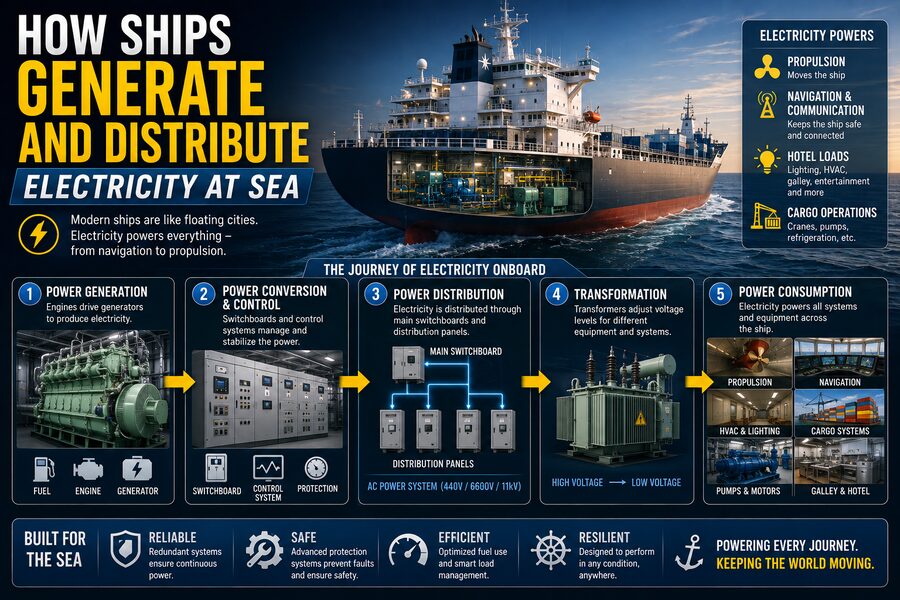

A modern ship is much more than a vessel with an engine and a propeller. It is also a floating electrical power system. 🚢⚡
Cargo ships, cruise ships, naval vessels, offshore support vessels, ferries, and tankers may need electricity for thousands of different loads, including:
- Navigation equipment
- Radar and communications 📡
- Lighting
- Pumps
- Ventilation
- Refrigeration
- Cargo-handling machinery
- Computers
- Passenger services
- Emergency systems
- Electric propulsion on some ships
In many ways, a large ship operates like a small isolated city.
But there is one major difference: at sea, the ship cannot normally rely on a national power grid. It must generate, control, distribute, and protect its own electricity.
That means marine electrical systems must be extremely reliable.
If power is lost, the consequences can range from inconvenient to dangerous. Pumps may stop, navigation systems may fail, steering could be affected, and propulsion may be lost on electrically driven vessels.
So how does a ship generate its own electricity and safely distribute it throughout the vessel? ⚙️🔌
The answer involves diesel generators, alternators, switchboards, transformers, circuit breakers, emergency generators, batteries, automation systems, and carefully designed redundancy.
⚙️ The Ship Is Its Own Power Plant
Most large ships carry several electrical generators.
A typical generator set consists of:
Engine → alternator → electrical power
The engine provides mechanical rotation.
The alternator converts that rotating mechanical energy into electricity.
On many commercial vessels, the generator engine is a diesel engine.
These units are often called:
- Diesel generators
- Generator sets
- Gensets
- Auxiliary generators
The ship may carry several of them so that electrical demand can be shared and backup capacity is available.
For example, a vessel might operate two generators while cruising and keep a third ready as a standby unit.
🔄 How an Alternator Generates Electricity
The electrical generator aboard a ship usually operates through electromagnetic induction.
A rotating magnetic field moves relative to coils of wire.
According to Faraday’s law, this changing magnetic field induces voltage in the conductors.
The basic energy conversion is:
Fuel energy → engine rotation → magnetic rotation → electrical energy
The electrical output is generally alternating current, or AC.
Large ships commonly use three-phase AC because it is efficient for transmitting power and operating motors.
Three-phase power is also well suited to pumps, fans, compressors, and heavy machinery. ⚡
🔺 Why Ships Use Three-Phase Electricity
Three-phase AC power consists of three alternating voltages offset from one another by 120 electrical degrees.
This offers several advantages.
Three-phase motors are:
- Efficient
- Compact
- Reliable
- Smooth-running
A large marine pump driven by a three-phase induction motor can operate continuously for long periods with relatively simple construction.
Three-phase systems also transmit substantial power with less conductor material than equivalent single-phase systems.
That makes them ideal for vessels where both space and weight matter.
🔌 What Voltage Do Ships Use?
There is no single voltage used by every vessel.
Electrical voltage depends on the size and purpose of the ship.
Smaller vessels may use relatively low-voltage systems.
Large commercial ships commonly use low-voltage three-phase distribution such as approximately:
400–480 V AC
while large vessels with very high power requirements may use medium-voltage systems such as:
3.3 kV, 6.6 kV, or 11 kV
depending on vessel design and applicable standards.
Why use higher voltage?
Because electrical power is approximately:
P = √3 × V × I × power factor
for a three-phase system.
If voltage increases for the same transmitted power, current can decrease.
Lower current means:
- Smaller cable sizes
- Lower resistive losses
- More practical distribution of high power
This becomes especially important on ships with large propulsion motors or heavy industrial loads.
🧠 The Main Switchboard Is the Electrical Control Center
After electricity is generated, it is sent to the main switchboard.
The main switchboard acts like the central electrical traffic controller of the ship.
It receives electrical power from generators and distributes it to major parts of the vessel.
The switchboard contains equipment such as:
- Busbars
- Circuit breakers
- Protective relays
- Meters
- Synchronizing equipment
- Control circuits
The busbars are heavy electrical conductors that carry large currents from generators to outgoing circuits.
From the switchboard, power may be sent to:
- Motor-control centers
- Distribution boards
- Transformers
- Propulsion equipment
- Large pumps
- Auxiliary machinery
🔀 Why Busbars Are Important
A ship’s electrical network is often organized around one or more bus sections.
Each busbar acts as a common electrical connection point.
For reliability, large switchboards may be divided into separate sections.
For example:
Port bus section | Bus-tie breaker | Starboard bus section
Normally, these sections may operate connected or independently depending on the vessel’s design.
If a serious electrical fault occurs on one section, engineers may isolate that part while keeping another section energized.
This improves survivability and helps prevent a single failure from blacking out the entire vessel.
🔄 Multiple Generators Can Operate Together
A ship’s electricity demand changes continuously.
During normal cruising, demand might be moderate.
During cargo operations, maneuvering, or heavy air-conditioning loads, demand may increase significantly.
Instead of running every generator continuously, the ship can connect additional generator sets when necessary.
But AC generators cannot simply be connected together at random.
Before closing a generator circuit breaker onto an energized bus, the generator must be synchronized.
🎯 What Does Generator Synchronization Mean?
For two AC electrical sources to operate in parallel, several conditions must closely match:
- Voltage
- Frequency
- Phase sequence
- Phase angle
Imagine one generator producing electrical waves while the switchboard is already energized by another generator.
If the waves are significantly out of alignment when the breaker closes, enormous currents and mechanical forces can occur.
The generator could be severely damaged. ⚠️
A synchronizing system therefore adjusts engine speed and excitation until the incoming generator matches the bus.
Then its breaker can close safely.
Modern vessels often automate much of this process.
📊 How Generators Share the Load
Once generators are operating in parallel, they share the ship’s electrical demand.
Suppose the vessel needs 2 MW of electrical power.
Two generators might each provide approximately:
1 MW
If demand increases, their engine governors and voltage-control systems adjust output.
Real power sharing is strongly influenced by engine speed or governor control.
Reactive power sharing is influenced by generator excitation.
Automatic power-management systems can coordinate these functions.
🤖 Power Management Systems
Modern ships often use computerized Power Management Systems, or PMS.
The PMS monitors:
- Electrical load
- Generator availability
- Bus voltage
- Frequency
- Breaker status
- Generator faults
It can automatically decide when to start or stop generators.
For example:
Load increasing → start standby generator → synchronize → connect to bus
If demand later drops:
Reduce load → unload one generator → disconnect → stop engine
This improves fuel efficiency while maintaining adequate reserve capacity.
⚠️ Preventing Generator Overload
Suppose only one generator is running and a massive electrical load suddenly starts.
If the generator cannot supply enough power, frequency and voltage may collapse.
To prevent this, the electrical system may use load-shedding.
Load shedding automatically disconnects less critical loads when available generation becomes insufficient.
For example, the system might temporarily disconnect:
- Some ventilation equipment
- Nonessential accommodation loads
- Certain auxiliary systems
while preserving critical services such as:
- Steering
- Navigation
- Essential pumps
- Safety equipment
The objective is to keep the power system stable.
🚨 What Happens During a Blackout?
A blackout means the main electrical bus loses power.
Possible causes include:
- Generator failure
- Fuel-system problems
- Electrical short circuits
- Protection trips
- Operator error
- Control-system failure
A blackout is a serious event because many systems can stop simultaneously.
Ships are therefore designed with procedures and equipment for blackout recovery.
Automatic systems may:
- Detect loss of main power.
- Start a standby generator.
- Restore the main bus.
- Reconnect essential loads in sequence.
Loads are often restored gradually rather than all at once to avoid immediately overloading the returning generator.
🚨 The Emergency Generator
Large ships commonly have a separate emergency generator.
This is one of the most important safety features in the electrical system.
The emergency generator is normally located away from the main engine room and main generating equipment.
Why?
Because a fire or flooding event could disable the main machinery spaces.
If the emergency generator were located beside the main generators, the same accident might destroy everything.
The emergency generator is therefore physically separated so it can supply critical loads during major failures.
🔋 What Does Emergency Power Supply?
Emergency electrical systems may supply essential services such as:
- Emergency lighting
- Navigation lights
- Communication systems 📡
- Fire detection
- Alarms
- Emergency pumps
- Selected steering systems
- Safety equipment
The exact requirements depend on vessel type and maritime regulations.
The purpose is not necessarily to power the entire ship.
It is to preserve the systems needed to keep people safe and maintain essential control.
🔋 Batteries Bridge the Gap
An emergency generator takes some time to start.
Even if it starts automatically, several seconds may pass before it is ready to carry load.
Some systems cannot tolerate that delay.
Ships therefore use batteries and uninterruptible power supplies, or UPS systems.
These can provide immediate electricity to critical equipment such as:
- Radios
- Navigation electronics
- Computer systems
- Alarm systems
- Control circuits
The sequence may be:
Main power fails → battery instantly supplies load → emergency generator starts → generator takes over
This creates continuity of power.
🔽 Transformers Adjust Voltage
Not every device on a ship operates at the same voltage.
Large motors may use hundreds or thousands of volts.
Lighting and smaller equipment may require much lower voltages.
Ships therefore use transformers to change AC voltage levels.
For example:
6.6 kV main distribution → transformer → 440 V machinery loads
Then another transformer might provide:
440 V → 230 V accommodation or service circuits
The exact values depend on ship design.
Transformers allow engineers to transmit high power efficiently while still providing suitable voltages to individual equipment.
🔌 AC and DC Systems Often Coexist
Although large ship power systems are commonly AC-based, DC electricity remains extremely important.
DC systems may be used for:
- Battery charging
- Control systems
- Emergency equipment
- Electronics
- Automation
- Communication systems
Some ships also use large DC links inside advanced propulsion and power-conversion systems.
Rectifiers convert:
AC → DC
Inverters convert:
DC → AC
Modern marine electrical systems increasingly rely on sophisticated power electronics.
🚢 Electric Propulsion Changes the Power Architecture
Traditional ships often use a diesel engine mechanically connected to a propeller shaft.
The chain is:
Diesel engine → gearbox or shaft → propeller
But some ships use diesel-electric propulsion.
Here the engines drive generators instead.
The chain becomes:
Diesel engines → generators → electrical distribution → propulsion motors → propellers
This architecture is common on many:
- Cruise ships
- Icebreakers
- Offshore vessels
- Naval ships
- Ferries
Electric propulsion can provide significant operational flexibility.
⚡ Why Use Electric Propulsion?
Electric propulsion separates the engine mechanically from the propeller.
This allows generator engines to be installed in more flexible locations.
It also allows several generators to supply both propulsion and hotel loads.
Instead of having one engine dedicated entirely to propulsion and separate engines for electricity, a shared power plant can serve the entire vessel.
Possible advantages include:
- Flexible machinery layout
- Improved low-speed control
- Efficient operation across changing loads
- Reduced mechanical shaft complexity
- Easy integration with batteries
However, the electrical equipment can be expensive and sophisticated.
🌀 Variable-Frequency Drives Control Large Motors
Propulsion motors and large pumps often need variable speed.
Ships use Variable-Frequency Drives, or VFDs.
A VFD changes the electrical frequency and voltage supplied to an AC motor.
Motor speed can therefore be controlled precisely.
A simplified conversion may be:
AC supply → rectifier → DC link → inverter → variable-frequency AC → motor
This technology allows smooth control of:
- Propulsion motors
- Thrusters
- Pumps
- Fans
- Compressors
Modern power electronics have made variable-speed marine drives highly practical.
🛳️ Bow Thrusters Create Huge Temporary Loads
During docking, ships may use bow and stern thrusters.
These motors can require enormous electrical power.
The load may appear suddenly.
The Power Management System must therefore ensure sufficient generating capacity is online before the thruster starts.
If a large thruster were connected with insufficient generation available, system frequency could fall and generators might trip.
This is why load management is so important during maneuvering.
❄️ Cruise Ships Have Enormous “Hotel Loads”
Cruise ships consume large amounts of electricity even when propulsion demand is moderate.
Thousands of passengers require:
- Air conditioning
- Elevators
- Kitchens
- Refrigeration
- Lighting
- Entertainment
- Laundry
- Water treatment
These are often called hotel loads.
On a large cruise ship, hotel electrical demand can be comparable to that of a small town.
The ship’s electrical plant must continuously balance propulsion requirements with passenger-service demand. 🏨🚢
🧊 Refrigerated Cargo Also Requires Continuous Power
Container ships carrying refrigerated containers, known as reefers, can have significant electrical loads.
Each refrigerated container may contain its own cooling machinery.
Hundreds or thousands of reefers can therefore create major power demand.
Electrical distribution systems must provide dedicated connections while protecting against:
- Short circuits
- Ground faults
- Overloads
Loss of power can threaten temperature-sensitive cargo, making reliability commercially important as well as operationally important.
🔥 Circuit Breakers Protect the Electrical Network
Electrical faults can release enormous energy.
A short circuit creates a very low-resistance path that can produce extremely high current.
If not interrupted quickly, the result may include:
- Cable damage
- Fire
- Generator damage
- Switchboard destruction
Ships therefore use circuit breakers and protective relays.
When abnormal current is detected, the breaker opens and isolates the faulty section.
The design objective is selectivity.
Only the nearest necessary protective device should trip when possible.
A small fault in one motor should not shut down the entire ship.
🌍 Grounding on Ships Is Different From Buildings
Electrical grounding aboard ships requires special engineering because the vessel is isolated from land and surrounded by conductive seawater.
Depending on the system design, some shipboard networks may use insulated or high-resistance grounding arrangements.
The goal is to maintain safety while reducing the risk that a single ground fault immediately causes complete power loss.
Insulation-monitoring systems can detect leakage or ground faults.
The exact grounding arrangement depends on voltage level, vessel type, classification requirements, and equipment design.
🔍 Insulation Monitoring Is Critical at Sea
Saltwater environments are harsh on electrical systems.
Moisture and contamination can reduce insulation resistance.
A damaged cable might begin leaking current to the ship’s hull.
Monitoring systems can detect declining insulation before the fault becomes severe.
Maintenance teams then investigate the affected circuit.
Early detection is particularly important because electrical failures at sea are much harder to repair than failures in a building connected to a utility grid.
🌊 Saltwater Creates a Harsh Electrical Environment
Marine electrical equipment must survive:
- Salt spray
- Humidity
- Vibration
- Temperature changes
- Engine-room heat
- Oil contamination
Connections that would remain reliable in a dry office building may corrode rapidly aboard a ship.
Marine equipment therefore uses specialized:
- Enclosures
- Coatings
- Cable insulation
- Connectors
- Sealing systems
Reliability begins with protecting equipment from the environment.
🔥 Fire Safety Is a Major Design Concern
Electrical faults are a potential ignition source.
Cables, switchboards, motors, and generators are therefore installed with careful fire-safety considerations.
Engineering measures can include:
- Flame-retardant cables
- Fire-resistant cable routes
- Circuit protection
- Separation of redundant systems
- Fire detection
- Emergency shutdowns
Critical cables may be routed through different parts of the vessel so one fire cannot disable both primary and backup systems.
🧯 Redundancy Keeps Essential Systems Running
Marine electrical engineering strongly emphasizes redundancy.
A ship may have:
- Several generators
- Multiple switchboard sections
- Separate transformers
- Backup control systems
- Emergency power
- Redundant pumps
The principle is simple:
One failure should not necessarily disable the entire vessel.
For certain high-reliability ships, electrical systems may be divided into physically separated zones.
This is especially important for vessels that must maintain position or maneuverability after equipment failure.
📍 Dynamic Positioning Requires Exceptional Reliability
Offshore vessels sometimes use Dynamic Positioning, or DP.
A DP vessel uses thrusters, sensors, and computers to maintain its position automatically.
These ships may operate near:
- Offshore platforms
- Subsea equipment
- Drilling operations
Loss of electrical power could cause the ship to drift into hazardous structures.
Therefore, DP vessels may use highly redundant power arrangements.
Generators, switchboards, thrusters, and control systems can be divided so that one failure does not remove all position-holding capability.
☀️ Solar Power Can Supplement Ship Electricity
Some modern vessels use solar panels as supplemental energy sources.
Solar electricity may help supply:
- Lighting
- Electronics
- Battery charging
- Small auxiliary loads
However, the deck area of a ship is limited, and marine power demand can be very large.
Solar panels therefore usually supplement rather than completely replace the main generation system on large commercial vessels.
Smaller electric or hybrid boats may rely more heavily on renewable energy. ☀️
🔋 Hybrid Ships Use Batteries
Battery-electric and hybrid marine systems are becoming increasingly important.
A hybrid ship might combine:
Diesel generators + batteries + electric propulsion
The battery can:
- Supply peak loads
- Absorb regenerative energy where applicable
- Allow generators to operate more efficiently
- Reduce engine running time in some situations
- Provide short-duration zero-emission operation
Ferries are particularly suitable for battery systems because they often travel predictable routes and can recharge frequently at terminals.
🔌 Shore Power Lets Ships Shut Down Generators in Port
When a ship is docked, it may connect to electricity from shore.
This is called shore power, cold ironing, or shore connection.
Instead of running onboard diesel generators, the ship receives electricity from the local grid.
Benefits may include:
- Reduced fuel consumption
- Lower local air pollution
- Less noise
- Reduced generator wear
However, the shore supply must be compatible with the vessel’s:
- Voltage
- Frequency
- Grounding
- Protection systems
Large shore connections can transfer several megawatts of power.
🔄 Why Frequency Matters
Shipboard AC systems must maintain stable frequency.
Depending on design, systems may operate at frequencies such as:
50 Hz or 60 Hz
Some specialized systems use other frequencies.
Generator frequency is related to the rotational speed of the engine and alternator.
If electrical load suddenly increases, the generator may slow slightly.
If load decreases rapidly, speed may rise.
Engine governors continuously adjust fuel input to maintain frequency close to its target value.
Stable frequency is essential for reliable electrical operation.
⚡ Voltage Regulation Is Equally Important
Generators must also maintain electrical voltage.
This is controlled through an Automatic Voltage Regulator, or AVR.
The AVR adjusts generator excitation.
If load changes cause voltage to fall, the AVR can increase excitation.
If voltage rises too much, excitation can be reduced.
The combination of:
Engine governor → frequency control
and:
AVR → voltage control
helps keep generator output stable as ship loads change.
📈 Engineers Perform Load Analysis Before the Ship Is Built
Before construction, marine electrical engineers estimate how much electrical power the vessel will require.
They create a load analysis.
Loads may be categorized according to operating condition.
For example:
- At sea
- Maneuvering
- In port
- Cargo loading
- Emergency mode
Not every electrical device operates at full power simultaneously.
Engineers therefore estimate realistic demand and determine:
- Number of generators
- Generator ratings
- Transformer sizes
- Cable sizes
- Switchboard capacity
The power system must be large enough for peak demand without being unnecessarily oversized.
📏 Cable Sizing Is More Complex Than It Looks
Ship electrical cables must carry current safely without excessive heating.
Engineers consider:
- Current
- Voltage drop
- Ambient temperature
- Cable grouping
- Short-circuit withstand
- Installation method
Long cable runs can create voltage drop.
High currents require larger conductors.
But larger cables add:
- Weight
- Cost
- Space requirements
In shipbuilding, reducing unnecessary weight is important.
Electrical design therefore requires careful optimization.
🧠 Automation Monitors the Entire Electrical Plant
Modern ships use Integrated Automation Systems to monitor machinery and power distribution.
Operators can see:
- Generator status
- Voltage
- Frequency
- Load
- Breaker position
- Alarms
- Fuel consumption
Control-room displays allow engineers to manage much of the electrical system from centralized workstations.
Automation can detect abnormal conditions faster than a human continuously watching individual gauges.
However, trained marine engineers remain essential because automated systems can also fail.
👨🔧 Marine Engineers Must Be Able to Operate the System Manually
Shipboard engineers train for situations where automation is unavailable.
They may need to:
- Start generators manually
- Synchronize equipment
- Reset breakers
- Identify faults
- Isolate damaged circuits
- Restore essential loads
At sea, there may be no external maintenance team arriving immediately.
The crew must often diagnose and stabilize the system using the equipment and spare parts carried onboard.
That is one reason marine electrical design values simplicity, redundancy, and accessibility.
📊 The Complete Shipboard Power Flow
A simplified electrical system may look like:
Diesel engine
⬇️
Alternator
⬇️
Generator circuit breaker
⬇️
Main switchboard
⬇️
High-voltage / low-voltage distribution
⬇️
Transformers and motor-control centers
⬇️
Motors, pumps, lighting, navigation, propulsion and hotel loads
Alongside this main system are:
Emergency generator + batteries + UPS systems
ready to support essential services when normal power is lost. ⚡
🌟 Final Thoughts
Ships generate and distribute electricity through a carefully engineered onboard power network that must function independently of the land-based grid. 🚢⚡
Diesel engines or other prime movers turn alternators.
Alternators generate three-phase AC electricity.
Main switchboards distribute the power.
Transformers adjust voltage.
Circuit breakers isolate faults.
Motors convert electricity back into mechanical motion.
Automation systems continuously balance electrical demand with available generation.
And if the main system fails, emergency generators and batteries keep critical equipment alive. 🔋🚨
On electrically propelled vessels, the power system becomes even more important because electricity does not merely operate lights and pumps—it may also turn the propellers themselves.
The key engineering principle is reliability through controlled distribution and redundancy.
A ship cannot afford to treat electricity as an invisible convenience.
At sea, electrical power supports navigation, steering, safety, communications, cargo operations, passenger comfort, and sometimes propulsion.
That makes the ship’s electrical network one of its most important engineering systems.
A modern vessel is therefore not only a machine moving through water.
It is also a self-contained floating power station, generating, managing, and distributing electricity around the clock—sometimes thousands of kilometers from the nearest electrical grid. 🌊⚙️🔌