
A container ship arriving at port looks much the same as it did years ago: steel hull, stacked boxes, tugboats alongside, cranes waiting on the quay. Yet inside its engine room, the decisions being made are changing rapidly. The next vessel on that route may burn liquefied natural gas, run on methanol, use batteries near the coast, or be designed to switch fuels later.
For crews and engineers, this is not simply a change of fuel supplier. It changes machinery layout, bunkering routines, maintenance work, risk assessments, training requirements, and the way a ship’s environmental performance is measured.
For cargo owners and passengers, the change may be less visible, but it matters. Shipping moves much of the world’s traded goods, and its fuel choices affect air quality around ports, energy demand, operating costs, and the maritime sector’s contribution to climate change.
The rise of alternative-fuel ships is therefore best understood as a practical engineering transition rather than a race to find one universal replacement for fuel oil. Different trades, vessel sizes, routes, and ports require different answers.
🌍 Why Maritime Fuel Is Changing
Conventional marine fuels have long been attractive because they store a large amount of energy in a small volume, can be supplied almost anywhere, and work with mature engine technology. Their major drawback is that combustion produces greenhouse gases and air pollutants.
International and regional emissions rules, customer expectations, and corporate climate targets are all pushing shipowners to reduce emissions. The direction is clear, but the route is complicated: a fuel that reduces emissions in an engine is not automatically low-emission across its full production chain.
⚓ What Counts as an Alternative-Fuel Ship
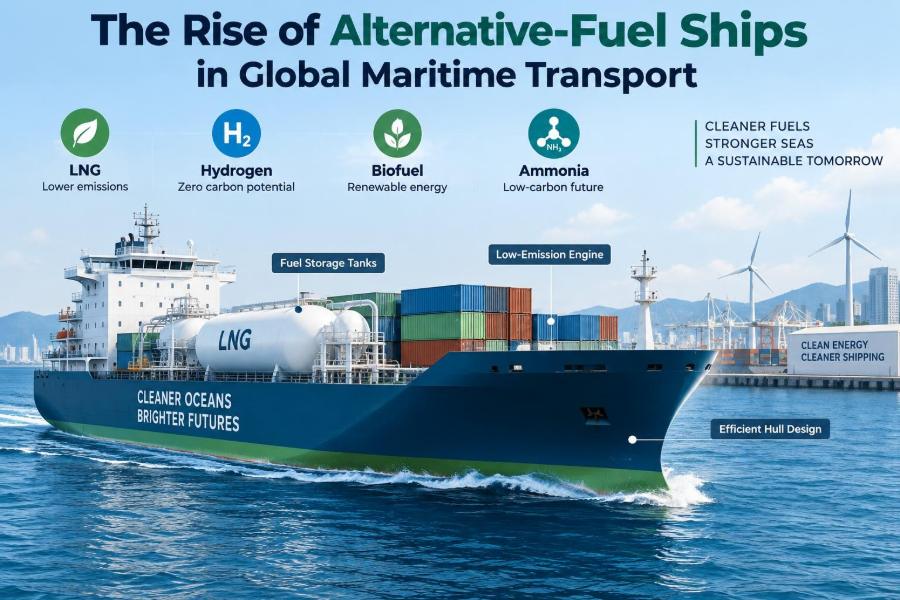
An alternative-fuel ship is a vessel designed to use a fuel or energy source other than conventional petroleum-based marine fuel as its primary propulsion energy, or as a significant part of a hybrid system. Common examples include LNG, methanol, ammonia, hydrogen, biofuels, battery-electric power, and wind-assisted propulsion.
Some vessels are built dual-fuel. They can operate on a new fuel while retaining the ability to use a conventional pilot fuel or backup fuel. This provides operational flexibility during a period when fuel supply networks are still uneven.
📉 The Two Emissions Questions
Alternative fuels are often discussed as though they answer one simple question: “Does this ship emit less?” Engineers need to ask two separate questions. The first is what leaves the funnel during operation; the second is the emissions created while making, processing, transporting, and bunkering the fuel.
This second view is called well-to-wake assessment. “Well” refers broadly to the energy source and production process, while “wake” covers the ship’s use of fuel. It prevents a solution from being judged only by what is visible at sea.
🧭 From Tank to Wake and Well to Wake
Tank-to-wake emissions describe the effects from fuel use aboard the ship. This is especially relevant to local air pollutants such as sulfur oxides, nitrogen oxides, and particulate matter near ports and busy shipping lanes.
Well-to-wake analysis adds upstream impacts. For example, electricity used to make hydrogen may come from low-carbon generation or from fossil sources. The same hydrogen-fuelled vessel can therefore have very different overall climate performance depending on how its fuel was produced.
🛢️ Why Heavy Fuel Oil Was So Hard to Replace
Marine fuel oil became deeply embedded in shipping because it is energy-dense and economical to carry. A large ocean-going vessel needs enough energy for long passages, weather margins, auxiliary loads, and schedule disruptions. Space taken by fuel tanks is space unavailable for cargo, stores, or machinery.
Replacement fuels must compete with this practical advantage. Many need larger tanks for the same voyage range, while some require tanks with insulation, pressure control, ventilation, or specially selected materials. Fuel choice is therefore a ship-design decision, not merely a procurement decision.
🔥 Liquefied Natural Gas as a Transitional Option
Liquefied natural gas (LNG) is natural gas cooled to a very low temperature so that it becomes a liquid and can be stored more compactly. In use, it can greatly reduce sulfur oxides and particulate emissions compared with high-sulfur fuel oil, and it can offer lower carbon dioxide emissions at the point of combustion.
Its climate value depends on the full chain. Methane is the main component of natural gas, and unburned methane released from engines or fuel systems is a concern because it is a powerful greenhouse gas. This is known as methane slip, and engine design, operating condition, and maintenance all affect it.
🧊 LNG Tank and Bunkering Challenges
LNG tanks are usually insulated and may be cylindrical or otherwise shaped to manage cryogenic conditions. Their size and geometry can complicate arrangement on ships where cargo space is valuable. Heat entering a tank can also create boil-off gas, which must be safely managed or used.
Bunkering LNG demands controlled transfer procedures, exclusion zones, trained personnel, compatible connections, and emergency shutdown arrangements. The fuel is not inherently unmanageable, but its low temperature and flammability require operating discipline that differs from handling conventional liquid fuel.
🍶 Methanol’s Growing Appeal
Methanol is a liquid alcohol that can be handled at ambient temperatures, making it easier to store and transfer than cryogenic fuels. It is already a globally traded chemical, so ports may find its supply chain more familiar than that of completely new marine fuels.
Its key limitation is lower energy density than conventional marine fuel. A ship needs more tank volume for an equivalent journey, and the source of methanol matters greatly. Fossil-derived methanol, biomethanol, and renewable methanol made using low-carbon hydrogen do not have the same life-cycle emissions.
⚠️ Methanol Safety and Machinery Design
Methanol is flammable and toxic if swallowed, inhaled in high concentrations, or absorbed through skin. Fuel systems therefore need leak detection, ventilation, suitable piping arrangements, drainage control, protective equipment, and clear emergency procedures.
These requirements do not make methanol unsuitable; they show why fuel selection must be accompanied by an integrated safety case. Engine-room personnel must understand both ordinary maintenance hazards and the distinctive consequences of a methanol leak.
🧪 Ammonia and the Carbon-Free Molecule
Ammonia contains no carbon. If used without carbon-based pilot fuel, it does not produce carbon dioxide from its molecular composition during combustion. That makes it a prominent candidate for deep emissions reduction on long-distance routes.
However, “carbon-free at use” is not the same as “climate-neutral.” Ammonia production requires energy, usually through hydrogen production and nitrogen separation. Its overall benefit depends on whether that energy and hydrogen come from low-carbon sources.
☣️ Ammonia’s Central Safety Challenge
Ammonia is toxic, and exposure can seriously harm people. This is the defining operational challenge of ammonia as a marine fuel. Ship design must focus on preventing release, detecting it quickly, containing leaks, protecting crew, and providing safe escape and response arrangements.
Combustion may also create nitrogen oxides and, under some conditions, unburned ammonia. Engine makers and researchers are developing combustion control and exhaust-treatment approaches, but the technology and operating practices are still developing. Careful validation matters more than optimistic assumptions.
💨 Hydrogen for Shorter Energy Chains
Hydrogen can be used in internal-combustion engines or converted into electricity in fuel cells. Fuel cells generate electricity electrochemically, often with water as the main direct by-product when pure hydrogen is used. They can be particularly attractive where quiet, efficient auxiliary or propulsion power is valuable.
Hydrogen is difficult to store aboard ships because it has low volumetric energy density. It may be compressed, liquefied at extremely low temperature, or carried in chemical forms. Each method changes tank size, energy use, handling equipment, and risk controls.
🔋 Batteries and Electric Propulsion
Battery-electric ships are already practical for some ferries, harbour craft, inland vessels, and short, predictable routes. Their strength is not unlimited range; it is the ability to recharge regularly, operate quietly, and avoid exhaust emissions while underway.
Battery systems demand serious engineering attention. Thermal management, fire detection, ventilation, segregation, cooling, charging interfaces, and emergency response all need to be designed as a system. A battery is not simply a larger version of a consumer device.
🔌 Why Shore Power Complements New Fuels
When a ship is alongside, auxiliary generators may provide electricity for pumps, refrigeration, lighting, accommodation, and cargo operations. Shore power allows a compatible ship to connect to the local electrical grid instead, reducing emissions and noise at berth.
Its actual climate benefit depends on grid electricity and on whether the ship can reliably connect at the terminal. Shore power does not replace propulsion fuel for an ocean crossing, but it can be an important part of a port-city air-quality strategy.
🌱 Biofuels and Drop-In Options
Some biofuels can be blended with, or used as alternatives to, conventional marine fuels with limited machinery modification. This makes them useful for vessels that cannot easily be rebuilt or replaced in the near term.
The hard question is sustainable supply. Feedstock origin, land-use impacts, processing energy, and competition with other needs all affect the final result. A fuel described as “bio” should still be assessed by traceable life-cycle criteria rather than treated as automatically sustainable.
🌬️ Wind Assistance Is Returning
Wind-assisted propulsion includes rotor sails, rigid sails, suction wings, kites, and other systems that reduce the power demanded from the main engine when wind conditions are favourable. These systems do not turn a modern cargo ship into a sailing vessel; they act as an energy-saving supplement.
Performance varies by route, weather, vessel design, deck layout, and operating profile. A slow bulk carrier on an open-ocean route may have different opportunities from a container ship making tightly scheduled port calls. The best applications are evaluated with realistic route data.
⚙️ Fuel Cells, Engines, and Hybrid Architectures
No single power-conversion system fits every fuel. Internal-combustion engines are familiar, robust, and able to provide high propulsion power. Fuel cells can offer efficient electrical generation and low local emissions, but they bring their own cost, fuel-purity, and integration constraints.
Hybrid architecture combines engines, batteries, generators, fuel cells, and energy-management controls. For example, a ferry may use batteries for manoeuvring and port departure while an engine or fuel cell supports the longer leg. The benefit comes from matching each device to the duty it performs best.
🧱 The Energy-Density Penalty
Energy density is one of the most important constraints in marine decarbonisation. A fuel may be excellent from an emissions perspective but require substantially more tank volume than fuel oil. On a cargo vessel, that volume can reduce payload or force changes in hull layout.
Designers weigh this penalty against route length and bunkering frequency. A short-sea vessel can refill often and tolerate larger tanks more easily than a ship expected to sail for weeks between reliable fuel hubs.
🏗️ Retrofitting an Existing Vessel
Retrofitting can extend the useful life of a ship while reducing emissions, but it is rarely a simple equipment swap. Engineers must examine tank location, stability, hazardous zones, structural reinforcement, ventilation, piping routes, control integration, firefighting arrangements, and class requirements.
A conversion may also require time out of service and affect cargo capacity. Before committing, an owner should compare retrofit feasibility with operational life remaining, expected fuel availability, charter requirements, and the possibility of a newbuild designed around the selected fuel.
📐 Designing Newbuilds for Flexibility
New ships can be designed with a specific fuel from the start, allowing tanks, machinery rooms, cofferdams, and safety systems to be placed more efficiently. But committing to a fuel too early can create commercial risk when supply and regulation are still evolving.
One response is fuel-ready design: reserving space, structural provisions, or routing for future equipment. This is not a guarantee that a later conversion will be cheap, but it can prevent today’s design from blocking tomorrow’s options.
🛟 Class Rules, Codes, and Approval
Alternative-fuel ships operate within a framework of international rules, flag-state requirements, port rules, classification society standards, and company safety-management systems. The International Code of Safety for Ships using Gases or other Low-flashpoint Fuels, commonly called the IGF Code, is an important reference for several fuel types.
Novel fuels can require additional engineering review because established prescriptive rules may not cover every arrangement. In such cases, risk-based design and documented evidence become central. Approval is not paperwork after the design is complete; it shapes the design from the beginning.
👩🔧 Crew Competence Is a Core System
New fuel systems add new alarms, transfer procedures, maintenance tasks, and emergency scenarios. A technically sound installation can still be unsafe if people do not understand its operating limits or if procedures are copied from a different fuel without adaptation.
Training should cover normal operations, abnormal conditions, permit-to-work controls, personal protective equipment, communications during bunkering, and realistic emergency drills. Competence must include contractors and shore teams where their actions affect the vessel’s safety.
🚢 Bunkering Infrastructure Decides What Is Practical
A ship can only use an alternative fuel reliably if it can obtain it where and when needed. Bunkering infrastructure includes production or delivery capacity, storage terminals, transfer equipment, trained operators, quality assurance, emergency arrangements, and compatible port procedures.
This creates a coordination problem. Fuel suppliers hesitate to build facilities without customer demand, while shipowners hesitate to order ships without supply certainty. Long-term contracts, hub-port development, and route-specific planning can help break that deadlock.
🗺️ Route Type Determines the Best Candidate
Fuel choice should begin with the voyage profile rather than with headlines. A battery system may suit a commuter ferry with frequent charging windows. Methanol may be practical on a service with accessible bunkering and sufficient tank volume. Ammonia may become more relevant to long-haul vessels once supply and safety systems mature.
Useful questions include:
- How far does the vessel travel between dependable bunkering points?
- How predictable are port calls and power demand?
- How much cargo-space or deadweight penalty is acceptable?
- What emissions rules apply along the route and in port?
- Can crews, terminals, and emergency services support the selected fuel?
📊 A Practical Comparison of Main Options
| Option | Practical strength | Main constraint | Commonly suited applications |
|---|---|---|---|
| LNG | Established marine experience and lower local pollutants | Methane slip and fossil supply-chain concerns | Vessels with reliable LNG bunkering |
| Methanol | Liquid handling and growing engine availability | Lower energy density; climate result depends on origin | Deep-sea and regional vessels with tank capacity |
| Ammonia | No carbon in the fuel molecule | Toxicity and developing machinery/supply systems | Potential future long-distance shipping |
| Hydrogen | Can support fuel cells and zero-carbon use phase | Storage volume and complex handling | Short routes and specialised applications |
| Batteries | Efficient, quiet, no exhaust while operating | Range and charging capacity | Ferries, harbour craft, inland operations |
This comparison is intentionally broad. A specific project needs a route study, energy model, hazard analysis, fuel-supply assessment, and commercial evaluation before a final decision can be defended.
💰 The Cost Is More Than the Fuel Price
Comparing fuels only by price per tonne is misleading because each fuel contains a different amount of usable energy. The full economic picture includes tank volume, lost cargo opportunity, machinery cost, port charges, fuel availability, maintenance, crew training, and possible emissions-related costs.
A cheaper fuel may be costly if it causes operational delays or cannot be supplied at key ports. Conversely, an expensive low-carbon fuel may make sense where customers value lower-emission transport or where regulatory exposure is high. The calculation is route-specific.
🧮 Measuring Performance Without Greenwashing
Environmental claims should identify the boundary being used. Is the claim about sulfur emissions at the funnel, carbon dioxide from combustion, or total well-to-wake greenhouse-gas intensity? These are different measurements and should not be mixed carelessly.
Good reporting also records fuel quantity, voyage distance, cargo carried, machinery operating mode, and verified fuel origin where possible. Clear data does not eliminate uncertainty, but it makes claims easier to test and improves future engineering decisions.
🚫 Common Mistakes in Fuel Transition Plans
One common mistake is selecting a fuel because it is popular rather than because it fits the vessel’s duty cycle. Another is treating a “fuel-ready” notation as proof that conversion will be easy, without checking the actual reserved space, structural provisions, and safety implications.
Projects also fail when technical and operational teams are separated. A design office may create a compliant concept, but masters, engineers, bunker suppliers, terminals, and emergency responders need to test whether it works under real time pressure.
🔍 A Better Decision-Making Process
A sound alternative-fuel project starts with a baseline: current fuel use, power profile, route pattern, port stays, maintenance history, and emissions obligations. From there, teams can model candidate solutions rather than trying to make every vessel fit one technology.
- Define operational requirements and non-negotiable safety limits.
- Compare fuels on a well-to-wake basis using transparent assumptions.
- Assess tank arrangement, range, cargo impact, and machinery integration.
- Confirm realistic bunkering and shore-support arrangements.
- Build crew competence, procedures, drills, and maintenance planning into the project.
- Review the design as fuel markets and regulations evolve.
🤝 Ports, Shipowners, and Cargo Interests Must Align
Shipping is a connected system. A vessel cannot decarbonise in isolation if its ports lack compatible infrastructure, its charter terms reward only speed, or its cargo owners do not recognise the cost of cleaner transport.
Shared planning can make investments more credible. For instance, a port, ferry operator, grid provider, and local authority may coordinate charging for an electric ferry service. The technical equipment is essential, but dependable scheduling and contractual alignment are what make it usable.
🔭 What the Next Decade May Look Like
The fleet is likely to become more diverse before it becomes more uniform. Some ships will use improved conventional fuels and efficiency measures, some will operate with batteries or biofuels, and others will adopt methanol, LNG, hydrogen, ammonia, or combinations of these options.
The pace will differ by market. Short routes with predictable infrastructure may change quickly, while long-haul sectors face harder energy-storage and fuel-supply problems. Engineering progress will matter, but so will the availability of genuinely low-carbon energy at scale.
🎓 What Marine Engineers Should Learn Now
Marine engineers do not need to become specialists in every alternative fuel at once. They do need a working understanding of fuel properties, hazard controls, energy balances, electrical systems, emissions accounting, and the relationship between design decisions and ship operations.
Useful habits include reading safety data carefully, questioning vague environmental claims, practising structured risk assessment, and learning how automation and energy-management systems influence machinery behaviour. The transition rewards engineers who can connect thermodynamics, safety, and everyday operational reality.
🧠 The Core Principle: Fit the Fuel to the System
The rise of alternative-fuel ships is not a contest with one winner. Each option involves trade-offs among energy density, safety, fuel origin, cost, infrastructure, emissions, and route suitability. Ignoring any one of these can move the problem rather than solve it.
The strongest projects treat the vessel, fuel supplier, port, crew, regulations, and cargo operation as one system. A lower-emission ship is not defined only by what is in its fuel tank; it is defined by the whole chain that makes safe and credible operation possible.
Alternative-fuel shipping will succeed when practical marine engineering, verified low-carbon energy, and well-prepared people advance together—not when any single technology is treated as a universal answer. That is the real course being charted for global maritime transport. ⚓🌍🔋