
A ship’s propeller shaft does something deceptively difficult: it passes from the dry interior of the vessel to the sea outside, then rotates continuously while carrying propeller thrust. Wherever a moving shaft crosses a watertight boundary, there is a potential route for water to enter.
On a small boat, a drip at the shaft seal may be noticed quickly. On a large commercial ship, the same basic problem exists at a far larger scale, often several metres below the waterline and hidden within machinery spaces.
A stern tube seal is the engineered barrier that manages this crossing. It must prevent unacceptable seawater ingress without gripping the shaft so tightly that friction, heat, wear, and power loss become problems.
Understanding stern tube seals helps explain why routine inspections, clean lubricating oil, correct alignment, and quick responses to leakage alarms matter so much in marine engineering.
⚓ The Opening Around the Propeller Shaft
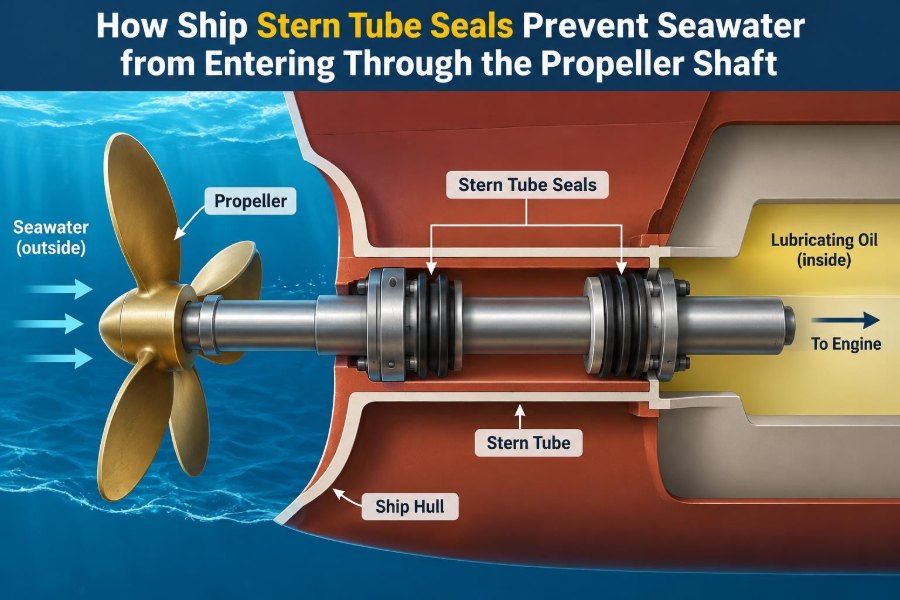
The propeller is driven by a long shaft extending aft from the main engine or gearbox. To reach the propeller, that shaft must pass through the ship’s stern structure. The surrounding structural passage is called the stern tube.
The shaft cannot be welded into that tube because it must rotate. A deliberate annular clearance is therefore needed around it, and without sealing arrangements, seawater pressure would push water through the clearance into the ship.
🌊 Why Seawater Wants to Move Inboard
Seawater outside the hull is under hydrostatic pressure, which rises with depth. The aft end of a stern tube is usually submerged, so water naturally seeks any lower-pressure path toward the vessel’s interior.
Ship motion complicates this simple picture. Draft changes, waves, propeller operation, shaft vibration, and vessel trim can all alter local pressure conditions. A seal must work reliably through these changing conditions rather than only in calm water.
🔄 A Rotating Boundary Is Hard to Seal
Sealing a fixed pipe through a bulkhead is comparatively straightforward. Sealing around a rotating, heavy shaft is different: the seal has to remain in contact while allowing smooth relative movement.
Think of a bicycle wheel axle passing through a waterproof case, except the shaft is much larger, the pressure is higher, access is restricted, and a failure can affect ship safety and pollution risk. The seal must accommodate motion without becoming a source of damaging friction.
🧩 The Main Parts of a Stern Tube System
A complete arrangement contains more than a rubber sealing ring. Typical elements include the stern tube structure, shaft liners or running surfaces, bearings, an aft seal near the propeller, and a forward seal at the machinery-space end.
Lubrication and monitoring systems are also part of the system. On an oil-lubricated installation, the stern tube contains lubricating oil; on a water-lubricated installation, water may lubricate the bearings and the sealing arrangement has a different design emphasis.
🛢️ Oil-Lubricated Stern Tubes
Many conventional arrangements use oil to lubricate the stern tube bearings and protect internal components from corrosion. The aft seal has two jobs: it limits seawater entry and prevents stern tube oil from escaping to the sea.
This creates a balancing act. Oil pressure is often controlled relative to outside seawater pressure so that the seal faces are neither starved of lubrication nor subjected to excessive differential pressure.
💧 Water-Lubricated Stern Tubes
Water-lubricated systems use water-compatible bearings, commonly with a non-metallic bearing material. Seawater or treated fresh water can provide cooling and lubrication depending on the system design.
These systems avoid keeping a large body of oil in the stern tube, reducing one potential pollution pathway. They still require effective seals, however, because unrestricted seawater entry into the vessel remains unacceptable.
🧱 The Shaft Liner Provides the Running Surface
The seal usually runs on a carefully finished shaft liner rather than directly on the main propeller shaft. This liner is a replaceable sleeve made from a corrosion-resistant material suited to the seal design.
Its surface condition is crucial. Scratches, corrosion pits, grooves, or deposits can create paths beneath the sealing lip. Replacing a liner is generally easier than repairing the main shaft, which is one reason the liner is such a valuable sacrificial component.
⭕ Lip Seals and Their Flexible Contact
A common stern tube seal arrangement uses several flexible elastomeric rings, often called lip seals. Each ring presses lightly against the rotating liner and forms a narrow contact band that restricts fluid flow.
The contact is not intended to be a dry, high-friction clamp. A thin lubricating film is normally present at the interface. Seal performance depends on the correct relationship between contact force, surface finish, lubrication, and pressure.
🧭 Why Several Seal Rings Are Used
Multiple rings create staged protection rather than relying on one barrier. Individual chambers between rings can be drained, vented, filled with lubricating fluid, or monitored for unusual leakage.
If an outer ring begins to leak, the inner rings may still prevent water reaching the machinery space. This arrangement also gives engineers diagnostic evidence before a minor defect develops into a serious ingress event.
📍 The Aft Seal Faces the Sea
The aft seal sits near the propeller end of the stern tube and is the primary interface with seawater. It is exposed to external pressure, marine growth, suspended particles, and the dynamic effects of propeller operation.
Its outer sealing elements resist seawater entering the stern tube. In oil-lubricated designs, inner elements help retain oil. The exact ring order and chamber arrangement vary by manufacturer, so maintenance must follow the applicable maker’s instructions.
🏭 The Forward Seal Protects the Ship
The forward seal is positioned at the inboard end of the stern tube, usually inside the shaft alley or engine-room area. Its principal purpose is to keep stern tube lubricant and any migrated water from entering the ship.
A small controlled drain from an intermediate chamber can reveal trouble early. Water seen where only oil should appear, or oil found in a drain that should remain dry, provides a useful warning to investigate.
⚖️ Pressure Control Reduces Seal Stress
Pressure difference across a lip seal affects how hard it bears on the liner. Too much pressure can increase friction, temperature, and wear; poorly managed pressure can also encourage oil discharge or seawater ingress.
Some oil-lubricated systems use header tanks or controlled air systems to maintain an appropriate oil pressure. The goal is not a universal pressure value, but a pressure relationship suitable for that specific vessel, draft, and seal design.
🫧 Lubrication Creates a Protective Film
At the seal contact, a very thin fluid film helps reduce direct rubbing. This is why a sealing ring can both restrict flow and survive long periods of shaft rotation.
If the contact runs dry, heat can rise rapidly and the elastomer can harden, crack, or lose its shape. Conversely, contaminated lubricant can carry abrasive particles into the contact zone and accelerate liner wear.
🌡️ Heat Is an Early Warning Sign
Unusual temperature at a stern tube or seal housing can indicate excess friction, poor lubrication, incorrect adjustment, misalignment, or a damaged ring. Temperature trends are generally more useful than one isolated reading.
An engineer should interpret heat alongside shaft speed, oil condition, vibration, leakage observations, and recent operating changes. Stopping a ship solely because of a single warm reading may not always be necessary, but ignoring a developing trend is risky.
📐 Shaft Alignment Affects Seal Life
The shaft should rotate concentrically within the stern tube. If alignment is poor, the liner can orbit slightly instead of running true, loading one area of a seal ring more heavily than another.
Hull deflection, bearing wear, incorrect installation, damaged couplings, and changes after dry docking can influence alignment. A seal may be where leakage becomes visible, but the underlying cause can be elsewhere in the shafting system.
📳 Vibration and Shaft Movement
Propeller-induced vibration, bearing clearance, and shaft motion challenge the seal’s ability to maintain even contact. The seal housing and its mounting must remain secure, while flexible components need enough compliance to follow minor movement.
Persistent vibration can create uneven liner tracks and fatigue components over time. Investigating vibration at the same time as seal leakage is often more effective than replacing rings alone.
🪨 Abrasive Water Can Damage the Interface
Ships operating in shallow, muddy, sandy, or ice-affected waters may expose seals to harsher conditions. Fine silt and sand are especially troublesome if they reach the running surface, because they can act like an abrasive paste.
Seal selection, flushing arrangements where fitted, and operating practices should reflect the vessel’s trading pattern. A system that performs well on deep-water routes may need closer attention in sediment-rich ports or rivers.
🔍 What Normal Leakage Looks Like
Some seal arrangements permit a very small, controlled amount of seepage or drainage. This does not automatically mean the seal has failed. The key question is whether the observed fluid, rate, and location match the equipment maker’s expected condition.
Engineers should record observations rather than relying on memory. A gradual change in drain appearance or quantity can reveal deterioration earlier than a sudden visual inspection during maintenance.
🚨 Signs That Require Prompt Attention
Warning signs include rising stern tube temperature, increasing drain flow, milky oil indicating water contamination, falling header-tank level, abnormal vibration, or oil appearing where it should not. None of these symptoms should be interpreted in isolation.
- Confirm which chamber or drain is producing the fluid.
- Check operating pressure, temperature, and shaft speed trends.
- Inspect oil samples and filters where the system provides them.
- Escalate according to the vessel’s procedures and the equipment manual.
Immediate action depends on severity, design, and operating circumstances. A ship’s safety management procedures and class or flag requirements remain the controlling references.
🧪 Oil Condition Tells Part of the Story
In oil-lubricated stern tubes, a cloudy or milky appearance can suggest water contamination, although laboratory analysis is needed for a reliable diagnosis. Changes in viscosity, wear debris, or corrosion indicators may also provide useful evidence.
Oil analysis does not replace physical checks. It complements visual inspections, pressure records, temperature trends, and examination of drained fluid from seal chambers.
🔧 Replacing a Seal Ring Is Not a Casual Job
Seal renewal demands clean working conditions, correct tools, proper ring orientation, and careful protection of the liner surface. A ring installed backwards, twisted, nicked, or contaminated can fail soon after commissioning.
Depending on the arrangement, repair may require dry docking, use of a specialized emergency seal device, or procedures that permit controlled work afloat. The feasibility and risk of each option are vessel-specific.
🧼 Cleanliness During Maintenance Matters
Small particles trapped beneath a ring or inside a seal housing can become leakage paths. Cleaning materials must also be compatible with elastomers; unsuitable solvents can swell, soften, or damage seal material.
Before reassembly, technicians inspect the liner for scoring and check the housing, springs, fasteners, and drain passages. A new ring on a damaged liner is rarely a durable repair.
🧰 Common Mistakes to Avoid
Many recurring seal problems begin with apparently minor shortcuts. Good engineering practice focuses on preventing these avoidable causes:
- Assuming every drip is harmless without checking its source.
- Running with low lubricant level or incorrect pressure control.
- Ignoring changes in vibration after docking or propulsion work.
- Using unapproved replacement materials or incompatible lubricants.
- Replacing seals without investigating liner condition and alignment.
- Failing to keep clear records of leakage, temperature, and oil additions.
🛟 Emergency Response to Suspected Ingress
If seawater ingress is suspected, the priority is to assess the rate, identify the location, and protect the vessel’s watertight integrity. Engineers may need to isolate drains, adjust the approved system configuration, reduce shaft speed, or stop the shaft depending on the situation and written procedures.
There is no safe universal emergency sequence because designs differ. Prompt communication between the engine room, bridge, shore management, and relevant technical support is essential when conditions could affect propulsion, pollution prevention, or flooding control.
🌱 Environmental Protection Is Part of Seal Design
A stern tube seal protects in two directions: it keeps seawater out and, in oil-lubricated systems, helps keep lubricant in. Oil leakage at the stern is an environmental concern even when the quantity appears small.
This is one reason water-lubricated systems and environmentally acceptable lubricants receive attention. Neither approach removes the need for maintenance; each has its own material, operating, and monitoring requirements.
🗂️ Records Turn Observations into Maintenance Decisions
A log of oil consumption, tank levels, drain observations, temperatures, and shaft operating hours makes gradual change visible. Without records, crews may only notice a fault once it becomes obvious.
Useful records also help technical teams compare performance before and after dry docking, liner renewal, bearing work, or a change in operating route. Trend-based maintenance is more informative than reacting only to obvious leaks.
👷 Roles of the Engine-Room Team
Watchkeepers are often the first people to see abnormal drain fluid, hear an unusual noise, or notice a tank level changing. Their accurate observations are valuable because stern tube problems can develop gradually.
Senior engineers coordinate diagnosis, consult manuals, plan repairs, and decide when external support is needed. Effective handovers matter: a small anomaly noted on one watch may be the missing piece that explains a larger trend later.
📚 Manufacturer Instructions Take Priority
Although the principles are common, seal geometries, pressures, fluids, drain layouts, and maintenance limits differ significantly among equipment designs. Generic advice must never override the vessel’s approved drawings, maker’s manual, or safety procedures.
When interpreting an abnormal condition, engineers should verify the actual installation rather than assume it matches another ship. Even two vessels with similar engines may have very different stern tube arrangements.
🧠 The Core Principle of Stern Tube Sealing
A stern tube seal does not defeat seawater with one rigid plug. It manages a demanding moving interface through carefully controlled contact, suitable lubrication, staged barriers, pressure management, and condition monitoring.
The most reliable systems are supported by the wider shaft line: sound bearings, correct alignment, clean fluids, intact liners, and crews who respond to changing trends before a minor defect becomes a major repair.
Ship stern tube seals keep the sea outside by combining flexible sealing surfaces with disciplined engineering control of pressure, movement, lubrication, and maintenance. When the entire system is treated as one connected arrangement, seawater ingress and lubricant loss become far more manageable risks. ⚓🌊🔧