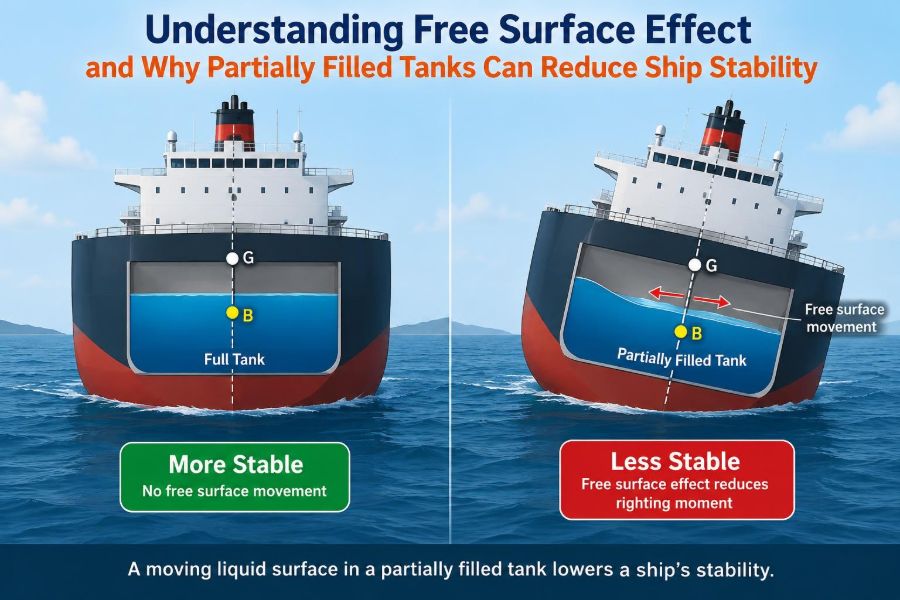

A ship may leave port with every tank apparently within its operating limit, yet feel noticeably different after only a modest heel. The crew has not shifted cargo, the weather may be manageable, and the vessel’s displacement may be unchanged. What has changed is the position of liquid inside a partly filled tank.
Picture carrying an open cup of coffee around a moving room. When you tilt the cup, the coffee runs to one side. A ship’s fuel, ballast water, fresh water, cargo oil, or liquid cargo behaves in the same basic way—except that many tonnes of liquid can move across a wide tank.
This movement is called the free surface effect. It is one of the most practical stability concerns in marine operations because it can reduce a vessel’s ability to return upright after heeling.
Understanding it is not just an examination topic. It affects ballasting plans, fuel management, cargo operations, damage control, loading-computer inputs, and the everyday decisions made on board.
🌊 The basic meaning of a free surface
A free surface is the exposed upper surface of a liquid in a tank that is not completely full. If the tank is partly filled and the ship heels, that surface remains approximately level with the horizon while the tank rotates beneath it.
As a result, liquid flows toward the lower side of the ship. Its centre of gravity shifts transversely, creating an additional heeling influence. The liquid is still on board, so vessel displacement does not change, but its distribution does.
⚓ Why a ship needs stability in the first place
Transverse stability is a ship’s capacity to resist a sideways inclination and return toward upright. For small angles of heel, naval architects commonly describe this ability using metacentric height, or GM.
A positive GM generally means the vessel has an initial righting tendency. A larger GM usually produces a stiffer, quicker motion; a small positive GM produces a gentler, slower motion but leaves less reserve against operational changes.
Free surface reduces the effective GM available to the ship. It therefore matters most when the original stability margin is already modest.
🧭 Centres of gravity, buoyancy, and metacentre
Three points help explain the mechanism. The ship’s centre of gravity, G, is where its total weight can be considered to act. The centre of buoyancy, B, is the centre of the underwater volume supporting the vessel.
When a stable ship heels slightly, the underwater shape changes and B moves toward the low side. The new buoyant force line intersects the original centreline at the metacentre, M. The distance GM is a useful measure of initial stability.
A liquid shifting toward the low side effectively raises the vessel’s G for stability calculations. This reduces GM, even though the actual steel structure has not moved upward.
🥤 A simple cup-and-tray analogy
Place a partly filled cup on a tray and tilt the tray. The liquid runs to the lower rim, and the combined centre of mass of cup plus liquid moves sideways. You must work harder to hold the tray level.
Now seal the cup completely full. On a small tilt, the liquid cannot develop a sloping free surface or transfer significantly from one side to the other. The fluid still has mass, but the particular free-surface penalty is largely absent.
A ship tank is more complicated than a cup because of tank width, internal divisions, fluid viscosity, and ship motion. The central idea remains the same.
📐 What happens when a vessel heels
At upright condition, liquid in a partly filled tank lies symmetrically about the centreline. When the vessel heels to starboard, liquid flows to starboard and its free surface slopes.
This transfer produces a heeling moment in the same direction as the heel. In stability calculations, its main effect is represented as a free surface correction applied to the vessel’s GM or virtual rise of G.
The correction is normally treated as a loss of stability rather than as a permanent list. If the ship returns upright, the liquid returns toward an even distribution—although sloshing can delay that response in real sea conditions.
📏 Why tank width matters so much
For a rectangular tank, the free surface moment depends strongly on its breadth. In simplified form, the transverse free surface moment is proportional to liquid density multiplied by tank length and the cube of tank breadth.
That cube relationship is operationally revealing. Doubling a tank’s width can increase its free-surface contribution by roughly eight times when other dimensions remain comparable. A broad, shallow tank may therefore be more damaging than intuition suggests.
Length matters too, but breadth is usually the feature that attracts the closest attention for transverse stability.
🧮 The working calculation behind the correction
A commonly used expression for a simple rectangular tank is FSM = rho × l × b³ / 12, where rho is liquid density, l is the tank length, and b is the free-surface breadth. Units must be handled consistently.
The virtual rise of G is then found by dividing total free surface moment by ship displacement: FSC = total FSM / displacement. This is the free surface correction, often abbreviated FSC.
In practice, officers normally obtain approved tank data from the stability booklet, loading computer, or tank tables. The formula explains the physics; it is not a substitute for vessel-specific approved information.
📝 Corrected GM versus solid GM
The GM found from the ship’s solid weights and hydrostatic data is often called the uncorrected or solid GM. To account for partly filled tanks, the total FSC is subtracted from it.
Corrected GM = Solid GM − Free Surface Correction
This is why a loading condition can look acceptable until tank contents are entered accurately. A positive solid GM does not automatically mean the ship has adequate corrected stability.
🛢️ Which liquids create a free surface effect
Any movable liquid with a free surface can contribute. Common examples include ballast water, fuel oil, marine gas oil, lubricating oil, fresh water, bilge water, liquid cargo, drilling fluids, and wash water.
Denser liquids produce a greater free surface moment for a tank of the same geometry. Salt water, for example, has a greater density than fresh water, while some cargoes may be substantially denser than either.
The relevant question is not simply, “Is there liquid in this tank?” It is, “Is there a broad, mobile liquid surface at this fill level?”
🚧 Why slack tanks are the concern
A slack tank is neither pressed full nor empty. It contains enough liquid for a free surface to form and enough vacant volume for that surface to move as the ship heels.
A pressed-up tank normally has little or no free surface. An empty tank contains no liquid to shift. Both states may create other operational considerations, but they do not create the same ordinary free-surface penalty as a slack tank.
This is why stability guidance often advises keeping tanks either pressed up or empty where practical. The wording “where practical” matters: structural, pollution-prevention, pumping, trim, and machinery requirements still apply.
🔢 Why the worst fill level is not always obvious
It is tempting to assume a tank is most harmful at half full. That may be a useful visual starting point, but it is not a universal rule for every tank shape or operational calculation.
For a simple prismatic tank with an unrestricted rectangular free surface, the free surface breadth may remain nearly constant through much of the filling range. In shaped tanks, wing tanks, tanks with slopes, and tanks containing internal structure, the effective surface can vary significantly by sounding.
Approved tables capture these changes. Never estimate a correction from percentage full alone when verified tank data are available.
🧱 How baffles and subdivisions help
Longitudinal bulkheads, baffles, and subdivisions reduce the uninterrupted width over which liquid can move. Because breadth has such a strong influence, dividing one wide tank into narrower compartments can greatly reduce free surface moment.
A central longitudinal bulkhead may be especially effective for transverse stability. However, openings, perforations, cross-connections, and structural arrangements affect how freely liquid can equalize, so the actual calculation must reflect the approved design.
Baffles can also reduce sloshing, but they do not automatically eliminate free surface effect. Their arrangement and the tank’s certified stability data determine the allowable credit.
🔗 Cross-connected tanks and equalization
Two tanks connected by an open line can behave differently from two isolated tanks. If liquid can flow freely between port and starboard spaces during heel, the effective free surface may become very wide.
This can be particularly relevant to ballast systems, anti-heel arrangements, and manifolds left open during transfer. A seemingly small operational change—opening a cross-connection—can alter the stability model.
Valve line-up must therefore match the assumptions used in the loading calculation. A valve status is not merely a pumping detail; it can be a stability detail.
⚖️ Free surface effect is not the same as a list
A list is a steady angle of heel caused by an off-centre weight, such as uneven cargo loading or liquid intentionally retained on one side. It shifts G away from the centreline.
Free surface effect primarily reduces the restoring ability around the upright position by allowing liquid to move with the heel. It is usually modelled as a virtual rise of G rather than a fixed transverse shift of G.
Both can occur together. A vessel with a list and several slack tanks may have less ability to recover from additional heel than either condition alone would suggest.
📊 A practical comparison of tank states
| Tank condition | Liquid movement during heel | Typical free-surface implication |
|---|---|---|
| Empty | No liquid shifts | No liquid free-surface correction |
| Pressed full | Movement is highly restricted | Normally negligible ordinary correction |
| Slack, narrow | Liquid can shift over limited breadth | Correction may be moderate |
| Slack, wide | Liquid can shift over broad breadth | Potentially significant correction |
| Cross-connected port and starboard | Liquid may traverse an enlarged effective width | Requires careful system-specific assessment |
The table is a conceptual guide, not an operating instruction. Tank geometry and approved vessel documentation always govern the actual result.
🚢 Ballast water: a routine but critical example
Ballast is often transferred to control draft, trim, propeller immersion, structural loads, and compliance with voyage requirements. During transfer, several tanks can temporarily become slack.
A safe ballast plan considers the sequence, not only the final condition. A ship may be stable before and after a transfer yet pass through an unsatisfactory intermediate stage if too many wide tanks are slack at once.
Watchkeeping during ballasting should include tank levels, transfer rate, valve positions, heel, trim, and the stability condition predicted for each stage.
⛽ Fuel consumption changes stability at sea
Fuel tanks gradually become slack as fuel is consumed. On a long passage, this can create a stability change without any cargo operation taking place.
Good fuel management considers which tanks will be used, in what order, and whether consumption will leave several broad tanks partly full. The best sequence depends on the vessel, machinery arrangement, trim needs, and approved operating guidance.
Fuel transfer at sea can also create transient slack-tank conditions. It should be planned with the same discipline applied to ballast transfer.
🛳️ Liquid cargo introduces further complexity
Tankers and other ships carrying liquid bulk cargo must account for free surface during loading, discharge, stripping, and tank cleaning. Cargo density, tank shape, segregation, and operational sequence can all affect the correction.
Some cargoes are viscous or may not flow freely at low temperature. That does not justify assuming no free surface effect unless the vessel’s approved stability information specifically addresses the condition.
Residual cargo and wash water can also matter. Small quantities in many tanks may collectively produce a meaningful correction, especially when the vessel has limited GM.
🌬️ Why weather exposes small stability margins
In calm water, a vessel with reduced GM may not immediately reveal the seriousness of its condition. Wind, waves, turning, cargo operations, and repeated rolling introduce the heel angles that allow liquid to move and interact with ship motion.
Free surface effect does not create bad weather, but it reduces the stability reserve available to deal with environmental and operational forces. A condition that appears manageable alongside may be less forgiving at sea.
Dynamic behaviour is complex. Static stability corrections remain essential, but crews should not treat them as a complete prediction of every rolling or sloshing response.
🔄 Sloshing and free surface are related but different
Free surface effect is generally a stability concept based on the change in liquid distribution as the ship inclines. Sloshing is the dynamic movement of liquid, often involving waves, impacts, and repeated oscillation inside a tank.
Sloshing can cause loads on tank boundaries and may affect motion in ways that simple static calculations do not fully represent. Large, partly filled tanks in energetic ship motions deserve particular operational attention.
Do not use “sloshing” as a casual replacement for free surface effect. The terms overlap physically but answer different engineering questions.
📉 The danger of adding corrections casually
A common error is to apply a correction for every tank with any liquid, even when a tank is pressed full or the approved data already include the relevant allowance. Another is to omit a slack tank because its volume appears small.
Corrections must be applied exactly as the vessel’s stability documentation specifies. Some loading instruments use pre-calculated moments, some use tank tables by level, and some distinguish between actual and assumed free surfaces.
Double-counting makes a condition look worse than it is; omission can make it look safer than it is. Both undermine reliable decision-making.
💻 Loading computers are tools, not substitutes for judgment
A loading computer can rapidly calculate drafts, trim, shear force, bending moment, GM, and free surface correction. Its result is valuable only when the entered tank soundings, densities, cargo data, and valve-related assumptions are correct.
Operators should understand what the displayed GM represents. Is it corrected or uncorrected? Which tanks are treated as slack? Is the program using measured quantities, planned quantities, or default values?
When a result is surprising, investigate rather than forcing inputs to match an expectation. The physical tank condition on board remains the reality the model must represent.
🧾 Reading stability booklets and tank tables
Approved stability information commonly provides free surface moments, corrections, or maximum values for named tanks. It may also state whether a conservative correction is to be assumed for certain groups of tanks.
Tank tables can show that correction changes with sounding, especially in irregular tanks. They may include separate information for different liquid densities or instructions for converting the listed values.
Use the terminology and assumptions of the approved document for the particular ship. Generic equations are excellent for understanding, but they cannot capture every shaped tank, internal bulkhead, or special operating arrangement.
🧰 A sensible pre-transfer checklist
Before starting a ballast, fuel, or liquid-cargo transfer, the team should evaluate the intended sequence as well as the final condition. This is especially important where several tanks will become slack simultaneously.
- Confirm current tank levels and expected liquid densities.
- Identify tanks that will be slack at each transfer stage.
- Check corrected stability, trim, draft, and structural limits.
- Verify planned valve positions, including cross-connections.
- Set monitoring intervals and clear stop points for unexpected heel or level changes.
- Record and communicate changes to the agreed plan.
Company procedures, vessel-specific manuals, and applicable regulatory requirements determine the formal process.
👀 Monitoring clues during operations
Unexpected list, changing heel during a routine transfer, abnormal rolling, or a tank level that does not match the planned sequence are reasons to pause and reassess. They do not prove free surface effect is the sole cause, but they deserve attention.
Soundings, level gauges, draft readings, and pump performance should be considered together. A faulty gauge or an unintended valve line-up can create a tank condition very different from the one entered in a calculation.
Clear communication between deck officers, engine-room personnel, and cargo-control staff reduces the risk of one team changing a liquid distribution that another team assumes is unchanged.
🧠 Common misunderstandings to avoid
- “More liquid always means more free surface.” A pressed-full tank can have less free-surface effect than a partly filled one.
- “Only cargo tanks matter.” Fuel, ballast, fresh water, and service tanks can all contribute.
- “A small tank can be ignored.” Its effect depends on density, breadth, and the ship’s available stability margin.
- “The final condition is all that matters.” Transfer stages can be the critical condition.
- “A positive GM ends the discussion.” The relevant question is whether corrected stability meets the vessel’s applicable criteria and operating limits.
🧪 A hypothetical operating scenario
Consider a vessel preparing for sea with adequate corrected GM while most ballast tanks are either full or empty. To improve trim, the crew begins transferring ballast between two wide double-bottom tanks and opens an equalizing connection.
For part of the operation, both tanks are slack and effectively connected over a broad width. The free surface correction rises, while the ship may also develop a small heel from the transfer sequence. If this intermediate condition was not checked, the final safe condition provides little reassurance.
This is a hypothetical example, but the lesson is practical: calculate and monitor the route between loading conditions, not just the destination.
🧩 Free surface in damaged stability
After flooding, free surface may become especially significant because water can occupy spaces not designed for routine liquid carriage. Floodwater may communicate between compartments, change as the vessel heels, and reduce residual stability.
Damage-stability assessment involves additional issues, including permeability, progressive flooding, downflooding points, and cross-flooding arrangements. These cases require approved damage-control information and, where available, dedicated onboard decision-support systems.
The routine operational principle is still recognizable: mobile liquid in broad spaces can reduce the vessel’s ability to resist further heel.
📚 What students should retain for calculations
For examination and foundational engineering work, remember the sequence: identify slack tanks, find or calculate each free surface moment, sum the moments, divide by displacement, and subtract the result from solid GM.
Also remember the limits of this simplified process. It usually addresses small-angle initial stability and relies on stated assumptions about tank geometry and liquid movement. Full stability assessment may require righting-arm curves, regulatory criteria, wind heeling moments, and vessel-specific software.
Understanding the assumptions is as valuable as remembering the equation.
🧑✈️ What working professionals should retain
For operational personnel, the most useful habit is to see every liquid transfer as a changing stability condition. Ask which tanks are slack now, which will become slack next, and whether any opened connection changes the effective free surface.
Use approved tools and procedures, but keep the physical picture in mind: broad, mobile liquid shifts toward the low side and reduces the stability margin. That mental model helps spot implausible entries and risky sequences before they become problems.
✅ The core principle behind safe tank management
Free surface effect is not a mysterious extra weight and not a separate force acting from outside the vessel. It is the stability consequence of liquid being able to relocate within a tank as the ship heels.
The practical response is straightforward in principle: minimize unnecessary slack tanks, avoid creating many slack tanks at once, account accurately for those that remain, and assess every stage of a transfer. Balance that goal against the real requirements of trim, hull loading, machinery operation, cargo handling, and environmental compliance.
A vessel is safest when its calculated condition faithfully matches its actual liquid distribution—and when the crew understands how that distribution will change over time.
Partly filled tanks can reduce ship stability because their liquid shifts with heel, effectively reducing the vessel’s available righting ability; managing that movement is a daily part of sound marine practice. ⚓🌊🚢