
A fourth engineer joining a first ship often hears wildly different pay figures from classmates. One is sailing on a tanker, another has joined a cruise vessel, and a third is waiting for a container-ship contract. All hold similar certificates, yet their offers do not look alike.
That difference can be confusing because a marine engineer’s income is not a single fixed salary. It is a package shaped by rank, vessel trade, employer, flag, contract pattern, qualifications, and the operational demands of the job.
For students choosing a cadetship and officers planning their next promotion, understanding the mechanics behind pay is more useful than chasing one headline number. It helps set realistic expectations and makes career decisions more deliberate.
This guide explains what drives marine engineer earnings, where comparisons can mislead, and how to evaluate an offer beyond the monthly figure.
⚙️ Salary Is a Package, Not Just a Monthly Figure
Marine engineer pay may be described as monthly basic pay, consolidated pay, daily pay, or an all-inclusive contractual amount. These terms are not interchangeable, so comparing only one number can lead to the wrong conclusion.
A package can include overtime, leave pay, travel, insurance, pension or provident-fund contributions, bonuses, and allowances. Some are paid while aboard; others are paid at a different time or only under defined conditions.
Ask whether an advertised figure is paid for every month of the year or only for months served on board. That single distinction can materially change annual income.
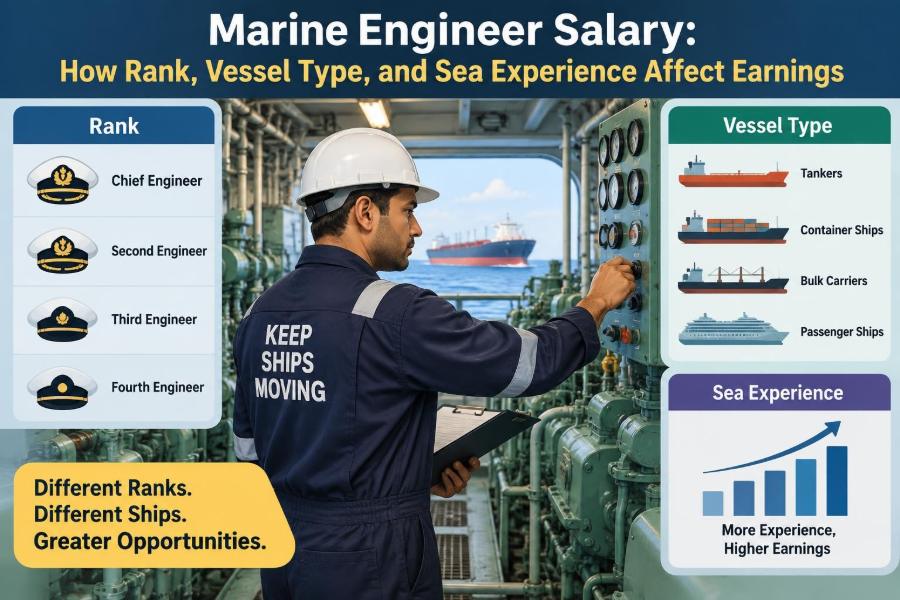
🧭 Rank Is the Strongest Everyday Pay Driver
Rank reflects legal responsibility, technical authority, and the decisions an officer is expected to make when machinery fails, maintenance is overdue, or an emergency develops. As rank rises, the employer is paying for broader competence and accountability, not simply more years at sea.
The usual engine-department progression moves from trainee or cadet through junior watchkeeping roles, second engineer, and chief engineer. Titles vary by company and vessel, but the pattern is consistent: greater operational control generally brings greater compensation.
A chief engineer carries overall responsibility for the engine department and machinery plant. A second engineer commonly manages day-to-day maintenance and personnel. That difference in command scope is reflected in pay.
🎓 Cadet Pay Is Training Support, Not Officer Pay
Engine cadets are learning under supervision while completing a structured sea-time requirement and training record book. Their pay is therefore usually an allowance or trainee wage rather than the salary of a licensed officer.
This stage still has major financial value: it provides the sea service, practical exposure, and assessed competence needed to progress toward a certificate of competency. A slightly better cadet allowance is rarely worth more than a berth that offers poor training, weak supervision, or unreliable documentation.
Before accepting, clarify berth duration, onboard mentoring, vessel machinery type, training-record support, and whether the company has a realistic path for cadets to return as junior officers.
🪪 Certificates of Competency Open Pay Bands
A certificate of competency, often called a CoC, is the professional license that permits an engineer to serve at specified ranks and power levels under the issuing administration’s rules. It is a gateway to roles, not an automatic promise of a particular wage.
Employers also consider the certificate’s acceptance under the ship’s flag, any required endorsements, medical fitness, security training, and recent experience. A newly qualified officer may hold the right certificate but still need to prove readiness for a demanding assignment.
Higher certificates expand the roles for which an engineer can be considered. That access is one reason promotion preparation matters financially as well as professionally.
📈 Promotion Changes Both Pay and Exposure
A promotion can raise earnings because it changes the type of decisions an engineer owns. The reward comes alongside responsibility for budgets, planned maintenance, pollution prevention, audits, safe work systems, and the performance of junior crew.
For example, moving from watchkeeping engineer to second engineer is not merely a title change. It often means organizing maintenance routines, assigning jobs, checking work quality, and keeping the chief engineer informed about risks before they become failures.
Do not treat promotion as a salary negotiation alone. A role accepted before the engineer is operationally ready can create safety, confidence, and career problems that outweigh a short-term increase.
🚢 Vessel Type Creates Different Pay Conditions
Vessel type affects workload, cargo risk, automation, port routine, equipment complexity, and the scarcity of suitable experience. These factors can influence both base pay and any premium attached to a particular ship.
There is no permanent rule that one vessel type always pays best. Market demand shifts, companies use different employment models, and a premium may compensate for a difficult trade rather than indicate a universally superior career path.
| Vessel category | Typical engineering pay influences | Career consideration |
|---|---|---|
| Tankers | Cargo safety systems, hazardous atmosphere controls, terminal procedures | Relevant tanker experience and endorsements can be valuable |
| Container ships | Fast port turns, auxiliary-load demands, schedule pressure | Exposure to varied routes and modern machinery |
| Bulk carriers | Long voyages, cargo-related maintenance, age and condition of ship | Experience varies substantially between operators |
| Cruise vessels | Hotel load, extensive auxiliary systems, passenger-facing safety standards | Large, complex plants and intensive operating routines |
| Offshore and specialized vessels | Special equipment, dynamic positioning support, demanding operations | May require specific competence and operational experience |
🛢️ Tanker Work Can Attract Specialized Value
Oil, chemical, and gas tankers have extensive cargo-related safety arrangements and strict operational procedures. Engineers may maintain inert-gas systems, cargo-support machinery, pumps, compressors, vapour-control equipment, and related protective systems, depending on the ship.
Because the consequences of equipment failure or procedural error can be serious, employers often value relevant experience highly. A tanker-related differential, where offered, should be read alongside the vessel’s age, trade, manning level, and leave arrangements.
A premium is not “easy money.” It may reflect additional training, more complex operational periods, and a higher expectation of procedural discipline.
📦 Container Ships Reward Operational Pace
Container ships can have frequent port calls and quick turnarounds. During port stays, engineers may manage generators, refrigerated-container loads, bunkering, maintenance windows, and machinery readiness while the schedule remains tight.
That pace may suit engineers who enjoy organized routines and rapid troubleshooting. It can also mean that sea time is not necessarily quiet time; port operations can be the busiest part of a voyage.
When assessing an offer, ask about typical port frequency and the number of engineers on board. A vessel’s published type alone does not reveal its daily workload.
🏗️ Offshore and Specialized Ships Need Niche Skills
Offshore support vessels, dredgers, cable vessels, research ships, and other specialized units may operate equipment uncommon on conventional cargo vessels. The engine department may support dynamic positioning, high-capacity electrical plants, deck machinery, subsea systems, or mission equipment.
Pay may reflect the need for established competence, specific courses, and operational availability. However, specialized experience can also narrow the immediate job market if an engineer later wants to switch sectors.
The best choice depends on personal interest and transferable skills. Electrical, automation, high-voltage, and reliability experience can remain valuable across many marine and shore-based roles.
🛳️ Passenger Vessels Add Hotel and Service Loads
A passenger vessel is a ship and a floating hospitality operation. Its engineering plant can support accommodation services, galleys, laundry systems, air conditioning, freshwater production, pools, entertainment spaces, and substantial electrical demand.
This can create excellent exposure to auxiliary machinery and large-team maintenance systems. It may also involve intensive drills, inspections, and strict expectations around continuous service availability.
Salary comparisons should account for the onboard environment as well as money. Passenger operations may have schedules and company rules that feel very different from deep-sea cargo work.
🧰 Ship Age and Equipment Condition Matter
Two engineers at the same rank on similar ships may face very different work because one vessel is newer and highly automated while the other requires constant attention to aging machinery. Neither case is automatically better.
Newer ships can offer valuable exposure to electronic controls, emissions systems, and integrated monitoring. Older ships can build practical fault-finding ability, but chronic defects, spare-part delays, and compressed maintenance time can create strain.
Pay should be considered with manning adequacy, maintenance budget, dry-dock planning, and the company’s repair culture. A higher rate does not cancel an unsafe or unmanageable workload.
🌊 Sea Experience Builds Earning Power Gradually
Sea experience is more than a number of months in a discharge book. Employers look for relevant service at rank, familiarity with comparable plant, good appraisal history, and evidence that the officer can handle routine work without losing control during abnormal conditions.
Time on a vessel type can make an engineer more employable for similar ships. For instance, experience with medium-speed generator plants, steam systems, dual-fuel machinery, or high-voltage distribution may be especially relevant when a matching vacancy appears.
Early careers often advance in steps rather than a smooth yearly rise. A significant increase may arrive when a new certificate, successful first contract at rank, or scarce technical skill changes the jobs available.
📅 Experience at Rank Often Counts Most
Employers generally distinguish total sea time from time served successfully at the rank being offered. A newly promoted second engineer and a second engineer with several completed contracts have different evidence of competence, even if their total seagoing time is similar.
Experience at rank shows that the officer has managed handovers, inspections, breakdowns, maintenance planning, and crew coordination within that level of authority. It reduces the uncertainty of placing someone in a key role.
Keep records that make this experience easy to verify: certificates, discharge documents, appraisals where available, and a clear description of machinery and duties.
🔧 Technical Scarcity Can Improve Negotiating Position
Engineers with current, demonstrable knowledge of systems that are difficult to staff may have access to better opportunities. Examples can include dual-fuel engines, gas handling, high-voltage installations, sophisticated automation, or particular propulsion arrangements.
Training alone is not always enough. Employers may prefer a combination of approved instruction, onboard experience, and a recent record of operating or maintaining the system.
Choose specialization carefully. Build a sound foundation in core marine engineering first: engines, pumps, heat exchangers, electrical basics, safety systems, maintenance planning, and clear communication.
🌱 Alternative Fuels Are Changing Skill Demand
Shipping is adopting a wider mix of fuels and energy technologies, but the pace and equipment choices vary by fleet and route. Engineers may encounter dual-fuel arrangements, battery systems, shore-power interfaces, exhaust-gas treatment, and more advanced emissions monitoring.
This does not mean every new technology will command a universal premium. It does mean that engineers who learn the safety principles, operating limits, and maintenance implications of new systems can be better prepared for changing assignments.
Be cautious of vague training claims. Check whether a course is recognized for the intended ship type and whether it matches the equipment you are likely to operate.
🏢 Employer Reputation Affects More Than Pay
Companies differ in fleet condition, training investment, promotion practices, crew-change reliability, claims handling, and the clarity of their contracts. A lower headline amount can sometimes be part of a more dependable employment arrangement; the reverse can also be true.
Look for practical signals: transparent joining instructions, timely communication, complete written terms, realistic manning, and a credible process for reporting safety concerns. Speak with current or former crew where possible, while recognizing that individual experiences differ.
An employer’s ability to give regular contracts and predictable promotion opportunities has real long-term financial value.
⚓ Flag, Labour Rules, and Nationality Affect Contracts
Ships operate under a flag state, while crew may be recruited through agencies and employed under contracts influenced by several jurisdictions. This can affect documentation, minimum employment protections, social-security arrangements, dispute procedures, and how pay is structured.
Nationality can also affect market access, visa needs, tax treatment, union arrangements, and the recruitment channels open to an engineer. These are structural realities, not measures of professional worth.
Do not assume that a salary figure has the same meaning across countries. Compare the actual contract, currency, payment method, benefits, and legal obligations relevant to your circumstances.
💱 Currency and Payment Timing Change Real Value
A contract paid in one currency may have a different real value when converted into the currency used for family expenses, loans, or savings. Exchange movements are uncertain, so avoid planning a household budget around the most favorable recent rate.
Also check when money is paid. Some arrangements include payment after sign-off, payment of accrued leave later, or deductions for items that were not obvious in an initial conversation.
- Which currency is specified in the contract?
- Is the amount net or subject to deductions?
- Are travel, medical examinations, visas, and documentation reimbursed?
- When are wages, leave pay, and any bonus actually payable?
🗓️ Contract Length Shapes Annual Earnings
A six-month onboard wage cannot be fairly compared with a year-round salaried arrangement without calculating time between contracts. Relief delays, medical appointments, training, and job searches can all create unpaid intervals.
Consider a hypothetical case: Engineer A receives a higher monthly amount but is paid only during sea service and waits several months between jobs. Engineer B receives less per month but has regular rotations and paid leave. The better annual outcome depends on the full calendar, not the monthly rate.
For personal planning, estimate conservative annual income using expected paid months, not the maximum possible number of contracts.
🏖️ Leave Pay Needs Careful Reading
Paid leave is one of the easiest details to misunderstand. Some contracts state a separate leave wage, some build leave into a consolidated amount, and some pay only while a seafarer is signed on.
Ask for the formula in writing. If leave is accrued, establish how it is calculated, when it becomes payable, and what happens if a contract ends early or a crew change is delayed.
Time off is not only a financial variable. Reliable leave supports rest, family life, medical care, and readiness for the next contract.
⏱️ Overtime and All-Inclusive Pay Are Different Models
Some contracts specify basic wages plus overtime at a stated rate and recordable hours. Others use an all-inclusive or consolidated figure intended to cover a defined workload. Each model can be fair or problematic depending on the terms and actual hours worked.
With all-inclusive pay, understand what duties and hours are assumed. If work regularly exceeds reasonable limits, a high consolidated amount may conceal fatigue and an understaffed department.
Never assume informal promises about overtime will be honored. The written employment agreement and onboard records are what matter when a dispute arises.
🩺 Benefits Have a Real Financial Value
Medical coverage, disability protection, repatriation, paid travel, accommodation during mobilization, retirement contributions, and death-in-service coverage can make a meaningful difference to the real value of an offer. The exact protections depend on the contract and applicable rules.
Read exclusions as carefully as benefits. Pre-existing conditions, off-duty incidents, family coverage, and the process for medical repatriation can all matter.
Do not treat insurance as a substitute for personal emergency savings. Claims and payments can take time, and coverage may have limits.
🧾 Bonuses Should Not Be Treated as Guaranteed Income
Retention bonuses, safety bonuses, performance incentives, and completion bonuses may be attractive, but their conditions matter. They can depend on completing a contract, meeting company targets, remaining available for a future assignment, or circumstances beyond one person’s control.
For budgeting, treat a conditional bonus as upside rather than income required to meet fixed expenses. Confirm eligibility, calculation method, payment date, and whether deductions or forfeiture clauses apply.
A clear written bonus clause is more useful than a verbal assurance from a recruiter.
🔍 Read the Employment Agreement Line by Line
Before signing, ensure the position, vessel or fleet assignment, wage components, contract duration, joining port, repatriation terms, and deductions are clear. If a recruitment agent is involved, confirm who the legal employer is and obtain the final contract rather than relying on an offer message.
- Rank and duties, including any acting-rank arrangement
- Basic pay, overtime basis, leave treatment, and payment schedule
- Travel, visa, medical, and training costs
- Insurance, repatriation, termination, and grievance provisions
- Notice requirements and conditions attached to bonuses
If language is unclear, ask before joining. For consequential legal or tax questions, obtain advice from an appropriately qualified professional in the relevant jurisdiction.
🚩 Warning Signs in a Salary Offer
A legitimate offer should survive reasonable questions. Pressure to pay recruitment fees, reluctance to provide written terms, inconsistent vessel details, unexplained deductions, or demands to surrender original documents are warning signs.
Another concern is an offer that appears unusually high but leaves out contract length, leave, travel, overtime assumptions, or insurance. High pay can be legitimate in difficult assignments, but opacity is never a good basis for a decision.
Verify the recruiting channel, company identity, and vessel information independently. Keep copies of every document and payment record.
🤝 Negotiation Works Best With Evidence
Negotiation is usually strongest when an engineer can point to relevant experience: time at rank, particular machinery, clean appraisals, required endorsements, reliability, and a record of completing contracts professionally.
Rather than asking broadly for “more,” frame a specific request. For example, an officer with recent dual-fuel experience may ask whether the company offers a premium, training support, or a defined review after successful completion of the first contract.
Be professional and realistic. A company may have fixed wage scales, but it may have flexibility in joining bonuses, rotation, training, or placement on a vessel that better matches your experience.
📚 Training Choices Should Support a Career Plan
Courses are valuable when they unlock a role, meet a documented requirement, or deepen a skill that the engineer will use. Collecting certificates without a plan can consume money and leave time without improving employability.
Map training against a target pathway: license upgrade, tanker specialization, electrical competence, high-voltage work, automation, or a future shore-based technical role. Then verify prerequisites and expiry requirements before enrolling.
The most effective development combines formal learning with deliberate onboard practice: troubleshooting, documentation, permit systems, maintenance planning, and calm communication during defects.
🧑🔧 Professional Reputation Compounds Over Time
In a close professional network, a reputation for safe work, accurate records, respectful leadership, and dependable handovers can influence future opportunities. This is not a shortcut around competence; it is how competence becomes visible to employers.
Maintain a factual professional record of ships, engine types, power plants, responsibilities, audits, major projects, and courses. Avoid exaggeration. A detailed interview can quickly expose claims that cannot be explained.
Good relationships with crewing teams and senior officers can help an engineer hear about suitable vacancies, but they should never replace formal qualifications or safe operating standards.
🏠 Compare Sea Pay With Shore Careers Carefully
Shore-based technical jobs may offer more predictable routines, local social-security systems, and daily family life, while sea-going roles can offer periods of concentrated earnings and distinctive operational experience. Neither path is automatically financially superior.
A fair comparison includes commuting, housing, taxation, healthcare, unpaid time, career progression, and the value of time at home. It also includes personal tolerance for separation, irregular schedules, and responsibility.
Sea experience can support later work in superintendence, technical management, surveying, training, shipbuilding, equipment service, or port operations, although each route has its own entry requirements.
🧮 Build a Personal Annual-Income Model
A simple model prevents the most common comparison error. List guaranteed onboard wage, expected paid months, confirmed leave pay, predictable allowances, likely travel costs, tax obligations, and a conservative estimate of unpaid gaps.
Keep conditional bonuses and uncertain currency gains separate from guaranteed income. Then compare the result against your actual financial needs: family support, debt, savings, insurance, education, and an emergency reserve.
This approach turns a vague salary discussion into a decision that reflects your own circumstances rather than another seafarer’s.
🛟 Protect Safety and Wellbeing While Chasing Pay
Fatigue, poor maintenance support, inadequate manning, and pressure to bypass procedures are not acceptable trade-offs for a larger wage. They increase the risk of injury, machinery damage, pollution, and professional consequences.
Before accepting a role, ask practical questions about crew numbers, watch patterns, port workload, maintenance backlog, spare parts, internet access, medical arrangements, and contract relief. The answers reveal more about the job than a headline rate.
A sustainable career depends on remaining competent, healthy, and trusted—not just on maximizing the next contract.
🎯 The Core Principle: Value the Whole Career, Not One Contract
Marine engineer earnings rise most reliably when rank, relevant sea experience, technical capability, and employer trust reinforce one another. Vessel type can create opportunities and premiums, but it is only one part of the picture.
The strongest offers are transparent about pay, time off, benefits, duties, and operational conditions. They also place the engineer on a path that builds usable competence for the next promotion or career move.
Choose contracts with a long view: gain meaningful sea time, protect your licenses and wellbeing, document what you learn, and calculate annual value rather than reacting to a single monthly figure.
A marine engineer’s best earning strategy is to build credible responsibility and compare complete employment packages, not simply pursue the highest advertised wage. That approach supports both financial progress and a safer, more durable career at sea. 🚢⚙️🌊