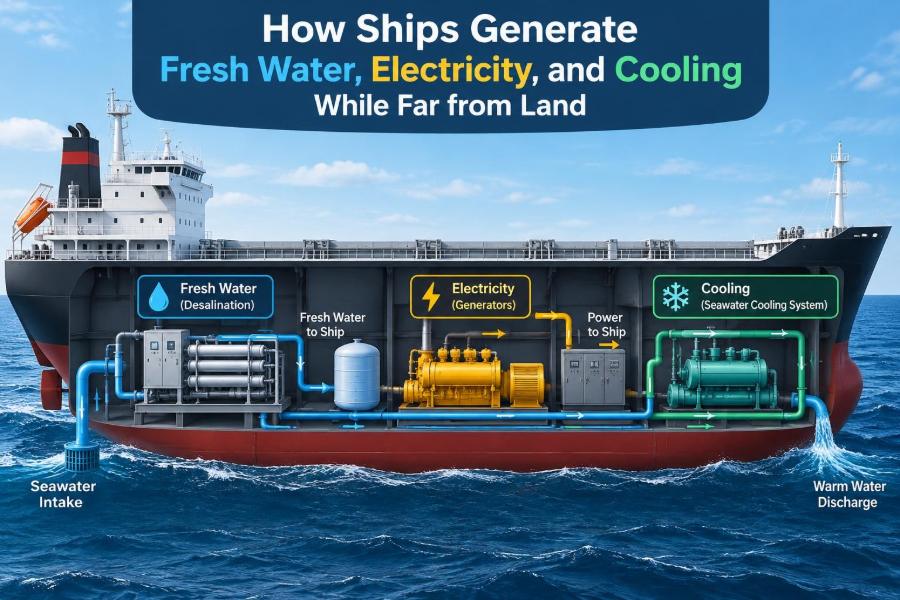

A ship crossing an ocean cannot simply connect to a municipal water main, a power grid, or an air-conditioning plant ashore. Yet people aboard still expect drinking water, lights, refrigeration, navigation equipment, hot showers, and safe temperatures in machinery spaces.
That independence is not a luxury. It is a core part of marine engineering. A vessel is a moving industrial site whose utilities must work despite vibration, salt spray, changing weather, limited storage, and no nearby repair shop.
The surprising part is that these services are closely connected. The same fuel that turns a propulsion engine can produce electrical power and useful heat; seawater can remove unwanted heat and, after careful treatment, become fresh water.
Understanding these systems as one shipboard “hotel services” network makes the machinery easier to follow. It also explains why a fault that begins as a cooling-water problem can eventually affect electrical supply, drinking water, cargo, or propulsion.
⚓ A Ship Is a Self-Contained Utility Plant
Marine engineers often think of a vessel as several plants operating together: a propulsion plant, electrical plant, freshwater plant, cooling plant, fuel system, and waste system. Their equipment may be in different rooms, but their energy and fluid paths overlap.
For example, a diesel generator needs fuel, lubricating oil, combustion air, cooling water, and exhaust routing before it can deliver electricity. If its cooling path is lost, it may need to reduce load or stop, even though its alternator is mechanically sound.
Designers therefore build in storage, redundancy, alarms, isolation valves, and operating procedures. Complete independence is never absolute, but a well-managed ship can sustain essential services for a planned voyage.
🧭 The Demands Change with the Vessel’s Mission
A cruise ship, container vessel, tanker, naval vessel, and offshore unit all require power and water, but not in the same pattern. Passenger ships have large accommodation, galley, laundry, and air-conditioning loads. Refrigerated cargo ships require reliable cooling around the clock.
A tanker may need substantial pump power during cargo operations, while a container ship can see electrical demand rise sharply when carrying refrigerated containers. Offshore vessels often need high station-keeping power and dependable services during remote operations.
This changing demand matters because machinery is selected for realistic operating profiles, not merely the highest possible load. Oversized equipment can waste fuel at low load; undersized equipment leaves little operational margin.
⚡ Electricity Starts with Mechanical Rotation
Most shipboard electricity is made by an alternator, also called an AC generator. A prime mover rotates the alternator’s rotor, creating a changing magnetic field that induces alternating current in stationary windings.
On many diesel-powered vessels, the prime mover is a medium-speed or high-speed diesel engine. Gas turbines, steam turbines, battery systems, shaft generators, and fuel cells can also contribute, depending on the ship and its design.
The basic conversion is straightforward: fuel energy becomes heat, engine motion, rotating shaft power, and then electrical energy. Each step has losses, which is why efficient operation depends on both machinery condition and sensible loading.
🔌 Diesel Generator Sets and Their Core Parts
A diesel generator set, commonly called a diesel genset, combines an engine, alternator, governor, automatic voltage regulator, control system, cooling equipment, and protective devices. It is far more than an engine bolted to a generator.
The governor controls engine speed. Since AC frequency depends on rotational speed and generator construction, speed control helps hold the electrical system near its required frequency. The automatic voltage regulator controls excitation so voltage remains within acceptable limits as load changes.
Protection relays monitor conditions such as overload, short circuit, abnormal frequency, reverse power, and insulation faults. They are intended to isolate a problem before it damages equipment or destabilizes the entire busbar.
📊 Matching Generators to the Electrical Load
The ship’s switchboard distributes power and shows engineers what the generators are doing. Loads include pumps, fans, steering gear, lighting, galley equipment, navigation systems, workshops, cargo machinery, and accommodation services.
When demand rises, an operating generator may be loaded more heavily. Before it reaches a defined operating limit, another generator can be started, brought to the same voltage and frequency, synchronized, and connected in parallel.
Load sharing then divides real power, measured in kilowatts, between generators. Reactive power sharing is also controlled because it affects current and voltage behaviour. Poor sharing can overload one machine even when the total plant appears lightly loaded.
🔄 Synchronizing Before Paralleling
Two AC generators cannot be casually connected to the same live busbar. Their voltage, frequency, phase sequence, and phase angle must be compatible. Otherwise, the connection can create severe electrical and mechanical stresses.
Automatic synchronizers often perform this task, although crews must understand what the system is doing. The incoming machine is adjusted until its waveform closely matches the busbar, then its breaker closes at the appropriate moment.
Once paralleled, the incoming engine is given more fuel to accept real load. Adjusting excitation changes its reactive-power contribution. These are related but distinct controls, a distinction that prevents many troubleshooting errors.
🛟 Emergency Power Has a Separate Purpose
Ships carry an emergency source of electrical power, commonly an emergency generator with its own fuel supply and location separated from the main machinery spaces as far as practicable. Batteries also support critical systems during transfer or for dedicated standby duties.
Emergency power is not designed to run every convenience load. It supplies selected essential services, which may include emergency lighting, alarms, communications, navigation equipment, firefighting support, and emergency bilge or steering functions depending on vessel arrangements.
The principle is survivability: a fire, flooding event, or blackout in the main engine room should not remove every means of control and safe evacuation. Exact requirements depend on ship type, flag, class rules, and applicable regulations.
🔋 Batteries, UPS Units, and DC Services
Many critical controls use direct current because batteries provide immediate, quiet power without waiting for an engine to start. Typical DC services can include emergency lighting, communication equipment, alarm circuits, engine control backup, and switchgear tripping circuits.
An uninterruptible power supply, or UPS, bridges short interruptions and conditions the supply for sensitive electronics. Navigation, automation, and computer equipment may be less tolerant of a brief voltage dip than a large induction motor.
Battery maintenance is a safety issue, not just an electrical task. Capacity testing, charger checks, clean terminals, ventilation, and awareness of hydrogen produced during charging all matter.
🌊 Seawater Is the Ship’s Ultimate Heat Sink
Every engine, generator, compressor, transformer, and galley appliance creates heat. A ship cannot let that heat accumulate, so it rejects much of it to the surrounding sea through a controlled cooling system.
Seawater is abundant, but it is corrosive and carries silt, marine growth, shells, and debris. Engineers therefore avoid sending it directly through every expensive engine component. Instead, most ships use seawater as the final heat sink through heat exchangers.
This arrangement is similar to a building cooling loop connected to an external cooling source. One fluid collects heat from machinery; another fluid carries that heat away.
💧 Central Cooling Keeps Clean Water Near Machinery
In a central cooling system, treated fresh water circulates through engine jackets, lubricating-oil coolers, air coolers, and other machinery circuits. This relatively clean closed loop is often called the freshwater cooling circuit, even though it is not potable water.
That closed loop transfers heat at central coolers to a seawater circuit. Keeping fresh treated water in contact with precision machinery reduces internal corrosion, scale formation, and contamination compared with direct seawater cooling.
Many systems use high-temperature and low-temperature fresh-water loops. The high-temperature loop serves engine jackets; the lower-temperature loop may cool charge air, lubricating oil, and auxiliary equipment. Separating them gives better temperature control.
🧊 Heat Exchangers Transfer Heat Without Mixing Fluids
A heat exchanger places two fluids on opposite sides of a conductive metal surface. Heat moves from the warmer fluid to the cooler one, while seals and plate or tube geometry keep the fluids physically separate.
Plate heat exchangers are compact and efficient but require clean passages and sound gaskets. Shell-and-tube designs are common and robust; tubes can be mechanically cleaned, though their arrangement may occupy more space.
A failed seal or perforated tube can allow cross-contamination. If seawater reaches a closed fresh-water circuit, chloride contamination can accelerate corrosion. If oil reaches the seawater discharge, it creates an environmental and operational concern.
🧺 Sea Chests, Strainers, and Marine Growth
Seawater enters through sea chests, protected openings in the hull connected to piping. Ships may have high and low sea suctions so the crew can select an intake better suited to draft, sea state, ice risk, or dirty harbour water.
Strainers remove larger debris before water reaches pumps and coolers. They must be inspected and cleaned safely; a partially blocked strainer can quietly reduce flow until engines run hot.
Marine organisms can settle in sea chests and piping, particularly in warm or biologically active waters. Fouling raises flow resistance and reduces heat-transfer performance, so prevention and planned cleaning are practical reliability measures.
🚰 Fresh Water Has Several Shipboard Sources
Fresh water may be loaded in port, made aboard, or supplied by both methods. Stored potable water gives operational flexibility, while onboard production reduces dependence on shore supply during long voyages.
Not every use needs drinking-water quality. Ships commonly separate potable water from technical fresh water used for machinery makeup, cleaning, or other services. Clear identification and cross-connection control are essential.
The two main onboard production methods are evaporation-based distillation and membrane-based reverse osmosis. Both start with seawater, but they rely on very different physical principles.
♨️ Freshwater Generators Use Low-Pressure Evaporation
A traditional marine freshwater generator is a vacuum distillation unit. It reduces pressure inside an evaporator so seawater boils at a lower temperature than it would at atmospheric pressure.
Low-pressure boiling lets the system use waste heat, often from the main engine’s jacket-water circuit, rather than burning extra fuel solely to make water. Vapour leaves much of the dissolved salt behind, then condenses into distillate.
Because seawater contains minerals and can foam, the unit needs effective separation between the evaporating brine and the vapour. Carryover of salty droplets would contaminate the product water even though evaporation itself is taking place.
🧪 Why Vacuum Matters in Distillation
Water’s boiling temperature falls as pressure falls. Creating vacuum allows evaporation using moderately warm engine cooling water, which is a valuable example of recovering energy that would otherwise be rejected through the cooling system.
An ejector or vacuum pump removes air and non-condensable gases from the unit. If vacuum deteriorates, boiling conditions change, production falls, and scale or unstable operation may follow.
The brine becomes more concentrated as fresh vapour is removed. A portion is discharged as brine to control salt concentration, while carefully designed flow and temperature conditions help limit scale on heat-transfer surfaces.
🧂 Salinity Monitoring Protects the Product Tank
Distillate is not automatically safe to send to a drinking-water tank. A salinometer or conductivity monitor checks whether dissolved salts in the product are within the system’s accepted limit.
If salinity rises, an automatic dump or diversion arrangement should send suspect water away from the potable tank. This prevents a brief fault—such as foaming, a damaged demister, or a leaking heat-exchanger surface—from contaminating a larger stored volume.
Potable-water treatment may also include mineral adjustment and disinfection. Distilled water can be low in minerals, and storage tanks and distribution pipes still need hygienic management.
🧼 Reverse Osmosis Pushes Water Through a Membrane
Reverse osmosis, usually shortened to RO, uses high pressure to force part of a saline-water stream through a semi-permeable membrane. The membrane allows water molecules to pass much more readily than dissolved salts.
The output is divided into permeate, the lower-salinity product water, and concentrate or brine, which contains the rejected salts. RO does not boil water, so it does not depend on an evaporation chamber or latent heat of vaporization.
It can be attractive where waste heat is limited or where compact, flexible production is required. However, its pumps consume electrical power, and membrane performance depends heavily on feed-water quality and operating pressure.
🧽 Pretreatment Determines RO Reliability
An RO membrane is easily damaged or fouled by suspended solids, biological growth, oil, chlorine exposure for certain membrane types, or scale-forming minerals. Pretreatment may include coarse strainers, cartridge filters, chemical dosing, and careful feed-water selection.
Pressure, flow, conductivity, and differential pressure across filters are watched for signs of trouble. A rising pressure drop can indicate a blocked filter; declining permeate flow at similar conditions may point to fouling or scaling.
A common mistake is treating RO as a fit-and-forget appliance. It is a process plant. Proper flushing, cleaning procedures, preservation during shutdown, and manufacturer-specific limits are fundamental to membrane life.
🏭 Waste Heat Connects Water Production and Propulsion
On a conventionally powered ship, the main engine rejects significant heat through jacket water, charge-air cooling, lubricating-oil cooling, and exhaust. Some of that energy can be recovered for freshwater generation, heating fuel, heating accommodation water, or other thermal services.
Using jacket-water heat in a freshwater generator is sensible only when engine load and cooling-water temperature are sufficient. During slow steaming, port stays, or main-engine shutdown, water production may fall or cease.
That limitation is why storage capacity and alternative supply matter. A vessel cannot assume that a waste-heat evaporator will meet demand during every operating condition.
❄️ Refrigeration Moves Heat Rather Than Creating Cold
Food stores, refrigerated cargo spaces, air-conditioning plants, and some technical rooms rely on refrigeration. The system does not “make cold”; it removes heat from a protected space and rejects that heat elsewhere, often ultimately to seawater.
A typical vapour-compression system circulates a refrigerant through four broad stages: compression, condensation, pressure reduction, and evaporation. In the evaporator, refrigerant absorbs heat as it changes phase at low pressure.
The compressor then raises its pressure and temperature. At the condenser, the refrigerant releases heat to a cooling medium and returns to liquid form before passing through an expansion device.
🌡️ Chilled Water Makes Air Conditioning More Manageable
Larger ships often use chilled-water air-conditioning systems. Central chillers cool fresh water or a water-glycol mixture, and pumps distribute it to air-handling units around the vessel.
Each air-handling unit passes cabin or space air across a cooling coil. The coil removes sensible heat, meaning temperature, and often condenses moisture from humid air. That condensate must drain correctly to avoid odours, water damage, and microbial growth.
Central chilled water simplifies distribution compared with routing refrigerant piping to every cabin, but it introduces its own demands: pump reliability, insulation integrity, water treatment, and careful balancing.
🧯 Refrigerants Require Controlled Handling
Refrigerants are selected for performance, safety, environmental impact, equipment design, and regulatory acceptability. No refrigerant is simply “best” in every marine application; some have flammability, toxicity, pressure, or climate-impact trade-offs.
Leaks can reduce capacity, waste energy, and create hazards in enclosed spaces. Detection, ventilation, maintenance records, compatible lubricants, and trained handling practices are therefore part of refrigeration engineering.
Technicians should never assume a refrigerant identity from pipe colour or equipment age. Correct recovery, charging, and leak-testing procedures depend on verified system information.
🌀 Pumps Keep Every Utility Moving
Water production, cooling, bilge management, fuel transfer, ballast operations, and firemain service all depend on pumps. Centrifugal pumps are common for high-flow water services, while positive-displacement pumps are used where a more fixed volume flow or higher viscosity is involved.
A pump can rotate while delivering inadequate flow. Loss of prime, suction blockage, air ingress, worn impellers, incorrect valve alignment, cavitation, or a closed discharge path can all be responsible.
Cavitation occurs when local pressure falls low enough for vapour bubbles to form and then collapse. It can cause noise, vibration, performance loss, and erosion, particularly at impellers.
🧠 Automation Helps, but It Does Not Replace Understanding
Modern ships use programmable controls to start standby pumps, regulate temperatures, synchronize generators, trend alarms, and shut machinery down before serious damage occurs. Automation reduces routine workload and can react faster than manual intervention.
But an alarm is evidence, not a diagnosis. A high jacket-water temperature could result from low seawater flow, an air lock, a faulty sensor, a fouled cooler, incorrect valve position, or an overloaded engine.
Good watchkeeping combines display information with physical checks: temperatures before and after coolers, pump sound, tank levels, leakage, vibration, and changes in operating trend.
🚨 Blackouts Reveal How Interdependent Systems Are
A blackout is loss of the main electrical supply. It can stop cooling pumps, fuel pumps, ventilation, steering auxiliaries, navigation equipment, and accommodation services, depending on what remains on emergency supply.
Many ships have blackout recovery arrangements that start an emergency generator and then restore selected services. A standby diesel generator may auto-start and connect if the fault has not damaged the common causes needed for it to run.
The operational lesson is to preserve stability. Starting every large motor immediately can overwhelm a recovering generator. Loads are normally restored in a planned sequence, with essential safety and propulsion-support services prioritized.
🛠️ Preventive Maintenance Targets the Quiet Failures
Utility systems often degrade gradually. Heat exchangers foul, filter elements load up, pump seals seep, insulation weakens, batteries age, and control sensors drift. None of these may trigger an immediate emergency, but together they reduce reserve capacity.
Effective maintenance uses planned inspections, condition monitoring, test runs, cleaning intervals, water analysis, and accurate records. Trends are especially useful: a steady increase in cooler pressure drop tells a clearer story than one isolated reading.
- Clean strainers and verify suction conditions before blaming a pump.
- Check generator load balance and record voltage, frequency, and temperatures.
- Test salinity protection before relying on produced water.
- Inspect refrigerated-space temperatures and defrost performance, not only compressor operation.
- Exercise standby and emergency equipment under realistic permitted conditions.
🧰 Isolation, Lockout, and Line-Up Prevent Human Error
Many failures occur after maintenance, when a valve is left shut, a bypass remains open, a strainer cover is not sealed, or a breaker is not restored. On a ship, systems are compact and line-ups can be complex.
Clear tagging, permit-to-work procedures, isolation plans, and independent checks reduce this risk. Lockout and tagout practices are especially important around rotating machinery and electrical equipment, where unexpected starting can injure personnel.
Before returning a system to service, engineers should confirm the intended flow path rather than relying on memory. A slow, deliberate valve check is often faster than diagnosing an avoidable alarm later.
📈 Energy Management Reduces Fuel Use and Wear
Electricity is generated from fuel on many ships, so unnecessary electrical load has a direct fuel and emissions cost. Efficient operation can include matching the number of online generators to demand, avoiding prolonged low-load running where unsuitable, and sequencing large consumers.
Variable-speed drives can reduce pump and fan energy when flow demand changes. Running a pump more slowly is often more efficient than throttling excess flow through a valve, although the benefit depends on the system curve and equipment design.
Energy recovery has limits. A freshwater generator using waste heat is efficient only if that heat is truly available and the added cooling-system effect is acceptable. Marine engineering decisions are usually trade-offs, not one-step optimizations.
🌱 Environmental Control Extends Beyond Efficiency
Discharging brine from freshwater production, handling refrigerants, preventing oil leaks from coolers, and managing chemical treatment all require controlled operation. The sea is a heat sink and water source, but it is not a place to send avoidable pollution.
Ships also manage biological fouling, corrosion products, and wash water within applicable operating rules and company procedures. Exact discharge requirements vary by location, vessel, equipment, and regulatory framework.
The practical approach is prevention: maintain seals, use chemicals as specified, keep accurate logs, and investigate abnormal consumption or leakage early rather than normalizing it.
🧑🔧 Troubleshooting Begins with the System Boundary
When a freshwater generator produces less water, the cause might lie in heating-water temperature, vacuum quality, seawater flow, brine flow, scale, feed salinity, or instrumentation. Replacing a component without identifying the affected process step wastes time.
A useful method is to define the boundary, compare actual readings with normal operating trends, and trace energy and fluid flow. Ask: What enters this unit? What leaves it? What must be transferred, rejected, or controlled?
For a cooling complaint, compare temperatures across the cooler and check both sides’ flows. For an electrical complaint, distinguish a generation problem from a distribution, protection, or load problem. The same reasoning works across shipboard utilities.
📚 Skills That Make Utility Engineers Effective
Marine utility work rewards engineers who can connect disciplines. Thermodynamics explains heat flow; fluid mechanics explains pump and pipe behaviour; electrical theory explains generators and protection; chemistry explains corrosion, scaling, and water treatment.
Equally valuable are disciplined rounds, accurate logkeeping, clear handovers, and the confidence to stop and verify before changing a critical line-up. These habits turn technical knowledge into reliable operation.
Students should practice reading simple process diagrams and single-line electrical diagrams. They show relationships that are difficult to grasp from component names alone.
🗺️ A Simple Energy-and-Water Flow Picture
| Service | Main input | Useful output | Major rejected flow |
|---|---|---|---|
| Diesel generator | Fuel and air | Electrical power | Exhaust heat and cooling heat |
| Freshwater generator | Seawater and low-grade heat | Distillate | Concentrated brine |
| Reverse osmosis unit | Seawater and electrical pump power | Permeate water | Concentrated brine |
| Chiller or refrigerator | Electrical compressor power | Cooling effect | Heat rejected to cooling water |
| Central cooler | Warm fresh-water loop and seawater flow | Machinery temperature control | Warmer seawater discharge |
This simplified picture leaves out many valves, controls, and safety devices, but it captures the central idea: ships continuously convert, move, and reject energy while managing limited supplies of clean water and fuel.
🏁 The Core Principle: Manage Flows, Not Isolated Machines
Fresh water, electricity, and cooling are not separate conveniences added to a ship after propulsion. They are interdependent services built around controlled flows of fuel, electricity, heat, seawater, fresh water, and refrigerant.
Reliable operation comes from understanding where those flows originate, what condition they must be in, how they are monitored, and where failures can interrupt them. Redundancy helps, but it cannot compensate for poor maintenance, incorrect valve line-up, or misunderstood alarms.
For the marine engineer, the most useful question is often not “Which machine has failed?” but “What flow has changed, and why?” That question leads naturally to safer, faster, and more systematic diagnosis.
A ship remains habitable and operational far from land because its engineers continuously turn fuel, seawater, and recovered heat into carefully controlled utility services. ⚓💧⚡