
A ship leaving port may look self-contained: cargo loaded, stores aboard, engines ready, and bunkers filled. Yet before it clears the harbor, planners have already made a detailed calculation about how far that fuel can safely take it.
That calculation is not simply “tank capacity divided by fuel use.” Weather can slow a vessel, currents can help or hinder it, and fuel that looks available on paper may be needed for generators, boilers, maneuvering, and mandatory safety reserves.
For a container ship, a cruise ship, fishing vessel, or ocean-going tug, fuel range affects route selection, cargo capacity, operating cost, emissions, and the ability to respond when a voyage does not go as planned.
Understanding ship range therefore means understanding the whole vessel as an energy system. The answer begins with fuel, but it ends with a carefully managed margin of safety.
🧭 What “Maximum Range” Actually Means
A ship’s range is the distance it can travel before it must take on more fuel. In its simplest form, range equals usable fuel onboard divided by fuel consumption per unit of distance.
Real operations require a more careful definition. A vessel may have a theoretical range under calm conditions at a chosen speed, and a lower practical voyage range after allowing for weather, reserve fuel, port operations, and uncertainty.
Range is usually expressed in nautical miles. One nautical mile is 1,852 metres, and ship speed is measured in knots, where one knot equals one nautical mile per hour.
⛽ Fuel Load: More Than the Size of the Tanks
The fuel load is often called bunker fuel or simply bunkers. It includes fuel held in storage tanks, settling tanks, service tanks, and transfer arrangements, depending on how the vessel is being assessed.
Tank volume alone does not reveal useful fuel mass. Marine fuels have different densities, and tanks cannot normally be emptied completely. Some fuel remains below suction points, in lines, or as an operational quantity that cannot be transferred safely at sea.
Engineers therefore distinguish between total capacity and usable fuel. Voyage planning should be based on measured onboard quantities, known tank limitations, and the fuel actually suitable for each consumer.
📏 The Basic Range Calculation
A useful planning relationship is:
Range (nautical miles) = Usable fuel (tonnes) ÷ Consumption (tonnes per day) × Speed (knots) × 24Suppose a hypothetical vessel has 1,000 tonnes of usable fuel, consumes 40 tonnes per day at 15 knots, and ignores reserves for the moment. Its estimated range would be 1,000 ÷ 40 × 15 × 24, or 9,000 nautical miles.
This is an estimate, not a promise. Consumption changes with speed, hull condition, sea state, engine loading, and the electrical demand onboard.
⚙️ Main Engines Drive Most of the Fuel Demand
On many merchant ships, the propulsion engine is the largest fuel consumer by a wide margin. A slow-speed two-stroke diesel engine directly turning a large propeller can be highly efficient for long ocean passages.
Other vessels use medium-speed engines, diesel-electric propulsion, gas turbines, or hybrid arrangements. Their operating characteristics differ, so range cannot be inferred from vessel length or gross tonnage alone.
The engine’s specific fuel oil consumption, often stated as grams of fuel per kilowatt-hour, helps engineers compare efficiency. But total consumption also depends on how much power the engine must produce at that moment.
🔌 Auxiliary Loads Still Consume Fuel
Propulsion is not the only energy demand. Auxiliary engines or generator sets supply electricity for pumps, navigation equipment, refrigeration, ventilation, lighting, crew accommodation, cargo systems, and many other services.
A refrigerated container ship may need substantial electrical power for reefer containers. A cruise ship can have a large “hotel load” from galleys, air conditioning, laundry, entertainment systems, and passenger spaces.
At berth, a ship may burn fuel solely to produce electricity and steam unless shore power is available. This use does not add distance, but it reduces the fuel remaining for the next leg.
🚤 Why Speed Has Such a Large Effect
Speed is one of the strongest controllable influences on ship range. As speed rises, hull resistance rises sharply, and the propeller needs much more power to maintain that higher speed.
For displacement ships, required propulsion power often increases roughly with the cube of speed over a normal operating range. This is a useful rule of thumb, not a universal law, because hull form, loading, waves, and propeller behavior all matter.
Reducing speed by a few knots can therefore cut daily fuel use substantially, while increasing speed to recover a schedule can shorten range quickly.
🐢 Slow Steaming and Schedule Trade-Offs
Slow steaming means operating below a vessel’s traditional service speed to reduce fuel consumption and emissions. It can extend range and reduce operating cost per voyage.
The trade-off is time. Cargo may arrive later, more ships may be needed to maintain a service frequency, and engines may require operating procedures suited to sustained low load.
For a shipowner, the best speed is not always the lowest practical speed. It is the speed that balances fuel use, charter requirements, weather windows, machinery condition, and the value of timely arrival.
🌊 Hull Resistance Changes With Loading
A fully loaded ship sits deeper in the water than a lightly loaded one. Its wetted surface area and displacement change, altering the resistance that propulsion must overcome.
Trim also matters. Trim is the difference between draft forward and aft. A small trim change can affect water flow around the hull and propeller, making the vessel slightly more or less efficient.
Ships increasingly use loading computers, performance models, and operational experience to select ballast and trim conditions that support safe stability as well as economical passage-making.
🦪 Fouling Can Quietly Reduce Range
Marine growth on a hull, such as slime, algae, and barnacles, increases surface roughness. A fouled propeller can also lose efficiency because its blades no longer produce thrust as smoothly.
The penalty builds gradually and may be hard to notice on a single voyage. Over time, a vessel needs more power to maintain the same speed, meaning more fuel is consumed per nautical mile.
Hull cleaning, propeller polishing, protective coatings, and dry-docking are therefore not merely appearance or maintenance issues. They are directly connected to fuel economy and available range.
🌬️ Wind, Waves, and Swell Add Resistance
A calm-water consumption figure is not a forecast for the open ocean. Head seas make a ship pitch, heave, and roll, while wind acting on exposed containers, accommodation blocks, or deck cargo adds aerodynamic drag.
In difficult conditions, the master may reduce speed for safety and comfort. Even at a lower speed, fuel use per mile can worsen because the ship is working against increased resistance.
Weather routing helps crews avoid the most punishing conditions where practical. It cannot remove weather risk, but it can support safer routes and more realistic fuel estimates.
🧭 Currents Can Extend or Shorten a Passage
Fuel consumption is tied mainly to speed through the water, while arrival time depends on speed over the ground. A favorable current can raise speed over the ground without increasing engine power.
A contrary current does the opposite. The engine may hold its intended speed through the water, but the ship covers fewer miles each day and burns more fuel to complete the route.
Ocean currents, tidal streams, and seasonal patterns are considered during route planning, especially on routes with strong known currents or constrained tidal passages.
🗺️ The Route Is Not Always the Shortest Line
The shortest geometric route can be unsuitable because of weather, shallow water, traffic separation schemes, piracy risk, restricted areas, ice, or operational requirements. A safer route may be longer but less fuel-intensive if it avoids persistent head seas.
Canal passages introduce another consideration: a canal may shorten distance but involve waiting, maneuvering, speed restrictions, and fees. The fuel decision is part of a broader voyage economics decision.
Good passage planning evaluates distance, forecast conditions, navigational risk, port constraints, and the vessel’s actual performance rather than selecting a route by mileage alone.
🛢️ Fuel Type Affects Energy Carried Onboard
Marine fuel may include residual fuel oil, distillate marine gas oil, liquefied natural gas, methanol, or other emerging alternatives. These fuels differ in density, energy content, storage temperature, tank arrangement, and handling requirements.
Two tanks with the same volume do not necessarily provide the same range. A lower-energy-density fuel may require more tank volume to deliver equivalent propulsion energy.
This does not make one fuel universally better than another. Fuel choice also involves emissions requirements, engine design, fuel availability, safety systems, price exposure, and the vessel’s trading pattern.
🧪 Usable Fuel Depends on Compatibility and Segregation
A ship may carry several fuel grades because ports or emission-control areas require different fuels. Those grades may need separate storage and treatment because blending incompatible fuels can cause instability, sludge, and filter blockage.
Fuel must also pass through settling, heating, purification, and filtration systems before it reaches machinery. A quantity physically onboard is not always immediately available to the main engine.
For range planning, engineers need to know not only total tonnes onboard but also which fuel is usable, where it is stored, and whether transfer capacity matches the voyage plan.
🧯 Reserve Fuel Is a Safety Requirement, Not Spare Capacity
A prudent voyage plan includes reserve fuel for foreseeable contingencies. The exact allowance depends on company procedures, charter instructions, route, weather exposure, port reliability, and applicable regulations.
Reserve fuel may cover delays, diversion to an alternate port, heavy weather, maneuvering, generator demand, or a period of reduced efficiency. It should not be treated as fuel available for routine schedule recovery.
A ship’s maximum theoretical range is not its safe operational range. The difference between the two is where disciplined fuel management protects the vessel, people, cargo, and environment.
🏗️ Port Operations Use More Fuel Than Many People Expect
Approaching, berthing, shifting berth, and departing require frequent changes in engine load. Bow thrusters, stern thrusters, steering gear, deck machinery, pumps, and additional generators may be operating at the same time.
Port stays can also be fuel-intensive when cargo operations demand power, heating, cooling, inert gas, ballast pumping, or refrigeration. Delays caused by congestion can turn a short call into several days of hotel load.
Voyage estimates should include realistic port consumption instead of allocating all bunkers to sea passage.
⚓ Maneuvering Fuel Cannot Be Estimated Like Ocean Fuel
At sea, a main engine may run at relatively steady load for days. During maneuvering, load can change rapidly as the ship accelerates, stops, reverses, and works against wind or tide.
Consumption records often use separate operating modes: sea passage, restricted waters, maneuvering, anchorage, and port. This gives planners better estimates than applying one daily figure to an entire voyage.
A vessel calling at several close ports may cover little distance while using a meaningful amount of fuel in repeated arrival and departure operations.
📦 Cargo and Vessel Type Shape the Range Question
Different ships are designed around different priorities. A bulk carrier may carry enough fuel for long, predictable ocean legs, while a harbor tug is optimized for powerful short-duration work close to fuel supply.
Fishing vessels may need long endurance because they operate far from port with refrigeration and processing loads. Offshore support vessels need fuel for transit, station keeping, and dynamic positioning.
Passenger ships prioritize service, redundancy, and hotel power. Their range must be assessed with the expected passenger operation, not just propulsion demand.
🧊 Specialized Cargo Can Change the Energy Balance
Some cargoes create major auxiliary demands. Refrigerated cargo needs continuous electrical power, tankers may operate cargo pumps and heating systems, and gas carriers use sophisticated cargo-management equipment.
Dynamic positioning vessels use multiple thrusters and control systems to hold position against wind and current. While holding station, they may consume fuel without making any voyage progress.
This is why endurance is sometimes a more useful term than range. Endurance describes how long a vessel can operate, whereas range describes how far it can travel.
📊 A Practical Comparison of Operating Modes
| Operating mode | Main fuel influence | Effect on range planning |
|---|---|---|
| Open-ocean transit | Speed, hull condition, weather, current | Usually estimated in tonnes per day and nautical miles per day |
| Restricted waters | Speed limits, traffic, frequent engine changes | Allow extra time and a distinct consumption rate |
| Maneuvering | Thrusters, rapid load changes, tug assistance | Budget separately from sea-passage fuel |
| At anchor or alongside | Generator and cargo or hotel load | Reduces fuel inventory without adding distance |
| Dynamic positioning | Thruster demand and weather | Plan primarily by endurance, not distance |
📈 Performance Monitoring Turns Estimates Into Better Decisions
Ships record fuel consumption, speed, engine power, weather, draft, trim, and other voyage data. Comparing these records over time reveals whether the vessel is performing close to expectation.
A sudden rise in fuel per mile may indicate hull fouling, a propeller issue, sensor error, machinery degradation, or a change in operating conditions. It should be investigated rather than accepted as normal.
Modern monitoring systems can support analysis, but their output still depends on reliable sensors and informed interpretation by ship and shore personnel.
🧮 Fuel Measurement Has Real Uncertainty
Fuel onboard is measured using tank soundings, ullages, temperature corrections, density information, flow meters, and inventory calculations. Each method has limitations, especially when a ship is rolling, trimming, or operating in changing temperatures.
Fuel expands and contracts with temperature, so volume must be interpreted carefully. Water or sediment in tanks can further complicate a simple volume reading.
For this reason, fuel planning includes margins. A range calculation with excessively precise inputs can create false confidence if the underlying fuel quantity or consumption rate is uncertain.
🧑✈️ The Master, Chief Engineer, and Shore Team Share the Decision
The master is responsible for safe navigation and the overall voyage, while the chief engineer manages machinery performance, fuel systems, and technical consumption information. Shore staff may provide routing, commercial schedules, bunker arrangements, and performance support.
Effective fuel management depends on clear communication among these roles. A schedule change, weather warning, machinery limitation, or unexpected port delay can alter the fuel picture quickly.
No single spreadsheet should replace professional judgment. The best plan is reviewed as conditions change and adjusted before margins become uncomfortable.
🚨 Common Mistakes in Range Calculations
- Using total tank capacity instead of usable fuel after reserves and unpumpable quantities.
- Assuming a calm-water trial consumption applies in all weather and loading conditions.
- Ignoring auxiliary fuel, port stays, and cargo-related electrical demand.
- Planning to arrive with only the minimum reserve rather than protecting a working margin.
- Using speed over the ground without accounting for current when estimating engine fuel use.
- Forgetting that separate fuel grades may not all be interchangeable or immediately available.
Most errors are not dramatic mathematical failures. They are small omissions that accumulate across a long voyage.
🛠️ Ways Operators Extend Practical Range
Extending range does not necessarily mean fitting larger tanks. Operators can often improve practical range through condition-based maintenance, clean hulls and propellers, sensible trim, weather routing, and speed optimization.
Energy-saving devices, improved propeller designs, waste-heat recovery, shaft generators, batteries for selected loads, and shore power can reduce fuel demand in the right operating profile. Each option has technical and economic limits.
The most effective measure depends on the vessel. A technology that benefits a slow bulk carrier may offer little value to a high-power offshore vessel working in dynamic positioning.
🌱 Range, Emissions, and Operational Choices
Burning less fuel usually reduces carbon dioxide emissions from that voyage and can also reduce certain air pollutants, depending on fuel and exhaust-treatment arrangements. This creates a close connection between range management and environmental performance.
However, lower fuel consumption is not the only objective. Ships must still meet safety, cargo-care, schedule, and regulatory requirements. A slower route that jeopardizes perishable cargo or misses a safe weather window may not be the best overall choice.
Good marine engineering seeks optimized operation rather than a single-minded pursuit of minimum fuel use.
🔋 Alternative Fuels Bring New Range Constraints
As fleets adopt alternative fuels, range calculations become more complex. Tank volume, fuel condition, boil-off or temperature control where applicable, bunkering availability, and reserve strategies may differ from conventional oil-fuel practice.
Some fuels require larger tanks for comparable energy, potentially reducing cargo space or changing vessel layout. Others may offer different refueling patterns or emissions advantages that suit particular routes.
Engineers must evaluate the entire energy chain onboard: storage, transfer, conditioning, propulsion, auxiliary generation, safety systems, and the ports where fuel can be obtained.
🧠 A Simple Voyage-Planning Example
Consider a hypothetical cargo vessel sailing 4,000 nautical miles. At its selected speed, it expects to use 30 tonnes per day and cover 360 nautical miles per day in favorable average conditions. The sea-passage estimate is about 333 tonnes before considering other uses.
The planner would then add allowances for departure and arrival maneuvering, generator load, expected weather, possible current effects, anticipated port time, and the company’s reserve policy. The final bunkering figure may be materially higher than the simple transit calculation.
The lesson is straightforward: calculate the base case first, then test it against credible deviations. Fuel planning is an exercise in managing uncertainty, not guessing one perfect number.
✅ The Core Principle Behind Ship Range
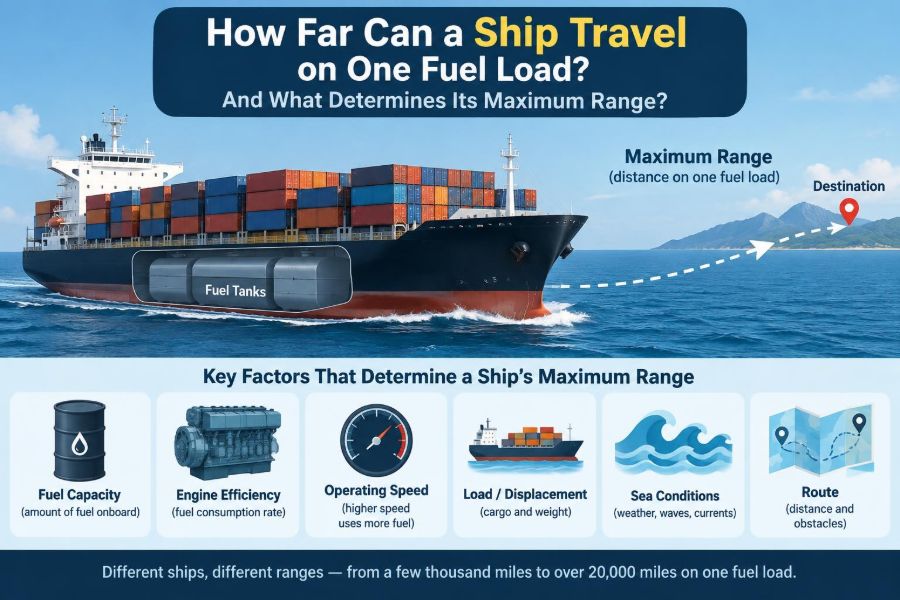
How far a ship can travel on one fuel load depends on usable fuel, energy demand, speed, route, weather, hull and propeller condition, vessel loading, auxiliary systems, and the safety margin required for the voyage.
Large tanks can support long passages, but they do not guarantee long range. A heavily fouled hull, adverse weather, high speed, strong current, or power-hungry cargo operation can consume that margin far faster than an ideal calculation suggests.
The most reliable answer is always operational: use measured fuel data, realistic performance assumptions, separate each operating mode, and protect reserve fuel throughout the voyage.
A ship’s true range is the safe distance it can cover under expected real-world conditions, not the furthest number obtained by emptying every tank on paper. That principle guides sound engineering, safer passage planning, and more resilient operations at sea. 🚢⛽🌊