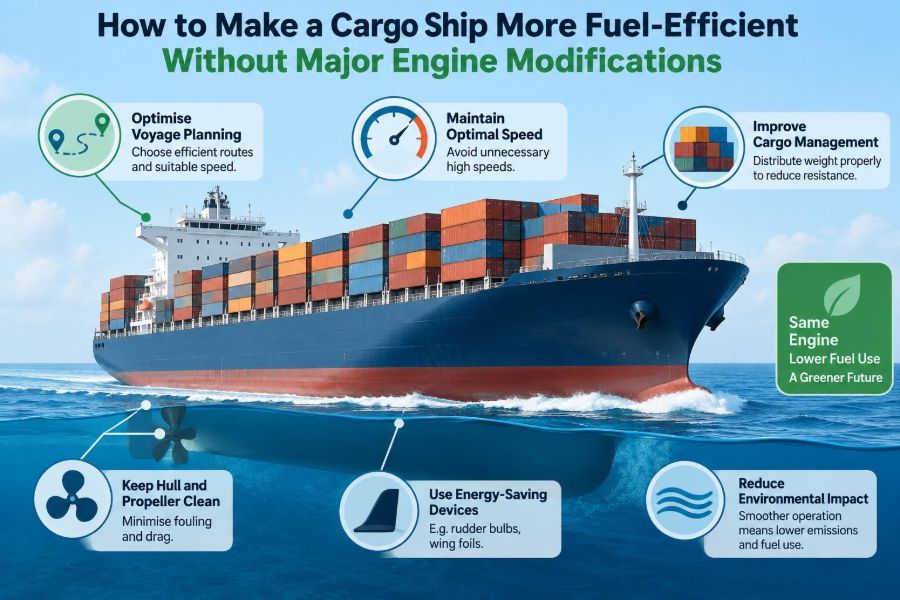

A cargo ship can leave port with a healthy main engine, clean fuel, and a carefully prepared voyage plan—then still consume more fuel than expected. The cause is often not a dramatic machinery failure. It may be a slightly fouled hull, an over-pitched operating condition, a poor trim, or a schedule that quietly encourages excessive speed.
This matters because propulsion fuel is one of the largest operating costs on most trading ships. It also drives a large share of a vessel’s operational emissions. Small losses that seem tolerable on one passage become significant when repeated across months of service.
The useful news is that many efficiency gains do not require replacing the main engine or carrying out a major conversion. Better performance usually begins with understanding where energy is being lost, measuring the right signals, and making disciplined operational decisions.
Fuel efficiency is not simply a chief engineer’s concern or a shore-office spreadsheet exercise. It depends on cooperation between deck officers, engine-room staff, superintendents, chartering teams, and maintenance planners. A ship operates as one system, and its fuel use reflects that system.
⚙️ Start With the Energy Picture
A ship’s main engine converts fuel energy into shaft power. The propeller turns that shaft power into thrust, and the hull converts thrust into forward motion. Losses occur at every step.
For a ship already fitted with a suitable engine, the practical question is: where can required shaft power be reduced for the same transport task? Lower resistance, better propeller operation, and smarter voyage execution can all reduce the power needed to maintain a safe, commercially acceptable speed.
📏 Establish a Reliable Baseline
Improvement cannot be confirmed without a baseline. Gather several comparable voyages rather than relying on one noon report, because weather, draught, current, cargo condition, and human reporting practice all affect a single result.
A useful baseline records fuel consumed, distance, average speed through water and over ground, displacement or draught, trim, weather, shaft revolutions, engine load, and any known hull or propeller condition. Normalize data where possible before deciding that performance has changed.
🧭 Separate Speed Through Water From Speed Over Ground
Speed over ground includes the effect of current. A favorable current can make a ship appear efficient even if hull resistance and shaft power are unchanged. An adverse current can make sound machinery performance look poor.
For propulsion analysis, speed through water is generally the more informative measure. Over-ground speed remains essential for arrival planning, but it should not be used alone to judge propulsion efficiency.
🌊 Understand Why Speed Costs So Much
At normal trading speeds, resistance rises rapidly as speed increases. The exact relationship depends on hull form, loading condition, sea state, and operating range, but the practical result is consistent: modest speed reductions can materially reduce required power.
That does not mean every vessel should always steam as slowly as possible. Very low load can introduce machinery, schedule, or safety constraints. The aim is to find the lowest practical speed that meets the voyage requirement without creating a larger operational problem elsewhere.
🗓️ Replace “Hurry Up and Wait” With Arrival Planning
A ship that races toward a congested port and then waits at anchor has spent fuel without improving the cargo operation. When port information is reliable, a planned arrival time can allow the vessel to adjust speed earlier in the voyage.
This practice is often called just-in-time arrival. Its effectiveness depends on communication: owners, charterers, agents, terminals, and masters need a realistic berth window. A nominal arrival instruction is not useful if the receiving berth is still unavailable.
- Confirm the latest expected berth or pilot time.
- Calculate a safe required average speed with weather allowance.
- Review the plan when terminal information changes.
- Keep navigational safety and master’s discretion above fuel targets.
🎯 Use Weather Routing as a Power Management Tool
Weather routing is not only about avoiding severe conditions. A route or departure adjustment may reduce time spent in head seas, heavy swell, strong winds, or adverse currents, all of which can raise resistance and propeller loading.
The shortest line on a chart is not always the lowest-fuel route. However, a longer route should be justified by credible expected conditions, not chosen automatically. Forecast uncertainty, traffic separation schemes, shallow water limits, and fuel reserves all need consideration.
⚓ Keep the Hull Smooth Below the Waterline
Marine growth and coating roughness increase frictional resistance. Even a hull that looks acceptable from a distance may have enough slime, weed, shell growth, or coating deterioration to increase the shaft power needed at a given speed.
Hull condition changes with trading pattern. A vessel spending long periods at anchor in warm, biologically active waters faces different fouling pressure from one sailing continuously in cooler routes. Inspection and cleaning decisions should reflect actual exposure rather than a fixed calendar alone.
🧽 Plan Hull Cleaning Carefully
Underwater cleaning can restore performance, but it needs planning. Improper tools or technique can damage coatings, leave rough patches, or create an uneven surface that reduces the expected benefit.
Environmental and port restrictions also vary. Before arranging cleaning, verify local requirements, coating manufacturer guidance, diving contractor competence, waste capture arrangements where required, and the vessel’s own hull condition records.
🌀 Treat the Propeller as a High-Value Asset
A propeller works in a complex wake behind the hull. Small defects—roughness, edge damage, corrosion, marine growth, or distorted blades—can reduce its ability to turn shaft power into thrust.
Propeller polishing is often considered during dry docking or underwater maintenance because a smooth blade surface can reduce losses. The work must preserve blade geometry. Aggressive grinding that changes an edge profile or introduces imbalance can create vibration and undermine the intended gain.
🔍 Inspect for Damage and Cavitation Clues
Cavitation occurs when local pressure around a blade falls enough for vapor bubbles to form and collapse. Some cavitation can be expected in propeller operation, but excessive cavitation may cause noise, vibration, surface erosion, and inefficient thrust production.
Look for abnormal vibration trends, changed shaft-power behavior, pitting, damaged tips, and unexplained speed loss. These clues do not automatically identify cavitation as the cause, but they justify a focused inspection rather than accepting poorer performance as normal.
📐 Optimize Trim for the Actual Condition
Trim is the difference between forward and aft draught. It changes how the hull sits in the water, which affects wetted surface area, wave-making behavior, propeller immersion, and flow into the propeller.
There is no universal “best trim.” A condition that helps one hull at a particular draught and speed may harm another. Ballast distribution must also comply with stability, longitudinal strength, visibility, propeller immersion, sloshing, and cargo requirements.
🧮 Build Trim Guidance From Vessel Data
Many ships have loading-computer guidance, model-test information, sea-trial data, or accumulated operational records that can support trim decisions. The most useful guidance is specific: it identifies loading range, speed range, and the expected direction of benefit.
A practical onboard approach is to compare repeated, similar conditions. Record trim, displacement, speed through water, weather, RPM, and shaft power. Over time, trends may reveal workable trim windows, while still recognizing that sea conditions can obscure small differences.
⚖️ Avoid Ballasting Only for a Theoretical Gain
Changing ballast consumes pumping energy, time, and crew attention. It may also alter port compliance, cargo operations, draft limitations, and structural loading. A small predicted propulsion benefit may disappear once these costs and constraints are included.
Use trim optimization when it fits the voyage and safety envelope. Do not treat it as a reason to make frequent, unnecessary ballast transfers or to operate outside approved loading conditions.
🔧 Maintain the Main Engine for Its Existing Design
No major engine modification is required to lose efficiency through ordinary deterioration. Dirty air coolers, restricted filters, poor scavenge-air condition, injector issues, exhaust-valve leakage, turbocharger fouling, and incorrect settings can all affect combustion and gas exchange.
Routine maintenance should follow manufacturer instructions and condition evidence. The objective is not to chase a single ideal reading; it is to keep the engine operating consistently within its approved parameters and to investigate meaningful deviations.
🌡️ Watch Charge Air and Cooling Performance
Charge air is compressed air supplied to the cylinders. If the air cooler is fouled or cooling-water performance is poor, charge-air temperature can rise and air density can fall. This can affect combustion quality and thermal loading.
Trend inlet and outlet temperatures, pressure drops, cooling-water temperatures, and engine load alongside ambient conditions. A one-off high temperature may reflect tropical weather, while a sustained trend under comparable conditions points more strongly toward maintenance attention.
🔥 Keep Fuel Injection and Combustion Balanced
Fuel injectors atomize fuel into fine droplets so it can mix with air and burn effectively. Worn or fouled components can alter spray quality, while incorrect timing or uneven cylinder performance can increase fuel use and thermal stress.
Cylinder pressure analysis, exhaust temperature trends, smoke observations, and approved diagnostic tools can help identify imbalance. Adjustments should be made only by qualified personnel and within the engine maker’s approved limits; efficiency work must never become an excuse for unsafe tuning.
🛢️ Manage Fuel Quality and Temperature
Fuel must reach the engine at a viscosity appropriate for its injection equipment. Heating, purification, filtration, and changeover procedures affect how consistently this happens, especially when the vessel uses different fuel grades.
Poor fuel management can lead to unstable combustion, filter blockage, wear, and operational disruption. Fuel efficiency starts with buying and handling fuel correctly, but onboard staff should avoid assuming that every consumption change is a fuel-quality problem without evidence.
🧰 Reduce Auxiliary Engine Running Hours
Propulsion fuel receives most attention, yet auxiliary engines can consume a meaningful amount of fuel, particularly during port stays, cargo operations, and heavy hotel loads. The best approach is usually to match generating capacity to actual demand.
Running too many generators at low load can be inefficient, but loading one set excessively can reduce reliability and leave inadequate reserve. Follow the vessel’s operating philosophy, consider maintenance needs, and maintain sufficient redundancy for the situation.
💡 Control Hotel and Deck Loads
Lighting, HVAC, galley equipment, pumps, cargo systems, hydraulic machinery, and deck equipment all draw electrical power. Not every load can be reduced, but many can be scheduled or controlled more carefully.
Examples include avoiding unnecessary lighting in unoccupied spaces, maintaining refrigerated-space insulation and door discipline, correcting compressed-air leaks, and stopping pumps that are left running without a process need. These are small actions, but they reduce generator demand continuously.
💨 Find Compressed-Air Leaks
Compressed air is expensive energy because it has already passed through several conversion losses. A leaking air line, valve, coupling, or hose can make a compressor cycle more often than necessary.
Routine leak checks are simple and valuable. Listen for persistent hissing, inspect known weak points, and use approved detection methods where available. Repairs also improve reliability by reducing unnecessary compressor wear and preserving air capacity for critical services.
🚰 Match Pump Operation to the Duty
Many pumps are operated by habit rather than verified need. Throttling a pump heavily, bypassing flow continuously, or running parallel pumps for a small demand wastes electrical energy and can create wear.
Before changing operation, confirm process requirements and equipment limitations. Some systems need minimum flow for cooling or protection. The aim is not merely to stop pumps; it is to deliver the required flow and pressure with the least avoidable loss.
📊 Use Data Trends, Not Isolated Noon Reports
Noon reports are useful, but they are affected by reporting intervals, weather estimates, draft changes, and calculation methods. A sound efficiency program combines them with engine logs, shaft-power or torque data where available, GPS data, weather records, maintenance history, and bunker information.
Trend charts are often more revealing than raw daily values. A gradual rise in power required for the same speed may indicate hull fouling, propeller degradation, or machinery deterioration long before a single report looks alarming.
🧾 Define Comparable Operating Conditions
Comparisons should be made between broadly similar conditions. A laden voyage in rough head seas should not be judged against a ballast passage with following current merely because both show the same average speed.
| Factor | Why it changes apparent fuel performance |
|---|---|
| Displacement | Heavier displacement generally increases hull resistance. |
| Sea state and wind | Head seas and wind can increase resistance and propeller load. |
| Current | Changes speed over ground without directly changing hull speed. |
| Hull condition | Fouling and roughness raise frictional resistance. |
| Engine condition | Combustion and air-path issues can increase fuel needed for power. |
🧑✈️ Make the Master’s Safety Decisions Clear
Commercial pressure can unintentionally push crews toward unsafe speed, trim, routing, or machinery choices. Masters must retain authority to respond to weather, traffic, visibility, stability, machinery condition, and navigational risk.
An effective fuel-efficiency policy states this plainly: savings targets do not override safe navigation, statutory requirements, class limitations, manufacturer guidance, or sound professional judgment.
🤝 Connect Deck, Engine, and Shore Teams
Deck officers see route conditions, traffic constraints, and trim execution. Engine staff see load patterns, machinery condition, and auxiliary demand. Shore teams influence maintenance budgets, port communication, charter-party commitments, and performance analysis.
Efficiency measures fail when each group receives only a partial picture. Short, regular reviews of performance anomalies and upcoming voyages can turn scattered observations into practical action.
🧠 Train Crews on the Reason Behind Procedures
Instructions such as “operate economically” are too vague to guide a watchkeeper. Crews need to understand what to monitor, what normal operation looks like, which changes require reporting, and which limits must not be crossed.
Training works best when tied to real equipment: a compressor that cycles excessively, a fouled cooler with a visible trend, or a voyage slowed early to meet a revised berth time. Clear cause and effect make procedures easier to retain.
🚫 Avoid False Economies in Maintenance
Deferring cleaning, operating with leaking systems, or postponing a known repair may appear to save money in the short term. It can instead increase fuel use, cause secondary damage, reduce reliability, and force maintenance at a less convenient time.
The opposite mistake is unnecessary work. Maintenance decisions should use inspections, operating trends, risk assessment, and manufacturer guidance. Condition-based action is usually stronger than either neglect or maintenance for appearance alone.
🛑 Do Not Chase Efficiency Beyond Equipment Limits
Slow steaming, generator loading changes, trim adjustments, and reduced auxiliary use all have boundaries. Engines may have minimum-load considerations, lubrication requirements, temperature limits, and approved operating envelopes. Pumps, boilers, and electrical systems also have safe operating constraints.
Any proposed change should be checked against vessel procedures and technical documentation. If the evidence is unclear, seek advice from the superintendent, maker, or other competent technical authority before making a permanent practice.
🧪 Test One Change at a Time When Possible
If a vessel changes trim, speed, generator arrangement, cooling-water settings, and route at once, it becomes difficult to determine what caused any result. Controlled trials are not always possible at sea, but a disciplined approach improves learning.
Document the starting condition, make a permitted change, collect data over an appropriate period, and compare like with like. This prevents attractive but unreliable conclusions based on coincidence or changing weather.
📋 Create an Action Register
An action register converts general intentions into accountable work. Each item should identify the observation, suspected cause, proposed action, responsible person, target date, operational restriction, and method for checking the outcome.
- Increasing power demand at constant speed: inspect hull, propeller, and weather-normalized trend.
- High compressor run time: perform a leak survey and review demand.
- Rising charge-air temperature: inspect cooler performance and cooling-water condition.
- Early port arrival risk: request updated berth information and revise speed plan safely.
This format helps shore and ship staff distinguish urgent defects from longer-term performance opportunities.
🏁 Focus on the Whole Voyage, Not One Number
A low daily consumption figure is not automatically a successful voyage. It may result from favorable current, reduced cargo work, or a delay that shifts consumption elsewhere. Likewise, a higher daily figure may be appropriate when safety requires weather avoidance or a schedule change prevents a costly disruption.
The better measure is whether the ship moved cargo safely and reliably while avoiding unnecessary energy use. That requires technical awareness, operational context, and honest data interpretation.
✅ The Core Principle: Remove Avoidable Resistance and Waste
Without major engine modifications, the strongest opportunities are usually practical: keep the underwater body and propeller in good condition, select sensible speed and route plans, optimize trim within safe limits, maintain machinery properly, manage auxiliary loads, and learn from comparable data.
None of these measures is a universal shortcut. Their value depends on vessel type, trade, loading condition, weather, equipment condition, and the quality of cooperation onboard and ashore. Taken together, they form a durable efficiency culture rather than a one-time fuel-saving campaign.
A cargo ship becomes more fuel-efficient when every team reduces the power demanded by the voyage before asking the engine to work harder. That is a practical engineering habit: observe, compare, maintain, plan, and improve—one sound decision at a time. 🚢⚙️🌊