
A chief engineer notices that yesterday’s voyage consumed more fuel than the passage plan predicted. The weather was manageable, the engine ran without alarms, and the vessel arrived on schedule. Yet the daily fuel report shows a clear gap between expectation and reality.
That situation is familiar across commercial shipping. Fuel consumption is shaped not only by the main engine, but also by the hull beneath the waterline, the propeller, the loading condition, the route, the watch team’s decisions, and even small losses in auxiliary systems.
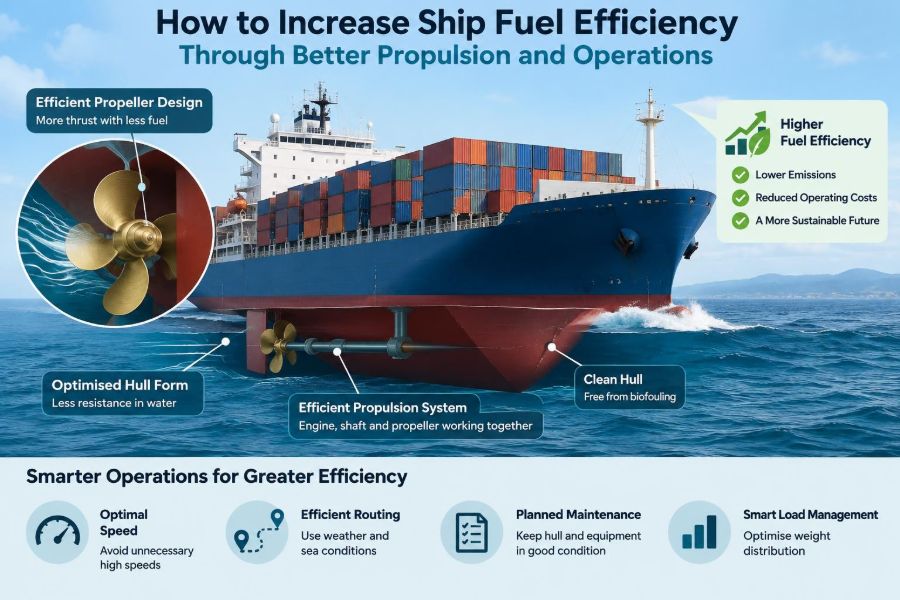
Improving fuel efficiency is therefore not a single retrofit or a single instruction to “slow down.” It is a disciplined process of converting as much fuel energy as possible into useful movement while avoiding unnecessary resistance, power demand, and operational variation.
For students, this topic connects naval architecture, machinery, and ship management. For working professionals, it offers practical opportunities to reduce cost, emissions, machinery wear, and uncertainty in voyage performance.
⚙️ Start With the Energy Chain
Marine fuel contains chemical energy. The engine converts part of that energy into shaft power, the propeller converts shaft power into thrust, and the hull converts thrust into forward motion. Losses occur at every stage.
A useful mental model is a bicycle riding into wind: harder pedalling does not guarantee proportionally higher speed. Some effort is lost in mechanical friction, some goes into moving water, and increasing speed sharply raises resistance. A ship follows the same principle on a much larger scale.
Fuel efficiency improves when the vessel needs less power for the required service speed and when its machinery produces that power efficiently.
📏 Understand the Power–Speed Relationship
For most displacement vessels, required propulsive power rises much faster than speed. The exact relationship varies with hull form, draft, sea state, and condition, but a modest speed increase can require a substantial increase in power and fuel.
This is why a schedule that demands maximum practical speed may be disproportionately expensive. Conversely, a carefully planned reduction in speed can lower daily consumption, although the voyage lasts longer and auxiliary loads continue for more time.
Fuel decisions must therefore compare fuel per day, fuel per nautical mile, arrival requirements, charter terms, safety margins, and port availability. Looking at only one measure can lead to poor decisions.
🌊 Reduce Hull Resistance First
The main engine must overcome hull resistance: frictional resistance along the wetted surface, wave-making resistance, air resistance, and added resistance from waves, wind, steering, and fouling.
At typical service speeds, frictional resistance is often a major component. A rough or fouled underwater surface disrupts smooth water flow and demands more shaft power to maintain the same speed.
Operators should treat hull condition as a propulsion issue, not merely a cosmetic maintenance matter. The hull is the first component in the efficiency chain.
🦠 Control Marine Growth and Surface Roughness
Biofouling includes slime, algae, shell growth, and other marine organisms on the hull and propeller. Even early-stage slime can increase friction. More severe growth creates a visibly rough surface and can degrade performance significantly.
Coating selection, application quality, idle time, trading pattern, water temperature, and cleaning practices all influence fouling risk. A vessel that remains stationary for long periods may face a different fouling profile from one that trades continuously.
Hull and propeller cleaning should be planned with environmental rules, coating condition, operational need, and verified performance data in mind. Cleaning too late wastes fuel; cleaning without proper controls can damage coatings or create compliance concerns.
🧽 Keep the Propeller Clean and Undamaged
The propeller works in the ship’s wake, where the water flow is already affected by the hull. Fouling, corrosion, bent edges, cavitation damage, or surface roughness reduce its ability to turn shaft power into thrust.
A polished propeller is not automatically the correct maintenance objective for every vessel, but a clean, smooth, undamaged working surface supports efficient flow. Inspection should include blade condition, edge damage, hub condition, and signs of unusual cavitation.
If vibration, noise, or a persistent rise in power demand appears after grounding, debris contact, or a long lay-up, propeller condition deserves early investigation.
🌀 Match Propeller Loading to the Vessel
A fixed-pitch propeller is designed around an expected operating condition. Changes in draft, trim, hull condition, weather, or engine limitations can move it away from its most efficient point.
Propeller loading describes the torque and power demand imposed on the engine. Excessive loading may make the engine struggle to reach rated revolutions; too little loading can also move the machinery away from a favourable operating condition.
For controllable-pitch propellers, the relationship between pitch and revolutions is an operational tool. Pitch and rpm should be selected according to the manufacturer’s guidance, engine limits, manoeuvring need, and expected load—not by a fixed habit.
🧭 Use Trim as an Efficiency Tool
Trim is the difference between forward and aft draft. It changes how the hull sits in the water, affecting wetted surface, wave pattern, propeller immersion, and resistance.
There is no universal “best trim.” A container ship, bulk carrier, tanker, and offshore vessel can respond differently, and the best condition may change with draft and speed. Excessive stern trim, for example, may increase wetted area, while insufficient immersion can affect propeller performance.
Trim optimisation should rely on vessel-specific trials, loading software where approved, and operating data. Ballast adjustments must always remain within stability, stress, visibility, propeller immersion, and safety requirements.
⚖️ Maintain a Sensible Loading Condition
Displacement has a direct effect on resistance. Carrying unnecessary ballast, storing excess consumables, or maintaining avoidable deadweight means the ship pushes more water aside throughout the voyage.
However, reducing weight is never a reason to compromise stability, structural strength, draught restrictions, or required reserves. The practical goal is not the lightest ship; it is the lightest safe and compliant condition consistent with the voyage.
Good loading planning also helps prevent excessive trim and can improve propeller immersion, steering response, and seakeeping.
🐢 Apply Slow Steaming Deliberately
Slow steaming reduces speed below a vessel’s traditional service speed to reduce main-engine power demand. It can be highly effective because of the steep power–speed relationship, particularly on long routes with schedule flexibility.
But slower operation must be engineered, not improvised. The engine may operate for extended periods at lower load, which can affect combustion quality, exhaust temperatures, turbocharger performance, cylinder lubrication, and fouling tendencies.
Before changing speed policy, review maker guidance, minimum load recommendations, maintenance implications, voyage duration, cargo requirements, and available power margin for weather.
🛠️ Operate the Main Engine in Its Efficient Range
Specific fuel oil consumption describes how much fuel an engine uses to produce a unit of energy. It varies with load, ambient conditions, fuel properties, machinery condition, and engine tuning.
Engines generally have operating ranges where efficiency and reliability are favourable, but the most economical point for the engine alone may not be the most economical point for the ship. Propeller efficiency, hull resistance, auxiliary power, and schedule all matter.
Engineers should monitor load, rpm, exhaust temperatures, scavenge condition, turbocharger behaviour, cylinder pressures where available, and fuel consumption trends. A sudden change is often more informative than a single isolated reading.
🔥 Improve Combustion and Engine Tuning
Fuel injection timing, injector condition, fuel pressure, air supply, compression, exhaust valve condition, and turbocharger cleanliness all influence combustion. Poor combustion can raise fuel use while also increasing deposits, smoke, and thermal stress.
Condition-based checks are more useful than adjusting machinery simply because a calendar date has passed. Comparing cylinder performance can identify imbalance, while trend data can reveal gradual deterioration before it becomes an operational problem.
Any adjustment must follow the engine manufacturer’s procedures and the vessel’s maintenance system. Aggressive tuning without correct measurements can trade a small apparent fuel saving for reliability risk.
💨 Protect the Air and Exhaust Path
An engine needs enough clean air to burn fuel efficiently. Restricted air filters, fouled charge-air coolers, dirty turbocharger components, or leaks in the scavenge air system can reduce air delivery and impair combustion.
On the exhaust side, deposits and turbine fouling can reduce turbocharger efficiency. This can alter scavenging conditions and increase exhaust temperatures, especially when the engine is heavily loaded.
Routine cleaning intervals should be based on maker recommendations and actual condition. Fuel quality, operating load, ambient air, and maintenance history can all change how quickly fouling develops.
🧊 Manage Cooling Water Temperatures
Cooling systems maintain safe component temperatures, but they also influence engine efficiency. Overcooling can reduce thermal efficiency and contribute to poor combustion conditions, while inadequate cooling can damage machinery.
Fouled coolers, poor seawater flow, incorrect thermostat operation, or unsuitable temperature control can increase pumping power and disrupt stable operation. The objective is controlled temperature, not simply the lowest achievable temperature.
Monitor temperature differences across coolers and compare them with normal vessel trends. A gradually widening difference can indicate fouling or flow problems.
🔌 Reduce Auxiliary Electrical Demand
Fuel efficiency is often discussed as a main-engine problem, yet auxiliary generators can consume considerable fuel. Pumps, fans, compressors, cargo systems, hotel loads, refrigeration, and deck machinery all add to total energy demand.
Running more generators than necessary at very low load can be inefficient. On the other hand, running too few can reduce redundancy and force an overloaded generator to operate poorly. Generator management must preserve safe margins.
Look for unnecessary continuous loads: pumps left running, poorly controlled ventilation, leaking compressed-air systems, and equipment operated in parallel when one unit would meet the demand.
💡 Use Variable-Speed Drives Where Suitable
Many pumps and fans are controlled by throttling valves or dampers. In these arrangements, the motor may consume substantial power while the restriction simply wastes part of the flow energy.
A variable-speed drive changes motor speed to match demand. It can be valuable for seawater pumps, ventilation fans, and some cargo or service systems where flow requirements vary.
Suitability depends on motor type, control system, harmonic effects, redundancy, cooling, maintenance capability, and the duty profile. A drive is not automatically beneficial if the equipment normally runs near full flow.
🧯 Eliminate Steam and Thermal Losses
On ships using steam for fuel heating, tank heating, cargo heating, or accommodation services, thermal losses can quietly increase boiler fuel demand. Leaking valves, failed steam traps, poor insulation, and excessive heating setpoints are common sources.
Insulation does more than protect personnel from hot surfaces. It keeps heat in the system, shortens heating time, and reduces the energy needed to maintain temperature.
Regular steam-trap inspection and thermal surveys can help locate problems, but repairs should be prioritised by safety impact, heat loss, access, and operational importance.
🗺️ Plan Weather Routing, Not Just Shortest Routing
The shortest track on a chart may not be the lowest-fuel route. Head seas, swell direction, wind, currents, restricted visibility, and safe navigation constraints can change the power required to hold a given speed.
Weather routing seeks a safe, practical route that balances distance, expected resistance, arrival time, cargo limits, and crew welfare. Avoiding severe conditions may reduce added resistance and prevent the need for high engine loads or damaging slamming.
Forecasts are uncertain, so route plans require review as conditions change. The master retains responsibility for navigational safety; fuel targets must never override safe seamanship.
🌬️ Account for Wind, Waves, and Current
Environmental effects can make performance data misleading if they are ignored. A following current can make speed over ground look excellent even if speed through water and propulsive performance are unchanged. A head current can create the opposite impression.
Similarly, wind and waves increase resistance and may require course or speed changes. When evaluating efficiency, record sea state, wind direction, current estimates, draft, trim, shaft power, rpm, and speed through water where available.
Without context, a daily noon report may describe weather effects rather than a genuine hull or engine problem.
🛞 Minimise Rudder Drag and Autopilot Hunting
A rudder held at an angle produces steering force but also drag. Frequent large corrections, known as hunting, can increase resistance and cause unnecessary variations in engine load.
Autopilot settings should suit the vessel, speed, weather, traffic situation, and sea state. A setting that works in calm water may be inappropriate in quartering seas or confined waters.
Excessively tight control can waste fuel; excessively loose control can create unsafe track deviation. The target is stable, safe course-keeping with the minimum practical rudder activity.
⏳ Arrive Just in Time Rather Than Hurry and Wait
A ship that races toward port only to wait at anchor has used fuel without improving the arrival outcome. When port information is reliable, adjusting speed to meet berth availability can reduce unnecessary high-power operation.
Just-in-time arrival depends on communication among vessel, operator, charterer, terminal, and port services. It also depends on realistic estimates: a nominal berth time is not the same as a confirmed ability to proceed safely alongside.
Operational coordination can sometimes deliver fuel savings that no machinery modification could achieve on its own.
📊 Build a Useful Performance Baseline
You cannot manage an efficiency loss if normal performance is unknown. A baseline links fuel consumption and shaft power to speed, draft, trim, weather, hull condition, and machinery configuration.
Start with consistent data collection rather than a complicated model. Log fuel used, distance, speed through water, rpm, shaft power if available, engine load, drafts, trim, wind, sea state, and generator operation.
Then compare like with like. A laden passage in head seas should not be judged against a ballast passage in calm water.
📈 Turn Data Into Trends, Not Isolated Numbers
Single-day reports can be distorted by weather, manoeuvring, fuel transfers, sensor error, or changes in watchkeeping practice. Trends across comparable voyages are better for identifying gradual hull fouling, propeller deterioration, or engine performance drift.
A practical review may ask: Has more shaft power been required for the same speed and draft? Has generator fuel use changed at a similar electrical load? Has a maintenance action restored prior performance?
Data quality matters. Incorrect tank soundings, inconsistent time intervals, or uncertain speed inputs can create a false efficiency problem—or hide a real one.
🧪 Verify Fuel Quality and Handling
Fuel properties affect combustion, storage, purification, heating, and injection. Off-specification or poorly handled fuel can lead to unstable operation, filter blockage, excessive deposits, or equipment damage.
Efficient fuel use begins with sound fuel management: correct storage temperatures, proper settling and purification, appropriate service-tank control, and attention to compatibility when fuels are changed.
Fuel sampling, testing, and handling must follow the vessel’s procedures and applicable requirements. Saving energy by reducing treatment below a safe standard is a false economy.
🧰 Maintain Pumps, Filters, and Mechanical Systems
Worn pumps, clogged filters, leaking valves, misaligned shafts, and poor bearing condition create losses that may be small individually but persistent over time. They can also reduce reliability and force equipment to operate longer or harder than necessary.
For example, a pump with internal wear may fail to deliver design flow efficiently. Operators may respond by running a standby pump in parallel, masking the fault while increasing electrical demand.
Condition monitoring, vibration checks, pressure readings, and maintenance records help distinguish genuine process demand from equipment deterioration.
🧑✈️ Give the Bridge and Engine Room Shared Targets
Fuel efficiency crosses departmental boundaries. The bridge controls route, speed, and course-keeping; the engine room manages propulsion, electrical generation, and machinery condition; cargo and deck operations influence loading, ballast, and hotel demand.
Shared daily discussion can prevent conflicting decisions. The bridge may need a requested arrival speed, while engineers can advise on stable operating ranges, generator configuration, weather margin, and machinery constraints.
Clear communication turns fuel management from a reporting task into an operational habit.
🧠 Train Crews to Recognise Performance Changes
Crew members are often the first to notice a change in smoke, vibration, steering response, scavenge condition, pump noise, or fuel consumption. Their observations become valuable when they understand what “normal” looks like.
Training should explain cause and effect rather than only issue instructions. A watchkeeper who understands why a pump is stopped when not needed is more likely to identify another avoidable load.
Simple onboard guidance, consistent log entries, and feedback on results help maintain engagement without turning efficiency into a blame exercise.
⚠️ Avoid Common Fuel-Saving Mistakes
Some actions appear economical but create larger costs or safety problems later. The strongest programmes set boundaries before savings targets are pursued.
- Operating below safe machinery limits: low load may require specific precautions and maker approval.
- Reducing maintenance: deferred cleaning or inspection can increase fuel use and raise failure risk.
- Ignoring weather margin: selecting too little power reserve can leave the vessel vulnerable in deteriorating conditions.
- Comparing unlike voyages: this can lead to incorrect conclusions about crew or machinery performance.
- Chasing one metric: reducing main-engine fuel while sharply increasing boiler or generator demand may not reduce total consumption.
🧩 Evaluate Retrofit Options Carefully
Retrofits can include pre-swirl devices, ducts, fins, propeller modifications, air-lubrication systems, improved coatings, waste-heat recovery, shaft generators, and advanced monitoring systems. Their value depends strongly on vessel type and operating profile.
A device that performs well on one hull may not deliver the same outcome on another. Installation effects, dry-docking opportunity, maintenance needs, operational reliability, and interaction with existing machinery all require assessment.
Use a transparent business case: expected operating condition, uncertainty range, off-hire risk, installation cost, verification method, and expected maintenance burden. Promised savings should be tested against actual post-installation data.
🔍 Use a Practical Improvement Cycle
Efficiency work is most effective when it follows a repeating cycle rather than a one-time campaign. Begin with a baseline, identify the largest controllable loss, make a safe change, monitor results, and standardise what works.
- Collect consistent voyage and machinery data.
- Separate environmental effects from equipment or operational effects.
- Prioritise low-risk actions with a clear mechanism.
- Implement changes within safety, class, and maker requirements.
- Review results over comparable operating periods.
- Update procedures, maintenance plans, and crew guidance.
This approach prevents teams from spending time on minor issues while a fouled hull, unsuitable speed plan, or oversized auxiliary load remains unaddressed.
✅ The Core Principle: Reduce Demand, Then Improve Conversion
The most reliable fuel strategy has two parts. First, reduce the power the ship needs by controlling resistance, speed, trim, route, rudder activity, and avoidable auxiliary loads. Second, make sure engines, propellers, pumps, generators, and thermal systems convert fuel into useful work as efficiently as practical.
No single measure fits every vessel. A slow-steaming strategy may suit one trade, while another vessel gains more from hull cleaning, generator optimisation, weather routing, or better port coordination. The correct choice comes from sound data and an understanding of the vessel’s actual operating pattern.
Above all, fuel efficiency must support safe navigation, machinery reliability, environmental compliance, and cargo care. Saving fuel by eroding those foundations is not an engineering improvement.
Efficient shipping comes from treating propulsion, machinery, voyage planning, and crew decisions as one connected system—not as separate fuel-saving projects. With careful measurement and steady operational discipline, small improvements can reinforce one another across every voyage. 🚢⚙️🌊