
Large ocean-going ships have traditionally used fuels that can be far heavier and dirtier than the gasoline or diesel used in cars. Some marine fuels, especially heavy fuel oil (HFO) and certain blended residual fuels, can contain water, sediment, catalytic fines, rust particles, and other contaminants that must be removed before the fuel reaches sensitive engine components. ⚓⛽
A ship’s main engine may consume many tons of fuel each day. If contaminated fuel were sent directly to the engine, abrasive particles could damage fuel pumps and injectors, while water and sludge could interfere with combustion and cause corrosion.
To prevent this, ships use a carefully designed fuel treatment system. One of its most important machines is the centrifugal fuel purifier.
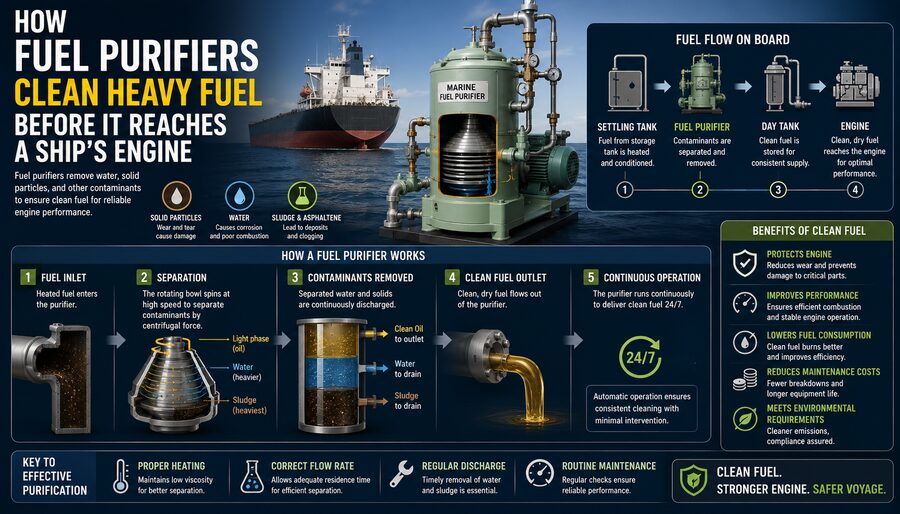
A purifier spins fuel at very high speed inside a rotating bowl. The resulting centrifugal force separates materials according to their density. Heavy contaminants such as water and solids move outward, while cleaner fuel moves toward a separate outlet.
The purifier therefore acts as a high-speed cleaning machine positioned between the ship’s fuel storage system and the engine. 🔄🚢
🛢️ Why Heavy Fuel Needs Cleaning
Heavy marine fuel can be a complex mixture.
Residual fuels are produced from heavier refinery fractions and may contain impurities originating from:
- fuel production,
- storage tanks,
- pipelines,
- bunker barges,
- shipboard tanks,
- corrosion products,
- previous fuel residues.
Contaminants may include:
- 💧 water,
- 🪨 sediment,
- 🔩 rust,
- 🧱 sludge,
- ⚙️ wear particles,
- 🧪 catalytic fines.
Some contaminants are relatively harmless in tiny quantities. Others can create severe engine damage.
Fuel treatment therefore aims to deliver fuel to the engine that meets the required cleanliness and condition.
⚠️ Why Catalytic Fines Are Especially Dangerous
One of the most important contaminants in some residual marine fuels is catalytic fines, often abbreviated as cat fines.
These are extremely hard microscopic particles containing materials such as aluminum and silicon compounds.
They can originate from catalysts used in petroleum refining.
Although individual particles may be tiny, they are highly abrasive.
If cat fines reach the engine, they can damage:
- fuel injection pumps,
- injector components,
- cylinder liners,
- piston rings.
Abrasive particles trapped between moving metal surfaces can behave like grinding material. 🔧
This can accelerate wear and, in severe cases, contribute to major engine damage.
Fuel purifiers are therefore an important defense against cat fines.
💧 Water Is Another Major Contaminant
Marine fuel can also contain water.
Water may enter fuel through:
- condensation,
- tank leakage,
- contaminated bunker deliveries,
- poor storage conditions,
- tank cleaning residues.
Water causes several problems.
It can reduce fuel quality, contribute to corrosion, interfere with combustion, and encourage sludge formation.
Sea water is particularly undesirable because it introduces dissolved salts.
A purifier is designed not only to remove solid contamination but also to separate much of the free water from the fuel. 💧➡️🚫
🌀 The Principle Behind Centrifugal Separation
The purifier works according to density differences.
Imagine a container holding oil, water, and sand.
If the mixture were left undisturbed, the sand would tend to settle at the bottom, water would collect below the oil, and the lighter oil would remain above.
Gravity can therefore separate materials naturally.
But gravity is relatively weak.
A marine purifier accelerates this process dramatically by spinning the mixture at thousands of revolutions per minute.
Inside the rotating bowl, centrifugal acceleration can be thousands of times stronger than ordinary gravitational acceleration. ⚡
As a result:
Heavy solids → move farthest outward
Water → moves outward
Lighter oil → remains closer to the center
This allows continuous separation while the ship is operating.
⚙️ What Is Inside a Fuel Purifier?
A centrifugal purifier typically contains several important components.
These may include:
- high-speed rotating bowl,
- disc stack,
- fuel inlet,
- clean-oil outlet,
- water outlet,
- sludge space,
- drive motor,
- operating-water system,
- controls and sensors.
The most distinctive internal feature is often the disc stack.
This consists of many thin, conical metal discs placed closely together.
The discs greatly improve separation efficiency. 🛠️
📀 Why the Disc Stack Is So Important
If oil simply entered an empty spinning bowl, particles would have to travel relatively long distances before reaching the outer wall.
The disc stack divides the fuel into many thin layers.
This dramatically shortens the distance that water droplets and solid particles must travel during separation.
As fuel flows between discs:
- heavier particles move outward,
- water moves outward,
- cleaner fuel moves inward.
The large effective separation area created by the discs allows the purifier to process significant fuel flow rates despite its compact size.
🌡️ Why Heavy Fuel Is Heated Before Purification
Heavy fuel oil can be extremely viscous.
At lower temperatures, it may flow almost like syrup.
High viscosity makes separation less effective because water droplets and particles move through the oil more slowly.
Before entering the purifier, heavy fuel is therefore usually heated. 🔥
Heating reduces viscosity.
When the fuel becomes thinner:
- water droplets separate more easily,
- solids move through the liquid more quickly,
- purifier capacity improves.
The exact purification temperature depends on the fuel properties and equipment requirements.
Operators usually aim for a viscosity suitable for efficient centrifugal separation rather than simply choosing the highest possible temperature.
🚰 From Storage Tank to Purifier
Fuel treatment begins long before the purifier.
A simplified shipboard fuel path may look like:
Bunker Tank → Settling Tank → Heater → Purifier → Service Tank → Engine Fuel System
Each stage contributes to cleaning and conditioning.
Let us examine this process.
🏗️ Step 1: Fuel Is Stored in Bunker Tanks
When a ship receives fuel during bunkering, the fuel is transferred into storage tanks.
These large tanks hold the ship’s fuel inventory.
Contaminants can gradually settle toward the bottom of these tanks.
However, ships generally do not rely on bunker tanks alone to prepare fuel for the engine.
Fuel is transferred from storage to a settling tank for further treatment.
🧱 Step 2: The Settling Tank Allows Initial Separation
A settling tank gives the fuel time to remain relatively undisturbed while being heated.
Gravity begins separating heavier materials.
Water and sludge tend to move downward.
Drain arrangements allow accumulated water and sediment to be periodically removed.
The settling tank therefore reduces the contamination load before fuel reaches the purifier.
Think of it as the first cleaning stage. 🛢️⬇️
🔥 Step 3: Fuel Is Heated
Fuel leaving the settling tank passes through a heater.
The heater raises the temperature until the fuel reaches an appropriate viscosity for centrifugal separation.
This step is critical.
If the oil remains too viscous, particles may not migrate through it quickly enough.
The purifier might then fail to remove contaminants efficiently.
Temperature control is therefore closely monitored.
🌀 Step 4: Fuel Enters the Spinning Bowl
The heated fuel enters the center region of the rapidly rotating purifier bowl.
It then flows into the spaces between the conical discs.
Because the bowl is spinning at very high speed, every component of the mixture experiences strong centrifugal force.
Density determines where each substance moves.
🪨 Step 5: Solid Contaminants Move Outward
Solid particles are generally denser than fuel.
As the mixture spins, these particles move toward the outer circumference of the bowl.
They eventually accumulate in a designated sludge space.
Contaminants collected here may include:
- rust,
- sand,
- catalyst particles,
- carbonaceous material,
- other sediment.
Modern purifiers can periodically discharge this accumulated sludge automatically. 🔄
💧 Step 6: Water Separates From the Oil
Water is denser than fuel oil.
It therefore also migrates outward.
The purifier is designed so that the water phase is separated from the oil phase.
Cleaner oil remains closer to the central region while separated water exits through another path or collects in a controlled region depending on purifier design.
This two-liquid separation capability distinguishes a purifier from some simpler centrifugal separators.
✨ Step 7: Cleaned Fuel Leaves the Purifier
After solids and water have been removed, cleaner fuel exits through the clean-oil outlet.
It is then normally transferred to a service tank, also known as a day tank.
The service tank supplies the engine’s fuel-conditioning system.
The fuel may still undergo:
- additional heating,
- viscosity control,
- fine filtration,
- pressure regulation.
Purification is therefore one major stage in a larger treatment chain.
🧹 How Automatic Sludge Discharge Works
If solids accumulated indefinitely inside the purifier, the bowl would eventually fill with sludge.
Modern self-cleaning purifiers avoid this by periodically opening discharge ports.
At programmed intervals, the machine briefly ejects accumulated sludge into a sludge tank.
The event may occur without stopping the machine for long.
A simplified cycle is:
Separate → Accumulate sludge → Discharge → Resume normal separation
This allows continuous operation over long periods. ⚙️
The exact mechanism often uses hydraulic operating water to open or close parts of the bowl.
💦 Why Operating Water Is Used
Many traditional centrifugal purifiers use carefully controlled water inside the bowl.
This operating water can perform functions such as:
- opening the bowl,
- closing the bowl,
- creating hydraulic seals,
- positioning the oil-water interface.
The water must be supplied at the correct pressure and timing.
Incorrect operating-water conditions can cause purification problems or fuel losses.
Modern separator designs may automate much of this process.
⚖️ The Oil-Water Interface Must Be Controlled
Inside a traditional purifier, oil and water form separate regions.
The boundary between them is known as the interface.
The position of this interface matters.
If it is too far inward, oil may escape through the water outlet.
If it is too far outward, water may contaminate the clean-oil outlet.
Older purifier designs often used components called gravity discs to help establish the proper interface according to fuel density.
Some modern purifiers use alternative control designs that reduce the need for manual gravity-disc selection. 🎯
🧪 Fuel Density Affects Purifier Operation
The density of marine fuel influences how it behaves in the separator.
If the density of the oil becomes very close to that of water, separation becomes more difficult.
Temperature also changes density.
Operators therefore need accurate fuel information and appropriate purifier settings.
Bunker fuel analysis can provide useful data such as:
- density,
- viscosity,
- water content,
- cat fine concentration,
- sulfur content.
This information helps engineers configure the fuel-treatment system correctly.
⏱️ Why Flow Rate Matters
A purifier can process only a certain quantity of fuel effectively.
If fuel is pushed through the machine too quickly, contaminants have less time to separate.
Reducing throughput can improve separation efficiency.
This creates an important operational tradeoff:
Higher flow → greater processing capacity
Lower flow → potentially better separation
For contaminated fuel, engineers may deliberately operate below the purifier’s maximum rated capacity to improve cleaning performance.
🔁 Why Ships May Use Two Purifiers
Large vessels often install more than one purifier.
This provides both redundancy and flexibility.
If one machine requires maintenance, another can continue treating fuel.
Multiple purifiers may also be operated:
- in parallel,
- in series,
- for different fuel grades.
When operating in series, one separator may perform initial cleaning while another provides a second purification stage.
This can improve protection when fuel quality is poor.
🧼 Purifier vs. Clarifier
The terms purifier and clarifier describe slightly different centrifugal separation arrangements.
A purifier is typically configured to separate:
- oil,
- water,
- solids.
A clarifier is primarily configured to remove:
- solids from oil.
In a clarifier, there may not be a continuous separate water outlet in the same way as in purifier operation.
Historically, some ship systems operated one unit as a purifier and another as a clarifier.
Modern practices depend on separator design, fuel type, and manufacturer guidance.
🔍 Fuel Filters Still Matter
A purifier does not remove every contaminant.
Very small particles can remain in the fuel.
Ships therefore also use filters.
A typical system may contain:
- coarse strainers,
- automatic backflushing filters,
- fine filters.
The purifier and filters perform complementary jobs.
The purifier removes bulk water and a large proportion of solids.
Fine filters provide an additional barrier immediately before sensitive fuel equipment. 🛡️
⚙️ What Happens If Purification Is Poor?
Poor purifier performance can create serious operational consequences.
Contaminated fuel may lead to:
- injector wear,
- fuel pump damage,
- clogged filters,
- poor atomization,
- unstable combustion,
- increased deposits,
- cylinder wear.
In severe situations, contaminated fuel can contribute to expensive engine repairs or loss of propulsion.
This is why ship engineers monitor purifier performance carefully.
📊 Engineers Monitor Fuel Treatment Continuously
Modern engine rooms use sensors and automation to monitor the fuel system.
Important parameters may include:
- purifier inlet temperature,
- flow rate,
- bowl speed,
- vibration,
- operating-water pressure,
- discharge frequency,
- clean-oil pressure.
Abnormal values can indicate problems.
For example, excessive vibration may suggest:
- sludge accumulation,
- bowl imbalance,
- mechanical wear.
High vibration in a rapidly rotating separator requires prompt attention because the bowl stores significant rotational energy. ⚠️
🛠️ Purifier Maintenance Is Critical
Fuel purifiers operate continuously under demanding conditions.
They require regular inspection and maintenance.
Typical tasks may include:
- cleaning bowl components,
- inspecting discs,
- checking seals,
- examining the drive system,
- replacing worn parts,
- cleaning sludge passages,
- verifying operating-water systems.
Disc stacks can become coated with deposits.
If the spaces between discs become blocked, separation efficiency falls.
Maintenance schedules are therefore closely followed.
⚠️ Correct Assembly Matters
A purifier bowl rotates at very high speed.
Its components must be assembled exactly as specified.
Incorrectly installed discs, loose components, damaged seals, or unbalanced parts can create serious mechanical hazards.
Maintenance should therefore be performed by trained personnel following manufacturer procedures.
High-speed centrifuges are not equipment where improvised assembly is acceptable. 🧑🔧
🧯 Fuel Heating Requires Safety Controls
Heating heavy fuel improves purification, but hot fuel introduces additional hazards.
Marine fuel systems must control:
- temperature,
- leakage,
- fire risk,
- insulation of hot surfaces.
Fuel leaking onto a hot engine-room surface can ignite.
Proper pipe maintenance, shielding, alarms, and housekeeping are therefore important parts of fuel-system safety. 🔥
🛢️ Fuel Purification and Modern Marine Fuels
Marine fuel use has changed significantly as environmental regulations have evolved.
Ships may operate with:
- very-low-sulfur fuel oil,
- marine gas oil,
- blended residual fuels,
- alternative fuels in newer systems.
Not every fuel requires exactly the same treatment.
Distillate fuels are generally cleaner and less viscous than traditional heavy fuel oil.
However, filtration and contamination control remain important.
Ships using residual or blended fuels must pay close attention to stability, compatibility, cat fines, and water content.
🧪 Fuel Compatibility Can Affect Sludge Formation
Two marine fuels that are individually stable may become unstable when mixed.
Certain combinations can cause heavier components to precipitate.
This creates sludge.
Sludge can:
- overload purifiers,
- clog filters,
- reduce usable fuel,
- cause operational problems.
Ships therefore manage fuel changeovers and tank segregation carefully.
Fuel compatibility testing can help reduce the risk of mixing incompatible bunkers.
🏭 What Happens to the Removed Sludge?
The contaminants removed by the purifier do not disappear.
They are discharged into a sludge tank.
This waste can contain:
- oil,
- water,
- solids,
- sediment.
Ships must manage oily waste according to applicable environmental rules and onboard waste-management procedures.
Sludge may be:
- stored onboard,
- processed further,
- transferred to approved shore facilities,
- handled through approved shipboard systems.
Improper disposal of oily waste can cause serious environmental harm and legal consequences. 🌊🛡️
🌍 Why Efficient Purification Also Improves Combustion
Clean fuel does more than protect mechanical components.
Good fuel treatment can also support better combustion.
Injectors must spray fuel into the cylinder in a fine, controlled pattern.
Contamination can interfere with this process.
Cleaner fuel helps maintain:
- correct injector operation,
- better atomization,
- stable combustion,
- reliable engine performance.
This can reduce unnecessary deposits and maintenance.
🔄 The Full Fuel Treatment Chain
A ship’s fuel system can be understood as a sequence of protective stages:
Storage Tank
⬇️
Settling Tank
Allows water and sludge to settle
⬇️
Fuel Heater
Reduces viscosity
⬇️
Centrifugal Purifier
Removes water and solids
⬇️
Service Tank
Stores treated fuel
⬇️
Booster / Conditioning System
Adjusts temperature, viscosity, and pressure
⬇️
Fine Filters
Capture remaining particles
⬇️
Fuel Pumps and Injectors
⬇️
Engine Cylinder 🚢🔥
Each stage protects the next.
🧠 Why the Purifier Is So Effective
The purifier does not chemically transform the fuel.
Instead, it uses physics.
Three main factors make the process effective:
Density differences separate oil, water, and solids.
Centrifugal acceleration makes separation happen rapidly.
Disc stacks create short separation distances and large effective area.
Heating helps by reducing fuel viscosity.
These principles allow a relatively compact machine to continuously process large quantities of difficult marine fuel.
🚢 Clean Fuel Before Combustion
A large marine diesel engine depends on extremely precise fuel injection.
Its pumps and injectors operate under demanding mechanical conditions, so abrasive solids, water, and sludge must be minimized before the fuel arrives.
The centrifugal purifier performs this cleaning by spinning heated fuel at high speed. 🌀
Dense solids move toward the outside of the rotating bowl.
Water separates from the lighter fuel.
The disc stack accelerates the process by dividing the fuel into thin flowing layers.
Cleaned fuel then moves onward to service tanks, conditioning equipment, filters, and eventually the engine.
The core principle can be summarized simply:
A marine fuel purifier protects the engine by using intense centrifugal force to separate heavy contaminants and water from fuel before those impurities can reach pumps, injectors, cylinders, and other sensitive components. ⚙️🛢️➡️✨
For a ship crossing thousands of kilometers of ocean, reliable propulsion depends on countless systems working correctly. The fuel purifier is one of the less visible but critically important machines ensuring that the massive engine receives fuel clean enough to burn safely and reliably. 🚢🌊