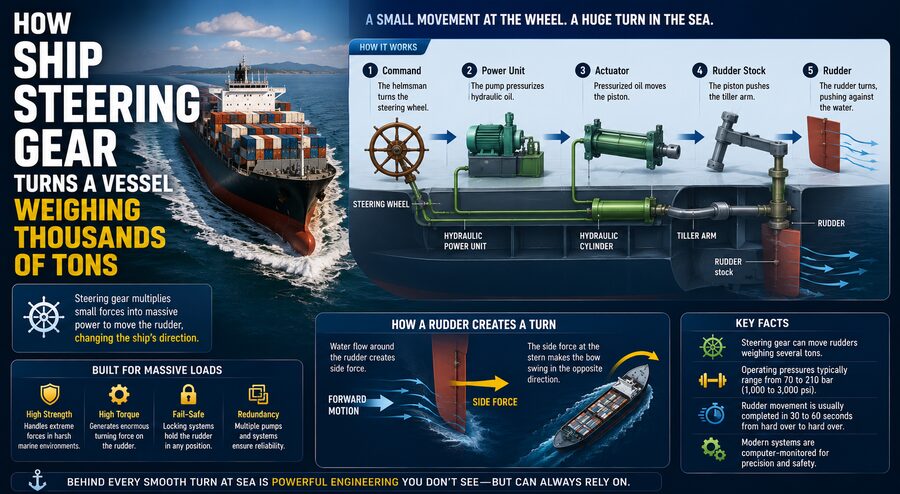

A large cargo ship can weigh tens of thousands—or even hundreds of thousands—of tons, yet a relatively small movement of its steering system can gradually change the direction of the entire vessel. From the outside, it may seem surprising that a ship so enormous can be turned by a rudder located at the stern. 🌊⚙️
The key lies in the interaction between steering gear, hydraulic power, the rudder, and the flow of water around the hull.
The steering gear does not directly “push” the entire ship sideways. Instead, it rotates the rudder into the moving water. The resulting hydrodynamic force acts at the stern, creating a turning moment that changes the vessel’s heading.
The basic process is:
Helm command 🧭 ➡️ Steering control system ➡️ Hydraulic steering gear ⚙️ ➡️ Rudder turns ↪️ ➡️ Water pushes on rudder 🌊 ➡️ Ship changes direction 🚢
This system allows a bridge officer to control a massive ship using comparatively small helm inputs.
🧭 What Is Ship Steering Gear?
Steering gear is the machinery that moves a ship’s rudder in response to steering commands from the bridge.
The system must be capable of rotating the rudder against large hydrodynamic forces while the vessel is moving through the water.
On a large commercial ship, the steering system may include:
- Steering wheel or autopilot interface
- Electronic control equipment
- Hydraulic pumps
- Oil reservoirs
- Control valves
- Hydraulic cylinders or rotary actuators
- Rudder stock
- Rudder
The rudder itself is usually located behind or near the propeller at the stern of the vessel.
The steering gear is normally installed inside a dedicated steering gear room close to the rudder stock.
🌊 Why a Rudder Can Turn Such a Massive Ship
The rudder works because water flowing around it generates force.
When the rudder is aligned with the ship, water flows approximately straight past it.
When the rudder is turned to an angle, the flow is redirected.
The rudder experiences a hydrodynamic force, and the water experiences an equal and opposite change in momentum.
Part of this force acts sideways.
That sideways force pushes the stern of the ship.
For example, when the rudder is turned to starboard, the hydrodynamic force may push the stern toward port, causing the bow to swing toward starboard.
The rudder therefore creates a turning moment, also called yawing moment, around the ship’s center of gravity.
Even though the sideways force is much smaller than the ship’s total weight, it is applied continuously while the vessel moves forward.
Over time, it changes the heading of the entire ship.
⚙️ Why Hydraulic Power Is Used
A person could never directly rotate the rudder of a large ship by hand.
At sea, enormous water forces act on the rudder.
Hydraulic systems are ideal for steering because they can generate extremely large forces using compact machinery.
The principle is based on pressure applied to hydraulic fluid.
In simplified form:
Force = Hydraulic pressure × Piston area
If high-pressure oil acts on a large piston, the resulting force can be enormous.
A hydraulic pump creates the pressure.
Control valves determine which side of a hydraulic cylinder receives pressurized oil.
The cylinder then pushes or pulls on the steering mechanism.
This allows electrical steering commands from the bridge to control machinery capable of moving many tons of rudder structure.
🛠️ Ram-Type Steering Gear
One common steering arrangement on large ships is ram-type steering gear.
This system uses hydraulic cylinders containing pistons called rams.
The rams connect mechanically to a component attached to the rudder stock, often called the tiller.
Suppose the bridge commands:
10° starboard rudder
The control system activates the appropriate hydraulic valves.
Pressurized oil enters selected cylinders.
The hydraulic rams move.
They push the tiller.
The tiller rotates the rudder stock.
The rudder turns toward the commanded angle. ↪️
Once the rudder reaches approximately 10°, a feedback system tells the steering controller that the requested angle has been achieved.
The hydraulic movement then stops.
🔄 Rotary Vane Steering Gear
Another design is rotary vane steering gear.
Instead of using long hydraulic rams, the system creates rotational motion directly.
A rotor connected to the rudder stock contains vanes inside a hydraulic housing.
Pressurized oil acts on the vanes.
The resulting force rotates the rotor and therefore the rudder stock.
Rotary vane systems can be relatively compact and can produce very high torque.
The fundamental principle remains the same:
Hydraulic pressure ➡️ Mechanical rotation ➡️ Rudder movement
🧠 How a Helm Command Reaches the Rudder
On modern ships, the wheel on the bridge usually does not have a direct mechanical connection to the rudder.
Instead, it provides a steering command to an electrical or electro-hydraulic control system.
If the helmsman turns the wheel to request 15° port rudder:
- 🧭 A steering sensor detects the command.
- ⚡ An electrical signal travels to the steering control equipment.
- 🧠 The system compares ordered rudder angle with actual rudder angle.
- ⚙️ Hydraulic pumps and valves operate.
- 🛠️ Steering actuators move the rudder.
- 📡 Rudder-angle feedback reports the new position.
- ✅ Movement stops when the requested angle is reached.
The bridge usually has a rudder angle indicator showing the actual rudder position.
🎯 Why Feedback Is Important
Ship steering gear operates as a closed-loop control system.
The command might be:
20° starboard
but the control system needs to know whether the rudder is actually at 20°.
A feedback sensor continuously measures rudder position.
Conceptually:
Commanded angle ➡️ Compare with actual angle ➡️ Move steering gear ➡️ Measure again
If the rudder is only at 12°, the system continues moving it.
When the rudder reaches 20°, the actuator stops.
Without this feedback, precise steering would be much more difficult.
🌀 How the Propeller Helps the Rudder
On many conventional ships, the rudder is positioned behind the propeller.
This arrangement is extremely useful.
The propeller accelerates a stream of water backward.
This accelerated flow, often called the propeller race or slipstream, passes over the rudder.
Because the water is moving faster over the rudder, the rudder can produce more steering force.
This is especially useful at relatively low vessel speeds when the ship itself is not moving quickly through the surrounding water.
However, rudder effectiveness still depends heavily on water flow.
A ship with no water moving past the rudder has much less conventional steering authority.
📐 Why Rudder Angle Matters
Increasing rudder angle generally increases turning force—up to practical hydrodynamic limits.
Typical steering commands might include:
- 5° rudder
- 10° rudder
- 20° rudder
- Hard-over rudder
A larger angle produces more lateral force, but it also creates more drag.
That means aggressive rudder use can reduce vessel speed.
At very large rudder angles, flow separation can also reduce efficiency.
Ship rudders are therefore designed to generate strong steering forces over a practical range of angles.
🛳️ Why Large Ships Turn Slowly
Even though the rudder can create large forces, enormous ships have tremendous mass and inertia.
They do not respond instantly.
When a large tanker begins turning, its momentum initially tries to keep it moving in the original direction.
The rudder gradually creates yaw.
The vessel then develops a curved trajectory.
This is why large ships require substantial distances to turn.
A ship’s turning performance depends on:
- Vessel speed
- Hull shape
- Rudder size
- Rudder angle
- Propeller thrust
- Ship loading
- Water depth
- Wind
- Currents
A vessel weighing hundreds of thousands of tons may need a turning circle measured in hundreds of meters or more.
⚖️ The Role of Torque
The steering gear must produce enough torque to rotate the rudder.
Torque is rotational force.
In simplified terms:
Torque = Force × Distance from axis
Water pressure acting over the rudder creates a hydrodynamic torque around the rudder stock.
The steering gear must overcome this resistance.
Engineers calculate the maximum expected rudder torque under demanding operating conditions.
The steering machinery is then designed with sufficient capacity and safety margin.
🧱 The Rudder Stock
The rudder stock is a strong vertical shaft connecting the rudder to the steering gear.
It must transmit enormous steering torque.
The rudder stock experiences:
- Torsion
- Bending
- Dynamic loading
- Repeated fatigue cycles
Because failure would be extremely serious, the component is designed using high-strength materials and careful structural calculations.
Bearings support the rudder stock while still allowing it to rotate.
🚨 Why Steering Gear Needs Redundancy
Loss of steering can place a ship in immediate danger.
A vessel without effective steering may be unable to avoid:
- Other ships
- Rocks
- Shallow water
- Port infrastructure
- Coastlines
For this reason, large ships commonly have redundant steering components.
Depending on vessel design and applicable regulations, systems may include:
- Multiple hydraulic pumps
- Separate power supplies
- Redundant control circuits
- Alternative steering control positions
- Emergency communication systems
If one component fails, another may continue providing steering capability.
🔌 Emergency Steering
Ships have procedures for steering failures.
If bridge steering control is lost but the hydraulic machinery remains functional, crew members may be able to control the steering gear locally from the steering gear room.
Communication between the bridge and steering gear room becomes critical.
Commands might be relayed by telephone or another independent communication method.
Emergency steering drills help crews prepare for these situations.
The exact procedures depend on ship type and equipment.
🤖 Autopilot and Steering Gear
During normal ocean passages, the steering gear often receives commands from an autopilot.
The autopilot compares the ship’s actual heading with its desired heading.
Suppose the vessel should maintain:
090°
but wind and waves push it toward:
092°
The autopilot calculates a small correction.
It commands the steering gear to move the rudder a few degrees.
The ship begins returning toward 090°.
As the heading approaches the target, the autopilot reduces the rudder command.
This cycle continues automatically.
Autopilot reduces repetitive steering workload, but bridge officers remain responsible for monitoring navigation.
🌬️ Wind Can Affect Steering
Large ships present enormous surfaces to the wind.
A container ship with stacks of containers can behave almost like a giant sail.
Crosswinds can push the vessel sideways or create yaw.
The rudder must then generate correcting force.
Wind effects are especially important:
- At low speed
- In narrow channels
- During harbor maneuvers
- When the ship has high freeboard
At very low speeds, ships may also use tugboats or thrusters because the main rudder becomes less effective.
🌊 Currents Also Change the Ship’s Path
Water currents can move the entire vessel relative to the seabed.
A ship may point in one direction while actually traveling along a slightly different ground track.
Navigators must account for current when choosing headings.
The rudder controls the ship relative to the surrounding water, while navigation systems observe its movement relative to Earth.
This distinction is important in strong tidal currents.
🛟 Bow and Stern Thrusters
Rudders are highly effective when water flows over them, but maneuvering in port often occurs at very low speeds.
Ships may therefore use bow thrusters or stern thrusters.
A bow thruster creates sideways thrust near the front of the vessel.
It can move the bow left or right without requiring substantial forward speed.
This is useful when:
- Leaving a berth
- Approaching a dock
- Turning in confined areas
Thrusters complement the steering gear rather than replacing the main rudder for normal navigation.
🚢 Twin-Rudder and Multiple-Rudder Systems
Some ships use more than one rudder.
Twin-screw ships may have a rudder behind each propeller.
Multiple rudders can improve maneuverability and provide different hydrodynamic characteristics.
Some specialized ships combine independently controlled propellers and rudders for exceptionally precise movement.
The steering arrangement is selected according to vessel size, speed, purpose, and propulsion layout.
🔄 Azimuth Thrusters Can Steer Without a Traditional Rudder
Some modern ships use propulsion units that rotate through large angles.
These are often called azimuth thrusters.
Instead of using a fixed propeller with a separate rudder, the entire propeller unit can turn and direct thrust.
Conceptually:
Propeller thrust ➡️ Rotate propulsion unit ➡️ Thrust points in new direction
Azimuth systems are common on:
- Tugboats
- Offshore vessels
- Cruise ships
- Dynamic-positioning vessels
They can provide extraordinary maneuverability.
📊 Steering Trials After Construction
After a ship is built, its maneuvering performance is tested.
One common test is a turning-circle trial.
The ship moves at a specified speed, and a particular rudder angle is applied.
Engineers measure characteristics such as:
- Advance
- Transfer
- Tactical diameter
- Final turning diameter
These measurements show how much space the vessel requires to execute a turn.
Other tests evaluate directional stability and response to alternating rudder commands.
🐍 The Zig-Zag Test
A zig-zag maneuver is used to evaluate steering response.
The ship applies rudder in one direction until the heading changes by a specified amount.
The rudder is then reversed.
The process is repeated in the opposite direction.
This shows how quickly the vessel responds and how much it overshoots the requested heading.
Such tests help characterize the ship’s maneuvering behavior.
🌡️ Hydraulic Oil Must Be Carefully Maintained
Hydraulic steering systems depend on clean, correctly maintained oil.
Problems can occur if hydraulic fluid contains:
- Dirt
- Water
- Air
- Degradation products
Contaminated oil can damage pumps, valves, seals, and actuators.
Engineers therefore monitor:
- Oil level
- Pressure
- Temperature
- Leakage
- Filter condition
Regular maintenance is essential because steering machinery is a critical safety system.
🔧 Routine Steering Gear Checks
Before certain maneuvers or voyages, steering systems may be tested according to operating procedures.
Checks can include:
- Main steering operation
- Backup steering systems
- Communication systems
- Rudder angle indicators
- Alarms
- Power supplies
The goal is to discover a fault before the ship reaches a situation where steering is urgently needed.
🌊 Shallow Water Changes Steering Behavior
A ship may behave differently in shallow water.
Restricted water beneath the hull changes the flow field around the vessel.
The ship may respond more slowly to steering, experience increased resistance, or behave differently during turns.
Bank effects in narrow channels can also push the bow and stern in unexpected directions.
Pilots and bridge teams account for these hydrodynamic effects when maneuvering large vessels near ports.
🧠 A Simple Example of a Ship Turning
Imagine a large bulk carrier traveling forward.
The bridge orders:
15° starboard rudder
The process is:
- 🧭 The helm transmits a 15° starboard command.
- ⚡ The steering controller receives it.
- ⚙️ Hydraulic pumps create pressure.
- 🛠️ Actuators rotate the rudder stock.
- ↪️ The rudder reaches 15° starboard.
- 🌊 Water strikes the angled rudder.
- ⬅️ The stern experiences a sideways force.
- ➡️ The bow begins swinging to starboard.
- 🚢 The vessel enters a curved path.
- 🧭 The bridge reduces or reverses rudder as necessary to settle on the new heading.
The steering gear itself only moves the rudder.
The surrounding water provides the hydrodynamic force that turns the massive vessel.
🌟 The Bigger Picture
Ship steering gear demonstrates how engineers use hydraulics and fluid mechanics to control extremely large machines.
A ship weighing thousands of tons does not turn because the steering system physically drags its entire mass sideways.
Instead, the system changes the angle of a comparatively small hydrodynamic surface—the rudder.
That small change redirects a huge flow of water.
The resulting sideways force acts at the stern and creates a turning moment around the vessel.
The complete chain is:
Bridge command 🧭 ➡️ Control system ⚡ ➡️ Hydraulic steering gear ⚙️ ➡️ Rudder movement ↪️ ➡️ Hydrodynamic force 🌊 ➡️ Turning moment 🔄 ➡️ Vessel changes heading 🚢
Hydraulic machinery provides enough torque to move the rudder against powerful water forces, while feedback systems ensure that the actual rudder angle matches the command.
Redundant pumps, emergency controls, monitoring equipment, and regular testing make the system safer.
At sea, this allows a helmsman or autopilot to guide a vessel whose mass may be measured in tens or hundreds of thousands of tons using surprisingly small steering commands.
The principle is a powerful example of engineering leverage: the steering gear does not need to overpower the ship’s entire mass—it only needs to control the surface that lets the water do the turning. 🚢🌊⚙️