
The diesel engines that propel large cargo ships, tankers, and container vessels are among the biggest reciprocating machines ever built. Some low-speed marine diesel engines stand several stories tall, contain pistons larger than a person, and produce tens of thousands of kilowatts of power.
Starting a machine of this size is very different from starting a car. 🚗➡️🚢
A passenger-car engine can usually be rotated by a small electric starter motor powered by a battery. A giant marine diesel engine, however, has an enormous crankshaft, heavy pistons, high compression, and substantial mechanical resistance. An ordinary electric starter would need to be extremely large and would place huge demands on the ship’s electrical system.
Instead, many large marine diesel engines are started using compressed air.
High-pressure air stored in dedicated receivers is admitted directly into the engine cylinders in a carefully controlled sequence. The expanding air pushes the pistons down, rotates the crankshaft, and accelerates the engine until fuel can be injected and normal combustion takes over. 💨⚙️
This starting-air system is a remarkable example of pneumatic power being used to bring an enormous machine to life.
🧠 Why Large Marine Engines Need a Special Starting System
A diesel engine must rotate before it can begin running on fuel.
During starting, the engine needs to:
- Move its pistons up and down
- Rotate the crankshaft
- Operate valve mechanisms
- Compress air inside the cylinders
- Reach a sufficient rotational speed for fuel ignition
A small engine can accomplish this with an electric starter.
A large two-stroke marine propulsion engine may weigh hundreds or thousands of tonnes. Its crankshaft alone can weigh many tonnes.
The force required to move these components from rest is enormous.
Compressed air provides a practical solution because it can deliver very large forces directly to the pistons without requiring an equally enormous electric motor.
💨 What Is Starting Air?
Starting air is compressed atmospheric air stored at high pressure.
On many large marine installations, starting air is commonly stored at pressures around 30 bar, although the exact pressure depends on the engine design and applicable rules.
To put this into perspective, normal atmospheric pressure is approximately:
1 bar
A 30-bar starting system therefore stores air at roughly 30 times atmospheric pressure before accounting for pressure-reference conventions.
This compressed air contains substantial potential energy.
When it is released into a cylinder, it expands and pushes the piston downward.
That piston force is transmitted through the connecting rod to the crankshaft, causing the engine to rotate.
🛢️ Why the Engine Cannot Start Simply by Injecting Fuel
Diesel engines ignite fuel using the heat created when air is compressed.
Fuel is injected near the end of the compression stroke.
The compressed air becomes hot enough for the fuel to ignite without a spark plug.
But when the engine is completely stopped, the crankshaft is not turning.
There is no compression cycle.
No piston is moving upward fast enough to heat the air.
Therefore, fuel injection alone cannot reliably start the engine.
Something external must first rotate it.
For massive marine engines, that external source is often compressed air.
⚙️ The Basic Starting Sequence
A simplified compressed-air starting sequence is:
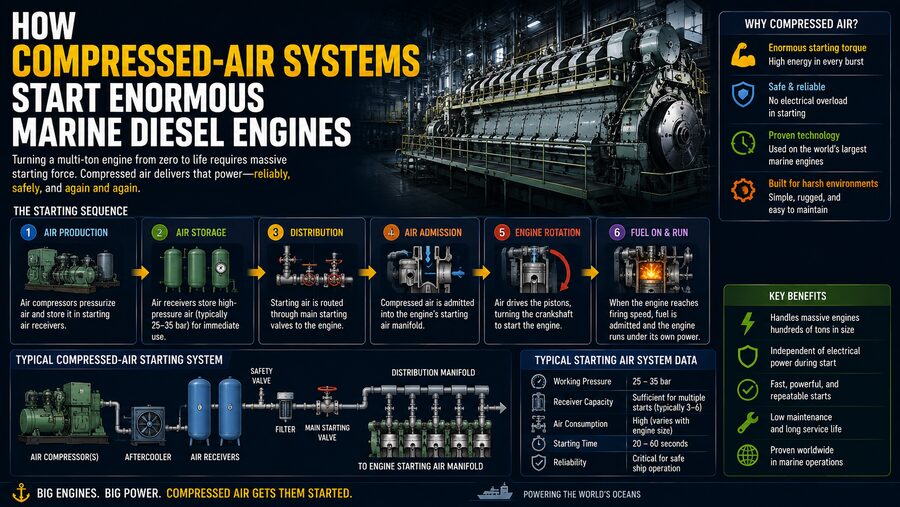
Compressed-air receiver → Starting-air manifold → Cylinder starting valve → Piston moves → Crankshaft rotates → Fuel injection begins → Combustion takes over
The system must admit air to the correct cylinders at exactly the correct moments.
If air were supplied to every cylinder simultaneously, some pistons could push the crankshaft in conflicting directions.
Instead, the starting system distributes air according to the engine’s firing order and crankshaft position.
This creates continuous rotational torque. 🔄
🛢️ The Starting-Air Receivers
Compressed starting air is stored in large pressure vessels called starting-air receivers or starting-air bottles.
These vessels act like energy reservoirs.
The ship’s air compressors charge them while the main engine is stopped or running.
The receivers contain enough compressed air to allow multiple starting attempts even if the compressors are temporarily unavailable.
This redundancy is important because a vessel must not become immobilized simply because one starting attempt fails.
Marine classification and safety requirements typically specify minimum starting-air capacity and redundancy arrangements depending on vessel and engine type.
⚙️ Starting-Air Compressors
The compressed air stored in the receivers is produced by starting-air compressors.
These are usually multi-stage reciprocating compressors because high discharge pressures are required.
A typical process is:
Atmospheric air → First compression stage → Intercooling → Second compression stage → Starting-air receiver
Intercooling reduces air temperature between compression stages.
Compressing air creates substantial heat, so cooling improves efficiency and protects the compressor.
Many ships have at least two starting-air compressors so that the loss of one does not eliminate the ability to recharge the starting-air system.
🌡️ Why Compressed Air Gets Hot
When gas is compressed, its temperature rises.
This follows basic thermodynamic behavior.
In a multi-stage compressor, air may be cooled between stages to reduce the work required for further compression.
The final compressed air may also pass through coolers and moisture separators before entering the receivers.
Removing moisture is important because water can cause:
- Corrosion
- Freezing in certain conditions
- Valve problems
- Contamination of pneumatic equipment
Clean and dry starting air improves reliability.
🔧 The Main Starting-Air Valve
Between the receivers and the engine is usually a main starting-air valve.
This valve controls whether high-pressure air can enter the engine’s starting-air manifold.
When the engine receives a valid start command, the control system opens the main starting-air valve.
High-pressure air then becomes available to individual cylinder starting valves.
When the starting phase ends, the main valve closes and isolates the receiver from the engine.
Because of the enormous amount of stored pneumatic energy involved, this valve is a critical safety component.
🧯 The Starting-Air Manifold
The starting-air manifold is a large pipe or distribution chamber that carries compressed air along the engine.
Branches from the manifold connect to the starting valve of each cylinder.
For a six-cylinder engine, for example, the manifold may distribute air to six individual starting valves.
However, the manifold does not decide which cylinder receives air.
That decision is controlled by the engine’s starting-air timing system.
🔄 The Air Distributor
Traditional marine engines use a component called a starting-air distributor.
Its purpose is similar to an ignition distributor in an older gasoline engine, although instead of distributing electrical sparks, it distributes pneumatic control signals.
The distributor is mechanically synchronized with the crankshaft.
As the crankshaft turns, the distributor sends pilot air to the starting valve of whichever cylinder is in the correct position to produce useful torque.
The sequence might conceptually resemble:
Cylinder 1 → Cylinder 5 → Cylinder 3 → Cylinder 6 → Cylinder 2 → Cylinder 4
The exact sequence depends on the engine.
Modern electronically controlled engines may replace mechanical distributors with electronically commanded pneumatic or hydraulic valves.
🔩 Cylinder Starting Valves
Each cylinder has its own starting-air valve.
This valve admits high-pressure air directly into the cylinder.
When pilot air or an electronic control signal activates the valve, it opens.
Main starting air flows from the manifold into the cylinder.
The compressed air acts on the piston crown and pushes the piston downward.
Once the cylinder has moved beyond the useful starting position, the valve closes.
The next cylinder then receives air.
This carefully timed process keeps the crankshaft rotating in the desired direction.
📐 Why Crankshaft Position Matters
A piston can only produce useful starting torque when it is in an appropriate position.
If compressed air enters a cylinder when the piston is at exactly top dead center, the downward force may produce little initial turning moment because the connecting rod and crank geometry are nearly aligned.
Therefore, starting air must be admitted after the piston has reached a suitable crank angle.
The control system uses crankshaft position to decide:
- Which cylinder should receive air
- When its starting valve should open
- When the valve should close
Correct timing is essential for reliable starting.
🔁 How the Engine Begins Turning
Imagine one cylinder is positioned just past top dead center.
Its starting valve opens.
Compressed air enters above the piston.
The air expands and drives the piston downward.
The connecting rod turns the crankshaft.
As the crankshaft rotates, another piston reaches its starting position.
Its air valve opens.
Then another follows.
The result is a sequence of pneumatic power strokes.
Even though no fuel is burning yet, the engine begins to rotate much like it does during normal operation.
🔥 When Fuel Injection Begins
Starting air is not intended to power the engine for long.
Its purpose is only to accelerate the crankshaft to a speed at which combustion can become self-sustaining.
Once the engine reaches the appropriate starting speed, the control system enables fuel injection.
Now the normal diesel cycle begins:
Air enters → Air is compressed → Fuel is injected → Fuel ignites → Combustion pushes piston
As combustion becomes stable, the starting-air system is shut off.
The main engine is now running under its own power. 🛢️🔥
🚫 Why Starting Air and Fuel Must Be Coordinated
The transition between pneumatic starting and combustion must be controlled carefully.
If fuel is injected too early, the engine may not be rotating fast enough for proper ignition.
Poor combustion could result.
If starting air continues too long after combustion becomes established, unnecessary mechanical and thermal stresses can occur.
Engine-control systems therefore coordinate:
- Starting-air admission
- Engine speed
- Crankshaft position
- Fuel injection
- Safety interlocks
Modern electronically controlled engines can perform this sequence with very precise timing.
↔️ Starting Ahead and Astern
Traditional large marine two-stroke engines can often run in either direction.
This is important because many ships with fixed-pitch propellers reverse the main engine itself to produce astern thrust.
For ahead operation, the engine rotates one direction.
For astern operation, it rotates the opposite direction.
The starting-air system must therefore be capable of changing its timing sequence.
On older engines, reversing mechanisms physically alter the starting-air distributor and fuel timing.
On modern electronic engines, control software can change valve and injection timing electronically.
The engine then starts in the selected direction. 🔄🚢
🛑 Why the Engine Must Be Fully Stopped Before Reversing
A directly reversible marine engine cannot simply change rotational direction while still spinning rapidly.
The engine must first slow and stop.
Then the control system changes to the opposite direction.
Compressed air is applied using the new starting sequence.
The crankshaft begins rotating backward.
Fuel is then admitted.
This process is especially important during maneuvering near ports, where the bridge may command repeated ahead and astern movements.
🎛️ Bridge Control and Engine-Room Automation
On modern ships, the bridge often sends propulsion commands electronically.
A command such as:
Dead Slow Ahead
may trigger a complex automated sequence.
The control system checks whether:
- Starting air pressure is sufficient
- Turning gear is disengaged
- Lubrication pressure is available
- Engine direction is correctly selected
- No shutdown condition exists
- Cylinder lubrication is ready
Only when the required conditions are satisfied will starting air be admitted.
This prevents dangerous starts under unsafe conditions.
🔒 Starting Interlocks
A large marine engine uses several interlocks to prevent accidental operation.
One of the most important involves the turning gear.
The turning gear is a slow electric or hydraulic mechanism used to rotate the engine during maintenance.
If the main engine were started while the turning gear was engaged, the result could be catastrophic.
Therefore, an interlock prevents starting air from being admitted until the turning gear is fully disengaged.
Other interlocks may involve:
- Low starting-air pressure
- Low lubricating-oil pressure
- Emergency-stop conditions
- Incorrect reversing position
- Control-system faults
⚙️ What Is the Turning Gear?
The turning gear rotates the engine very slowly.
Engineers use it during:
- Inspection
- Maintenance
- Cylinder checks
- Positioning the crankshaft
- Pre-start preparation
Because the crankshaft is enormous, manually rotating it is impractical.
The turning gear allows controlled movement at low speed.
Before starting, crew members verify that the gear has been mechanically and electrically disengaged.
💧 Blowing Through the Engine
Before starting a large marine engine, operators may perform a procedure known as blowing through or turning the engine with indicator cocks open, depending on engine design and operating procedure.
The purpose is to make sure there is no accumulated liquid inside the cylinders.
Liquids are essentially incompressible.
If a piston attempts to compress a significant amount of water or oil, enormous forces can develop.
This condition is sometimes called hydraulic lock.
Blowing through helps verify that the cylinders are clear before normal starting.
🧯 Starting-Air Explosions
Starting-air systems contain a specific hazard known as a starting-air manifold explosion.
Although the manifold normally contains compressed air, oil contamination can accumulate inside the piping.
If hot combustion gases flow backward through a leaking cylinder starting valve, they can ignite oil deposits in the manifold.
The resulting fire or explosion can be extremely dangerous.
Marine engines therefore include protective measures designed to reduce this risk.
🔥 How Hot Gas Can Enter the Starting-Air System
During normal combustion, cylinder pressure can become extremely high.
The cylinder starting valve should remain tightly closed.
If the valve leaks, however, hot gases may pass backward into the starting-air branch pipe.
These gases can carry enough thermal energy to ignite oil or carbon deposits.
Possible contamination sources include:
- Compressor lubricating oil
- Cylinder oil
- Carbon deposits
Good maintenance and valve condition are therefore essential.
🛡️ Safety Devices on the Starting-Air Manifold
Starting-air systems may include protective devices such as:
- Flame traps
- Non-return valves
- Bursting discs
- Relief valves
- Drain arrangements
A non-return valve helps prevent high-pressure gases from flowing backward toward the receiver.
Relief devices can limit pressure if abnormal combustion occurs within the manifold.
Flame traps can help prevent flame propagation between components.
Exact arrangements depend on the engine and applicable marine standards.
🚰 Why Starting-Air Lines Need Drains
Compressed air contains moisture, and oil contamination may also enter the system.
Low points in starting-air piping can therefore collect liquid.
Drain valves allow this contamination to be removed.
Routine draining reduces:
- Corrosion
- Valve sticking
- Liquid carryover
- Fire hazards
Starting-air receivers themselves also require periodic draining.
These simple maintenance tasks are important for safe operation.
🧼 Keeping Starting Air Clean
Starting-air compressors and separators must prevent excessive lubricating oil from entering the air system.
Oil-coated pipe surfaces create a dangerous fuel source if exposed to high temperatures.
Engine-room crews therefore monitor:
- Compressor oil carryover
- Air-filter condition
- Separator operation
- Receiver drainage
- Starting-valve leakage
Cleanliness is a major part of starting-air safety.
🧯 Non-Return Valves
A non-return valve, also called a check valve, permits flow in only one direction.
In a starting-air system, it helps prevent pressure or combustion products from moving backward from the engine toward the receivers.
If a cylinder starting valve leaked during combustion, the non-return arrangement provides another layer of protection.
Marine machinery often uses several independent safety barriers rather than relying on a single valve.
🔊 What Starting a Huge Engine Sounds Like
A large marine engine starting on compressed air has a distinctive sound.
Before normal combustion begins, the engine may produce a sequence of powerful pneumatic bursts.
The crankshaft begins turning slowly.
Then fuel is admitted.
The sound changes as individual cylinders begin firing.
Within moments, the engine settles into its characteristic low-speed rhythm.
Large two-stroke engines may operate at only tens or around a hundred revolutions per minute, yet each combustion event releases enormous energy. 🚢💥
📉 What Happens if Starting-Air Pressure Is Too Low?
Starting requires enough air pressure to overcome:
- Cylinder compression
- Friction
- Mechanical inertia
- Auxiliary loads
If receiver pressure is too low, the crankshaft may turn too slowly.
The engine may fail to reach fuel-starting speed.
Repeated unsuccessful attempts can further reduce receiver pressure.
This is why ships maintain adequate receiver capacity and compressor redundancy.
Low starting-air pressure may also trigger an automatic start interlock.
🔄 Multiple Starting Attempts
Marine rules typically require sufficient stored starting energy for repeated starting attempts.
This is particularly important for directly reversible engines because maneuvering may require several rapid ahead and astern starts.
If a vessel were approaching a berth and lost its ability to restart the engine after one failed attempt, the consequences could be serious.
Starting-air receivers therefore provide a reserve of stored energy independent of immediate compressor operation.
🏗️ Why Not Use a Giant Electric Starter?
In theory, an enormous electric motor could rotate a large marine diesel engine.
But several practical problems arise.
The starter would need:
- Very high torque
- Heavy electrical cables
- Large switching equipment
- Significant generator or battery capacity
- Strong mechanical gearing
Compressed air already works naturally with the engine’s cylinders.
Instead of applying torque through a gear at one point on the crankshaft, pneumatic starting applies force directly through several pistons.
This distributes the starting effort through the engine’s normal mechanical system.
🌀 Why Pneumatic Starting Is So Effective
Force on a piston is approximately:
Force = Pressure × Area
A marine-engine piston has an enormous surface area.
Applying high-pressure air across that area generates tremendous force.
For example, even without using exact engine dimensions, a large piston subjected to several megapascals of pressure can experience forces measured in hundreds of thousands or millions of newtons.
This is why compressed air can start machinery that would overwhelm conventional starter motors.
🔧 Starting Medium-Speed Marine Engines
Not every ship uses enormous low-speed two-stroke engines.
Many vessels use medium-speed four-stroke diesel engines connected to reduction gearboxes or generators.
These engines may also use compressed-air starting.
Depending on the engine design, compressed air can be:
- Admitted directly into cylinders
- Used to operate a pneumatic starter motor
Smaller marine diesels may use electric starters instead.
The choice depends on engine size, application, reliability requirements, and vessel design.
⚙️ Air Starter Motors
Some engines use an air starter motor rather than direct cylinder air admission.
Compressed air powers a turbine or vane-type starter.
The starter turns the engine through a gear mechanism.
This concept is similar to an electric starter except that compressed air provides the energy.
Air starters are common in applications where:
- High starting torque is needed
- Electrical sparks are undesirable
- Large battery systems would be inconvenient
However, the very largest slow-speed marine engines typically rely on direct starting-air admission into their cylinders.
🛢️ Lubrication Before Starting
A massive diesel engine should not begin rotating with dry bearings.
Before starting, lubricating-oil pumps circulate oil through important components.
These can include:
- Main bearings
- Crosshead bearings
- Crankpin bearings
- Camshaft components
The control system verifies adequate lubricating-oil pressure before allowing the start.
This creates a protective oil film before heavy loads develop.
Without proper pre-lubrication, expensive bearing damage could occur.
🌡️ Keeping the Engine Warm
Large marine engines may also use preheating systems.
Jacket cooling water is kept warm when the engine is stopped.
Warm machinery provides several advantages:
- Easier starting
- Reduced thermal shock
- Better lubrication
- More consistent clearances
- Improved combustion after startup
Starting a completely cold multi-story marine engine would create significant mechanical and thermal stresses.
🔄 Slow Turning and Pre-Start Procedures
Some engines use slow-turning systems before normal start.
The crankshaft rotates at very low speed while monitoring systems check resistance.
If the engine suddenly becomes difficult to turn, there may be an obstruction or liquid inside a cylinder.
This gives the crew an opportunity to stop the sequence before full starting-air pressure is applied.
Automated slow-turning functions can therefore add another safety layer.
🧠 Electronically Controlled Marine Engines
Modern electronically controlled low-speed engines have replaced many traditional mechanical control functions with electronic systems.
Instead of a mechanical camshaft directly determining every event, electronic controllers can manage:
- Fuel injection
- Exhaust valve timing
- Cylinder lubrication
- Starting-air timing
Crank-angle sensors tell the controller exactly where each piston is.
The system can then command individual starting valves with high precision.
This improves flexibility and allows sophisticated diagnostics.
🖥️ Sensors Used During Starting
A modern engine-control system may monitor:
- Crankshaft speed
- Crankshaft position
- Starting-air pressure
- Lubricating-oil pressure
- Control-air pressure
- Engine direction
- Turning-gear status
If any essential parameter is outside safe limits, the controller can block the start.
This is significantly safer than relying only on human observation.
🚨 Failed Start Detection
An automatic control system must recognize when a starting attempt has failed.
For example, the engine may rotate on air but fail to ignite.
The controller can detect that engine speed does not continue increasing after starting air is removed.
It may then:
- Stop fuel injection
- Close starting air
- Generate an alarm
- Permit another attempt if safe
Repeated failures require investigation rather than endless starting attempts.
🔧 Common Reasons a Marine Engine May Fail to Start
Possible causes include:
- Insufficient starting-air pressure
- Starting valve malfunction
- Incorrect air-distributor timing
- Low fuel pressure
- Fuel injection problems
- Low compression
- Control-system faults
- Safety interlock activation
Engine-room personnel use alarms, pressure gauges, and control-system diagnostics to determine why the engine did not start.
📋 Maintenance of Starting-Air Valves
Cylinder starting valves operate under demanding conditions.
They must open quickly during starting but seal perfectly during combustion.
Maintenance may involve inspecting:
- Valve seat condition
- Valve spindle
- Springs
- Pilot-air passages
- Carbon deposits
- Leakage
A leaking starting valve is particularly dangerous because it can allow combustion gases into the starting-air manifold.
Regular inspection is therefore critical.
🔩 Maintaining the Air Distributor
On mechanically controlled engines, the starting-air distributor must remain correctly synchronized with crankshaft position.
Wear, contamination, or incorrect adjustment can alter timing.
If air reaches a cylinder too early or too late, starting torque can decrease.
Incorrect timing may also create abnormal mechanical loads.
Maintenance procedures therefore include timing checks.
💨 Control Air vs. Starting Air
Large ships commonly have several compressed-air systems.
Starting air is high-pressure air used to rotate the main engine.
Control air is usually lower-pressure, clean air used to operate pneumatic valves, actuators, and automation equipment.
Service air may be used for tools and general machinery purposes.
These systems may be connected through pressure-reducing and isolation arrangements, but they serve different purposes.
Keeping their functions separate improves reliability.
⚓ Why Reliability Matters at Sea
A failed starter motor in a car is inconvenient.
A failed main-engine starting system on a large ship can become a serious navigation problem.
The vessel may need propulsion quickly to:
- Avoid another ship
- Maneuver near a harbor
- Respond to changing weather
- Leave a dangerous position
For this reason, marine starting-air systems are designed with substantial redundancy, stored energy, safety interlocks, and maintenance requirements.
Reliability is not simply a convenience—it is part of safe navigation. ⚓
🏭 Starting Air on Diesel-Electric Ships
Some vessels use diesel engines primarily to drive electrical generators instead of directly driving the propeller.
These generator engines may use compressed-air starters, electric starters, or other systems depending on size.
The generated electricity then powers propulsion motors.
Even in diesel-electric architectures, reliable engine starting remains crucial because generators must be brought online when electrical demand increases.
🛑 Emergency Stopping and Restarting
After an emergency shutdown, the main engine may need to restart quickly once the cause has been corrected.
Because compressed-air receivers store energy independently, they can provide immediate restarting capability.
However, automatic systems may block a restart until shutdown conditions are reset.
Examples include:
- Very low lubricating-oil pressure
- Overspeed
- Critical bearing conditions
This prevents the starting system from forcing a damaged engine back into operation.
🌍 Energy Efficiency of Starting-Air Systems
Compressing air consumes electrical energy.
Some energy is lost as heat during compression and expansion.
Therefore, compressed-air starting is not chosen because compressed air is universally the most energy-efficient form of storage.
It is chosen because it is:
- Powerful
- Reliable
- Simple at the point of use
- Capable of storing energy for multiple starts
- Well suited to giant piston engines
For occasional starting operations, these advantages outweigh the energy losses involved in producing compressed air.
⚠️ Why Compressed Air Demands Respect
Thirty-bar compressed air stores substantial energy.
A damaged pipe or improperly handled fitting can release that energy violently.
Marine engineers therefore treat starting-air systems as high-energy pressure systems.
Safe practices include:
- Isolating and depressurizing before maintenance
- Verifying pressure gauges
- Opening valves correctly
- Inspecting piping and receivers
- Following lockout procedures
Starting-air receivers also undergo periodic inspection because corrosion or structural damage could compromise pressure-vessel integrity.
🔬 The Physics Behind the Start
The starting process combines several basic engineering principles.
Compressed air stores pressure energy.
When a starting valve opens, the air expands.
Pressure acting over piston area creates force:
F = P × A
The piston moves linearly.
The connecting rod converts that linear force into crankshaft torque.
As several cylinders receive air sequentially, the crankshaft gains rotational kinetic energy.
Once rotational speed is high enough, the diesel combustion process becomes self-sustaining.
In other words:
Pneumatic energy → Linear piston motion → Rotational energy → Combustion power
This energy conversion is what brings the enormous engine to life. ⚙️💨🔥
✨ Conclusion
Compressed-air starting systems allow enormous marine diesel engines to begin rotating without requiring impossibly large conventional starter motors.
High-pressure air is produced by compressors and stored in starting-air receivers. When a start command is given, the main starting-air valve opens and supplies a manifold running along the engine.
A distributor or electronic control system then opens each cylinder’s starting valve in the correct sequence.
Compressed air enters selected cylinders, pushes their pistons downward, and rotates the crankshaft. As additional cylinders receive air, the engine accelerates.
Once sufficient rotational speed is reached, fuel injection begins and diesel combustion takes over. 🔥🚢
The process may take only a short time, but it depends on an extensive supporting system of compressors, pressure vessels, valves, manifolds, sensors, interlocks, drains, non-return devices, and automated controls.
Safety is especially important because starting air is stored at high pressure and because leaking cylinder valves can expose oil-contaminated air lines to hot combustion gases.
Proper drainage, clean compressed air, reliable valves, protective devices, and routine maintenance all help prevent dangerous starting-air fires or explosions.
The result is an elegant engineering solution to an extraordinary mechanical challenge.
Instead of trying to turn a multi-tonne crankshaft with one gigantic electric motor, engineers use the engine’s own huge pistons as pneumatic actuators. 💨⚙️
Cylinder by cylinder, compressed air creates enough torque to overcome inertia, build rotational speed, and prepare the engine for combustion.
That is how a supply of stored air can awaken one of the largest machines on Earth and prepare it to propel an entire ship across the ocean. 🌊🚢