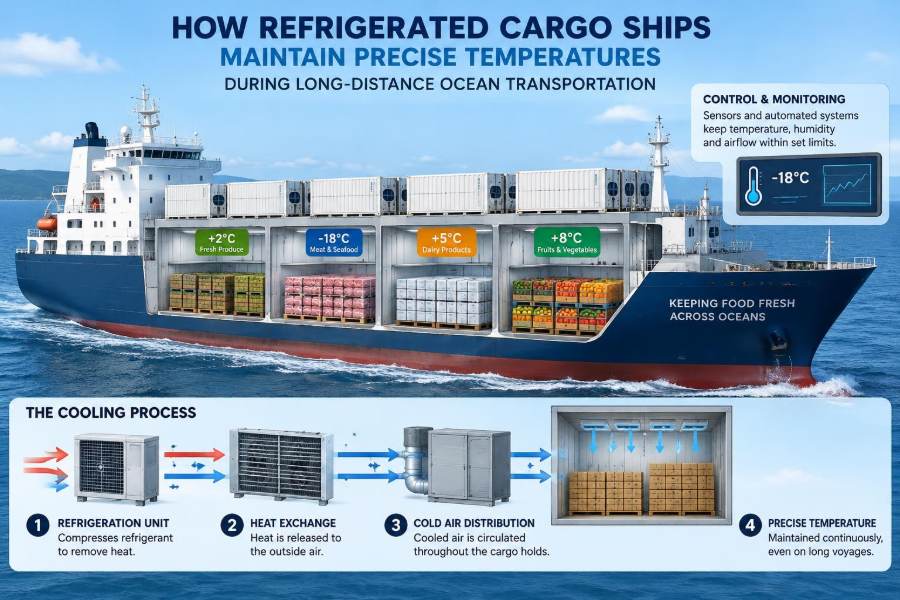

A carton of berries picked near a farm, a shipment of frozen fish loaded at a busy harbor, and a container of vaccines moving between continents may all spend weeks at sea. Their commercial value depends not just on reaching the destination, but on arriving within a narrow temperature range.
That requirement turns an ordinary voyage into a carefully controlled engineering task. Outside a ship, air temperature, solar radiation, humidity, seawater conditions, and electrical demand can change dramatically from one day to the next.
Inside the cargo space, however, the target may need to remain steady: just above freezing for fresh produce, well below freezing for ice cream, or within a tightly specified band for specialized goods. A few degrees in the wrong direction can shorten shelf life, damage texture, or create a safety concern.
Refrigerated cargo shipping, often called reefer shipping, relies on insulated spaces, refrigeration machinery, air management, monitoring, trained people, and contingency planning. The central challenge is not simply making cargo cold; it is removing heat at the right rate and proving that conditions stayed under control throughout the journey.
⚓ The Meaning of Refrigerated Cargo
Refrigerated cargo is any cargo carried under a controlled temperature condition. It includes chilled products such as fruit, vegetables, dairy, meat, and flowers, along with frozen goods such as seafood, prepared meals, and ice cream.
Some shipments require temperature control without being conventionally “cold.” Certain pharmaceuticals, chemicals, and confectionery products may need protection from excessive heat or rapid temperature change. The correct setpoint always comes from the cargo’s handling specification, not from a generic shipping rule.
🧊 Reefer Containers and Refrigerated Holds
Most modern refrigerated cargo travels in refrigerated containers, commonly known as reefer containers. Each unit has insulated walls and an integrated refrigeration machine, usually at one end, and connects to the ship’s electrical supply.
Some vessels also have refrigerated cargo holds, known as reefer holds, where cargo is stowed directly in temperature-controlled compartments. Containerized reefer transport is more flexible for multimodal logistics, while specialized holds can suit high-volume cargoes handled as a single shipment.
🌡️ A Setpoint Is Not the Cargo Temperature
The number entered into a reefer controller is the setpoint: the target used by the refrigeration unit to regulate air conditions. It is not automatically the exact temperature at the center of every carton or pallet.
Air cools or warms faster than cargo. A large pallet of frozen product has thermal mass and changes temperature slowly, while exposed cartons near an airflow path may respond much faster. Good cargo care therefore considers both supply-air conditions and the actual product temperature.
🔥 Where the Heat Comes From
A reefer system continuously fights a heat load. Heat enters through container walls, doors, floor structures, gaps around fittings, and from warm surrounding spaces. Sun striking the deck or container roof can increase the load substantially.
Fresh produce creates another source: respiration heat. Fruit and vegetables remain biologically active after harvest, using stored sugars and releasing heat, moisture, and carbon dioxide. The refrigeration system must remove this heat without dehydrating or chilling the product too aggressively.
🧱 Insulation Slows Heat Transfer
Insulation is the first line of defense. Foam-insulated panels in a reefer container reduce conductive heat flow between the exterior and interior, allowing machinery to maintain conditions with less frequent or less intense cooling.
Insulation does not eliminate heat transfer. A container in tropical sun still gains heat, and damaged panels, degraded door gaskets, or poorly sealed openings can undermine performance. Refrigeration capacity must therefore be matched to the expected voyage conditions, not just the cargo’s target temperature.
❄️ The Basic Refrigeration Cycle
Most marine refrigeration systems use a vapor-compression cycle. A refrigerant absorbs heat while evaporating at low pressure, then is compressed, condensed, and expanded so it can absorb heat again.
Within a reefer unit, the evaporator removes heat from circulating air. The compressor raises refrigerant pressure and temperature. At the condenser, that captured heat is rejected to the surroundings, often through air-cooled equipment on the container or through seawater-assisted systems in larger shipboard installations.
⚙️ What the Compressor Actually Does
The compressor is often described as the heart of the refrigeration plant because it keeps refrigerant moving through the cycle. By compressing vapor, it enables the refrigerant to release absorbed heat at a higher temperature in the condenser.
Its workload rises when ambient conditions are hot, airflow around the condenser is poor, or a warm container is first pulled down toward its setpoint. High discharge pressures, unusual noise, vibration, or repeated protective trips require investigation rather than simple resetting.
💨 Airflow Is the Delivery System
A refrigeration unit can be operating normally while cargo still suffers if air cannot move correctly through the load. Cold air must travel from the unit, through the container or hold, across cargo surfaces, and back as warmer return air.
Think of airflow as the route by which cooling reaches the product. The refrigerant never touches most cargo; the moving air does the practical work of collecting heat from cartons, pallets, and packaging.
⬇️ The Importance of Bottom-Air Delivery
Many reefer containers deliver supply air beneath the cargo through a grooved floor. Air rises through vented packaging and returns toward the refrigeration unit at a higher level.
This arrangement only works if the floor channels remain clear and the cargo is packed in suitable cartons. Loading loose materials across the floor, covering air channels, or using non-ventilated packaging can create warm zones even when the display indicates a normal setpoint.
📦 Packaging Must Work With the System
Packaging protects goods, but it also determines how readily air can reach them. Fresh produce cartons often need ventilation openings aligned with the direction of airflow. Pallets may require gaps and stacking patterns that preserve vertical air movement.
Frozen cargo has different priorities. It generally arrives already frozen and needs packaging that limits heat gain, crushing, and moisture exposure. Its refrigeration objective is usually temperature maintenance, not rapid removal of heat from warm goods.
🚫 Why Overstowage Causes Temperature Problems
Overstowage means loading cargo so tightly that required air passages are restricted. A container may appear efficiently filled, yet blocked circulation can isolate a section of cargo from the cooling stream.
The resulting problem is often uneven temperature rather than a complete refrigeration failure. This distinction matters: increasing the setpoint or forcing the unit to run harder may not correct a physical airflow blockage.
🍌 Pre-Cooling Before Loading
Reefer equipment is designed primarily to maintain cargo at its required temperature. Although it can remove heat, it should not be treated as a substitute for proper pre-cooling of a full shipment of warm perishables.
For example, produce harvested in warm conditions should normally be cooled using an appropriate land-based method before stuffing. Loading it warm adds a heavy pull-down load, may delay cooling in the center of the stack, and can accelerate quality loss before the vessel has even sailed.
🫁 Fresh Produce Is a Living Cargo
Fresh fruit and vegetables continue to respire after harvest. Their sensitivity differs widely: some are vulnerable to chilling injury, while others tolerate near-freezing storage. Some produce also releases ethylene, a natural plant hormone that can speed ripening in nearby cargo.
For these goods, the objective is a balanced environment involving temperature, air exchange, humidity, and compatibility with neighboring products. A cold setting that is safe for one commodity can damage another.
🌬️ Fresh-Air Ventilation and Gas Control
Reefer containers can introduce fresh air through adjustable vents. Ventilation removes respiratory gases, particularly carbon dioxide, and can help manage ethylene accumulation for cargoes that need it.
More ventilation is not always better. Fresh outside air may be warmer, colder, or more humid than the container air, increasing the refrigeration load or affecting product moisture. Settings should follow the cargo plan, with the shipper’s requirements and equipment capabilities taken into account.
🧪 Controlled Atmosphere Adds Another Layer
Some reefer systems can manage oxygen and carbon dioxide concentrations in addition to temperature. This is known as controlled atmosphere transport. For suitable produce, a carefully managed atmosphere can slow respiration and extend transport life.
It is not a universal solution. The acceptable gas range is commodity-specific, and a wrong atmosphere can cause physiological damage or off-flavors. It also demands reliable sensors, sound seals, defined procedures, and personnel who understand the system’s limitations.
💧 Humidity, Condensation, and Moisture Loss
Humidity affects both appearance and weight. If air is too dry, leafy vegetables and flowers may wilt. If moisture condenses excessively, packaging can weaken and mold risk may rise.
Condensation often occurs when moist air meets a surface below its dew point. It is managed through appropriate temperature control, airflow, drainage, packaging, and, where fitted, humidity-related settings. Water inside a reefer is not always a machinery fault, but it always deserves inspection.
🔌 Shipboard Power Keeps Each Unit Running
A reefer container plugs into a shipboard socket supplied by the vessel’s electrical generation and distribution system. The ship must provide adequate capacity for all connected refrigerated units while also serving propulsion-related auxiliaries, accommodation services, pumps, navigation equipment, and other loads.
Engineers monitor generator loading, voltage, frequency, switchboard condition, and the integrity of reefer circuits. A stable electrical supply is essential because a refrigeration unit cannot control temperature if it has no power.
⚡ Redundancy Reduces, But Does Not Remove, Risk
Ships commonly have multiple generator sets so that loss of one source does not automatically interrupt essential services. Electrical protection systems isolate faults to prevent a local problem from spreading through the network.
Redundancy is valuable, but it is not a reason to relax maintenance or watchkeeping. A reserve generator may be unavailable if it has a hidden defect, inadequate fuel arrangements, or an unresolved starting problem. Reliability is built through testing, inspection, and disciplined operation.
📡 Sensors, Controllers, and Data Logs
Modern reefer units use sensors to measure temperatures and equipment conditions. Their controllers compare measurements with the setpoint and adjust compressor operation, fans, defrost cycles, and alarms accordingly.
Data logging creates a record of conditions across the voyage. Depending on the equipment and cargo arrangement, records may include supply-air temperature, return-air temperature, setpoint, alarm events, power interruptions, and door openings. These records support troubleshooting and cargo claims assessment.
🔎 Supply Air and Return Air Tell Different Stories
Supply-air temperature shows the condition of air leaving the unit. Return-air temperature reflects air returning after it has passed through or around the cargo. The difference between them can offer useful clues about heat pickup and airflow.
Neither reading alone proves that every package is acceptable. A small temperature difference may occur when the cargo is already stable, but it can also indicate weak airflow. Interpretation requires knowledge of the product, load pattern, voyage stage, and equipment behavior.
🚨 Alarm Response Requires Judgment
An alarm may signal high temperature, low temperature, power loss, sensor fault, compressor protection, fan trouble, or a controller issue. The correct response begins with verification: confirm the alarm, inspect the unit status, check power supply, and compare available temperature readings.
Blindly clearing alarms can erase useful evidence and delay correction. A practical response should record time, readings, actions taken, and any communication with the vessel, terminal, technical manager, or cargo interests as required by operating procedures.
🧊 Defrosting Prevents Ice From Blocking Heat Exchange
Moisture in the air can freeze on an evaporator coil. As frost accumulates, it acts as insulation and restricts airflow, reducing the unit’s ability to remove heat.
Reefer systems periodically defrost the coil using a controlled method appropriate to the equipment. Defrosting briefly changes normal operating conditions, so its timing and termination controls matter. Excessive or unsuccessful defrost cycles may point to a drainage, sensor, door-seal, or refrigeration issue.
🛠️ Preventive Maintenance Protects Cargo
Maintenance is not limited to repairing a unit after failure. Before and during service, personnel inspect electrical cables and plugs, condenser cleanliness, fan operation, door gaskets, drainage paths, alarms, and signs of physical damage.
For shipboard systems, planned maintenance also covers generators, switchboards, circuit protection, seawater cooling arrangements where applicable, and emergency power readiness. A small defect in any supporting system can become a cargo problem during a long passage.
🧭 Voyage Planning Starts Before Departure
Temperature control begins with the booking and loading plan. Operators need to know commodity type, target temperature, ventilation needs, whether the cargo is chilled or frozen, special atmosphere requirements, and any segregation concerns.
Stowage planning considers access for inspection, cable routing, available sockets, anticipated heat exposure, and the need to avoid incompatible cargoes. A container placed where its condenser airflow is obstructed or its cable is vulnerable is harder to manage safely.
🌞 Weather, Deck Position, and Ambient Load
Ambient conditions affect how hard a reefer machine must work. Containers on exposed deck positions can receive direct solar heating, while those in enclosed spaces may experience restricted ventilation around their condenser.
Sea routes also cross different climate zones. A voyage from a cool port through tropical conditions and back into cold weather can change refrigeration demand several times. Equipment selection and monitoring must accommodate the expected range rather than a single average condition.
🚪 Door Openings Are Controlled Interruptions
Every door opening allows outside air to enter and conditioned air to escape. In humid climates, the incoming moisture can later freeze on coils or condense on surfaces. In hot conditions, it adds immediate sensible heat to the cargo space.
Inspections are sometimes necessary, but they should be planned and kept brief. Personnel should know what needs to be checked before opening doors, and doors should be properly resealed afterward.
🧯 What Happens During a Power Interruption
During a loss of power, the insulation slows temperature change but does not stop it. How quickly conditions deteriorate depends on ambient temperature, container location, cargo mass, initial product temperature, door integrity, solar exposure, and duration of the interruption.
The priority is restoring safe electrical supply while documenting the event and assessing the unit. Cargo quality decisions should not be based only on a brief air-temperature reading; the product’s thermal history and any available data record are more informative.
📋 Cargo Temperature Records and Chain of Custody
A cold chain is the uninterrupted management of required temperature conditions from production through transport, storage, and delivery. The ship is one part of that chain, following farms, factories, cold stores, truck transport, terminals, and preceding inland delivery.
Documentation helps identify where a deviation occurred. A container arriving warm does not automatically mean the vessel caused the problem; cargo might have been loaded above its required temperature, packed incorrectly, or held improperly at an earlier stage.
⚖️ Common Misunderstandings About Reefer Transport
- “Lower is safer.” Not for every commodity. Chilling injury can damage products held below their safe range.
- “The unit will cool anything quickly.” Refrigeration capacity is finite, and warm cargo should generally be pre-cooled.
- “A normal display means all cargo is fine.” Local airflow blockages or packaging problems can create uneven conditions.
- “A frozen load can never be affected.” Repeated warming, partial thawing, or poor packaging can reduce quality even if the cargo refreezes.
👷 The Human Element Behind Stable Temperatures
Automation helps, but reliable refrigerated transport still depends on people. Shippers provide correct cargo instructions; packers prepare the product; terminal teams handle connections; officers and engineers monitor shipboard systems; and technicians diagnose faults.
Clear handovers are especially important. A wrongly entered setpoint, disconnected plug, closed ventilation setting, or ignored alarm can defeat sophisticated machinery. Training must combine equipment knowledge with an understanding of the cargo being carried.
🌍 Energy Use and Environmental Trade-Offs
Refrigeration consumes electrical energy, and a ship carrying many reefers has a meaningful auxiliary power demand. Better insulation, efficient compressors, clean heat-transfer surfaces, intelligent controls, and sound stowage practices can reduce unnecessary energy use.
There are trade-offs. Reducing ventilation may save energy but be unsuitable for a respiring cargo; maximizing cooling output may protect a warm load but increase fuel consumption and strain equipment. Good engineering aims for the required cargo condition with the least avoidable waste.
🔮 Digital Monitoring Improves Visibility
Remote monitoring platforms can transmit reefer status and alarm information to ship and shore teams. This can shorten the time between an abnormal reading and a technical response, especially when many containers are carried.
Digital data is only as useful as the sensors, communications, procedures, and people behind it. A transmitted alarm still needs interpretation, and remote visibility does not replace local inspection when a physical defect, airflow obstruction, or cable problem is suspected.
🧠 A Practical Fault-Finding Sequence
When conditions drift from the target, engineers and operators should work from the simple, observable causes toward more complex faults. This reduces the risk of changing settings without understanding the problem.
- Confirm the setpoint, alarm message, and current readings.
- Verify electrical supply, plug connection, voltage, and protective devices.
- Check whether doors, seals, drains, airflow paths, and condenser spaces are clear.
- Review data trends, defrost activity, and any recent loading or handling event.
- Escalate to qualified technical support when refrigeration or control-system defects are indicated.
Actual procedures vary by vessel, equipment maker, cargo contract, and safety management system. Personnel should follow approved instructions and avoid work on energized or pressurized systems unless authorized and competent.
✅ The Core Principle: Control the Whole System
Precise marine refrigeration is not achieved by one machine alone. It depends on matching the cargo requirement to the right container or hold, loading it at the right temperature, preserving airflow, supplying reliable power, monitoring trends, and responding early to deviations.
The most useful engineering mindset is to view the reefer as part of a complete thermal system. Cargo condition reflects insulation, refrigeration capacity, ambient heat, moisture, packaging, stowage, operating practices, and human decisions working together.
Refrigerated ships maintain cargo quality over long ocean passages by managing heat, air, energy, and information as one connected system—not by simply making a space cold. That is why disciplined preparation and attentive operation matter from loading berth to final delivery. 🚢❄️⚙️