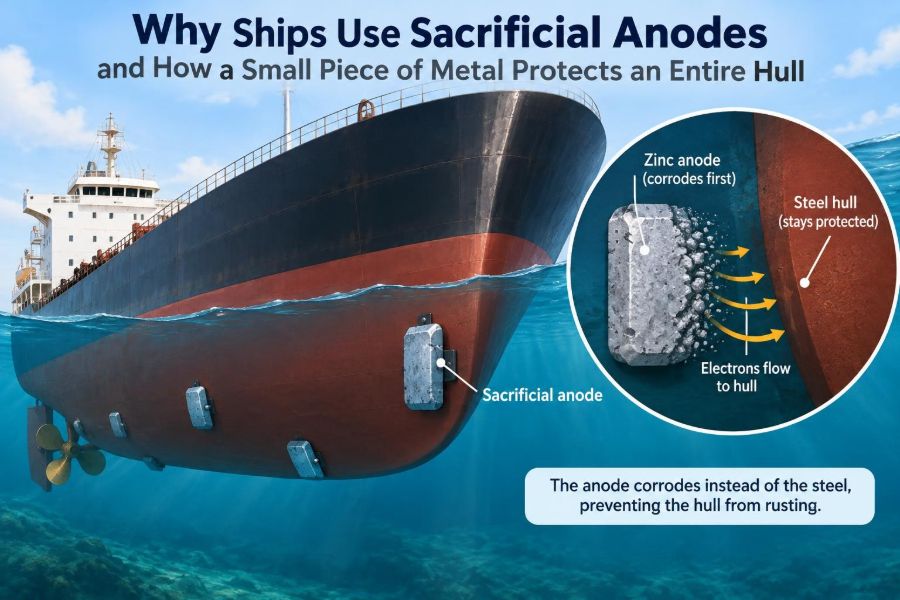

A vessel can leave dry dock with a spotless paint system, a carefully maintained propeller, and steel plating designed for decades of service. Yet the moment it enters seawater, an invisible electrochemical process begins at every exposed metal surface.
Most corrosion is slow enough to escape notice during daily operations. By the next docking, however, wasted anodes, rust staining, coating damage, and pitting around appendages may reveal what has been happening below the waterline.
This is why ships carry blocks of zinc, aluminium, or occasionally magnesium on their hulls. These modest-looking pieces of metal are designed to corrode first, preserving more valuable steel, bronze, and aluminium components.
The principle is simple, but correct protection depends on material selection, electrical continuity, coating condition, seawater chemistry, inspection, and replacement at the right time.
⚓ The underwater corrosion problem
Seawater is an excellent electrolyte: it conducts ions and allows electrochemical corrosion cells to operate. A steel hull immersed in seawater contains countless local areas with slightly different electrical potentials.
Where conditions favour metal loss, iron atoms leave the steel and enter the surrounding water as ions. The familiar rust products are evidence of this process, but damaging corrosion can also occur as localized pits beneath deposits or damaged coatings.
🔋 Corrosion is an electrical circuit
Corrosion is often described as a chemical problem, but on a ship it is also an electrical one. For corrosion to continue, there must be an anode, a cathode, an electrolyte, and a metallic path for electrons.
At the anodic area, metal dissolves and releases electrons. Those electrons travel through the metal to a cathodic area, where a reduction reaction occurs, commonly involving dissolved oxygen in seawater.
Breaking or controlling any part of this circuit reduces corrosion. Sacrificial anodes do this by deliberately becoming the preferred anodic material.
🧪 What a sacrificial anode actually does
A sacrificial anode is a metal alloy with a more negative electrochemical potential than the structure it protects. When it is electrically connected to a steel hull and both are immersed in water, the anode supplies protective current.
Instead of the hull giving up iron ions, the anode alloy gradually dissolves. The hull is shifted toward a more cathodic condition, so it is also called a cathodically protected structure.
The word “sacrificial” is literal: consumption is expected. An anode that remains completely unchanged throughout its intended service period may not be working properly.
🧲 Why hull steel needs a less noble metal
Metals do not behave identically in seawater. Some, such as zinc and aluminium alloys used for anodes, readily give up electrons compared with carbon steel. These materials are commonly called more active or less noble.
The practical goal is not merely to attach any different metal to the hull. The selected anode must have sufficient driving voltage to protect steel under expected service conditions without introducing avoidable complications.
Alloy composition matters because pure metals can form films or behave inconsistently. Marine anodes are manufactured to controlled alloy specifications so they activate and dissolve predictably.
🌊 Why seawater makes protection possible
Saltwater carries electrical current through moving ions. That conductivity allows current produced at an anode to travel through the water to exposed areas of the hull.
Temperature, salinity, oxygen content, water movement, and pollution can all affect corrosion behaviour. Protection designed for open seawater may not perform identically in brackish water, freshwater, stagnant ballast spaces, or warm tropical service.
This is one reason cathodic-protection design is based on operating conditions, not just vessel length.
🧱 Coatings and anodes work as a system
Paint does most of the routine work by separating steel from seawater. Modern underwater coating systems greatly reduce the area that requires cathodic protection.
No coating remains perfect forever. Scrapes, impact damage, abrasion, poor surface preparation, and natural aging create exposed spots. Sacrificial anodes provide backup protection at those defects.
A useful analogy is a waterproof jacket with a small tear: the jacket still does most of the job, but the tear needs attention. Anodes protect the exposed steel; they do not restore a failed coating system.
🎨 Why damaged paint raises anode demand
When coating damage increases, more bare steel becomes available for cathodic reactions. The anodes must deliver more current, so their consumption rate can rise.
This can create a maintenance cycle. Poor coating condition shortens anode life, while depleted anodes leave damaged areas increasingly vulnerable. Maintaining coatings is therefore also a way to preserve cathodic-protection capacity.
Designers normally allow for coating deterioration over time, but severe or unexpected damage can exceed those assumptions.
⚙️ The three common anode materials
Marine sacrificial anodes are usually made from zinc-based, aluminium-based, or magnesium-based alloys. Each has a different balance of driving voltage, output capacity, weight, and suitability.
| Material | Typical marine use | Key consideration |
|---|---|---|
| Zinc alloy | Seawater hulls, sea chests, and appendages | Reliable traditional choice; can be relatively heavy |
| Aluminium alloy | Seawater structures and hull protection | High electrochemical capacity and lower weight; alloy quality is critical |
| Magnesium alloy | Freshwater or low-salinity applications | Usually too active for unrestricted use on seawater ship hulls |
The table gives broad guidance only. Final selection should follow the vessel’s protection design, material compatibility, classification requirements, and operating environment.
⚖️ Zinc anodes: familiar and dependable
Zinc alloy anodes have long been recognizable as bolted or welded blocks on hulls, rudders, shafts, and sea-water systems. In normal seawater service, they provide a suitable protective potential for steel.
They are not interchangeable with random zinc pieces. A poorly controlled composition can passivate, meaning its surface develops a film that restricts useful current output.
During inspection, a working zinc anode usually shows progressive, reasonably even wastage rather than a clean, unchanged surface.
🪶 Aluminium anodes: more capacity for less weight
Aluminium-based anodes are widely used because they can offer high current capacity for their mass. Their lower weight can simplify handling and reduce added weight on large structures.
Marine aluminium anodes contain carefully selected alloying elements to prevent unstable behaviour and to encourage activation in seawater. They should never be confused with scrap aluminium or ordinary structural alloy.
Correctly specified aluminium anodes are a practical choice for many vessels, but compatibility with protected materials and the planned electrical system still matters.
🏞️ Why magnesium belongs mainly in freshwater
Magnesium has a much more negative potential than steel and can drive strong protective current in freshwater, where electrical conductivity is low. That makes it useful for inland-water structures and some freshwater systems.
In seawater, magnesium may provide excessive driving voltage and current for many marine applications. Overprotection can damage certain coatings and can create other operational concerns, particularly in confined or sensitive systems.
Material choice must follow the environment, not habit.
🔩 Where anodes are fitted on a ship
Anodes are concentrated where corrosion risk and current demand are greatest. Typical locations include the flat bottom, bilge region, rudder, stern frame, propeller shaft brackets, thruster tunnels, sea chests, and sea-water intakes.
They are also installed on appendages and in tanks where appropriate. A ballast tank, for example, experiences alternating wet and dry conditions, varying oxygen levels, and difficult access, so its protection strategy may differ from that of the outer hull.
🌀 The stern area deserves special attention
The stern combines several different metals and complex flow conditions: steel structure, a bronze or nickel-aluminium-bronze propeller, stainless-steel shaft components, seals, and brackets. This creates a strong possibility of galvanic interaction.
Propeller-induced water flow can also increase oxygen supply and remove protective deposits. Designers often place anodes around the stern, rudder, and shaft supports to provide adequate current distribution.
Anodes must not be placed so they disturb flow unnecessarily or become vulnerable to mechanical damage.
🔗 Electrical continuity is non-negotiable
An anode protects only what it is electrically connected to. Hull anodes need a low-resistance metallic path to the structure, usually through welded steel cores or approved mounting arrangements.
Paint, corrosion products, insulating gaskets, poor welds, or incorrect installation can interrupt that path. An anode may look present and intact but provide little useful protection.
Separate components such as rudders, shafts, and removable fittings may require bonding arrangements or dedicated anodes because bearings and seals can electrically isolate them.
📍 Current must reach the exposed surface
Electrical connection alone is not enough. Protective current must travel through the electrolyte and distribute across the wetted surface. Distance, shielding, geometry, coating condition, and water resistance all affect where that current goes.
A recess, narrow gap, or shielded area may receive less protection than an open plate near an anode. For this reason, anode layouts use multiple locations rather than one oversized block in a convenient place.
Good design considers current distribution, not just the total kilogram mass of anodes.
🧭 Galvanic corrosion versus cathodic protection
Galvanic corrosion happens when dissimilar metals are electrically connected in an electrolyte and one becomes the less noble, corroding member. A steel hull connected to a more noble bronze propeller can be part of such a couple.
Cathodic protection uses the same electrochemical principles intentionally. A still more active anode alloy is added so that it becomes the preferred metal to dissolve.
The difference is control: an unwanted galvanic couple consumes a ship component; a designed sacrificial system consumes a replaceable anode.
📏 Anode sizing is more than choosing a block
Engineers estimate how much current the structure will require during the intended docking interval. This depends on submerged area, coating quality, anticipated coating breakdown, seawater conditions, voyage pattern, and special features such as thrusters.
They then select anode type, quantity, mass, and location to provide enough output and enough total material to last. Designs also account for anode utilisation, because a mounting core and residual material cannot be consumed completely.
Adding extra anodes without analysis is not automatically safer. Placement and potential control matter as much as quantity.
📉 What normal anode consumption looks like
Working anodes become smaller, rougher, and more irregular over time. Consumption is often greatest at edges and exposed surfaces, but the pattern should be assessed alongside vessel condition and measured potentials where available.
Uneven wastage can point to local current demand, coating failure, stray current, or water-flow effects. A diver’s photograph is useful evidence, but it should be interpreted in context rather than treated as a complete diagnosis.
Replacement is commonly planned before anodes become too depleted to deliver their designed performance.
🚨 When anodes disappear unusually fast
Rapid loss deserves investigation. It may mean extensive coating breakdown, a poor anode selection, an unexpectedly aggressive environment, an electrical fault, or a direct-current leakage problem.
Stray-current corrosion is different from ordinary galvanic corrosion. It occurs when external direct current leaves a metal surface and can cause severe, localized metal loss at the discharge point.
Possible sources include faulty impressed-current systems, welding return paths, shore connections, or onboard DC equipment. Replacing anodes without finding the cause can hide a developing defect.
🧊 The risk of overprotection
More negative potential is not always better. Excessive cathodic protection can produce hydrogen at the metal surface, interfere with some coatings, and create conditions that are unsuitable for particular materials or environments.
High-strength steels and certain susceptible components require careful engineering because hydrogen can contribute to embrittlement under particular conditions. This is a specialist assessment, not a reason to avoid cathodic protection altogether.
Well-designed systems aim for an effective protection range rather than the maximum possible current.
🛠️ Sacrificial anodes versus impressed-current systems
Sacrificial-anode cathodic protection is passive: once installed, it needs no external power source. Impressed-current cathodic protection, or ICCP, uses inert or long-life anodes and a controlled DC power supply to deliver protective current.
ICCP can be advantageous for large hulls because output can be adjusted as conditions change. It also needs monitoring, reference electrodes, power, controls, and protection against malfunction.
Sacrificial anodes remain valuable for localized areas, smaller vessels, tanks, appendages, and as protection where simplicity and independence from electrical power are desirable.
🏗️ Installation details affect performance
Hull anodes may be welded through steel inserts or attached using approved fasteners, depending on the vessel and location. The connection must be mechanically secure, electrically sound, and compatible with the hull coating specification.
After installation, surrounding coating repairs need care. Painting over the active face of an anode can prevent it from working; leaving unsealed steel around a mounting detail can create a local corrosion concern.
For aluminium hulls, attachment details need particularly careful material compatibility to avoid creating a new galvanic problem.
🔍 What surveyors and crews should inspect
Underwater inspections, dry-dock surveys, and tank-entry inspections provide opportunities to assess the whole protection system. The goal is not simply to count remaining blocks.
- Check that anodes are firmly attached and electrically connected.
- Record remaining size, wastage pattern, cracking, or passivation.
- Look for coating damage, rust streaks, pitting, and corrosion near fittings.
- Inspect high-risk areas such as sea chests, thruster tunnels, rudders, and stern gear.
- Compare findings with earlier reports to identify changing trends.
Where the vessel uses monitoring equipment, potential measurements can provide another layer of evidence. Measurements must be taken and interpreted using appropriate procedures because location and operating condition affect results.
🧰 Replacing anodes at dry dock
Dry docking is the practical time to renew depleted anodes, repair coatings, and inspect areas that cannot be examined safely in service. The best sequence is usually to remove failed material, repair steel and coating defects, install the correct anodes, and verify the connection.
Installing new anodes onto badly corroded or poorly prepared attachment points is a weak repair. The system should be restored as a package, with records of anode type, location, and condition retained for future comparison.
Replacement criteria should follow the vessel’s approved design and maintenance practice rather than a single visual rule applied to every anode.
🧯 Common mistakes that shorten protection life
Several recurring mistakes reduce the value of an otherwise sound system:
- Using anodes made from unsuitable or unverified alloy.
- Painting an anode surface or insulating it from the hull.
- Assuming all underwater corrosion is solved by adding more anodes.
- Ignoring electrical isolation of a rudder, shaft, or appendage.
- Replacing consumed anodes without repairing widespread coating failure.
- Overlooking unusual anode wastage that may indicate stray current.
These errors are preventable when hull maintenance, electrical practice, and corrosion control are treated as connected disciplines.
📚 A simple hypothetical example
Consider a coated steel workboat operating in seawater. During docking, the crew finds that anodes around a bow thruster tunnel are heavily consumed while most flat-bottom anodes remain in fair condition.
This does not automatically mean the tunnel needs larger blocks. The team should inspect the tunnel coating, check for damage from debris or cavitation, confirm electrical continuity, and review whether local geometry limits current distribution.
If coating damage is the underlying cause, coating repair plus correctly positioned replacement anodes is likely more effective than increasing anode mass alone.
🌱 Environmental and operational considerations
Sacrificial anodes release metal corrosion products into the marine environment as they perform their function. This is one reason material selection, correct sizing, and avoidance of unnecessary consumption matter.
Operationally, anodes add drag only minimally when properly designed and installed, but damaged or poorly positioned blocks can be vulnerable in ice, shallow water, or contact with debris. Their location must suit the vessel’s service profile.
Corrosion control also supports sustainability in a practical way: extending hull and machinery life reduces avoidable steel repair, replacement work, and off-hire time.
🧠 The core principle to remember
A sacrificial anode does not “stop seawater” or make steel permanently immune to corrosion. It deliberately supplies a more willing source of electrons so the connected hull remains the cathodic, protected part of the electrochemical circuit.
Its success relies on a complete system: suitable alloy, sound electrical connection, sensible placement, adequate remaining mass, compatible coatings, and investigation of abnormal consumption.
For engineers and seafarers, the practical lesson is clear: treat anode wastage as useful information. It is a visible record of underwater electrical and corrosion conditions, not merely a routine dry-dock replacement item.
A small sacrificial anode protects a large hull because it is engineered to be the metal that corrodes first, in a controlled and replaceable way. ⚓🔋🌊