
A ship’s main engine may look like a self-contained source of propulsion, but much of the fuel energy supplied to it never reaches the propeller. It leaves in exhaust gas, cooling water, charge air, lubricating oil, and other hot streams that must be controlled to keep machinery within safe operating limits.
On a long sea passage, that rejected heat is not merely a loss. It can become a useful onboard resource: steam for heating fuel, hot water for accommodation, electrical power for hotel loads, or energy for cargo systems. The opportunity is especially relevant when auxiliary generators would otherwise burn fuel just to provide those services.
Waste heat recovery is therefore not one single machine bolted to an engine. It is a family of systems that collect heat at different temperatures and match it to a demand at the right time and pressure.
For engineers, the practical question is not simply, “How much heat is available?” It is, “Can this heat be recovered reliably, safely, and economically during the vessel’s real operating profile?”
🔥 Where the Lost Energy Goes
In a marine diesel engine, only part of the fuel’s chemical energy becomes useful shaft power. Significant energy leaves with the exhaust gases, while lower-temperature heat is rejected through jacket-water cooling, charge-air cooling, and lubricating-oil cooling.
Temperature quality matters as much as heat quantity. Hot exhaust can support steam generation or a turbine. Warm jacket water may be excellent for accommodation heating but usually cannot efficiently produce useful steam on its own.
Waste heat recovery, often shortened to WHR, captures some of this unavoidable rejected energy before it is discharged to the sea or atmosphere.
⚙️ The Temperature Cascade Principle
A well-designed system uses the hottest source for the highest-temperature duty first, then passes remaining heat to lower-temperature services. This is often called cascading or temperature matching.
For example, exhaust gas may produce steam in an economizer. The engine jacket-water circuit may then heat domestic water, while a still cooler return stream may preheat feedwater. Trying to use a low-temperature source for a high-temperature duty usually creates a large, costly system with disappointing output.
This principle is why a vessel can have abundant “waste heat” yet limited recoverable power.
🚢 The Main Engine as the Primary Heat Source
On many ocean-going ships, the slow-speed main engine is the largest continuous source of recoverable heat. When it operates steadily near its efficient load range, exhaust conditions are comparatively predictable, which suits steam and power-recovery equipment.
Its usefulness falls during manoeuvring, port stays, low-speed operation, or long periods at reduced load. Exhaust temperature and mass flow both influence available recovery, so a system sized around a high-load design point may perform differently in service.
Modern machinery plans must account for slow steaming rather than assuming a permanently high engine load.
🌡️ Auxiliary Engines and Smaller Heat Sources
Generator engines, boilers, incinerators, thermal-oil systems, refrigeration compressors, and hydraulic equipment can also supply recoverable heat. Individually, these streams may be modest; collectively, they can cover useful hotel and process loads.
Auxiliary-engine heat is particularly valuable in port, when the main engine is stopped but electrical demand remains. A jacket-water heat exchanger can provide domestic hot water or support fuel conditioning without running a separate boiler continuously.
The trade-off is operational complexity. Multiple sources require controls that prevent unwanted heat transfer, over-temperature conditions, and conflicting equipment priorities.
💨 Exhaust-Gas Economizers in Daily Service
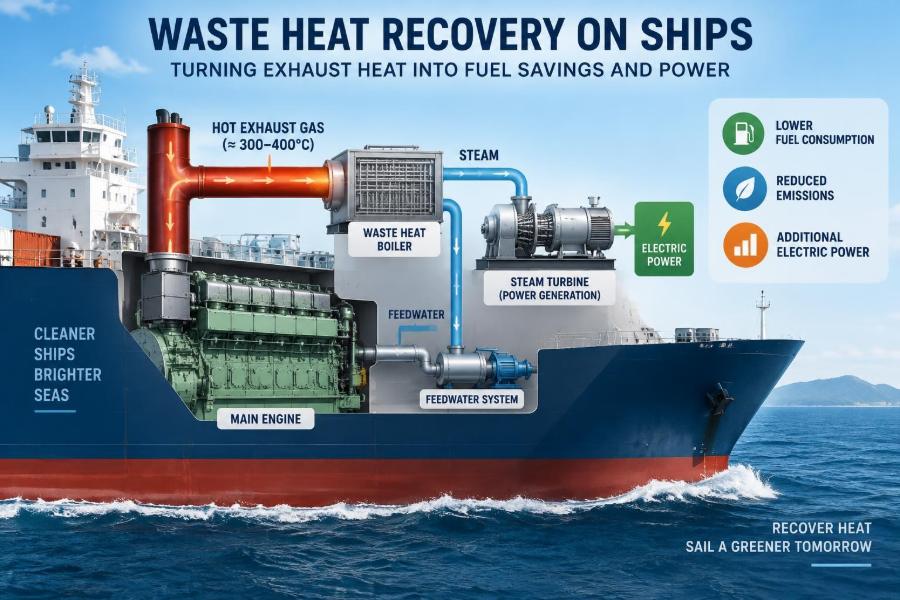
An exhaust-gas economizer is a heat exchanger installed in the main-engine exhaust path. Water flowing through its tubes absorbs exhaust heat and is converted into hot water or steam, depending on the design.
Its most familiar use is supplying steam to a ship’s auxiliary steam system while underway. That steam may serve fuel heaters, tank heating coils, accommodation services, galley equipment, and cargo-related demands.
By producing steam at sea, the economizer can reduce the firing hours of an oil-fired auxiliary boiler. It does not eliminate the boiler’s role: a boiler is still commonly needed for port operations, low-load passages, and peak demand.
🧯 Why Exhaust Temperature Cannot Be Reduced Without Limit
Extracting more exhaust heat sounds attractive until the exhaust temperature approaches a point where condensation and corrosion become likely. Fuel sulphur, combustion products, and moisture can form corrosive deposits when surfaces become too cold.
Fouling also increases as soot accumulates on heat-transfer surfaces. Rising gas-side pressure drop can affect engine performance, while reduced heat transfer cuts steam output.
Designers therefore maintain a suitable exhaust outlet temperature and provide cleaning arrangements. The best recovery point is a balance between heat capture, corrosion risk, fouling behaviour, back pressure, and maintainability.
♨️ Steam for Fuel Heating and Treatment
Residual marine fuels need controlled heating to reach a viscosity suitable for pumping, purification, and injection. Steam has traditionally been an effective heating medium because it transfers heat rapidly and its temperature is linked to pressure.
Recovered steam can heat settling and service tanks, fuel lines, and certain treatment-system duties. This directly replaces steam that might otherwise come from a fired boiler.
Good temperature control is essential. Overheating fuel can cause unnecessary losses, while inadequate heating can compromise separator performance or leave viscosity outside the engine maker’s required range.
🏠 Hot Water for Accommodation and Hotel Loads
Crew accommodation requires domestic hot water for showers, laundry, galleys, and cleaning. Passenger vessels may have substantially larger hotel loads, including extensive hot-water circulation and laundry services.
Low- to medium-temperature engine cooling water is often well suited to these duties through a calorifier or plate heat exchanger. A calorifier is essentially an insulated vessel that stores heated domestic water, allowing heat supply and demand to occur at different times.
This is one of the simplest practical WHR applications because the required temperature is modest and the service remains useful even when steam demand is low.
🛢️ Cargo Heating on Tankers
Some liquid cargoes must be kept warm to remain pumpable or within contractual temperature limits. Tank heating can be a major thermal duty, and recovered heat may reduce boiler firing during sea passages.
The available method depends on cargo, vessel design, and the heating medium. Steam coils, thermal oil, or closed hot-water circuits may be used. Direct assumptions are unsafe because cargo compatibility, contamination risk, and terminal requirements all matter.
For a tanker, WHR is valuable only if the recovery system can meet the required cargo-heating schedule without compromising cargo safety or propulsion reliability.
🧊 Absorption Chillers and Cooling from Heat
Heat can sometimes produce cooling through an absorption refrigeration machine. Instead of relying mainly on an electrically driven compressor, an absorption chiller uses a heat source to drive a refrigerant-absorbent cycle.
Potential marine uses include accommodation air-conditioning or process cooling where a sufficient heat source exists. This is an appealing concept on vessels with both high cooling demand and surplus heat.
However, absorption equipment is relatively bulky, needs careful water treatment and control, and may not suit rapidly changing loads. It is a case where technical possibility must be tested against space, weight, maintenance capability, and operating pattern.
⚡ Turning Exhaust Heat into Electricity
Electrical WHR systems seek to convert recovered thermal energy into generator output. On large vessels with high, steady main-engine loads, this can reduce the electrical load carried by diesel generator sets.
A common arrangement generates steam in an exhaust-gas economizer and expands it through a steam turbine coupled to a generator. The output depends on steam conditions and demand elsewhere in the plant; it is not a fixed bonus available at all times.
Electricity is particularly useful because it can serve pumps, fans, lighting, navigation equipment, refrigeration, and hotel services through the existing shipboard distribution system.
🌀 Steam Turbine Generator Arrangements
A steam turbine generator works by expanding high-pressure steam through turbine stages, converting thermal energy into rotating mechanical energy and then electrical power. Exhaust steam may be condensed or used at a lower pressure for heating duties.
Back-pressure arrangements can be effective when the ship has a continuous low-pressure steam demand. Condensing arrangements can extract more turbine work but require a condenser, cooling capacity, vacuum equipment, and additional complexity.
The choice should reflect the ship’s real heat balance. Producing power while wasting useful low-pressure steam can be less sensible than supplying a direct heating load.
🔄 Power Turbines and Turbo-Compounding
Some systems recover energy directly from exhaust flow using a power turbine positioned downstream of the turbocharger. The turbine can drive a generator or contribute mechanical power through a suitable arrangement.
This approach differs from steam WHR because it uses the exhaust gas’s remaining pressure and velocity rather than first converting heat into steam. Integration with turbocharger performance is critical: the engine still needs enough turbine energy to supply scavenge air.
It is generally a specialized solution requiring close coordination among engine, turbocharger, controls, and shaft or electrical plant designers.
💧 Organic Rankine Cycles for Lower Temperatures
An organic Rankine cycle, or ORC, is similar in principle to a steam power cycle but uses an organic working fluid that can evaporate at lower temperatures than water. This allows recovery from jacket water, charge-air cooling, or mixed low-grade heat sources.
ORC equipment can make sense where steam generation is impractical but a stable heat source exists. Its output is usually constrained by the low temperature difference, and pumps, heat exchangers, controls, and working-fluid management add maintenance considerations.
It should not be viewed as a universal replacement for direct heating. When a hot-water demand is available, direct heat use is often simpler.
🔋 Shaft Generators and the Wider Energy System
A shaft generator is not necessarily a waste heat recovery device, but it often complements one. It uses main-engine shaft power to generate electricity, potentially allowing auxiliary generators to be stopped during passage.
When combined with exhaust-steam power generation, battery support, and intelligent load management, it becomes part of a broader onboard energy strategy. The key is to avoid double-counting savings: each device changes the operating point of the others.
Engineers should compare complete operating modes, not isolated equipment efficiencies.
📊 Matching Recovery to Vessel Type
The right WHR system depends heavily on vessel mission, engine size, route, cargo, and hotel load. A simple comparison illustrates why one design cannot suit every ship.
| Vessel or operating feature | Likely useful recovery focus | Main design question |
|---|---|---|
| Deep-sea cargo vessel with steady passage | Economizer steam, turbine generation | Is engine load high enough for much of the voyage? |
| Tanker with heating duty | Steam or thermal heating | Can cargo temperature requirements be met safely? |
| Passenger vessel | Hot water, HVAC-related uses, power integration | How variable are hotel loads and port stays? |
| Short-sea vessel | Simple hot-water recovery | Are transit periods long enough to justify complex equipment? |
| Refrigerated cargo operation | Heat for defrost or selected process duties | Does the timing of heat supply match refrigeration demand? |
The table is a starting point, not a design rule. A voyage-specific energy balance is always more useful than selecting technology by vessel label alone.
🧭 Operating Profile Determines Real Savings
A theoretical heat balance often assumes continuous sea-going operation at a chosen engine load. Actual vessels encounter weather routing, port congestion, slow steaming, manoeuvring, dry-dock periods, and changing cargo or hotel demands.
If the main engine spends much of its time below the economizer’s preferred operating range, boiler support may remain necessary. Conversely, a vessel with long stable passages can use recovery equipment more consistently.
Annual operating hours at useful conditions matter more than peak heat availability. This is why onboard data logging is valuable before major retrofits.
📏 Building a Heat Balance Before Selecting Equipment
A heat balance maps energy sources, sinks, temperatures, flows, and operating hours. It identifies where heat is rejected, where it is needed, and where timing does not match.
A practical assessment should include:
- main- and auxiliary-engine load profiles;
- exhaust temperatures, allowable back pressure, and gas flow information;
- cooling-circuit temperatures and available margins;
- steam, hot-water, and electrical demand by operating mode;
- boiler firing patterns and fuel types;
- space, weight, piping, and maintenance constraints.
Without this foundation, a recovery project risks being optimized for a rare condition rather than normal service.
🧪 Water Chemistry and Steam-System Reliability
Steam systems demand disciplined water treatment. Poor feedwater quality can cause scale, corrosion, foaming, carryover, and deposits on economizer tubes. These problems reduce heat transfer and can lead to expensive failures.
Recovery equipment does not remove the need for routine sampling, chemical control, blowdown practices, and inspection. In fact, adding an economizer can make water-side management more consequential because tube failures may affect both the steam system and exhaust path.
Operating instructions should define water-quality limits and actions for abnormal results in line with equipment-maker guidance.
🧹 Soot, Fouling, and Fire Prevention
Exhaust-side deposits are a normal operational concern, particularly when engines run at lower loads or fuel and combustion conditions promote soot formation. Deposits reduce heat transfer and can ignite under certain conditions.
Economizers therefore need suitable soot-cleaning arrangements, temperature monitoring, drainage, inspection access, and crew procedures for abnormal events. A cleaning method that works in theory but cannot be used safely during the vessel’s schedule offers little value.
Engine tuning and combustion condition also influence fouling. WHR performance begins upstream, at the engine itself.
🛠️ Controls, Bypass Lines, and Load Changes
Shipboard heat demand changes quickly. A system may need to move from steam production at sea to boiler operation in port, or respond to an engine load reduction without destabilizing pressure and temperature.
Bypass arrangements, control valves, circulation pumps, pressure controls, and protective trips make these transitions manageable. The controls must protect the engine from excessive exhaust back pressure and protect the recovery equipment from overheating, low flow, or overpressure.
Simple operating modes and clear alarm logic matter. The watchkeeper needs to understand not only what an alarm means, but which energy source should take over.
🧱 Retrofit Constraints on Existing Ships
Newbuildings can reserve space and route pipework around WHR equipment from the outset. Retrofitting is harder: uptake geometry, funnel space, structural supports, electrical integration, machinery-room access, and dry-dock scope can all limit options.
Added mass and high-level equipment may affect structural design and maintenance access. Routing a new steam line through a crowded engine room can require insulation, drains, expansion allowances, fire protection, and careful separation from other services.
A technically efficient package is not automatically a practical retrofit if routine inspection requires difficult or unsafe access.
💰 Evaluating Fuel Savings Honestly
Fuel savings arise when recovered heat displaces boiler fuel or when recovered power displaces generator output. The value depends on fuel consumption at the actual displaced operating point, not on a generic fuel-rate assumption.
Evaluation should also include electrical consumption of pumps and fans, added maintenance, chemical treatment, cleaning, downtime risk, spare parts, and changes to boiler operating efficiency. Sometimes a small direct-heating project is more robust than an elaborate power cycle.
Financial decisions should use a range of realistic fuel prices and operating scenarios. A single optimistic voyage profile can make any recovery system look better than it will be.
🌍 Emissions and Compliance Benefits
When WHR reduces fuel burned by boilers or auxiliary engines, it can reduce associated carbon dioxide and air-pollutant emissions. The exact result depends on the displaced fuel, machinery efficiency, and how the ship is operated.
It can also support broader energy-efficiency management by making better use of fuel already consumed for propulsion. Yet WHR is not a substitute for compliance equipment where regulations require a specific control method.
The practical environmental benefit is strongest when recovery equipment remains available, properly maintained, and used during the operating modes for which it was designed.
⚠️ Common Design and Operating Mistakes
Several recurring mistakes turn a promising energy project into an underused system:
- Sizing for maximum continuous rating only: normal slow-steaming conditions may be very different.
- Ignoring heat timing: heat available during passage cannot automatically serve a port-only demand.
- Overcooling exhaust gas: corrosion, fouling, and engine back-pressure risks rise.
- Neglecting bypass and backup capacity: a recovery unit must not become a single point of failure.
- Underestimating crew workload: cleaning, sampling, and fault finding require time and competence.
Most of these errors are avoided by treating WHR as an integrated plant rather than a stand-alone efficiency accessory.
👷 The Engineer’s Watchkeeping Role
Watchkeepers translate design intent into real savings. They monitor steam pressure, water level, feedwater condition, exhaust temperatures, differential pressure, pump operation, and signs of soot accumulation or leaks.
Trend data is more useful than isolated readings. A gradual fall in steam output at comparable engine load, for example, may indicate fouling, changed combustion, poor water circulation, or an instrumentation problem.
Clear log entries help the engineering team distinguish a genuine heat-source limitation from a recoverable equipment fault.
🎓 Training and Procedures That Make Systems Usable
Training should cover the energy path as well as the equipment. Crew should understand what happens when the main engine slows down, why boiler cut-in is required, and which protections prevent damage during changeover.
Useful procedures include startup and shutdown sequences, low-water and high-pressure responses, soot-fire actions, isolation steps, and handover notes for changing operating modes. Simulator practice can be helpful where available, but onboard drills and familiarization remain essential.
A sophisticated WHR plant only saves fuel when personnel can operate it confidently without compromising safety.
🔮 Future Directions in Marine WHR
Future systems are likely to be shaped by lower-load engine operation, hybrid electrical plants, alternative fuels, digital monitoring, and tighter integration between propulsion and hotel energy demands. These trends may change both the amount and temperature of recoverable heat.
More sensors and performance models can help crews identify fouling and quantify avoided boiler or generator running. However, data does not replace sound thermodynamics: heat still flows only when there is a usable temperature difference.
Modular low-temperature recovery and improved control integration may broaden applications, particularly where direct heat use is limited.
🧩 A Practical Decision Sequence
For a new project or retrofit, the most reliable sequence is to start with demand rather than technology. Identify what heat or power is currently purchased through fuel, then find the available source that best matches it.
- Measure representative operating modes and energy demands.
- Prioritize direct use of heat before heat-to-power conversion.
- Check engine limits, corrosion margins, safety requirements, and backup arrangements.
- Compare lifecycle complexity against realistic displaced fuel use.
- Plan commissioning, crew training, maintenance, and performance verification.
This approach prevents a familiar engineering trap: selecting an impressive machine before proving that the vessel needs what it produces.
✅ The Core Principle of Shipboard Heat Recovery
Waste heat recovery works best when it connects a dependable heat source to a dependable, well-matched demand. An exhaust economizer feeding a real steam load is often more valuable than a complex power system with no stable operating window.
It is equally important to preserve machinery reliability. Heat recovery must never impose unacceptable exhaust back pressure, threaten water-side integrity, complicate emergency response, or remove essential backup capability.
The most successful installations are built around good heat matching, realistic operating data, maintainable equipment, and competent operation. Those principles apply whether the recovered energy heats water, conditions fuel, supports cargo operations, or generates electricity.
On a ship, the most useful wasted heat is not the hottest stream or the largest stream—it is the stream that can be safely and reliably matched to a real onboard need. 🚢⚙️🌍