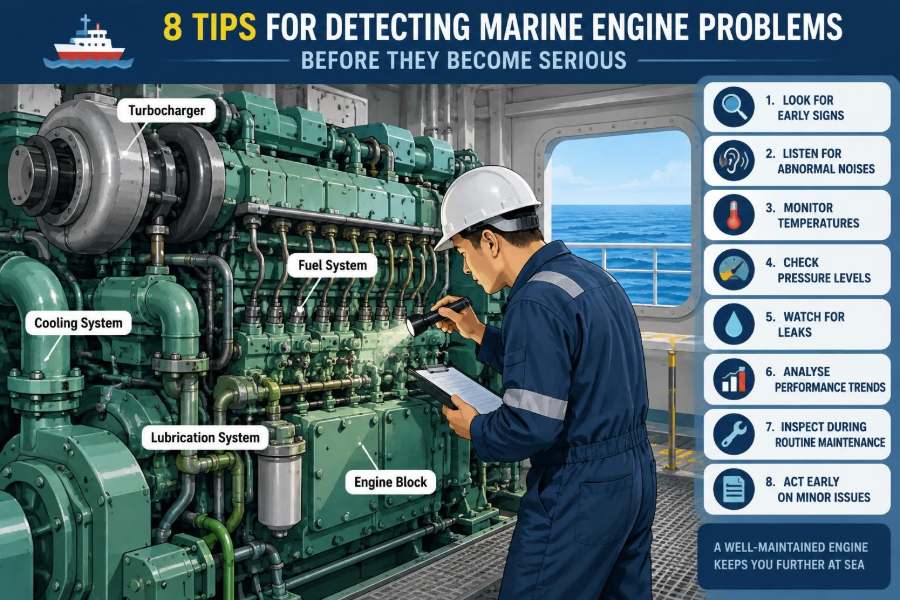

A main engine rarely fails without leaving clues. The clues may be a faint knock during a watch, a trend line that has started to climb, an oily patch where none was seen yesterday, or a cylinder exhaust temperature that no longer follows the others.
At sea, small abnormalities can be easy to postpone. The machinery is running, schedules are demanding, and a single odd reading may seem less urgent than the immediate job. But a developing fault does not pause because it is inconvenient.
Early detection gives the engineering team choices: reduce load, investigate safely, order spares, correct an operating condition, or plan maintenance before a defect becomes a blackout, loss of propulsion, or major repair.
The aim is not to react to every variation with alarm. It is to recognize what is normal for a particular engine, identify meaningful changes, and verify them methodically.
🧭 Start with a Reliable Baseline
Condition monitoring begins with knowing the engine’s normal behaviour. Record pressures, temperatures, load, speed, fuel consumption, vibration observations, and fluid levels at consistent operating conditions wherever possible.
A single reading has limited value. A jacket-water temperature of 82°C, for example, may be acceptable on one engine and unusual on another. The more useful question is whether it has changed from its established pattern at the same load.
Keep in mind that ambient air temperature, seawater temperature, fuel grade, vessel draft, and weather can affect readings. A baseline is not one fixed number; it is an expected operating range with reasons for variation.
📋 Treat Logbook Trends as an Early-Warning System
Engine-room logs are most valuable when they reveal direction. A gradual rise in lube-oil temperature, repeated small coolant top-ups, or a slowly falling scavenge pressure can indicate deterioration long before an alarm activates.
Compare like with like: similar load, similar speed, and, where relevant, similar fuel mode. Plotting selected parameters makes slow movement much easier to see than scanning handwritten columns.
- Watch for values that steadily move toward alarm limits.
- Compare cylinder-to-cylinder readings, not only overall averages.
- Investigate sudden step changes after maintenance or a fuel change.
- Record corrective actions so later watchkeepers can judge whether they worked.
👂 Listen for Changes in Mechanical Sound
An experienced engineer often notices a problem first by sound. Combustion knock, irregular firing, gear chatter, bearing rumble, air leaks, and loose guards each have a different character, although sound alone rarely identifies the exact defect.
Make listening part of the round at comparable engine loads. Use approved listening tools where provided, keep clear of moving machinery, and never lean into an unguarded coupling or rotating shaft.
A new metallic knock deserves prompt assessment because it may relate to combustion timing, injector condition, excessive bearing clearance, or loose components. Do not assume that a noise is harmless merely because the engine continues to run.
👃 Notice Smells Before They Become Smoke
Odours can provide useful warning: overheated insulation often has a sharp electrical smell, fuel vapour has an unmistakable hydrocarbon odour, and hot lubricating oil may signal a leak reaching a heated surface.
Smell should lead to a careful search, not a casual sniff near suspected vapours. Ventilate as required, use gas detection procedures where applicable, and follow the vessel’s safety system for any suspected fuel leak or fire risk.
A persistent burnt-oil smell around a turbocharger casing, for example, may justify checking for oil leakage, insulation contamination, abnormal bearing temperature, or exhaust-gas leakage. The source must be confirmed before deciding on the remedy.
👁️ Use Your Eyes During Every Machinery Round
Visual inspection remains one of the strongest low-cost diagnostic tools. Look for leaks, loose fasteners, rubbed pipes, damaged lagging, discoloured paint, abnormal vibration, poor housekeeping, and changes in the appearance of drains or filters.
Focus especially on interfaces: flanges, flexible connections, pump seals, injector pipes, expansion joints, valve spindles, and joints near hot surfaces. These are common places for vibration, thermal cycling, and pressure to reveal weaknesses.
Good lighting matters. A clean engine room also matters because fresh oil, coolant, or fuel is easier to identify against a clean background than on a surface already coated with grime.
🌡️ Compare Cylinder Exhaust Temperatures
For multi-cylinder diesel engines, individual exhaust temperatures are a practical window into combustion balance. One cylinder running significantly hotter or cooler than its neighbours at similar load should not be ignored.
A high temperature may be associated with late injection, an injector fault, poor atomization, restricted cooling, excess fuel, or poor air supply. A low temperature can point to weak combustion, low fuel delivery, compression loss, or an inaccurate sensor.
Sensor error is possible, so confirm a suspicious indication using approved methods before dismantling equipment. The useful diagnosis comes from combining exhaust data with fuel index, pressure readings, scavenge condition, and the engine’s operating history.
💨 Monitor Air Supply and Scavenge Performance
Diesel combustion needs the correct mass of clean air. Dirty air filters, fouled turbocharger components, leaking charge-air coolers, blocked drains, or scavenge-space contamination can reduce air supply and raise exhaust temperatures.
Check air-filter differential pressure where fitted, charge-air pressure and temperature, turbocharger speed or condition indicators, and scavenge drains. Changes should be assessed against load, because air pressure naturally responds to engine demand.
On a two-stroke engine, increased oil or carbon deposits in scavenge spaces require particular attention. They can indicate cylinder-liner, piston-ring, or combustion problems and may create a serious fire hazard if neglected.
🛢️ Read Lubricating Oil as Evidence
Lubricating oil carries information from bearings, gears, pistons, and hydraulic components. Milky oil can suggest water contamination, a strong fuel smell may indicate fuel dilution, and unusual darkening or deposits can reflect overheating or contamination.
Routine laboratory analysis, when available through the vessel’s maintenance program, can identify wear metals, viscosity changes, water, fuel dilution, soot, and additive depletion. It is a condition-monitoring tool, not a diagnosis by itself.
Take samples correctly. A sample from a stagnant drain or dirty bottle may misrepresent the system. Use the designated sampling point, clean containers, and repeatable procedures so results can be compared over time.
🔍 Check Filters and Strainers for What They Catch
A filter is not merely a service item; it is a collection point for evidence. Metallic particles, rubber fragments, fibre, paint flakes, carbon, or biological debris can indicate where a fault may be developing.
Inspect filter contents safely and record what is found. Fine grey paste may have a different significance from bright metallic flakes, but visual assessment alone cannot reliably identify every material or source.
If abnormal debris appears in a lube-oil filter, follow the manufacturer’s guidance and the vessel’s defect-reporting process. Continuing operation without considering the possible source can turn a localized wear problem into widespread damage.
💧 Track Cooling-Water Balance and Quality
Cooling systems often give early warnings through level changes, pressure instability, temperature spread, or water quality. Repeated need to add treated freshwater is not normal simply because a system is old; it means the loss or consumption should be explained.
Possible causes include external leakage, evaporative loss from a faulty vent arrangement, leaking cooler tubes, seals, or internal leakage. The correct investigation depends on the circuit and engine design.
Maintain treatment within the approved program. Poor water chemistry can encourage corrosion, scale, and deposits that restrict heat transfer. Conversely, overdosing chemicals can also create problems, so follow the specified testing and dosing instructions.
🔥 Investigate Any Sign of Local Overheating
Discolouration, burnt paint, smoking insulation, hot smells, or a noticeably hot bearing housing are signs to take seriously. Local overheating can result from friction, poor lubrication, electrical resistance, exhaust leakage, or inadequate cooling.
Non-contact temperature instruments can help compare similar components, but their readings depend on surface condition, distance, emissivity setting, and viewing angle. They are excellent for finding differences, while contact measurement or installed sensors may be needed for confirmation.
Never place hands near moving or hot machinery to “feel” a suspected temperature. A safe inspection method is part of accurate diagnosis.
📳 Take Vibration Changes Seriously
All engines vibrate, but a change in vibration level, direction, or frequency can reveal imbalance, misalignment, loose mountings, damaged bearings, combustion irregularity, or a coupling problem.
Simple observation is valuable: does vibration increase at a particular speed, after engaging a driven pump, or only under higher load? These patterns narrow the search.
Formal vibration analysis requires suitable instruments, reference data, and competent interpretation. It should complement—not replace—visual checks, operating data, and inspection of foundations, fasteners, and alignment.
⚙️ Watch Pressure Differentials, Not Just Pressures
A pressure reading can look acceptable while a restriction is growing. Differential pressure measures the difference across a filter, cooler, or other component and often shows whether flow resistance is increasing.
Examples include rising differential pressure across a lube-oil filter, an air filter, or a fuel filter. The value must be interpreted with flow and temperature in mind, but a rising trend usually warrants planned attention.
Do not wait automatically for a high differential-pressure alarm. Alarms are protective limits, not maintenance targets. An earlier intervention can prevent bypass operation, reduced flow, or contamination reaching sensitive components.
⛽ Treat Fuel-System Changes with Care
Fuel problems can appear as rough running, uneven exhaust temperatures, unstable speed, poor starting, increased filter blockage, or unusual smoke. Water, sediment, incompatible fuel residues, poor temperature control, and injector defects are among the possible contributors.
Verify fuel temperature, viscosity controls where fitted, supply and return pressures, purifier performance, and filter condition. Avoid changing several settings at once; doing so makes it harder to discover which action affected the result.
Fuel injection equipment operates at hazardous pressure. Follow isolation and manufacturer procedures, and never search for leaks with fingers or exposed skin. High-pressure injection injuries require urgent medical attention.
🌫️ Read Exhaust Smoke in Context
Exhaust appearance can help identify a developing issue, but it is not a complete diagnosis. Black smoke may be associated with excess fuel, restricted air, overload, or poor combustion. White or pale smoke may occur with unburnt fuel, cold combustion conditions, or water-related issues depending on the engine.
Blue-grey smoke can be associated with lubricating-oil burning, but lighting, weather, and fuel type can affect what is seen. Record the operating condition and compare with exhaust temperature, load, and fluid consumption.
A brief plume during a transient condition is different from persistent smoke at stable load. The duration and circumstances matter as much as the colour.
🔌 Include Electrical and Starting Systems
Engine reliability depends on more than the crankshaft and cylinders. Loose electrical terminals, weak batteries, failing chargers, contaminated sensors, poor grounding, and starter-motor faults can produce intermittent alarms or no-start events.
Look for heat discolouration at terminals, damaged cable insulation, corrosion, loose supports, and unusual voltage behaviour. Isolate electrical systems correctly before tightening or cleaning components.
Intermittent faults are especially difficult because they may disappear during inspection. Accurate records of the time, load, weather, alarm sequence, and actions taken can turn a vague complaint into a solvable pattern.
🧪 Confirm Sensors Before Assuming a Mechanical Failure
Modern engines rely heavily on transmitters, thermocouples, pressure switches, and control signals. A faulty sensor can mimic a serious mechanical issue, while a real fault can be missed if a sensor has drifted.
When a reading is implausible, compare it with related parameters and an independent approved measurement. A sudden isolated exhaust-temperature jump with no accompanying change in engine behaviour may suggest instrumentation, but it still needs verification.
Do not silence or bypass a protective alarm merely because a sensor is suspected. Use the vessel’s approved fault-finding and risk-control procedures.
🧰 Inspect After Maintenance and Disturbance
Many defects become evident after work has been completed: a gasket may not seal, a valve may be left in the wrong position, a tool may be missed, or a cable may be chafing because a support was not restored.
After maintenance, check fluid levels, leaks, guards, fasteners, isolations, alarms, and operating readings. Compare post-maintenance data with the pre-work condition.
A disciplined handover is essential. The watchkeeper should know what was changed, what remains under observation, which parts were renewed, and whether any temporary limitation applies.
📝 Use a Simple Fault-Detection Routine
Consistency prevents small clues from being lost in a busy watch. A practical routine can be brief, provided it is performed carefully and results are recorded.
- Observe from a safe distance: sound, vibration, smell, leaks, and alarms.
- Check key readings against normal trends at the current load.
- Compare parallel units and individual cylinders where applicable.
- Verify an abnormal indication with an independent safe method.
- Assess immediate risk and notify the responsible engineer.
- Record findings, actions, and the result of any intervention.
This sequence discourages guesswork. It also produces a useful trail for the next watch and for shore support if escalation is required.
🚨 Know When Observation Must Become Action
Not every deviation calls for shutdown, but some conditions demand immediate escalation under the vessel’s emergency and operating procedures. These may include fuel spraying near hot surfaces, rapid loss of lube-oil pressure, severe overheating, abnormal crankcase conditions, heavy smoke, or violent vibration.
The correct response depends on engine type, redundancy, operating situation, and the manufacturer’s instructions. Safety systems and the chief engineer’s directions take priority over informal rules of thumb.
Early detection is not an excuse to operate through danger. Its purpose is to create time for a safe, informed decision.
🧠 Avoid the “It Has Always Done That” Trap
Normalizing abnormal conditions is a common human error. A small leak, nuisance alarm, or recurring high temperature can become familiar enough that people stop questioning it.
Sometimes an old defect is controlled and documented. Often, however, familiarity hides a worsening condition or masks the evidence needed to identify a new fault.
Ask a better question: has the condition changed in frequency, severity, location, or response to load? If the answer is yes, reassess it rather than relying on memory.
👥 Make Detection a Team Activity
Engineers, motormen, electricians, deck personnel, and shore staff may each notice different signs. A deck report of unusual exhaust smoke, for instance, can be valuable when paired with engine-room data from the same time.
Clear reporting should describe facts before conclusions: what was observed, where, when, under what load, and whether it is getting worse. “No. 3 exhaust temperature 35°C above its usual relationship at 70% load” is more useful than “engine seems wrong.”
A blame-free reporting culture supports earlier intervention. People are more likely to report a weak signal when they know it will be assessed constructively.
📚 Follow the Engine Maker’s Limits and Procedures
Generic condition-monitoring advice cannot replace the engine manual. Alarm settings, allowable temperature spread, sampling intervals, fuel requirements, tightening sequences, and shutdown criteria vary by design.
Use approved manuals, planned-maintenance records, and company procedures when deciding inspection intervals or corrective actions. If data conflicts with the manual or a condition is unclear, seek competent technical support rather than improvising.
This is particularly important after modifications, software updates, fuel changes, or replacement of major components, because the expected operating baseline may need to be reviewed.
🛡️ Build Prevention into Daily Operations
The eight habits that most often expose developing engine problems are straightforward: establish a baseline, trend readings, use sight and sound during rounds, compare cylinders, inspect fluids and filters, monitor cooling and air systems, verify instruments, and act on meaningful change.
None is a substitute for planned maintenance, correct operation, or safety procedures. Together, however, they form a practical defence against surprises because they turn routine watchkeeping into evidence-based monitoring.
The core principle is simple: a marine engine usually tells you when its condition is changing, but only a disciplined observer can turn those signals into timely action.
Reliable machinery care is built from small, repeatable observations made before an abnormality becomes an emergency. Notice the change, verify the evidence, communicate clearly, and respond within the approved procedure. 🚢🔧⚓