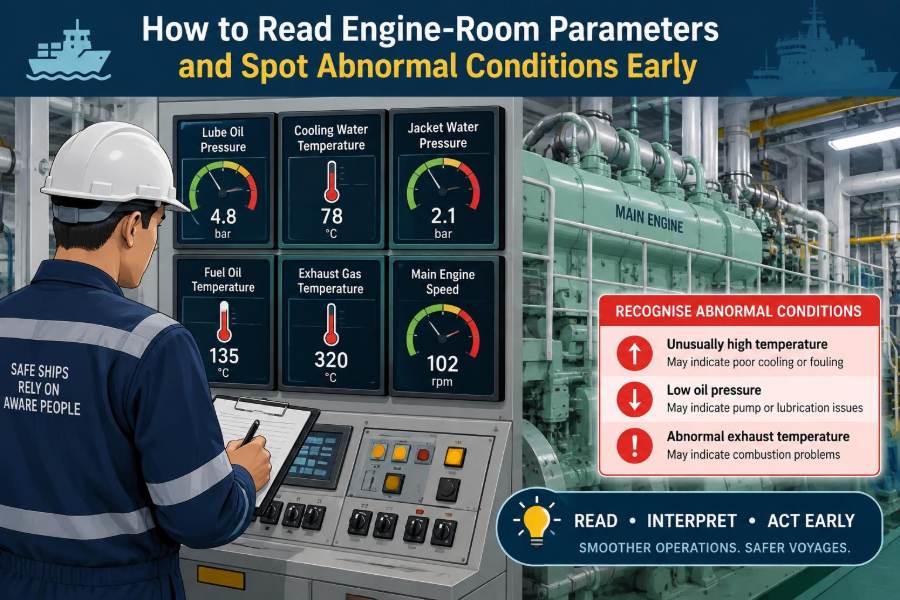

The engine-room watch can look deceptively calm. Pumps are running, the main engine is carrying load, and every digital display appears to show a number within a green band. Then a familiar temperature rises by a few degrees, a pressure needle begins to wander, or one cylinder starts behaving differently from its neighbours.
These are often the moments that decide whether a fault remains a manageable adjustment or develops into lost propulsion, damaged machinery, delayed cargo operations, or a safety incident. The warning is rarely a dramatic alarm at first. More often, it is a small change in a pattern.
Reading engine-room parameters well is therefore not the same as checking whether a number is above or below an alarm limit. It means understanding what the number represents, what normally influences it, and how it relates to other readings.
For cadets, junior engineers, and experienced watchkeepers alike, the practical skill is to turn rows of readings into a picture of machinery condition. This guide explains how to build that picture and act early without jumping to conclusions.
🧭 Start with the Purpose of Each Reading
Every parameter is a clue about one of four things: energy input, fluid condition, machine response, or protection. Fuel pressure describes supply conditions; jacket-water temperature describes cooling performance; exhaust temperature reflects combustion and load response.
Before recording a value, ask what physical process creates it. A lube-oil pressure reading is not merely a number to copy into a logbook. It indicates whether an oil film can be maintained at loaded bearings and other lubricated components.
This mental link makes abnormalities easier to interpret. If you know the process, you can begin to predict which other readings should change with it.
📍 Establish a Reliable Normal Baseline
“Normal” is specific to the vessel, engine type, operating mode, ambient conditions, and load. Manufacturer guidance, approved operating instructions, and alarm settings provide essential limits, but the best working baseline also comes from the machinery’s own stable history.
Compare like with like: readings at similar rpm, load, sea-water temperature, fuel grade, and machinery arrangement. A main engine at manoeuvring load will not have the same exhaust, scavenge, and cooling values as it has during steady sea passage.
Useful log entries include context, not just figures:
- main-engine load or rpm;
- generator load and units in parallel;
- sea-water and engine-room air temperature;
- pumps, coolers, or filters in service;
- recent maintenance, changeover, or operational event.
📈 Read Trends Before You Read Limits
An alarm limit is a protective boundary, not a target. A reading can be technically within its permitted range while moving in a direction that deserves attention.
For example, a slow fall in main lube-oil pressure across several watches may be more informative than one low-but-steady value known to occur at idle speed. Likewise, a gradual rise in cooler differential pressure can reveal fouling before flow becomes restricted enough to trigger an alarm.
Trend review is especially valuable after repairs. A parameter that changes immediately after a filter renewal, valve adjustment, or pump overhaul should be examined in relation to that work.
🔗 Use Relationships, Not Isolated Numbers
Machinery systems are connected. A temperature, pressure, level, or flow reading gains meaning when checked against related measurements.
Consider a hypothetical rise in jacket-water outlet temperature. The cause might be increased engine load, reduced cooling-water flow, a dirty cooler, trapped air, a thermostat problem, or an inaccurate sensor. Comparing inlet temperature, cooler sea-water temperatures, pump pressure, expansion-tank level, and engine load narrows the possibilities.
A sound watchkeeping habit is to ask: What else should change if my suspected cause is correct? If the expected supporting evidence is absent, reconsider the diagnosis.
🌡️ Understand Temperature as a Heat-Balance Signal
Temperature tells you where heat is being generated, transferred, retained, or rejected. It is often sensitive, but it must be interpreted with care because sensor location and response time matter.
A high outlet temperature may reflect high heat input, poor cooling, or reduced circulation. A small temperature difference across a cooler may indicate low heat load, excessive flow, bypassing, or poor measurement; it does not automatically prove the cooler is healthy.
Always distinguish between the actual temperature and the temperature difference across a component. The difference often says more about heat transfer than either reading alone.
💧 Read Cooling Systems from Both Sides
Cooling faults are frequently misdiagnosed because engineers look only at the fresh-water circuit. A cooler is a meeting point between two circuits, and both sides need consideration.
If central cooling performance deteriorates, check fresh-water inlet and outlet temperatures, sea-water inlet and outlet temperatures, sea-water pressure, filter condition, pump arrangement, and whether any bypass is open. Rising sea-water outlet temperature with normal flow may simply indicate increased heat rejection; a reduced pressure or abnormal differential may point toward restriction.
Marine growth, scale, air pockets, defective valves, and reduced pump performance can produce similar symptoms. Inspection and approved troubleshooting procedures are needed before assigning one cause with confidence.
🛢️ Treat Lubricating Oil as Both Fluid and Evidence
Lube oil must lubricate, cool, clean, seal, and protect surfaces from corrosion. Its pressure, temperature, level, and condition should therefore be read as a group.
Low pressure can result from low tank level, suction restriction, worn pump components, relief-valve leakage, excessive bearing clearance, low viscosity from high temperature, or a faulty transmitter. A pressure value alone cannot identify which one applies.
Watch the pattern. Low pressure with unusually high oil temperature may suggest viscosity loss or a cooling issue. Low pressure with stable temperature but a rising filter differential may point more directly toward a restriction. Follow the ship’s procedures before changing over filters or pumps.
🧪 Notice Oil Condition Beyond the Gauge
Some of the most useful oil information is sensory and laboratory-based rather than displayed on a control panel. Hazy oil can suggest water contamination; unusually dark oil, sediment, or a burnt smell may justify further investigation, depending on the oil type and service.
Purifier discharge, filter debris, drain samples, and routine laboratory analysis can reveal wear particles, fuel dilution, water, or loss of additive reserve. No single observation is definitive, but these findings can support or challenge conclusions drawn from pressure and temperature trends.
Sampling must be representative and clean. A poor sample can create a false concern or hide a developing problem.
🔥 Compare Exhaust Temperatures Cylinder by Cylinder
On multi-cylinder engines, exhaust temperatures are most useful as a comparison between cylinders at a similar stable load. One cylinder consistently above or below the group deserves attention even if it remains below its high-temperature alarm.
A higher reading may be associated with delayed injection, poor atomisation, injector leakage, reduced air supply, exhaust-valve leakage, or increased fuel quantity. A low reading may accompany reduced fuel delivery, poor compression, a sensor fault, or a cylinder that is not contributing normally.
Do not condemn an injector solely from one reading. Confirm load stability, compare scavenge conditions and peak-pressure information where available, and consider whether the thermocouple or its connection is reliable.
💥 Connect Combustion Data to Air Supply
Combustion requires fuel, air, compression, and correct timing. When exhaust temperatures rise across several cylinders, the fault may be common rather than individual.
Restrictions in the air filter, fouling on the turbocharger gas or air side, scavenge-air cooler fouling, leaking air ducts, or insufficient blower performance can reduce available air. The result may include higher exhaust temperatures, increased scavenge temperature, smoky exhaust, and altered turbocharger behaviour.
Engine load matters here. A temperature increase following a deliberate load increase may be expected; the concern is a disproportionate increase or a pattern that differs from previous performance at comparable load.
🌬️ Read Scavenge-Air Condition as a System Check
Scavenge pressure and temperature give a broad view of the main engine’s breathing. They are influenced by turbocharger output, air-cooler effectiveness, receiver cleanliness, engine load, and the condition of air-side components.
High scavenge-air temperature can reduce air density and leave less oxygen available in the same receiver volume. It can also increase thermal loading. Causes may include warm engine-room air, poor cooler performance, reduced cooling-water flow, or fouled cooler surfaces.
Scavenge-space inspections, carried out only in accordance with safe procedures, add valuable evidence. Excessive deposits, oil accumulation, or abnormal drain condition should never be treated as routine housekeeping.
🌀 Watch the Turbocharger Without Overinterpreting It
Turbocharger speed, charge-air pressure, exhaust temperatures, vibration, and sound are related indicators. A change in one may be meaningful, but the operating condition must be comparable before judging it.
A lower-than-usual speed at a given load can reflect reduced exhaust-gas energy, fouling, intake restriction, exhaust leakage, or instrumentation error. Conversely, high speed does not automatically mean healthy performance; it may occur alongside abnormal gas flow or load conditions.
Never approach a running turbocharger or disturb guards for a quick check. Use installed indications, approved inspection points, and the manufacturer’s maintenance instructions.
⚙️ Interpret Fuel Pressure and Temperature Together
Fuel viscosity changes strongly with temperature, especially for residual fuels. The fuel system needs the correct viscosity at the injection equipment, as specified for that engine and fuel arrangement.
Low fuel temperature can leave fuel too viscous, increasing pumping resistance and impairing atomisation. Excessive temperature can reduce viscosity too far and affect lubrication within fuel equipment. Pressure changes may also result from clogged filters, transfer-pump performance, return-line restrictions, or pressure-control valves.
During fuel changeover, readings may move as expected. The key is to follow the vessel’s approved changeover procedure, watch the rate of temperature change, and avoid treating every transitional reading as a defect.
⛽ Make Filter Differential Pressure Actionable
Differential pressure measures the pressure drop across a filter. As contamination accumulates, resistance increases and the difference between inlet and outlet pressure generally rises.
The useful question is not simply whether the differential is high. Ask whether it is increasing rapidly, whether flow or downstream pressure is affected, and whether the standby unit is ready. A sudden rise may indicate a batch of contaminated fuel or a disturbed tank condition rather than ordinary gradual loading.
Changing a filter too early can waste service life; waiting too long can starve equipment or force an inconvenient changeover. Follow vessel-specific limits and monitor the rate of change.
🔌 Assess Generators by Load Sharing and Quality
For auxiliary engines, electrical values are inseparable from mechanical condition. Kilowatts, current, voltage, frequency, power factor, fuel rack or injection index, and exhaust temperatures together show how a generator is responding.
When generators run in parallel, unequal load sharing can overload one unit even though the total plant load appears acceptable. A governor, load-sharing, excitation, or control issue may be involved, but diagnosis should follow the installed system documentation.
Electrical instability can also originate outside the generator: large cycling consumers, fault conditions, or switching events affect the plant. Watch both the generator panel and the operating context.
🔋 Separate Battery Symptoms from Charging Symptoms
Battery voltage alone is a limited health indicator. A battery may show normal voltage at rest yet drop severely under a starting load; alternatively, a normal charging voltage does not prove each battery cell is healthy.
Check charge current or charging status, electrolyte and cell condition where applicable, terminal cleanliness, temperature, charger alarms, and starting performance. Repeated slow cranking should be reported and investigated before an emergency start is required.
Battery work carries electrical and chemical hazards. Use the vessel’s safety procedures, correct PPE, and ventilation requirements rather than improvising tests.
🚰 Track Tank Levels as Dynamic Measurements
Tank levels are often treated as inventory figures, but they are also early fault indicators. A falling expansion-tank level may indicate leakage, venting issues, or changing system condition. A rising bilge level can signal leakage, overflowing drains, or poor segregation.
Rate matters. A small change after topping up, temperature variation, or transfer may be expected. A steady unexplained trend deserves prompt tracing because the location of a leak is usually easier to find before secondary effects appear.
Verify suspicious levels by an approved independent method where possible. Remote transmitters can drift, stick, or be affected by vessel motion.
🧯 Treat Bilge and Leakage Alarms as Clues, Not Nuisances
A bilge high-level alarm is a protective warning, not a command to silence and move on. The immediate priorities are to identify the liquid, establish its source, prevent escalation, and comply with the vessel’s pollution-prevention procedures.
Clear water may originate from a cooler, gland, drain, or condensation source; oil contamination changes the urgency and response. A leaking mechanical seal can initially look minor but may indicate deteriorating alignment, bearing condition, or seal faces.
Good housekeeping makes these changes visible. Dirty bilges hide the colour, source, and rate of a leak until the evidence becomes much harder to interpret.
📊 Know the Difference Between Alarms, Trips, and Trends
An alarm calls for attention. A trip or shutdown protects machinery by stopping or limiting it when a dangerous condition is detected. A trend is an observed change that may require action before either protective level is reached.
| Signal | What it usually means | Watchkeeper response |
|---|---|---|
| Stable normal reading | Condition is consistent with the current operating state | Record and continue routine monitoring |
| Adverse trend | Condition is changing before a set limit is reached | Verify, compare related parameters, inform as required |
| Alarm | Preset condition requires attention | Respond under standing orders; find and address the cause |
| Trip or shutdown | Protective function has acted or is imminent | Make safe, follow emergency or operating procedures, report |
Never alter alarm or trip settings casually to stop recurring alerts. Repeated alarms are information about a condition, a configuration issue, or a faulty instrument that needs formal correction.
🧭 Verify the Instrument Before Declaring a Fault
Instruments fail too. A sudden impossible jump, a value that does not respond to a major operating change, or a disagreement between duplicate indicators may be a measurement problem rather than machinery deterioration.
Verification may include comparing local and remote gauges, checking another related parameter, inspecting impulse lines where relevant, confirming valve positions, or using an approved portable instrument. Avoid creating a hazard by opening hot, pressurised, or fuel-containing systems merely to test a suspicion.
A faulty sensor still requires attention. If it provides an alarm, shutdown input, or control signal, its unreliability can reduce the safety margin of the entire system.
📝 Build Logbook Entries That Support Diagnosis
A useful logbook preserves the story of the plant. Enter readings clearly, at consistent intervals, and with enough context that the next watch can understand a change.
When something is abnormal, record the observed value, time, load, related readings, actions taken, response, and who was informed. Avoid vague notes such as “checked okay” when a specific observation can be written.
For example, “No. 3 exhaust 35°C above cylinder average at steady load; local indication compared with monitoring system; duty engineer informed” is far more useful than “No. 3 high.”
👀 Use Your Senses Alongside the Monitoring System
Engine-room rounds remain essential even on highly automated ships. Sight, sound, smell, and touch—used safely—can detect information that a screen may not show.
Look for vibration, leaks, loose fasteners, abnormal smoke, or staining. Listen for changed pump noise, bearing rumble, air leaks, or irregular firing. Smell can reveal overheated insulation, fuel vapour, or deteriorating oil, but never rely on it where toxic or flammable atmospheres may be present.
Do not touch unguarded moving machinery or hot surfaces. Use safe observation methods and treat a changed sensory condition as a reason to check instruments, not as proof of a diagnosis.
🧩 Diagnose by Elimination, Not Guesswork
A disciplined approach prevents a plausible first idea from becoming an unsupported conclusion. Start with the symptom, list likely categories of causes, and test the safest, simplest explanations first.
- Confirm the operating condition and the reading.
- Compare it with previous values at similar load.
- Check related parameters and recent changes.
- Inspect accessible, safe, and likely causes.
- Escalate and follow approved fault-finding procedures.
If an auxiliary engine has high cooling-water temperature, for instance, do not immediately assume a blocked cooler. Check load, coolant level, pump status, valve line-up, inlet and outlet temperatures, and alarm reliability before arranging further work.
⚠️ Avoid the Most Common Reading Errors
Many avoidable mistakes arise from routine, not lack of technical knowledge. Copying old log values, reading the wrong scale, overlooking units, and comparing values from different loads can conceal meaningful change.
- Do not assume a green display means the condition is healthy.
- Do not compare a cold-engine value with a fully warmed-up baseline.
- Do not reset an alarm without understanding why it operated.
- Do not make uncontrolled adjustments to “bring the number back.”
- Do not ignore a repeated small deviation because it has not yet caused a trip.
The opposite mistake is overreaction. A single unusual value should prompt verification and proportionate action, not panic or unsafe intervention.
🛠️ Link Parameter Changes to Recent Work
After maintenance, a focused monitoring period is good engineering practice. A newly cleaned cooler, changed filter, adjusted valve, replaced sensor, or reassembled pump can alter normal readings immediately.
Some changes are expected: pressure drop across a clean filter may decrease, or a repaired cooler may improve temperature margin. Others may reveal incomplete restoration, incorrect valve alignment, air ingress, leakage, or a calibration issue.
Document the before-and-after condition where possible. This turns maintenance into a learning opportunity and provides evidence if later troubleshooting is needed.
🗣️ Escalate Early and Communicate Precisely
Early reporting is not an admission of failure; it is part of safe watchkeeping. Inform the responsible engineer according to standing orders when a trend is unexplained, a protective system operates, redundancy is lost, or the condition may affect propulsion, power, safety, or pollution prevention.
Give a concise factual report: what changed, when it changed, the operating condition, related readings, actions already taken, and current status. Avoid presenting an uncertain theory as fact.
“Lube-oil pressure is gradually falling at constant load; temperature remains stable; standby pump is available; local gauge agrees with remote indication” helps the next decision-maker act efficiently.
📚 Use Manuals and Standing Orders as Working Tools
Generic rules are useful for learning, but each vessel has its own machinery layout, alarm philosophy, approved operating ranges, and emergency arrangements. The manufacturer’s manual and company procedures take priority over broad advice.
Know where to find alarm setpoints, normal operating data, changeover instructions, valve diagrams, maintenance history, and emergency checklists. Familiarity before a problem occurs is far more valuable than searching under pressure.
Where data conflict, do not invent a rule. Verify the documentation, seek guidance through the chain of command, and preserve a safe operating margin.
🎯 The Core Habit: Detect Change, Confirm Meaning, Act Safely
Effective parameter reading is a cycle: observe a change, place it in operating context, compare related evidence, verify the measurement, and take or report the appropriate action. It combines technical knowledge with patience and disciplined communication.
The goal is not to memorise every perfect number. It is to recognise when the engine room is no longer behaving like itself and to understand enough about the system to respond before protective limits are challenged.
Small deviations are often the beginning of the story. A watchkeeper who records them accurately, investigates them logically, and escalates them at the right time gives the ship the best chance to correct a problem while options remain open.
Read parameters as connected evidence, not isolated figures: early abnormal-condition detection comes from trends, context, verification, and safe action. 🚢⚙️📈