
A container ship leaving port can look much the same as it did decades ago: steel hull, diesel-like exhaust, a slow turn toward open water. Yet beneath the deck, the decisions being made about its fuel, engines, tanks, and electrical systems are changing rapidly.
Shipping moves the raw materials, food, manufactured goods, and energy products that support daily life. It also consumes large quantities of energy because moving heavy cargo across oceans requires sustained power for days or weeks at a time.
For a chief engineer, a shipowner, or a cadet planning a career at sea, cleaner propulsion is not a distant environmental topic. It affects bunkering routines, machinery-space hazards, maintenance skills, cargo capacity, voyage planning, and the reliability expected from every voyage.
The race is not simply about choosing one “green fuel.” Methanol, ammonia, batteries, biofuels, shore power, and wind-assist devices all solve different parts of the problem. The most useful question is: which combination fits a particular vessel, route, and operating profile?
🌍 Why Shipping Is Under Pressure to Change
Most ocean-going ships have traditionally used fossil marine fuels because they are energy-dense, widely available, and practical to store on board. Burning them releases carbon dioxide, while fuel quality and combustion can also contribute to air pollutants such as sulfur oxides, nitrogen oxides, and particulate matter.
International and regional rules are tightening, while cargo owners and financiers increasingly examine a vessel’s emissions performance. The International Maritime Organization has a greenhouse-gas strategy, and many operators now face efficiency requirements that influence both newbuild design and day-to-day operation.
The engineering challenge is unusually demanding: ships cannot simply stop to recharge every few hours. Their energy system must work across long distances, rough weather, changing loads, and ports with uneven fuel infrastructure.
⚓ The Real Meaning of Decarbonizing a Ship
Decarbonization means reducing greenhouse-gas emissions across the full fuel lifecycle, not merely changing what leaves the funnel. A fuel may produce little or no carbon dioxide on board yet still have significant emissions if its production uses fossil energy.
Engineers often separate this into tank-to-wake emissions, produced during onboard use, and well-to-wake emissions, covering production, processing, transport, and use. Both perspectives matter when comparing fuels.
A low-carbon pathway can therefore involve cleaner fuel, less fuel consumption, or both. Improving hull efficiency and using wind assistance can reduce energy demand even before a new fuel is introduced.
🔋 Why Marine Energy Is Hard to Replace
Liquid fuels have historically dominated shipping because they pack substantial usable energy into a relatively small volume. A bulk carrier crossing an ocean needs an energy store far beyond the practical size and mass of current battery systems.
Alternative fuels often need larger tanks than conventional fuel oil for the same voyage energy. Those tanks can compete with cargo space, ballast arrangements, machinery access, and stability margins.
That does not make alternatives unsuitable. It means fuel choice begins with an energy balance: required propulsion power, auxiliary load, voyage duration, reserve policy, bunkering opportunities, and the space available for safe storage.
🧭 Different Ships Need Different Answers
A ferry making repeated short crossings can use batteries or hybrid power because it returns regularly to a charging point. A deep-sea tanker may need a liquid fuel that can be stored for weeks and bunkered in major trading hubs.
Operational pattern matters as much as ship type. A vessel that spends long periods alongside may gain more from shore power than one that makes rapid port calls. A slow-moving bulk carrier on a favorable route may be a strong candidate for wind-assist technology.
There is unlikely to be one universal marine fuel. A practical future fleet will probably use several energy pathways.
🍃 Efficiency Comes Before Fuel Switching
The cleanest unit of fuel is the one a ship does not need to burn. Reducing demand lowers emissions immediately and can reduce the size, cost, and frequency of alternative-fuel bunkering.
Useful measures include hull cleaning, propeller polishing, trim optimization, weather routing, speed management, machinery tuning, and recovery of waste heat where technically viable. Individually modest changes can matter because main engines run for long periods.
Efficiency is not a substitute for low-carbon energy, but it makes every fuel pathway easier to deploy. A ship requiring less power has more flexibility in tank volume, machinery selection, and voyage planning.
🧪 Methanol: A Practical Early Mover
Methanol is a liquid alcohol that can be used in suitably designed marine engines. It has attracted attention because it is liquid at ambient conditions, making storage and transfer more familiar than for cryogenic fuels.
Methanol can be made from fossil feedstocks, biomass-derived sources, or synthetic pathways using captured carbon and hydrogen. Its climate value depends heavily on that production route. Calling all methanol “green” would hide an essential distinction.
For operators, methanol’s appeal is partly logistical: it can be handled with liquid-fuel systems adapted for its chemical properties, and engines capable of operating on methanol are already entering service.
🛢️ What Methanol Changes On Board
Methanol has lower energy density than conventional marine fuel, so a ship generally needs more tank volume for comparable range. Newbuilds can incorporate this early; retrofits may face difficult space and piping constraints.
It is also toxic and flammable. Its flame can be difficult to see in some conditions, so machinery-space design, gas detection, ventilation, drainage, material compatibility, firefighting arrangements, and crew procedures need careful attention.
Many methanol installations use dual-fuel engines. This can provide operational flexibility where low-carbon methanol is unavailable, but the actual emissions benefit still depends on how much low-carbon fuel is used.
🌱 The Methanol Supply Question
A ship fitted for methanol is not automatically operating with low lifecycle emissions. Conventional methanol may reduce some local air-pollutant concerns compared with certain fuel oils, but its greenhouse-gas outcome depends on feedstock and production energy.
Bio-methanol and renewable synthetic methanol can offer lower lifecycle emissions when responsibly produced, but supplies are limited relative to potential shipping demand. Certification and transparent accounting are therefore central, not administrative extras.
Procurement teams need to ask what the fuel is made from, what energy powered its production, and whether its claimed attributes can be credibly traced.
⚗️ Ammonia: Carbon-Free at the Funnel
Ammonia contains no carbon. When used as a fuel, it does not produce carbon dioxide from the fuel molecule itself. This makes it a prominent candidate for long-range shipping where batteries are not practical.
However, ammonia is not automatically low-carbon on a lifecycle basis. Most global ammonia production has historically depended on fossil-based hydrogen. Renewable electricity and low-carbon hydrogen are needed to create genuinely low-emission ammonia pathways.
Its potential is significant, but so are the engineering and safety demands. Ammonia should be understood as a new shipboard hazard system, not simply a replacement liquid in an existing tank.
☣️ Ammonia’s Safety Case Is Fundamental
Ammonia is toxic to people and harmful to aquatic life at sufficient concentrations. A leak can create a serious hazard, particularly in enclosed or poorly ventilated spaces.
Safe use requires containment, segregated piping, leak detection, ventilation, emergency shutdown, protective equipment, access control, drills, and clear interfaces between ship and shore. Design must consider credible leak scenarios rather than assuming normal operation will always prevail.
Crew competence is just as important as hardware. A robust safety management system must explain alarm responses, evacuation boundaries, decontamination arrangements, communications, and the limits of emergency intervention.
🔥 Combustion Challenges With Ammonia
Ammonia is harder to ignite and burns more slowly than conventional marine fuels. Engines may need pilot fuel, ignition support, or carefully controlled combustion strategies, depending on their design.
Another concern is ammonia slip: unburned ammonia escaping in exhaust. Nitrous oxide can also form under some conditions and is a potent greenhouse gas, so combustion development and exhaust treatment are critical parts of the environmental case.
These issues do not rule out ammonia engines, but they show why real-world performance must be evaluated across safety, reliability, emissions, and maintenance—not by carbon content alone.
🧊 Storage, Tanks, and Lost Space
Ammonia is commonly stored under pressure or at low temperature, depending on the system design. Both choices affect tank construction, insulation, pressure management, location, and the arrangement of adjacent spaces.
Fuel tanks may need cofferdams, protected locations, and dedicated fuel preparation rooms. The knock-on effects can reach accommodation layout, cargo capacity, structural design, and damage-stability calculations.
Early design decisions have great value. Retrofitting a mature vessel around large alternative-fuel tanks can be possible, but it is often more constrained and expensive than designing the space from the keel up.
🌬️ Wind Assist Is Not a Return to Sailing Ships
Wind-assisted propulsion uses aerodynamic devices to reduce engine power demand. It does not usually mean relying on wind alone or abandoning schedule reliability.
Modern systems may include rotor sails, rigid wing sails, suction wings, towing kites, or automated soft sails. Sensors and control systems can adjust or stow equipment as conditions change.
The principle is familiar: use wind energy when it is available so the main engine supplies less propulsive power. The vessel remains engine-powered, but its fuel bill and emissions can fall on suitable routes.
🌀 Rotor Sails and the Magnus Effect
A rotor sail is a tall rotating cylinder. Airflow around the spinning cylinder creates a force known as the Magnus effect, which can generate thrust when the apparent wind approaches at a useful angle.
Rotor sails consume electrical power to spin, so their benefit is the net result after that demand is counted. Their performance depends on wind conditions, ship speed, route, arrangement, and how much aerodynamic force can be converted into useful thrust.
They are most credible when evaluated with actual operational data rather than a single favorable weather case.
🪽 Wings, Sails, and Kites Compared
| System | Basic operating idea | Key design consideration |
|---|---|---|
| Rotor sail | Rotating cylinder produces aerodynamic lift | Deck foundations, visibility, electrical demand |
| Rigid wing sail | Adjustable airfoil creates thrust | Air draft, cargo operations, automation |
| Soft sail or suction wing | Controlled sail surface uses apparent wind | Stowage, handling, route suitability |
| Towing kite | High-altitude kite pulls the vessel forward | Launch and recovery in operating conditions |
No device is best for every ship. Container cranes, bridge sightlines, air-draft restrictions, deck cargo, and port routines can determine whether a concept is feasible.
🗺️ Route and Weather Decide Wind Value
Wind-assist performance is route-specific. A ship regularly encountering favorable crosswinds or following winds may gain more than a vessel operating where winds are weak, head-on, or highly variable.
Seasonal weather patterns matter too. A concept that performs well on annual average may still need to fit schedules, loading windows, and safety margins during less favorable periods.
Before installation, owners should use voyage data, weather records, and realistic speed assumptions. A hypothetical saving calculated at one wind angle is not a guaranteed annual result.
🏗️ The Hidden Structural Work of Wind Assist
A tall wind-assist device introduces substantial loads into the deck and supporting structure. Naval architects must assess local strength, fatigue, global hull response, stability, and the effect of wind heeling.
Air draft may limit passage under bridges or access to particular ports. Devices may need folding or tilting mechanisms, which add moving parts, controls, inspection tasks, and failure modes.
Deck layout is equally important. Crew still need safe routes for mooring, cargo work, emergency access, and routine maintenance.
🔌 Batteries Have a Clear but Focused Role
Batteries are highly effective where vessels have short routes, predictable charging opportunities, or variable electrical loads. Ferries, harbor craft, offshore support vessels, and port equipment are common candidates.
On larger ships, batteries can support hybrid operation, peak shaving, spinning reserve, hotel loads in port, or smoother integration of renewable electricity. They can also reduce the need to run auxiliary generators inefficiently at low load.
For long ocean voyages, battery mass and volume remain major constraints. Their strongest role is often targeted electrification rather than full replacement of liquid fuels.
⚡ Shore Power Reduces Port-Side Emissions
Shore power allows a berthed ship to switch off some onboard generators and connect to the local electrical grid. This can reduce noise, vibration, and emissions near populated port areas.
The total climate benefit depends on the grid’s generation mix, and the system requires compatible ship and terminal equipment. Connection procedures, cable management, frequency and voltage compatibility, and berth availability all matter.
Shore power is a reminder that cleaner shipping extends beyond the vessel. Ports, utilities, fuel suppliers, and regulators are part of the propulsion transition.
🛠️ Biofuels and Drop-In Blends
Some biofuels can be blended with, or used in place of, conventional marine fuels with limited machinery changes, subject to fuel specifications and engine-maker guidance. This makes them attractive as a near-term option for existing fleets.
Yet “biofuel” describes many feedstocks and production pathways. Lifecycle emissions, land-use impacts, traceability, storage behavior, and compatibility all require scrutiny.
Engineers should treat a new blend as a managed fuel change. Sampling, stability checks, tank cleanliness, microbial risk, filter monitoring, and supplier documentation can prevent avoidable operational problems.
💧 Hydrogen Has Promise and Constraints
Hydrogen can be used in fuel cells or combustion systems and produces no carbon dioxide at the point of use. It is especially relevant to some short-sea applications and as an ingredient for producing ammonia or synthetic fuels.
Its very low volumetric energy density creates storage challenges. Compressed or liquefied hydrogen needs specialized tanks, and liquefied systems require very low temperatures.
Hydrogen is therefore likely to appear in selected marine segments rather than as an easy direct replacement for every deep-sea fuel application.
🔧 Engines, Fuel Cells, and Hybrid Architectures
Internal-combustion engines remain familiar, robust marine machines and can be adapted for several new fuels. They are likely to coexist with fuel cells, batteries, shaft generators, and power-management systems for many years.
Fuel cells convert chemical energy to electricity electrochemically. They can be efficient and quiet, but their cost, durability, fuel purity requirements, and scale remain important practical considerations.
A hybrid architecture is valuable when loads vary. For example, batteries may absorb rapid load changes while engines or fuel cells operate in a steadier, more efficient range.
📏 Measuring Emissions Without Misleading Yourself
Fuel consumption per nautical mile is useful, but it does not tell the full story. Cargo carried, speed, weather, port time, and fuel origin all affect the interpretation.
Lifecycle accounting should avoid double counting and should state the system boundary clearly. A low tank-to-wake result does not automatically mean a low well-to-wake result.
Data quality matters. Flow meters, bunker delivery documentation, engine logs, weather data, and cargo records need consistent handling if an operator wants emissions reporting that supports real engineering decisions.
📜 Rules Are Shaping Design Choices
Marine fuel transitions operate within a framework of international conventions, flag-state requirements, classification rules, port regulations, and company procedures. Requirements evolve as technologies mature, especially where fuel toxicity, flammability, pressure, or cryogenic storage introduce new hazards.
For novel fuel systems, approval may involve detailed hazard identification and risk assessment. Classification societies, engine makers, shipyards, insurers, and authorities all have roles in building an acceptable safety case.
Compliance should not be treated as a final paperwork step. It is most effective when integrated into concept design and operating procedures from the start.
🧑🚒 Crew Training Is a Design Requirement
New fuels change the competencies needed at sea. Engineers and deck officers may need training in fuel properties, bunkering communication, detection systems, emergency isolation, ventilation logic, and personal protective equipment.
Training should include realistic drills. An alarm response is stronger when crew have practiced locating the hazard, accounting for personnel, isolating systems, and deciding when not to enter a contaminated space.
Human factors matter during routine work as well. Clear valve labeling, accessible manuals, alarm prioritization, and sensible maintenance access reduce the chance that a complex system becomes difficult to operate under pressure.
⛽ Bunkering Is the Critical Interface
Bunkering brings together ship, terminal, fuel supplier, transfer equipment, and people working under time pressure. For alternative fuels, this interface may be one of the highest-risk stages of operation.
Transfer procedures need agreed communications, emergency shutdown arrangements, connection checks, exclusion zones, spill or leak response plans, and confirmation of fuel quality. The correct checklist depends on the fuel and installation.
Infrastructure is developing unevenly. A ship can only use a fuel reliably if safe, verified supply is available where its trade requires it.
💰 Cost Is More Than the Price of Fuel
Comparing fuels by bunker price alone can be misleading. The real decision includes tank volume, lost cargo capacity, machinery cost, installation work, maintenance, crew training, insurance considerations, and access to supply.
There is also commercial risk in choosing a pathway before standards and infrastructure fully settle. Conversely, waiting too long may leave a vessel exposed to future operating restrictions or less attractive to charterers.
A lifecycle cost assessment cannot predict every market change, but it can reveal which assumptions most influence a project: fuel availability, utilization rate, carbon exposure, route flexibility, or remaining vessel life.
🔄 Newbuilds and Retrofits Need Different Thinking
A newbuild can integrate tanks, ventilation trunks, double barriers, electrical capacity, and machinery arrangement from the outset. It may also be designed “ready” for a future fuel, although readiness should be defined precisely rather than used as a vague label.
A retrofit starts with constraints: existing structure, available deck space, cargo commitments, drydock duration, stability, and the remaining economic life of the ship. Sometimes an efficiency retrofit or wind-assist installation is more practical than a full fuel conversion.
The best choice is not always the most technologically ambitious one. It is the one that safely delivers meaningful improvement within the vessel’s actual operating life.
🧩 Avoid the Single-Technology Trap
It is tempting to frame the transition as methanol versus ammonia versus wind. In practice, these options can complement each other because they address different parts of the energy problem.
A vessel might combine an efficient hull, optimized routing, a dual-fuel engine, batteries for auxiliary peaks, shore power in port, and wind assistance at sea. Each component reduces a different source of fuel use or emissions.
System integration is the hard part. Controls, electrical load management, machinery redundancy, safety zones, maintenance planning, and crew workload must work together.
🔍 A Practical Evaluation Sequence
- Define the vessel’s real duty cycle: route, speed, cargo, port stays, weather, and remaining life.
- Reduce demand first through hull, propeller, operational, and machinery efficiency measures.
- Compare fuel pathways on both onboard and lifecycle emissions.
- Check tank volume, safety zones, structural changes, and cargo impacts.
- Confirm bunkering availability and fuel-quality assurance at relevant ports.
- Build training, maintenance, emergency response, and regulatory approval into the project plan.
This sequence prevents a common mistake: selecting a technology because it sounds promising before confirming that it fits the ship’s operation.
🎓 Skills Marine Engineers Will Need
The future engineer will still need strong foundations in thermodynamics, engines, pumps, electrical systems, stability, and safety management. Those fundamentals make new technologies easier to understand rather than mysterious.
Additional value will come from familiarity with lifecycle emissions, automation, high-voltage systems, hazardous-area design, data analysis, and risk assessment. Communication skills matter too, because cleaner propulsion projects involve deck teams, shore staff, yards, suppliers, and regulators.
Curiosity is an operational asset. Fuel systems will evolve, and procedures that are correct for one vessel may be unsafe or irrelevant on another.
🚢 The Core Principle: Reduce Demand, Then Choose Wisely
Cleaner shipping will not be achieved by a single fuel announcement or one piece of deck equipment. It will come from matching technologies to real operating conditions and judging them by safety, lifecycle impact, reliability, and total system performance.
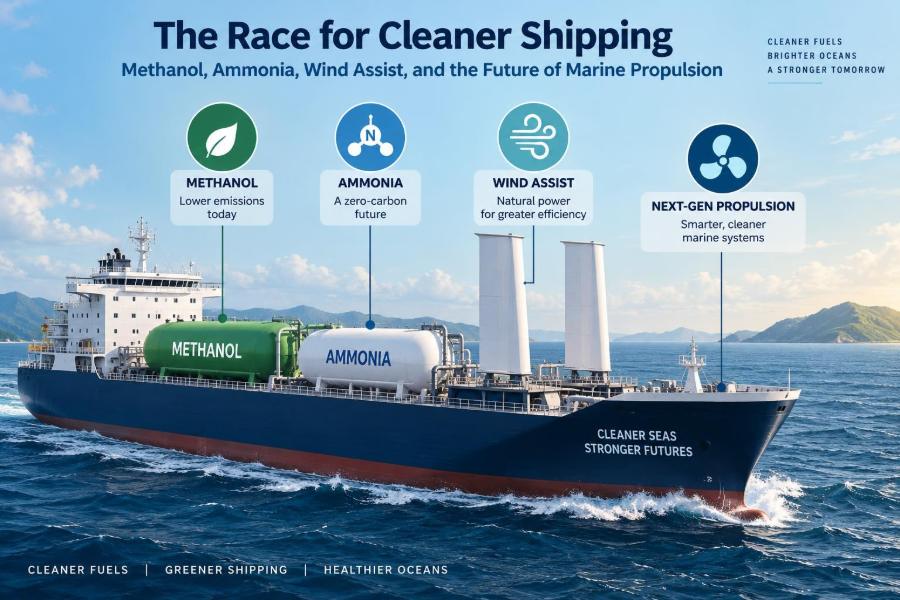
Methanol offers a relatively familiar liquid-handling route but requires credible low-carbon supply. Ammonia offers carbon-free onboard fuel use but demands rigorous toxicity control and careful emissions management. Wind assist can cut propulsion demand but depends on route, vessel design, and operations.
The strongest projects begin with efficiency, use honest emissions accounting, and treat crew readiness and bunkering arrangements as engineering essentials rather than afterthoughts.
The future of marine propulsion is not one winner-takes-all fuel race; it is a disciplined transition toward lower energy demand and safer, genuinely lower-emission energy systems. ⚓🌬️🌍