
A second engineer notices the same pattern across several vessels: recurring purifier alarms, rushed handovers, incomplete maintenance histories, and shore teams asking why a familiar fault keeps returning. The technical answer may be clear, but finding time to explain it between watches, port calls, and family life is another matter.
Many marine engineers have knowledge that is valuable beyond their present vessel or office. They understand how machinery behaves at sea, how procedures meet reality, and where apparently small decisions create expensive downtime or safety exposure.
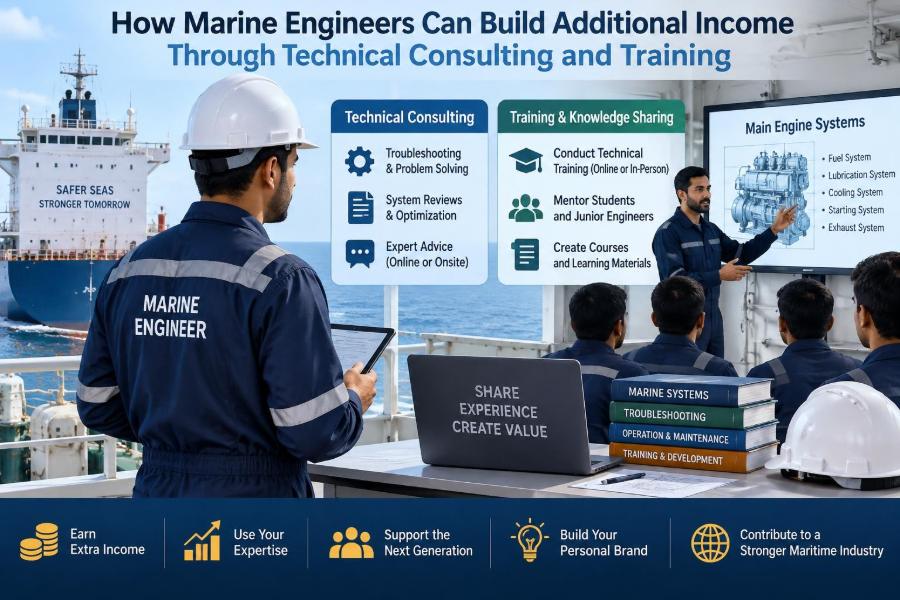
Technical consulting and training can turn part of that experience into additional income. They can also strengthen professional judgement, communication, and career resilience. But this work is not simply “giving advice” online; it requires a defined service, careful boundaries, and respect for confidentiality and safety.
The most sustainable approach starts small: solve a narrow, real problem for a clearly defined audience, deliver work to a professional standard, and build a reputation that does not conflict with the engineer’s main employment.
⚓ Why marine expertise has value beyond the vessel
Marine engineering sits at the intersection of machinery, operations, regulation, procurement, maintenance, and people. A practical insight about cooling-water treatment, planned maintenance, fuel changeover, or troubleshooting can be useful to vessel operators, technical managers, equipment suppliers, training providers, and junior engineers.
What clients often need is not a generic textbook explanation. They need someone who can connect a technical symptom to an operational decision: what to inspect first, what evidence to collect, when to stop and escalate, and how to prevent recurrence.
This is especially valuable when office staff, crew, and vendors each see only one part of the problem. A marine engineer can translate between those perspectives.
🧭 Start with a realistic definition of additional income
Additional income should complement, not endanger, the primary role that supports an engineer’s career and certificates. Sea-going schedules are irregular, internet access may be limited, and fatigue is a genuine safety concern. A side activity must fit those realities.
For most people, the early goal is not to replace a salary. It is to test whether a service is useful, repeatable, and manageable during leave periods or predictable shore-based hours.
A good test is simple: could you deliver this work to the agreed standard without using employer time, confidential information, or energy needed for safe watchkeeping? If not, redesign the offer before accepting work.
🔍 Choose a narrow problem you can solve well
“Marine consultant” is too broad for a new independent practice. A focused offer makes it easier for potential clients to understand what you do and for you to price, prepare, and deliver consistently.
Useful niches usually emerge from repeated experience rather than from the most fashionable topic. Examples include maintenance-system improvement, engine-room familiarisation, lubrication practice, machinery troubleshooting frameworks, technical report writing, or competency coaching for cadets.
- A former motorman may develop practical engine-room safety and maintenance training.
- A superintendent may offer structured review of maintenance backlogs and defect reporting.
- An automation-focused engineer may teach fault-finding logic for common control-system issues, without diagnosing a specific vessel remotely.
The narrower the first offer, the easier it is to demonstrate value. Expansion can come later when the work pattern is proven.
🧠 Inventory experience before selling expertise
Write down the problems you have handled, the decisions you supported, and the results you helped achieve. Avoid claiming sole credit for team outcomes, but do identify your actual contribution: investigation, documentation, training, coordination, or follow-up.
Then separate knowledge into three groups: subjects you can explain, tasks you can demonstrate, and outcomes you can help others improve. The third group is usually where consulting opportunities appear.
For example, “I know auxiliary boilers” is broad. “I can help a junior engineering team build a practical checklist for diagnosing unstable boiler water-level control” is a specific capability.
🎯 Identify the client, not just the technical topic
A course on fuel systems will look very different for cadets, experienced watchkeepers, technical office staff, or small vessel owners. Each group has different vocabulary, authority, equipment access, and consequences when something goes wrong.
Define one initial audience. Ask what they are trying to achieve, what mistakes they commonly make, and what format they can realistically use. A busy superintendent may want a concise review call and action list; cadets may need diagrams, quizzes, and guided exercises.
Clients buy clarity around a job to be done. They rarely buy a long list of everything an engineer has ever worked on.
🧩 Separate consulting, training, and coaching
These services overlap, but they should not be confused. Clear distinctions protect both the provider and the client.
| Service | Primary purpose | Typical deliverable | Key boundary |
|---|---|---|---|
| Technical consulting | Analyse a defined operational or technical issue | Findings, options, and an action plan | Do not promise outcomes outside your control |
| Training | Build knowledge or practical competence | Lesson, exercise, assessment, and materials | Do not imply formal certification unless authorised |
| Coaching | Support an individual’s development or decision-making | Structured sessions and goals | Do not replace employer supervision or competency assessment |
A client may need all three over time, but each should have its own scope. This prevents a short training session from quietly becoming open-ended operational consultancy.
🛠️ Package a first service that is easy to buy
A defined package reduces uncertainty. Instead of offering “technical support as needed,” describe a fixed problem, process, timeframe, deliverables, exclusions, and revision limit.
A practical starter offer could be a maintenance-programme review for one machinery category. The client provides agreed records; you review them against stated operating needs; then you provide observations, questions for follow-up, and a prioritised improvement list.
Another option is a two-hour online workshop on engine-room troubleshooting. It can include a case scenario, a fault-isolation sequence, and a short knowledge check. A clear package is easier to deliver repeatedly than completely custom work.
📋 Write a scope before you start technical work
Scope is the written boundary of the engagement. It should state what you will examine, what information the client must provide, what you will deliver, and what you will not do.
For example, a remote review of maintenance records is not a physical survey, a class inspection, a statutory audit, a design approval, or a guarantee of machinery condition. Those distinctions should be explicit, not hidden in a vague conversation.
- State the question being addressed.
- List assumptions and information sources.
- Set a delivery date and feedback process.
- Identify exclusions, including emergency response or onboard supervision.
- Record who may rely on the final document.
Good scoping is not bureaucracy. It keeps expectations proportional to the evidence available.
⚖️ Check employment contracts and conflicts of interest
Before earning outside income, review the employment contract, company policies, collective agreements where applicable, and any restrictions on secondary employment. Some employers require written disclosure or approval; others restrict competing work, use of company contacts, or work involving suppliers.
Do not use an employer’s reports, manuals, vessel data, photographs, templates, or paid training materials without permission. Even an apparently harmless example can expose confidential operating information.
If the proposed work overlaps with a current employer’s business, supplier network, or vessels, seek clear guidance. Independence is easier to defend when conflicts are identified before work begins.
🔒 Protect confidential information and intellectual property
Marine work often involves sensitive details: machinery failures, voyage schedules, commercial performance, crew information, security procedures, and vendor correspondence. Treat these as confidential unless you have clear permission to use them.
Build examples from fictionalised scenarios, public technical principles, or material you created independently. If a client shares records for a review, store them securely, limit access, and agree how long they will be retained.
Also decide who owns your deliverables. A client may own its specific report while you retain ownership of general methods, blank checklists, and independently developed teaching materials. Put the arrangement in writing.
🦺 Keep safety and professional limits visible
Marine machinery decisions can affect personnel safety, pollution prevention, vessel availability, and regulatory compliance. A consultant should be cautious about remote conclusions based on incomplete data.
Use language that matches the evidence: “possible causes,” “recommended checks,” and “consider escalation to the manufacturer, class, or a competent attending specialist” are often more responsible than definitive instructions. Never encourage a person to bypass procedures, alarms, permits, isolation requirements, or the vessel’s chain of command.
Where statutory, classification, design, or legal interpretation is involved, clients may need an authorised surveyor, designer, lawyer, manufacturer, or recognised training body. Knowing when to refer work is part of professional competence.
📚 Turn sea experience into teachable learning outcomes
Experience alone does not automatically produce good training. Learners need a clear statement of what they should be able to explain, identify, calculate, inspect, or decide by the end of a session.
Replace broad goals such as “understand fuel pumps” with observable outcomes: “trace the fuel path through the system,” “identify common symptoms of air ingress,” or “select safe first checks before dismantling.” These outcomes guide content and assessment.
Training improves when it moves from principle to symptom to decision. That mirrors the way engineers encounter faults in real operations.
🧪 Use realistic cases without claiming they are universal
Case-based learning is particularly effective in marine engineering because equipment condition and operating context matter. A learner remembers a troubleshooting sequence more readily when it is attached to a plausible scenario.
Label hypothetical cases clearly. For instance: a fictional vessel experiences repeated high jacket-water temperature after maintenance. Learners can identify information needed, rank possible causes, and discuss safe checks before deciding on action.
The aim is not to create a single “correct” diagnosis from sparse information. It is to teach disciplined reasoning: verify the symptom, protect safety, collect evidence, isolate variables, and escalate when limits are reached.
🖥️ Select a delivery format that fits maritime schedules
Live online training can create interaction and immediate questions, but time zones, connectivity, and sailing schedules can make attendance difficult. Recorded modules are flexible, yet require strong structure and may offer less accountability.
A blended format often works well: short pre-recorded lessons, downloadable exercises, and a scheduled live session for cases and questions. Keep files small enough for practical internet conditions where possible.
For consulting, asynchronous review can be more realistic than constant availability. Agree a response window rather than allowing urgent messages to redefine the engagement.
🧰 Build materials that work away from a perfect classroom
Marine learners may study on a vessel, in shared accommodation, or after a demanding shift. Materials should therefore be direct, legible, and useful without elaborate software.
Use simple system diagrams, checklists, decision trees, photographs you have permission to use, and short scenarios. A well-labelled sketch showing flow, pressure, temperature, and control signals can teach more than many slides of text.
Provide a practical takeaway: an inspection prompt sheet, a fault-report structure, or a maintenance planning template. Avoid presenting a generic template as a substitute for company procedures or machinery manuals.
🧾 Create reports clients can act on
A useful technical report separates facts, assumptions, interpretations, and recommendations. Readers should be able to see what evidence supports each conclusion and what still needs verification.
A dependable structure is: purpose, scope, information reviewed, observations, analysis, risks or limitations, recommended actions, and items requiring specialist confirmation. Use photographs, data extracts, or diagrams only when permission and confidentiality allow.
Prioritise actions by consequence and urgency rather than simply listing every possible improvement. A client needs to know what should be investigated first, who should own it, and what information is still missing.
💬 Learn to explain technical risk in plain language
Clients may understand operations well without sharing the engineer’s vocabulary. The ability to explain a risk plainly is a commercial skill and a safety skill.
Rather than saying “the system has poor resilience,” explain that a single failed component may stop an essential function because there is no effective backup or tested workaround. Then describe the operational consequence and the evidence needed to assess it.
Plain language does not mean oversimplification. It means preserving the technical meaning while making the decision clear to the person who must act.
💰 Price the work around scope and effort
Pricing depends on experience, complexity, client type, overheads, liability, preparation time, and local market conditions. There is no universal rate that suits every marine engineering service.
For a new provider, fixed pricing for tightly defined packages is often easier than open-ended hourly work. Estimate not only the delivery call or review time, but also preparation, correspondence, document formatting, revisions, administration, and taxes or platform costs where relevant.
Do not underprice work because it feels like “only a few hours.” A short workshop may rest on many hours of curriculum design. At the same time, do not charge for expertise you cannot yet demonstrate; build credibility through a narrow, well-executed offer.
🧮 Keep business records separate from shipboard records
Use separate files, accounts, and communication channels for independent work. This makes confidentiality easier to manage and helps distinguish personal consulting from employer responsibilities.
Keep basic records of agreements, invoices, expenses, delivered versions, client approvals, and time spent. Depending on where you live and operate, tax registration, invoicing rules, insurance, and business registration may apply.
Requirements vary by jurisdiction and client arrangement. A qualified accountant, business adviser, or lawyer can clarify obligations in your circumstances; technical skill alone is not enough to navigate them safely.
🛡️ Consider insurance and contractual risk carefully
A client may rely on advice when making operational decisions. If your work involves technical recommendations, professional indemnity or errors-and-omissions cover may be relevant, subject to the insurer’s terms and the nature of the service.
Insurance does not remove the need for good scope, careful records, and honest limitations. It may also exclude certain activities, territories, vessel types, or claims, so assumptions should be checked before relying on cover.
Use agreements that define liability and reliance in a manner appropriate to applicable law. Obtain professional advice for contracts with significant risk, cross-border elements, or complex technical responsibilities.
🌐 Build credibility through useful professional visibility
Marketing does not require dramatic claims. It can begin with consistently useful, non-confidential material: a short explanation of a maintenance concept, a fictional troubleshooting exercise, or a practical note on clearer defect reporting.
A professional profile should say who you help, which problems you address, your relevant experience, and how to make an enquiry. Avoid presenting certificates, endorsements, or affiliations in misleading ways.
Reputation in maritime work often travels through trust. A concise, accurate explanation of what you do is more effective than presenting yourself as an expert in every system afloat.
🤝 Use networks without exploiting relationships
Former colleagues, alumni groups, local maritime associations, and professional communities can help identify real learning needs. Approach them as communities, not as lists of sales targets.
Ask thoughtful questions: What technical topics are junior engineers struggling with? Which reports consume the most superintendent time? Where do handovers repeatedly fail? These conversations can reveal a service gap without requiring anyone to disclose sensitive information.
Never pressure current crew to buy personal services or use a position of authority to create business. Professional relationships must remain voluntary and appropriate.
🧑🏫 Run a pilot before building a large course
It is tempting to spend months recording a complete course. A smaller pilot is usually more informative. Deliver one workshop to a limited group, or conduct one defined review for a client with a genuine need.
Before the pilot, decide what you want to learn: whether the audience understands the examples, whether the timing works, which questions recur, and whether the deliverable changes a decision or behaviour.
Request specific feedback, such as which exercise was useful and where instructions were unclear. General praise is pleasant, but concrete feedback improves the next version.
📈 Measure value without promising machinery outcomes
Consulting and training can be valuable even when a provider cannot control final operational results. Measure what is reasonably connected to the service: completion of agreed actions, improvement in report quality, learner performance on a scenario, or reduction in repeated questions.
Do not claim that a training session will prevent failures, ensure compliance, or guarantee fuel savings. Machinery reliability depends on design, condition, maintenance, operation, environment, spares, and organisational decisions.
Instead, describe the intended contribution: clearer fault isolation, stronger maintenance planning, or more consistent escalation. This is accurate and helps clients set sensible expectations.
⏱️ Protect time, rest, and competency
Side work can become harmful if it consumes rest periods, distracts from watchkeeping, or creates pressure to respond while on duty. Fatigue affects judgement, and judgement is central to marine engineering.
Set operating rules: no consulting during watch or employer hours, no emergency availability unless explicitly contracted and practical, and no commitments that cannot survive an unexpected sailing schedule. Leave space for professional development and personal life.
Additional income is only worthwhile if it is sustainable. A modest, reliable service is stronger than a large promise followed by missed deadlines.
🚫 Avoid common early mistakes
Several mistakes repeatedly weaken new technical services. The first is accepting any project offered, which leads to work outside competence or beyond available time. The second is offering vague “advice” without a scope or written deliverable.
- Using confidential vessel material as portfolio content.
- Giving definitive remote instructions from incomplete evidence.
- Confusing attendance certificates with regulated competency certification.
- Ignoring employer approval requirements or conflicts of interest.
- Customising every project so heavily that nothing becomes repeatable.
- Delaying invoices, records, and basic business administration.
Most of these problems are prevented by a simple operating system: defined offer, written scope, secure files, realistic schedule, and a clear referral process.
🔄 Turn repeat questions into scalable assets
When clients ask the same question repeatedly, do not answer from scratch forever. Turn the underlying explanation into a checklist, short lesson, template, or frequently asked questions document.
For example, repeated requests about writing defect reports can become a compact training module with examples of symptom, evidence, operational impact, temporary controls, and required support. The module can support many learners while preserving time for higher-value discussions.
Scaling should not mean removing professional judgement. Standardise the repeatable parts and retain human review where context, safety, or uncertainty demands it.
🧭 Create a practical 90-day starting plan
A deliberate first quarter is enough to test the idea without making oversized commitments. Begin with one topic in which you have credible, current experience and an audience you can reach appropriately.
- Review employment terms, conflicts, and available time.
- Choose one client group and one narrow problem.
- Draft a one-page service description with scope and exclusions.
- Create one sample deliverable or a short pilot workshop.
- Test it with a small, suitable audience and gather specific feedback.
- Improve the materials, pricing assumptions, recordkeeping, and agreement.
- Decide whether to repeat, refine, pause, or expand based on evidence.
This plan reduces the pressure to have a complete consultancy before speaking to anyone. It replaces speculation with a small professional experiment.
🌊 The core principle: serve competence, not hype
The strongest additional-income path for a marine engineer is built on useful competence: a real problem, an honest scope, sound technical communication, and respect for the safety and commercial limits around every vessel.
Consulting rewards careful diagnosis and structured recommendations. Training rewards the ability to make experience understandable and usable by others. Both depend on trust, and trust grows when claims are proportionate, records are reliable, and boundaries are maintained.
Start with the work you can perform responsibly now. As your portfolio, teaching skill, and client understanding develop, the service can become broader without losing the practical discipline that made it valuable.
Additional income becomes durable when marine engineers package genuine experience into clear, safe, and repeatable help for a defined audience. Build slowly, protect your professional standards, and let useful results earn the next opportunity. ⚓📘🚢