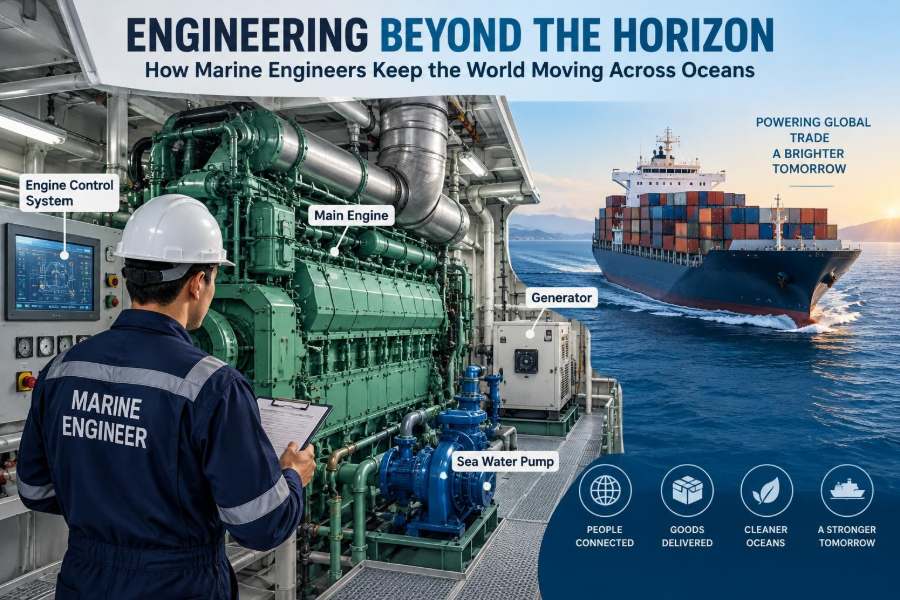

A container of coffee beans leaves a port on one continent, crosses rough water and changing weather, arrives weeks later, and is unloaded into a supply chain that may end at a neighborhood café. Most people see the product, the ship, or perhaps the port cranes. Few see the engineering systems making that journey possible.
Below deck, machinery must convert fuel or electrical energy into propulsion, cooling systems must protect cargo, pumps must move fluids safely, and power must remain available even when the vessel is far from shore. A small fault can become a costly delay—or, in the wrong circumstances, a serious safety risk.
That is why marine engineering matters. It is the discipline that helps ships, offshore installations, and other marine assets operate reliably in one of the most demanding working environments on Earth.
For students, it offers a practical meeting point between mechanical, electrical, environmental, and systems engineering. For working professionals, it is a reminder that safe shipping depends less on one impressive machine than on hundreds of connected systems being understood, maintained, and operated well.
🌍 The Invisible Infrastructure Behind Global Trade
Ocean transport moves raw materials, manufactured goods, food, energy products, and project equipment between regions. Ships are often the most practical option for large, heavy, or high-volume cargoes that do not need immediate delivery.
A vessel is not simply a floating warehouse with an engine. It is a self-contained industrial plant that must generate power, manage heat, control fluids, support navigation, protect people, and comply with environmental requirements while moving through saltwater and severe weather.
Marine engineers keep that plant functioning. Their work supports continuity: cargo reaches port, passengers remain safe and comfortable, and the vessel can complete its voyage without avoidable equipment failure.
⚙️ What Marine Engineering Actually Covers
Marine engineering concerns the design, operation, maintenance, inspection, and improvement of machinery and technical systems used at sea. It includes shipboard work, but it also reaches shipyards, classification and inspection work, ports, offshore energy, naval architecture support, and equipment manufacturing.
The central challenge is integration. A propulsion engine affects fuel consumption, heat recovery, electrical demand, emissions, vibration, maintenance planning, and the ship’s ability to meet its schedule. Engineers must understand those connections rather than treat each item as isolated.
- Mechanical systems: engines, shafts, pumps, compressors, valves, and heat exchangers.
- Electrical systems: generators, switchboards, motors, protection devices, and batteries.
- Control systems: sensors, alarms, programmable controllers, and automation logic.
- Environmental systems: fuel treatment, exhaust cleaning, wastewater management, and ballast-water treatment.
🚢 A Ship Is a Moving Power Station
Calling a ship a moving power station is more than a metaphor. It produces its own electricity, rejects waste heat, circulates cooling water, distributes fuel, treats water, and maintains emergency services without a permanent connection to a public utility network.
Unlike a land-based facility, it must do this while rolling, pitching, vibrating, and operating in a corrosive atmosphere. Access to spare parts, specialist technicians, and repair workshops may be limited until the next port.
This changes engineering priorities. Redundancy, clear operating procedures, robust materials, sensible access for maintenance, and early fault detection become especially valuable.
🔥 The Main Engine and Propulsion Chain
On many large commercial vessels, a slow-speed diesel engine drives the propeller through a direct shaft connection. Other arrangements use medium-speed engines with reduction gears, diesel-electric propulsion, gas turbines, or hybrid systems depending on vessel type and operating profile.
The propeller converts shaft rotation into thrust by accelerating water aft. This sounds straightforward, but propulsion efficiency depends on hull form, propeller design, fouling, sea conditions, engine loading, and the interaction between hull and propeller wake.
A marine engineer watches more than engine speed. Exhaust temperatures, lubricating-oil condition, cooling-water temperatures, vibration, scavenge conditions, and fuel consumption can all reveal whether the propulsion plant is operating as intended.
🌀 Why the Propeller Deserves Close Attention
A propeller works efficiently only within practical limits. If local pressure around a blade falls too low, vapor bubbles can form and collapse. This phenomenon, called cavitation, can create noise, vibration, reduced efficiency, and eventually surface damage.
Marine growth, dents, blade damage, or an unsuitable pitch setting can also increase resistance. Even a well-maintained engine cannot compensate fully for a poorly performing underwater body.
Engineers therefore consider the vessel as a complete hydrodynamic system. Monitoring power required at a given speed can help reveal whether propeller, hull, machinery, or weather-related factors are raising energy use.
⚡ Electrical Power: Essential Beyond Propulsion
Ships require electrical power for pumps, lighting, navigation equipment, communications, cargo systems, galley equipment, accommodation, ventilation, refrigeration, and automation. On some vessels, electricity also drives the propulsion motors.
Diesel generators commonly supply the main electrical network. Their output is managed through switchboards that control connection, load sharing, and protection. If one generator is overloaded or fails, the remaining plant must respond without destabilizing the network.
A blackout can affect steering, propulsion, cooling, and navigation support. For that reason, emergency generators and batteries provide independent power for selected critical services. The exact arrangement varies by vessel and applicable safety requirements.
🔌 Load Sharing and Blackout Prevention
Parallel generators must share load properly. If their governors and voltage regulators are poorly coordinated, one generator may carry excessive real power while another carries disproportionate reactive power, creating unstable conditions.
Good operating practice includes anticipating large electrical loads. Starting a major motor, such as a pump or compressor, can produce a high temporary current demand. Engineers may sequence equipment starts or bring another generator online before the load arrives.
Automation helps, but it is not a substitute for understanding. Operators need to recognize alarms, verify automatic actions, and know how to recover the plant if normal controls do not behave as expected.
🌡️ Cooling Systems: Managing Heat at Sea
Internal-combustion engines convert only part of fuel energy into useful work. A substantial amount becomes heat, which must be removed at controlled rates to prevent component damage and maintain efficient combustion.
Many ships use separate cooling circuits. Fresh water circulates through engines and equipment, while seawater removes heat through coolers. Separating the circuits reduces direct seawater exposure inside sensitive engine passages.
Cooling problems may develop gradually through fouled heat-exchanger surfaces, air pockets, pump wear, incorrect valve positions, or poor water chemistry. A rising temperature trend can be more informative than a single high reading because it suggests a developing restriction or loss of performance.
💧 Pumps, Piping, and the Ship’s Circulatory System
Ships use pumps for ballast, bilge, fire main, cooling, fuel transfer, lubrication, cargo operations, freshwater supply, and many other duties. Their piping networks resemble a circulatory system, but the consequences of a wrong valve alignment can be immediate.
For example, ballast systems move water in and out of tanks to control draft, stability, and trim. Bilge systems collect unwanted liquids from machinery spaces. Fire pumps supply water to firefighting lines. These systems must be clearly identified and correctly isolated when maintenance takes place.
Valve line-ups are a classic source of operational error. A procedure, independent check where appropriate, and a clear understanding of flow paths reduce the chance of pumping the wrong fluid to the wrong place.
🛢️ Fuel Systems and Safe Fuel Handling
Fuel passes through storage, transfer, settling, treatment, service, and injection stages before it reaches an engine. Each stage removes or manages contaminants, controls temperature and viscosity where needed, and helps provide a stable fuel supply.
Water and abrasive particles in fuel can damage precision components. Centrifugal separators are often used to remove contaminants, while filters provide an additional barrier. Fuel sampling and routine checks are practical ways to catch problems before they become machinery failures.
Fuel is also a fire hazard. Leaks near hot surfaces are particularly dangerous, which is why shielding, insulation, leak detection, clean machinery spaces, and disciplined maintenance matter as much as the fuel-treatment equipment itself.
🧴 Lubrication Is More Than “Adding Oil”
Lubricating oil reduces friction, carries heat away from moving parts, helps control deposits, and protects surfaces from wear and corrosion. Different equipment may require different oil properties; an oil suitable for a gearbox is not automatically suitable for a diesel engine.
Oil analysis can reveal contamination, fuel dilution, water ingress, abnormal wear metals, or loss of useful properties. Results require interpretation in context: a single test result is a signal to investigate, while repeated trends often tell a stronger maintenance story.
Using an incorrect lubricant or mixing incompatible products can reduce protection. Engineers rely on approved specifications, clean transfer practices, and records rather than assumptions based on color or appearance alone.
❄️ Refrigeration Protects Cargo and People
Refrigerated containers, provision stores, air-conditioning plants, and certain cargo systems depend on refrigeration. These systems move heat from one place to another using a refrigerant cycle involving compression, condensation, expansion, and evaporation.
For a refrigerated cargo, temperature control is a commercial and quality requirement. A failure may damage food, pharmaceuticals, or other temperature-sensitive goods even though the ship itself remains mechanically sound.
Marine engineers monitor temperatures, pressures, compressor condition, condenser performance, and alarms. Refrigerant handling also requires care because substances differ in toxicity, flammability, pressure, and environmental impact.
🧭 The Boundary Between Deck and Engine Departments
Traditional shipboard organization distinguishes deck operations from engine operations, but effective vessel performance depends on close cooperation. Bridge personnel need predictable propulsion and steering response; engineers need timely notice of maneuvering, cargo operations, and changing power demands.
During port arrival, for instance, machinery may shift from economical sea-going operation to a readiness condition with more pumps, generators, steering gear, and maneuvering activity. Clear communication prevents surprises at the moments when operating margins are smaller.
Modern ships increasingly blend these boundaries through integrated automation and shared operational data. The need for human coordination remains unchanged.
🛟 Safety Starts With System Understanding
Safety is not a separate activity performed after technical work is finished. It is built into design, procedures, maintenance, housekeeping, communication, and the willingness to stop when conditions are unsafe.
Machinery spaces contain hot surfaces, pressurized fluids, rotating equipment, electrical hazards, confined spaces, and potentially flammable vapors. A routine task such as changing a filter can become hazardous if energy sources are not isolated or pressure is not released.
- Identify the equipment and its energy sources before work begins.
- Isolate, lock or secure, and verify the isolation where procedures require it.
- Use the correct permit and protective equipment for the task.
- Restore systems carefully and confirm normal operation afterward.
🚨 Alarms Are Clues, Not Annoyances
An alarm tells the crew that a measured condition has crossed a set limit. It does not always identify the root cause. Low lubricating-oil pressure, for example, may result from low oil level, pump trouble, a blocked strainer, sensor error, or an internal mechanical problem.
Suppressing or repeatedly acknowledging an alarm without investigation can allow a manageable issue to grow. Conversely, treating every alarm as proof of catastrophic failure can lead to unnecessary disruption. The correct response is structured diagnosis.
Good alarm management asks: What changed? Is the reading credible? Which related parameters support or contradict it? What immediate protection is needed while the cause is investigated?
🧪 Planned Maintenance Prevents Surprises
Planned maintenance systems organize tasks by running hours, calendar intervals, condition data, and manufacturer guidance. Their purpose is not to replace engineering judgment; it is to make essential work visible, traceable, and less dependent on memory.
Time-based maintenance is useful for items with known service intervals. Condition-based maintenance becomes valuable when measurements such as vibration, temperature, oil condition, insulation resistance, or performance trends show the actual health of equipment.
A maintenance plan must be realistic. Deferring work may be necessary during an operational constraint, but deferrals need risk assessment, documentation, and a credible plan for completion—not quiet disappearance from the schedule.
📈 Condition Monitoring and Trend Thinking
Many failures give warning signs before they become obvious. A bearing may run progressively hotter, a pump may deliver less pressure, or a generator may show changing vibration. Trend data allows engineers to notice direction, not merely whether a value is inside a limit today.
Imagine a seawater cooler whose outlet temperature rises slowly under similar load conditions. The likely response is not to wait for an engine trip; it is to inspect flow, clean heat-transfer surfaces if needed, and verify instruments.
Condition monitoring is strongest when paired with good records. Data without operating context can mislead, especially when weather, vessel speed, cargo load, or machinery configuration has changed.
🔧 Troubleshooting Without Guesswork
Effective troubleshooting begins by defining the symptom precisely. “The pump is bad” is a conclusion; “the pump discharge pressure has fallen while motor current is lower than usual” is evidence that can guide investigation.
A practical sequence is to verify the indication, compare related readings, check recent changes, inspect simple causes, and test one hypothesis at a time. Replacing parts at random can introduce new faults and consume limited spares.
- Make the situation safe and protect essential services.
- Confirm what is actually abnormal.
- Trace the system from input to output: energy, fluid, control signal, and mechanical movement.
- Correct the cause, then test and document the result.
🧰 Spares Management Is Operational Resilience
A critical spare is not simply an expensive item stored on a shelf. It is a part whose absence could leave the vessel unable to operate safely, legally, or commercially before it can be resupplied.
Ships must balance storage space, cost, shelf life, and uncertainty. Rubber seals age, electronics may become obsolete, and poorly preserved parts can be unusable when finally needed.
Good spares control includes identification, preservation, stock review, reorder planning, and confirmation that the part matches the installed equipment. A near-identical component can have a different material, rating, software version, or connection detail.
🌊 Corrosion: The Constant Marine Opponent
Saltwater, humidity, temperature differences, and dissimilar metals make corrosion a persistent challenge. Corrosion is not merely cosmetic; it can thin pipes, weaken structures, seize fasteners, degrade electrical connections, and create leaks.
Protection methods include coatings, material selection, drainage, ventilation, insulation design, and cathodic protection. Cathodic protection uses sacrificial anodes or impressed current to reduce corrosion on protected metal surfaces.
One common mistake is treating rust only where it is visible. The underlying cause may be trapped moisture, damaged coating, poor drainage, or an electrical interaction that must be addressed to prevent recurrence.
🌱 Environmental Performance Is an Engineering Task
Marine engineers have a direct role in reducing emissions, preventing pollution, and using energy more efficiently. This involves day-to-day control of machinery as well as longer-term equipment and fuel decisions.
Examples include maintaining combustion quality, minimizing unnecessary generator running, recovering useful heat where practical, preventing oil leaks, managing waste streams, and operating treatment equipment correctly. Compliance equipment is only effective when it is maintained, monitored, and documented properly.
Environmental choices involve trade-offs. A technology that reduces one emission may increase complexity, energy demand, cost, or maintenance burden. Good engineering evaluates the full operating system rather than assuming a single solution fits every ship.
💨 Energy Efficiency Is Mostly About Small Losses
Fuel efficiency is influenced by voyage planning and hull design, but machinery practices matter too. Dirty filters, leaking steam or air systems, poorly matched generator load, fouled coolers, and worn pumps all consume energy indirectly.
Engineers often look for avoidable losses before pursuing major modifications. Running two lightly loaded generators when one can safely carry the demand, for example, may waste fuel depending on the specific machinery and operating limits.
The objective is not simply to run equipment at the lowest possible power. It is to operate safely within recommended limits while meeting the vessel’s real electrical, thermal, and operational needs.
📡 Automation Changes the Engineer’s Role
Automation can control machinery sequences, adjust setpoints, record operating data, and initiate protective shutdowns. It reduces routine workload and can improve consistency, particularly when systems are well designed and well maintained.
However, automation can hide gradual deterioration if people rely only on a green status light. Sensors drift, cables fail, software logic may not anticipate every condition, and a control loop can perform poorly even while remaining technically “in automatic.”
The modern marine engineer needs both digital literacy and physical intuition: understand the screen, but also understand the sound, temperature, smell, vibration, and flow behavior of the actual plant.
🛜 Cybersecurity Reaches the Engine Room
As ship systems become connected, operational technology—the hardware and software that controls physical processes—needs protection alongside conventional information technology. Navigation, cargo, machinery monitoring, maintenance records, and communications may exchange data through connected networks.
Cybersecurity does not mean assuming every fault is an attack. It means controlling access, managing software updates carefully, using secure practices for removable media, segmenting networks where appropriate, and having recovery procedures.
Availability matters at sea. A poorly planned update can be as disruptive as a malicious one if it affects a control system during critical operations. Changes should be tested and governed according to the vessel’s procedures.
🏗️ Design for Maintenance, Not Just Installation
Equipment can appear excellent on a design drawing yet be difficult to maintain after installation. Can filters be opened safely? Is there lifting space for a motor? Can valves be reached during rough weather? Is a drain positioned where it can actually be used?
Maintainability affects safety, downtime, and total cost across a vessel’s life. Engineers should think about access, isolation points, spare-part replacement, inspection visibility, and the sequence of real maintenance tasks.
This is a useful lesson for students: engineering quality is not measured only by whether a system works on day one. It is also measured by how safely and reliably people can operate and repair it over years of service.
👷 Human Factors Shape Machinery Reliability
Human factors examine how equipment, information, procedures, work environments, and organizational conditions affect human performance. Fatigue, noise, poor lighting, confusing labels, rushed handovers, and unclear alarms can all increase the likelihood of error.
Blaming an individual after an incident may miss the deeper design issue. If several competent people make the same valve-alignment mistake, the system may need better labeling, a revised procedure, improved layout, or an interlock.
Good teams encourage reporting of near misses and abnormal conditions. Learning early from a minor event is far less costly than learning after an equipment failure or injury.
📚 Training Turns Theory Into Judgment
Marine engineering education includes thermodynamics, fluid mechanics, electrical theory, materials, mechanics, automation, and safety. At sea or in a workshop, those subjects become practical decisions: why is this temperature rising, what causes this pressure loss, and what is the safest next action?
Competence develops through supervised practice, careful observation, technical reading, drills, and honest reflection after problems. No one gains sound judgment by memorizing a checklist without understanding what the checklist protects against.
For early-career engineers, asking precise questions is a strength. “What failure does this test detect?” often produces more useful learning than “What button do I press?”
🧑🏭 Careers Beyond the Engine Room
Sea-going engineer officers are one path, but marine engineering skills transfer widely. Employers value people who can interpret machinery data, manage maintenance, understand safety-critical systems, and communicate across operational teams.
- Ship management and technical superintendence
- Shipbuilding, repair, and commissioning
- Equipment design, service, and field support
- Ports, terminals, and marine infrastructure
- Offshore installations and subsea support
- Survey, inspection, assurance, and regulatory support
The strongest career foundation is not a narrow familiarity with one engine model. It is the ability to learn systems, diagnose evidence, manage risk, and work constructively with people.
⚖️ Balancing Reliability, Cost, and Schedule
Marine operations involve competing pressures. A vessel must meet commercial commitments, but maintenance takes time. A repair may be expensive, but postponing it may expose the ship to a larger failure later. Engineers contribute by making risks visible in technical and operational terms.
Good decisions distinguish between work that can be monitored temporarily and work that threatens a safety barrier or critical function. The answer depends on equipment condition, redundancy, voyage plan, available support, and the vessel’s operating limits.
“Keep it running” is not always good engineering. Sometimes the professional decision is to reduce load, change plans, or stop equipment until a defect is properly understood.
🧠 Common Mistakes That Weaken Engineering Decisions
Several habits repeatedly undermine otherwise capable teams. They are not always dramatic, which is why they can become normalized.
- Chasing symptoms: resetting an alarm without identifying why it occurred.
- Trusting one instrument blindly: failing to compare readings with related parameters or local indicators.
- Skipping documentation: leaving the next watch without the history needed to understand a fault.
- Assuming familiarity equals safety: treating a routine job casually because it has been done many times.
- Ignoring small leaks or vibration: allowing early warnings to become larger defects.
The corrective habit is disciplined curiosity. Notice change, verify evidence, communicate clearly, and treat the system—not only the immediate component—as the object of investigation.
🔭 The Future Fleet Will Be More Diverse
Future marine power systems are likely to use a broader mix of fuels, batteries, shore power, energy-saving devices, and digital monitoring. The pace and combination of change will differ by route, vessel type, port infrastructure, fuel availability, and regulation.
This diversity creates opportunity but also complexity. Engineers may need to manage high-voltage systems, new fuel hazards, battery thermal management, unfamiliar sensors, and more sophisticated control strategies alongside conventional machinery.
The durable skill is adaptability. Core principles—energy conversion, heat transfer, fluid flow, materials behavior, control, maintenance, and risk management—remain useful even as the hardware changes.
🌟 The Core Principle: Keep the Whole System Safe and Capable
Marine engineering is ultimately systems engineering under real operational constraints. A ship succeeds when propulsion, power, cooling, fuel, controls, people, and procedures work together well enough to handle normal operation and credible failures.
The most effective engineers do not wait for a breakdown to demonstrate skill. They observe trends, respect safeguards, maintain clear records, communicate across departments, and make decisions that protect people, the vessel, cargo, and the marine environment.
That mindset explains how marine engineers keep the world moving across oceans: not through a single heroic repair, but through informed, consistent care for the complex machinery beneath the horizon.
Every successful voyage depends on engineering that turns energy, machinery, and human judgment into safe, reliable movement across the sea. 🚢⚙️🌊