
A container ship is approaching a busy port at night. Rain is reducing visibility, fishing boats are crossing the channel, and a pilot boat is preparing to come alongside. On a conventional vessel, the bridge team, engine department, lookout, and port services all contribute to a safe arrival.
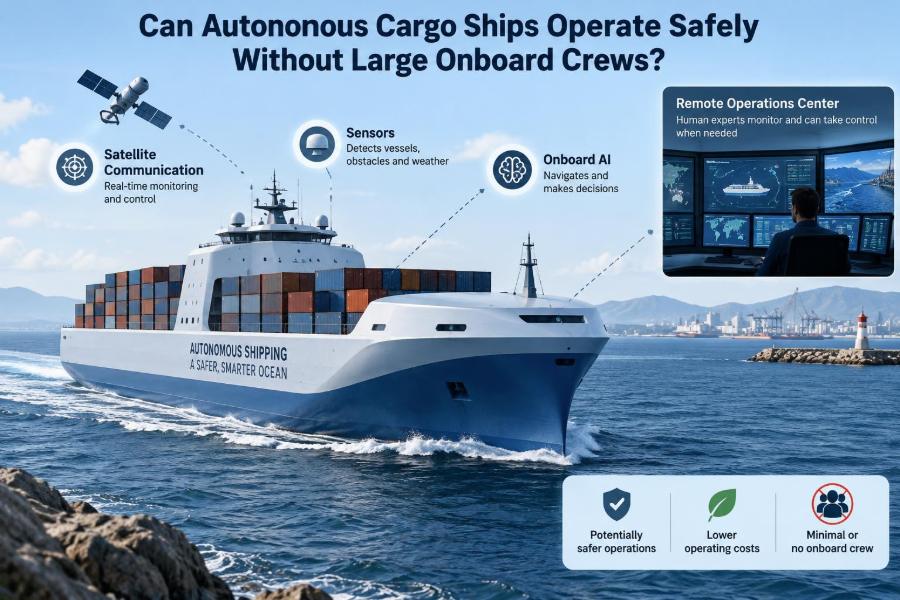
Now imagine the same ship with only a small technical crew—or no crew at all. Its sensors detect targets, software recommends manoeuvres, and a shore control centre monitors the voyage from hundreds of miles away. The question is no longer whether such technology can move a ship in open water. It can. The harder question is whether it can manage the full range of situations that make real shipping difficult.
Autonomous cargo ships matter because commercial shipping depends on safety, reliability, and predictable operations. Reduced crewing may ease some personnel pressures and remove people from certain hazardous tasks, but it also changes where risk sits and who must respond when systems fail.
The most realistic answer is not a simple yes or no. Safe operation without large onboard crews depends on the vessel, route, cargo, regulatory approval, system design, and the ability to recover from abnormal events. Understanding those conditions is central to modern marine engineering.
⚓ What “Autonomous” Actually Means at Sea
Autonomous shipping describes vessels that can perform some or many tasks with limited direct human action. It does not always mean an empty ship navigating independently from departure to arrival.
A ship may automate machinery control, route keeping, collision-warning functions, or docking assistance while still carrying a conventional crew. Another may have a reduced crew supported by operators ashore. Fully unmanned operation is the most demanding model because every onboard emergency must be detected, diagnosed, and managed remotely or automatically.
🧭 Levels of Autonomy Are Not All the Same
Autonomy is best understood as a spectrum. A vessel may be highly automated in normal passage but require people for harbour manoeuvring, cargo operations, maintenance, or emergencies.
- Decision support: systems advise mariners, who make and execute decisions.
- Remote operation: shore personnel control some ship functions, with or without crew onboard.
- Constrained autonomy: the vessel acts independently within defined operating limits.
- Full autonomy: the ship completes its mission without onboard crew or continuous human intervention.
These distinctions matter because the safety case for a short coastal voyage under close shore supervision is very different from that for an ocean-crossing bulk carrier.
🌊 Why Open Water Is the Easiest Part
In clear weather and open sea, a cargo ship usually follows a planned route at steady speed. Modern autopilots, integrated bridge systems, electronic charts, and machinery automation already handle many routine functions effectively.
But routine navigation is only one part of a voyage. A safe design must also handle the unusual event: a drifting container, a small craft without a reliable electronic signal, a fire alarm, a blocked sea chest, or a fuel-system fault during heavy weather.
Automation performs best when the environment is predictable. Shipping becomes most demanding precisely when the environment is not.
👀 Situational Awareness Requires More Than Sensors
Human watchkeepers build situational awareness: a working understanding of what is happening, what it means, and what may happen next. They combine radar, visual observations, radio calls, vessel behaviour, weather, local knowledge, and practical judgment.
Sensors can provide excellent data, but data is not automatically understanding. A camera may see a small target but struggle with glare, rain, spray, darkness, or a dirty lens. Radar detects range and movement well in many conditions, but interpreting clutter and unusual echoes remains challenging.
A reliable autonomous system needs sensor fusion, meaning that radar, cameras, satellite navigation, inertial sensors, Automatic Identification System data, and other inputs are checked together rather than trusted individually.
📡 The Limits of AIS and Digital Visibility
The Automatic Identification System, usually called AIS, broadcasts a vessel’s identity, position, course, and speed. It is valuable for traffic awareness, but it is not a complete picture of the sea.
Some small vessels may not carry AIS. Transmissions can be incorrect, interrupted, or misunderstood. Floating debris, unlit objects, and people in the water do not transmit useful AIS signals at all.
For this reason, a ship cannot safely treat AIS as an authority on collision risk. It is one input among several, much like a road vehicle should not assume every hazard appears on its navigation screen.
🚦 Collision Regulations Still Need Judgment
The International Regulations for Preventing Collisions at Sea set out responsibilities such as maintaining a proper lookout, taking early action, and avoiding manoeuvres that confuse another vessel. Applying these rules involves more than calculating closest point of approach.
Two vessels may technically follow a rule but still create uncertainty if one behaves unexpectedly. A human master may slow down, call another vessel, or make an intentionally obvious course alteration after recognizing that a developing situation is becoming ambiguous.
Autonomous navigation must therefore be conservative, explainable, and predictable to nearby mariners. A mathematically efficient route is not necessarily the safest social behaviour in mixed traffic.
🏙️ Ports Create a Different Navigation Problem
Ports combine narrow channels, tugs, pilots, ferries, fishing craft, dredgers, cranes, berth schedules, tidal limits, and local traffic rules. The ship must interact with people whose actions are shaped by practical port experience rather than a shared software model.
Docking is also sensitive to wind, current, shallow water effects, and delayed engine response. Small errors in speed or angle can have large consequences near a berth.
For this reason, early autonomous operations are more plausible on tightly defined routes and purpose-built terminals than in congested international ports with constantly changing conditions.
🗺️ The Operational Design Domain Sets the Boundary
An operational design domain, or ODD, defines the conditions in which an autonomous system is intended to work. It may specify route length, water depth, traffic density, weather limits, communication coverage, acceptable wave conditions, and port arrangements.
This is not a weakness; it is a disciplined safety tool. Aviation, rail, and industrial automation all use operating boundaries because no system is equally capable everywhere.
A credible autonomous vessel should know when it is outside its ODD and respond safely: reduce speed, hold position where appropriate, request remote assistance, divert, or enter a pre-planned safe state.
🧠 Artificial Intelligence Cannot Replace Engineering Discipline
Machine-learning tools may help classify camera images, detect patterns in machinery data, or prioritize alarms. However, they should not be treated as a mysterious substitute for robust marine engineering.
Safety-critical control requires defined failure modes, tested fallback behaviour, traceable software changes, and evidence that the system behaves acceptably in foreseeable conditions. A system that works impressively in demonstrations may still be unsuitable for unrestricted commercial service.
Explainability matters. After an incident or near miss, operators and investigators need to know what information the system received, what decision logic it used, and why it selected an action.
🔧 Machinery Rooms Do Not Maintain Themselves
Automation can start and stop pumps, balance generator loads, control cooling systems, and raise alarms. Unattended machinery-space concepts have existed for many years on conventionally crewed ships. Yet machinery automation assumes that trained personnel are available to investigate faults.
A leaking seal, vibrating pipe support, clogged filter, or abnormal smell may be noticed before it becomes a major alarm. Such observations are difficult to reproduce fully through sensors, especially on older equipment or systems exposed to vibration, heat, and saltwater.
Removing engineers from the ship shifts maintenance toward condition monitoring, modular equipment, increased redundancy, and carefully planned intervention at port.
🔥 Fire Is the Defining Unmanned Emergency
Fire safety is one of the strongest arguments for caution. Ships contain fuel, lubricants, electrical equipment, batteries, packaging materials, and machinery spaces where an early response can prevent escalation.
Fixed detection and suppression systems are essential, but automatic suppression is not identical to firefighting. A crew can verify an alarm, isolate ventilation, close dampers, assess boundaries, cool adjacent spaces, and adapt if the first response does not work.
An unmanned ship needs exceptionally dependable detection, compartmentation, remote isolation, suppression arrangements, and procedures for a fire that cannot be fully controlled before outside help arrives.
💧 Flooding and Damage Control Need Physical Action
Hull damage, failed piping, or a malfunctioning valve can introduce water into spaces that were never intended to flood. Pumps may control a limited leak, but effective damage control can require locating the source, shutting valves, fitting temporary patches, and managing stability.
Stability is especially important because water moving within a compartment can reduce a vessel’s ability to remain upright. Automated ballast systems can help, but they must avoid creating a new problem while correcting the first one.
Remote teams may diagnose some situations, yet there are events where physical presence remains the fastest and most flexible repair tool.
🔋 New Energy Systems Change the Risk Picture
Battery-electric, hybrid, methanol, ammonia, hydrogen, and other energy pathways can support lower-emission shipping, but each introduces different hazards and maintenance needs. Automation may improve monitoring, yet it does not remove the need for a well-designed emergency response strategy.
For example, some battery failures can involve thermal events that need detection, isolation, cooling, and specialist planning. Alternative fuels may bring toxicity, flammability, cryogenic temperatures, or unfamiliar handling requirements.
Autonomy and decarbonisation should be assessed together rather than treated as separate upgrades to the same vessel.
📶 Shore Control Depends on Communications
Remote operation requires dependable communication, but maritime links can suffer from latency, limited bandwidth, weather effects, equipment failure, or cyber disruption. Even a short interruption matters if a remote operator is expected to take immediate control.
Safe concepts therefore need local capability onboard. The ship must continue navigating within defined limits, execute a safe manoeuvre, or transition to a safe state when communication is lost.
Continuous remote joystick-style control across open oceans is a less robust idea than supervised autonomy with carefully engineered onboard fallback functions.
🛡️ Cybersecurity Becomes a Navigation Safety Issue
When navigation, machinery, cargo systems, communications, and shore centres are interconnected, cybersecurity is no longer only an information-technology concern. A compromised system could disrupt operational data, disable equipment, or create misleading information for operators.
Good cyber resilience includes network separation, access control, secure software updates, logging, monitoring, backup arrangements, and practiced response procedures. It also includes mundane controls such as managing removable media and contractor access.
The goal is not to promise that intrusion is impossible. It is to ensure that an attempted compromise does not easily become loss of control.
🧑✈️ Remote Operators Need Different Skills
A shore control centre is not simply a bridge moved onto land. Operators may supervise several vessels, use multiple data displays, coordinate with ports, and take over during unusual conditions. Their workload can rise sharply if several ships request help at once.
They need navigational competence, system knowledge, clear authority, fatigue management, and realistic simulator training. The control centre itself needs backup power, redundant communications, secure procedures, and a clear chain of command.
A key design question is simple: when an alert occurs, who has authority to act, how quickly can they understand it, and what happens if they are unavailable?
⚖️ Responsibility Cannot Be Left Ambiguous
Traditional shipping assigns defined duties to the master, officers, engineers, owner, operator, and shore management. Reduced-crew and unmanned vessels complicate these relationships because decisions may be distributed among onboard automation, a remote operator, a technical support team, and company management.
Clear responsibility is essential for normal operations and incident response. Port authorities, insurers, flag administrations, classification organizations, cargo interests, and rescue services also need confidence about who can communicate and make binding decisions.
Technology can change tasks, but it cannot eliminate accountability.
📜 Rules Must Catch Up Without Lowering Standards
Maritime rules were largely written around ships with masters and crews onboard. Existing requirements on watchkeeping, manning, emergency arrangements, radio operation, and certification can be difficult to apply directly to an unmanned vessel.
Regulatory development is therefore a safety process, not merely paperwork. New rules must establish equivalent or better protection for life, property, and the marine environment while allowing different technical solutions.
Approval should be based on evidence for a particular operation, not on the assumption that removing people automatically makes a vessel innovative or safe.
🧪 Risk Assessment Must Examine the Whole System
A robust safety assessment considers more than whether an algorithm detects another ship. It examines the vessel, shore centre, communications, maintenance plan, ports, emergency services, human operators, and the environment as one connected system.
Useful methods include hazard identification, failure mode analysis, simulations, sea trials, and scenario testing. The strongest tests focus on combinations of problems: heavy rain plus sensor degradation, a machinery alarm plus communication loss, or traffic congestion during a remote handover.
Rare events deserve attention because they are often the events that determine whether an unmanned concept is truly resilient.
🔁 Redundancy Is Not Just Duplicating Equipment
Redundancy means that a critical function can still be performed after a failure. Two identical sensors installed side by side may not be truly independent if both are vulnerable to the same power fault, weather condition, software defect, or contaminated surface.
Effective redundancy uses diversity: different sensor types, separated power supplies, independent computing paths, manual or remote alternatives, and physical separation where practical.
Engineers must also avoid alarm overload. A remote operator cannot respond effectively if a single fault creates hundreds of low-priority messages with no useful diagnosis.
🧰 Maintainability Often Determines Real Reliability
Equipment that cannot be inspected, cleaned, calibrated, or replaced easily will not remain reliable simply because it was reliable when new. Salt spray, vibration, temperature changes, and marine growth are persistent realities.
Autonomous vessels should be designed with accessible sensor locations, protected connectors, automated health checks, spare capacity, and port-based maintenance workflows. This may favour simpler vessel arrangements over densely packed systems that are difficult to service.
Reliability is built through design, maintenance, and operational discipline—not purchased as a feature.
📦 Cargo Type Changes the Case for Reduced Crews
A small vessel carrying uncomplicated cargo on a short, repeatable route presents a different risk profile from a large ship carrying hazardous chemicals, liquefied gas, passengers, or complex refrigerated cargo.
Some cargoes demand regular inspection, temperature management, gas detection, securing checks, and specialist emergency actions. Containerized cargo can also conceal problems that sensors do not immediately reveal.
The question is not whether autonomy is safe in the abstract. It is whether a specific vessel can safely carry a specific cargo in a specific operating environment.
🚤 Search and Rescue Creates an Ethical Limit
A conventional ship may be required to assist persons in distress when it can do so without serious danger to itself. A fully unmanned ship cannot recover survivors, provide first aid, offer shelter, or make the same practical contribution as a crewed vessel.
It may still relay information, deploy suitable equipment if designed to do so, or coordinate with rescue authorities. But these capabilities are not equivalent to people physically present at sea.
This issue shows why the safety of autonomous shipping cannot be measured only by collision rates or machinery uptime. Shipping also has wider responsibilities to other people using the sea.
🌱 Environmental Protection Needs Fast Detection
An oil leak, exhaust-treatment fault, ballast problem, cargo release, or grounding can harm the marine environment. Early detection and isolation are valuable, but response may still require physical action and local assessment.
Autonomous systems can improve monitoring by recording equipment states continuously and detecting deviations quickly. At the same time, operators must plan for cases where the vessel cannot repair itself or where a remote diagnosis is uncertain.
Environmental safeguards must be integrated into the vessel’s emergency philosophy, not added after navigation systems are complete.
🏗️ Where Small Crews May Make Sense First
The earliest workable applications are likely to be limited and highly controlled: short-sea routes, inland or sheltered waters where permitted, predictable cargoes, dedicated terminals, strong communication coverage, and rapid access to technical support.
These operations allow designers to constrain the ODD and gather operational experience without claiming that the same model fits every trade. A reduced crew may also be a sensible intermediate step, keeping people onboard for maintenance and emergencies while automation takes over repetitive monitoring.
Gradual deployment is not hesitation. It is how safety-critical systems earn trust.
🚢 Why Deep-Sea Unmanned Shipping Is Harder
Long voyages expose ships to changing weather, long distances from assistance, equipment wear, complex maintenance needs, and extended periods during which small faults can develop into serious failures. The logistics of sending technicians offshore are also far more difficult than arranging support at a regular terminal.
Deep-sea vessels encounter diverse traffic patterns, ports, languages, regulations, and cargo requirements. A system proven on a fixed coastal route cannot be assumed to work safely across this broader operational landscape.
Large onboard crews may decline over time on some ships, but completely crewless deep-sea cargo operations face a much higher evidence threshold.
⚠️ Common Mistakes in the Autonomy Debate
One mistake is to compare an ideal autonomous system with an imperfect human crew. Real comparisons must include equipment faults, cyber threats, maintenance errors, communication losses, and the performance of remote teams under pressure.
Another is to assume that fewer people always means fewer human errors. Some onboard errors may disappear, but new errors can arise in software configuration, data interpretation, remote handovers, and shore-centre workload management.
- Do not confuse automatic steering with autonomous seamanship.
- Do not treat a simulator result as proof of all-weather readiness.
- Do not design normal operations first and improvise emergency recovery later.
- Do not overlook port personnel, pilots, tugs, and rescue services.
📋 A Practical Safety Checklist for Marine Engineers
When evaluating an autonomous or reduced-crew concept, engineers should ask whether each critical function has a credible answer during normal, degraded, and emergency conditions.
- Can the vessel detect hazards using independent sources of information?
- What does it do when sensors disagree or communications fail?
- How are fire, flooding, power loss, and propulsion failure contained?
- Who monitors the vessel, and how is operator overload prevented?
- How are sensors cleaned, tested, repaired, and updated?
- Is the route and cargo within a clearly defined ODD?
- Can the system demonstrate safe behaviour to regulators and other water users?
If the answer relies on “someone will handle it later,” the design is not yet mature enough.
🔭 The Likely Future Is Graduated Autonomy
Marine automation will continue to improve navigation support, predictive maintenance, energy management, and remote diagnostics. These advances can make ships safer and help crews focus attention where judgment is most needed.
But the most plausible path is graduated autonomy: more capable onboard systems, reduced routine workload, shore-based support, and different crew models chosen for particular trades. In many cases, the objective will be a better human-machine team rather than the total removal of people.
Success should be judged by measurable operational resilience, not by how few humans appear in the concept drawing.
✅ The Core Test: Safe Recovery, Not Smooth Automation
A vessel that follows a route perfectly on a calm day has demonstrated only a small part of safe operation. The decisive test is what happens when it loses a sensor, encounters unexpected traffic, suffers a machinery casualty, cannot contact shore, or needs to help in an emergency.
Autonomous cargo ships can operate safely without large onboard crews in carefully bounded applications, provided their technical systems, operating limits, remote support, maintenance arrangements, and regulatory approval form a coherent safety case. They are not yet a universal replacement for capable mariners in every trade.
The central engineering principle is straightforward: design for degraded conditions and recovery, not only for normal performance.
Autonomous shipping becomes credible when it proves that it can fail safely, recover reliably, and keep clear human accountability wherever the sea remains uncertain. 🚢⚓🌊