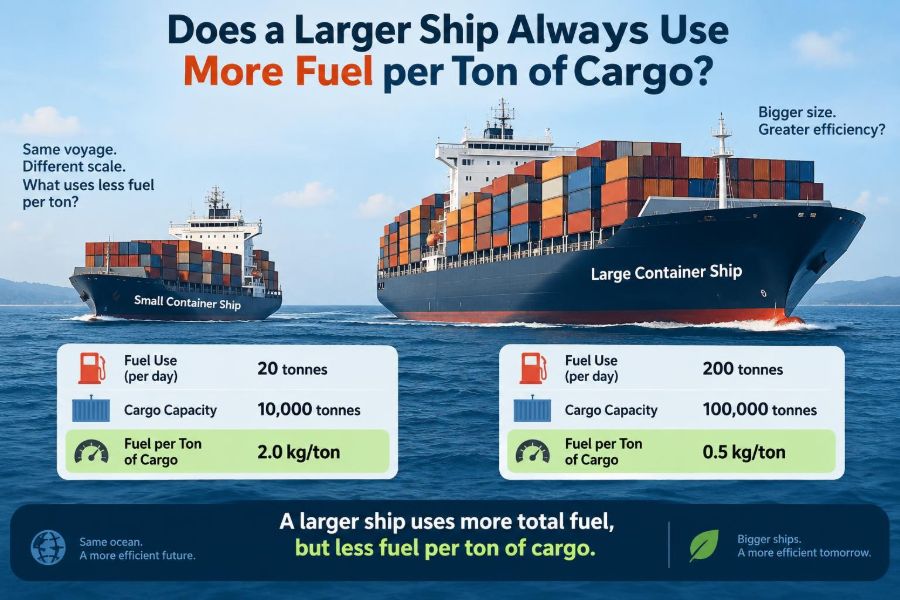

A charterer compares two ships for the same cargo movement: a handy-size bulk carrier and a much larger vessel. The larger ship will clearly burn more tonnes of fuel each day, so it seems natural to assume it must be the less efficient choice.
That conclusion can be badly misleading. A ship’s daily fuel consumption tells only part of the story; the cargo moved, distance travelled, service speed, weather, port time, and machinery condition all change the answer.
This matters to ship operators deciding on vessel size, engineers monitoring performance, and cargo interests estimating freight emissions. It also matters when discussing whether economies of scale genuinely reduce the environmental intensity of shipping.
The useful question is not simply “Which ship burns more fuel?” but “How much fuel is used to move one tonne of cargo over a useful distance?” The distinction is the key to understanding ship fuel efficiency.
🧭 Start with the Right Measure
A large ship almost always has a higher absolute fuel consumption than a smaller ship at comparable service conditions. Its engines provide more power, its auxiliary systems may be larger, and moving its own heavier hull requires energy.
For cargo transport, however, the more revealing measure is fuel per tonne of cargo, usually considered over distance: fuel per tonne-nautical-mile or per tonne-kilometre. This is often called transport work or cargo transport intensity.
A vessel that burns 40 tonnes per day while carrying 50,000 tonnes can be more efficient per tonne than one burning 20 tonnes per day while carrying 10,000 tonnes.
⚖️ Absolute Consumption and Specific Consumption
Two related measures are frequently confused. Daily consumption is the fuel burned by the vessel in a day, often expressed as tonnes per day. It matters for bunker planning, voyage cost, range, and emissions from one ship.
Specific transport fuel use divides fuel by cargo and distance. It is better suited to comparing ships that carry different quantities of cargo or sail different routes.
| Measure | What it answers | Best use |
|---|---|---|
| Tonnes of fuel per day | How much fuel does the ship burn? | Bunker planning and operational cost |
| Fuel per tonne of cargo | How much fuel supports each tonne carried? | Comparing loaded voyages of similar length |
| Fuel per tonne-nautical-mile | How efficiently is cargo moved over distance? | Comparing transport efficiency across voyages |
No single number is sufficient in every situation. The denominator must match the decision being made.
📦 Cargo Capacity Creates Economies of Scale
Ships benefit from an important physical advantage: as a hull becomes larger, cargo capacity can increase faster than some forms of resistance and equipment weight. A larger hull does not need a separate bridge, accommodation block, engine room, or crew for every additional tonne of cargo.
One propulsion plant and one voyage can therefore move far more cargo. The fuel cost of operating essential ship systems is spread across a larger payload.
This is the basic reason large bulk carriers, tankers, and container ships can achieve low fuel use per tonne of cargo under suitable conditions. It is an economy of scale, not a rule that every larger vessel will always win.
🌊 Hull Resistance Still Rises
Size is not a free efficiency gain. A larger ship has greater wetted surface area, pushes aside more water, and may experience substantial wave-making resistance. Hull resistance is the force the propulsion system must overcome to maintain speed.
At low and moderate speeds, frictional resistance along the hull is significant. At higher speeds, wave-making resistance can become much more influential, especially as the ship approaches a speed regime where it creates larger waves.
Designers seek a hull form that delivers the required deadweight, draft, stability, and cargo volume without demanding excessive power. That balance varies greatly by ship type.
🏗️ Why Dimensions Matter More Than Length Alone
Calling a ship “larger” is incomplete. Length, beam, draft, displacement, deadweight tonnage, gross tonnage, and cargo capacity describe different things. Two ships of similar length can carry very different cargo quantities.
Draft is particularly influential. A deeper-drafted vessel can displace more water and potentially carry more cargo, but it needs adequate channel depth, berth depth, and under-keel clearance. Beam affects stability and cargo volume, while also influencing hull resistance and port access.
For fuel per cargo tonne, actual payload is more meaningful than a headline size measurement.
⚓ Deadweight Is Not the Same as Payload
Deadweight tonnage, or DWT, is the maximum weight a vessel can safely carry, including cargo, fuel, fresh water, stores, crew, and other consumables. It is useful, but it is not the cargo quantity on a particular voyage.
A ship departing with heavy bunkers, ballast water, provisions, and only a partial cargo may use a smaller share of its deadweight for freight. A vessel that is full by volume before reaching its permissible weight also cannot use all its DWT for cargo.
When calculating transport efficiency, use cargo actually carried. Assuming every voyage uses full deadweight can make real performance appear better than it is.
🧱 Dense Cargo and Light Cargo Behave Differently
Iron ore, crude oil, grain, wood chips, vehicles, and packaged consumer goods do not fill a ship in the same way. Dense cargoes may be limited by weight, while low-density cargoes may fill holds, tanks, or container slots before the ship reaches its weight limit.
A bulk carrier carrying a dense mineral may sail close to its draft limit. The same vessel carrying a lighter bulk commodity might reach hold volume limits with lower cargo weight, increasing fuel used per tonne carried.
Container ships add another layer: the number of containers on board says little about weight without knowing their contents and stowage constraints.
🏎️ Speed Has an Outsized Effect
Speed can change fuel use more dramatically than a modest change in vessel size. The power needed to propel a displacement ship rises steeply as speed rises; a commonly used operational approximation is that required power varies roughly with the cube of speed in a limited operating range.
This is not a universal law for all hulls, drafts, seas, and speeds, but the practical message is sound: a small increase in speed can require much more engine power and fuel.
A larger ship steaming slowly may therefore have lower fuel per tonne-nautical-mile than a smaller vessel steaming fast. Comparing ships without comparing speed is rarely useful.
🐢 Slow Steaming Changes the Comparison
Slow steaming is the deliberate operation of a vessel below its traditional service speed to reduce fuel consumption. Because propulsion demand falls sharply with speed, it can substantially improve fuel intensity on routes where schedule and cargo commitments allow it.
But slower is not automatically better. Longer voyage time may require more days of auxiliary power, increase inventory time for cargo, reduce annual voyage cycles, and complicate fleet schedules. Main engines also need to operate within safe limits set by their manufacturers and operators.
The best speed is an operational and commercial decision, not merely a hydrodynamic one.
🔧 Engine Efficiency Is a Separate Question
A ship can have a well-designed hull but inefficient machinery operation. Engine specific fuel oil consumption, often abbreviated SFOC, describes fuel consumed per unit of brake power produced. It varies with engine type, fuel, load, maintenance condition, and operating point.
Large slow-speed two-stroke engines used in many deep-sea cargo ships are highly suited to direct propeller drive. Yet even these engines may consume fuel less efficiently when operated far from their preferred load range.
Transport efficiency combines engine efficiency with hull, propeller, cargo, route, and operational factors. Improving only one part may not improve the whole system as expected.
🌀 Propeller Matching Makes Power Useful
The propeller turns shaft power into thrust. If its diameter, pitch, revolutions, and blade design are poorly matched to the hull and engine, more fuel may be needed for the same speed.
Larger, slower-turning propellers can often be efficient for large merchant ships, provided draft and hull-clearance constraints permit them. Propeller cavitation—local vapor formation caused by low pressure—can reduce efficiency, create vibration, and damage blades.
Energy-saving devices, ducts, fins, and improved propeller designs may recover small portions of losses. Their value depends on the vessel’s duty profile and must be assessed for the real operating condition.
🧼 Hull Fouling Can Erase Expected Gains
Marine growth and slime on the underwater hull increase surface roughness and frictional resistance. Propeller roughness and damage have a similar effect on propulsion performance.
A large ship designed for excellent cargo efficiency can lose part of that advantage if its hull condition deteriorates. The crew may respond to lost speed by increasing power, which raises fuel use rapidly.
Hull inspections, appropriate coating systems, careful cleaning practices, and performance monitoring are therefore not cosmetic tasks. They protect the efficiency expected from the original design.
🌬️ Weather and Sea State Are Not Background Details
Wind, waves, swell, current, water temperature, and sea condition affect resistance and achievable speed. A head sea can lead to added resistance, propeller emergence, slamming risk, and speed loss; following seas bring their own handling considerations.
Weather routing can reduce exposure to severe conditions or take advantage of favorable currents, although the shortest route is not always the lowest-fuel route. Safety of ship, people, and cargo remains the overriding constraint.
For a single voyage, weather can make a performance comparison uncertain. Meaningful benchmarking needs enough data to separate normal environmental variation from a genuine machinery or hull problem.
🧭 Route Constraints Can Limit Vessel Size
The most efficient vessel on open water may be unsuitable for the route. Canal dimensions, bridge clearances, port approach depth, turning basins, berth strength, lock size, and tug availability can all restrict ship dimensions.
A larger vessel may need a longer route, a deeper port, a transshipment arrangement, or tidal windows. These requirements can offset part of its sea-going efficiency advantage.
The relevant comparison is the whole transport chain, from loading point to final discharge point, not just the fuel consumed between two open-sea waypoints.
🏥 Port Time Adds Fuel Without Adding Distance
While alongside, at anchor, or drifting outside a congested port, a ship may run generators for lighting, pumps, refrigeration, ventilation, accommodation, cargo equipment, and other services. This fuel use does not move cargo any distance.
Larger ships may spend longer loading or discharging because they carry more cargo, although terminal productivity can reduce that time where equipment and planning are adequate. Delays caused by berth availability or paperwork can be especially costly in fuel and emissions terms.
Shore power, efficient cargo handling, coordinated arrivals, and reduced anchorage waiting can improve voyage-level performance for ships of every size.
⚡ Auxiliary Loads Matter More Than Many Calculations Show
Main-engine fuel usually dominates a sea passage, but auxiliary consumers should not be ignored. Refrigerated containers, cargo pumps on tankers, ballast pumps, inert gas systems, heating, and hotel loads may be material on certain vessel types or voyage phases.
A container vessel carrying many refrigerated units can have a markedly different auxiliary profile from a dry bulk carrier. A tanker may consume energy for cargo operations and temperature management that is not visible in a simple sea-speed calculation.
Good fuel accounting separates main-engine, auxiliary-engine, boiler, and cargo-related consumption where practical.
🔄 Ballast Voyages Are the Major Caveat
Many ships do not carry cargo in both directions. A bulk carrier may discharge a full cargo and sail in ballast to its next loading port. A tanker may similarly need an empty repositioning voyage.
During ballast passage, the vessel still burns fuel but carries little or no revenue cargo. If the fuel of both legs is allocated to the cargo on the loaded leg, fuel per tonne of cargo rises substantially.
This is why a loaded-voyage comparison and a round-voyage comparison can lead to different conclusions. Neither is wrong; they answer different commercial and environmental questions.
🔁 Backhaul Cargo Improves System Efficiency
A backhaul cargo is freight carried on the return leg that might otherwise be a ballast voyage. It can spread fuel use over more tonnes moved and reduce empty repositioning.
Finding backhaul cargo is not always feasible. Trade flows can be fundamentally imbalanced, cargo compatibility may be limited, and a vessel may need cleaning, inspection, or repositioning before its next employment.
Still, route planners should treat cargo pairing as an efficiency opportunity. A smaller ship with reliable two-way cargo can sometimes outperform a larger ship that repeatedly makes long ballast legs.
📊 A Simple Hypothetical Comparison
Consider two hypothetical vessels sailing the same 1,000-nautical-mile route at suitable speeds. Ship A burns 24 tonnes of fuel and carries 12,000 tonnes of cargo. Ship B burns 52 tonnes but carries 45,000 tonnes.
Ship A uses 24 divided by 12,000, or 0.002 tonnes of fuel per cargo tonne over the voyage. Ship B uses 52 divided by 45,000, or about 0.00116 tonnes per cargo tonne. Despite burning more than twice as much total fuel, Ship B uses less fuel per tonne carried.
This example is deliberately simplified. It excludes port consumption, ballast legs, weather, cargo limitations, and fuel differences, but it demonstrates why total fuel alone is an incomplete comparison.
🧮 Calculating Fuel per Tonne-Nautical-Mile
A basic voyage calculation can be expressed as:
Fuel intensity = total fuel consumed / (cargo carried × distance travelled)If a ship uses 60 tonnes of fuel to move 30,000 tonnes of cargo for 2,000 nautical miles, the denominator is 60 million tonne-nautical-miles. The result is one millionth of a tonne of fuel per tonne-nautical-mile, or a value that can be converted into grams for easier reporting.
Use consistent boundaries. Decide whether fuel includes port operations, pilotage transit, waiting time, or both laden and ballast legs before comparing results.
🧾 Emissions Follow Fuel, but Fuel Type Matters
For the same fuel, lower fuel use generally means lower carbon dioxide emissions. That makes fuel per tonne-distance a useful starting indicator of climate performance.
However, comparing different fuels requires care. Carbon intensity per unit of energy can vary, and broader life-cycle effects depend on fuel production, processing, transport, and, for some fuels, methane emissions. Local air pollutants also depend on fuel properties and exhaust-treatment arrangements.
A vessel can improve its operational fuel efficiency while using a fuel pathway with different overall environmental trade-offs. The measures should not be treated as identical.
📐 Design Speed Can Lock in a Trade-Off
Ships are designed around an intended operating profile. A hull optimized for high service speed may not be the best performer at much lower speeds, while an ultra-efficient slow vessel may not meet a trade’s schedule requirements.
Engine derating, propeller selection, hull form, cargo arrangement, and installed auxiliary capacity are all influenced by the design brief. Retrofitting can improve an existing ship, but it cannot fully erase every compromise built into its original geometry.
For newbuildings, clear expectations about speed, draft, route, and cargo mix are more valuable than simply requesting “maximum efficiency.”
🛠️ Maintenance and Measurement Support Each Other
Fuel performance cannot be managed reliably with occasional estimates. Operators combine noon reports, flow meters, shaft-power measurements, draft readings, weather records, speed data, and engine logs to identify trends.
Every measurement contains uncertainty. Draft estimates, fuel tank soundings, current effects, wave conditions, and cargo declarations can all influence calculated performance. One poor-weather voyage should not trigger a conclusion that a hull or engine has failed.
Repeated, normalized data is more useful: compare similar drafts, speeds, sea states, and routes over time, then investigate meaningful deviations.
🚫 Common Comparison Mistakes
Several shortcuts produce misleading claims about vessel efficiency:
- Comparing tonnes of fuel per day without considering cargo carried.
- Comparing ships at different speeds or with different weather exposure.
- Using design deadweight instead of actual cargo.
- Ignoring ballast passages and port fuel.
- Comparing one vessel type with another without considering cargo density or handling needs.
- Assuming a larger vessel can call at every port or safely use every route.
The remedy is straightforward but demanding: define the transport task first, then use data that reflects that task.
🧰 Practical Questions for a Voyage Plan
Before deciding that a bigger ship is the efficient option, planners can ask:
- What cargo mass can each candidate actually load at the relevant ports?
- What service speed and arrival window are required?
- Are there draft, canal, berth, or terminal-productivity constraints?
- Will either vessel make a ballast leg, and how should that fuel be allocated?
- What is the expected weather route and seasonal current pattern?
- Can the vessel’s machinery operate efficiently and safely at the intended speed?
These questions move the discussion from a simple size comparison to a decision grounded in operating reality.
👷 What Engineers Can Influence On Board
Shipboard engineers do not choose every commercial variable, but their work strongly affects the fuel needed to execute the voyage. Maintaining fuel-injection equipment, turbochargers, coolers, pumps, filters, generators, boilers, and lubrication systems helps machinery operate as intended.
Engine-room teams can also improve data quality. Accurate fuel records, alarm follow-up, sensible generator loading, timely reporting of performance changes, and cooperation with deck officers on speed and trim all support better decisions.
A gradual increase in required power at the same speed may point to fouling, propeller condition, machinery deterioration, or an environmental change worth investigating.
⚙️ Trim and Draft Offer Operational Adjustments
Trim is the difference between a ship’s forward and aft draft. Small trim changes can alter how water flows around the hull and propeller, potentially changing resistance and propulsion efficiency.
There is no universal “best trim.” It depends on hull form, loading condition, speed, sea state, propeller immersion, stability, structural limits, and safety considerations. Ballast used to optimize trim also has pumping and operational consequences.
Trim optimization tools can be useful, but their advice should be validated against the vessel’s approved loading conditions and the master’s safety judgment.
🌍 The Best Ship Is Not Always the Biggest Ship
Small and medium ships remain essential where ports are shallow, cargo parcels are limited, coastal distribution is needed, or customers require frequent calls. A giant vessel that cannot reach the cargo origin or destination creates extra handling and inland transport.
Larger ships can also concentrate risk: a delay, casualty, or port disruption affects more cargo at once. Smaller vessels offer flexibility, though often with higher fuel intensity on the sea leg.
Efficiency is therefore a system property. The right vessel is the one that completes the required transport task safely, reliably, and with the lowest practical resource use.
🎯 The Core Principle: Cargo Work, Not Ship Size
A larger ship does not automatically use less fuel, and it almost certainly does not use less fuel in absolute terms. Its potential advantage is that its additional fuel consumption may be much smaller than its additional cargo capacity.
That advantage holds best when the ship is well loaded, operates at an appropriate speed, uses an efficient hull-propeller-engine combination, has access to suitable ports, and avoids excessive ballast or waiting time. It weakens when cargo is light, capacity is unused, speed is high, routes are constrained, or the vessel is poorly maintained.
Judge ship efficiency by the fuel and emissions required for useful cargo transport over distance, with the complete voyage and operating conditions included.
A bigger ship can move each tonne more efficiently, but size alone never guarantees it. Good comparisons begin with cargo work, then account for speed, loading, route, machinery, and the return voyage. 🚢⚙️🌊