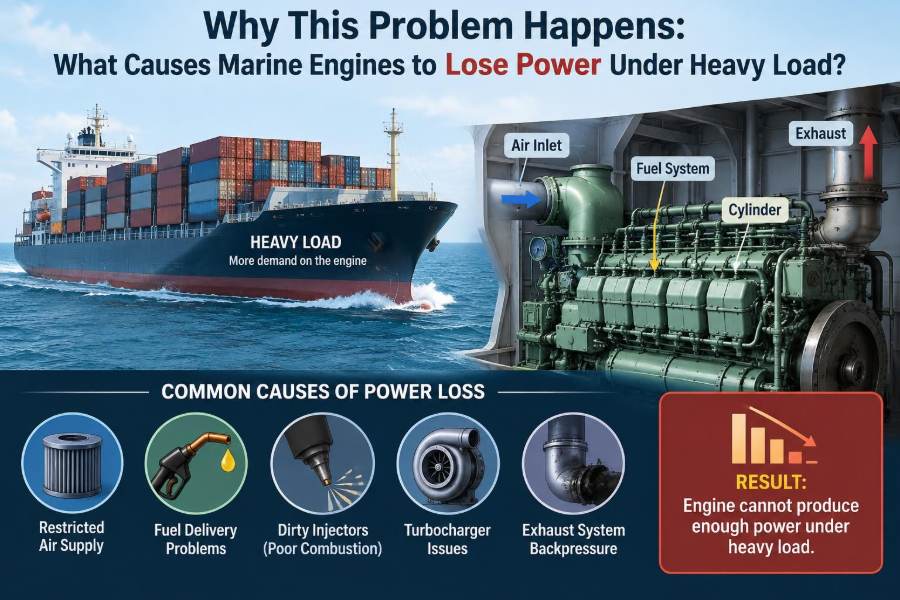

The engine is running smoothly alongside. It starts readily, the exhaust looks normal, and routine readings seem acceptable. Then the vessel leaves harbour, encounters weather, or begins pulling hard against current—and the engine will not reach its expected rpm.
For an engineer, this is one of the most frustrating fault patterns at sea. The machinery may sound healthy at light load, yet it feels weak when the ship actually needs thrust. Sometimes rpm falls away; sometimes black smoke appears; sometimes temperatures climb until an alarm or protective slowdown intervenes.
Power loss under load is not one single defect. It is the visible result of an imbalance between what the engine needs and what its fuel, air, cooling, exhaust, control, and drivetrain systems can deliver.
Understanding that balance helps crews diagnose logically rather than replacing parts at random. It also helps operators recognize when the “engine problem” is actually a hull, propeller, gearbox, or vessel-condition problem.
⚙️ Start With the Meaning of “Power Under Load”
An engine produces torque, the twisting force delivered at the crankshaft. Power depends on both torque and rotational speed. In simple terms, when a propeller demands more torque than the engine can provide at a given speed, rpm falls.
A lightly loaded engine can keep turning even with modest fuel restriction, poor air supply, or imperfect combustion. Under heavy load, those hidden limitations become large enough to prevent the engine from producing its rated output.
This is why a no-load test alone cannot prove that a propulsion engine is healthy. A useful diagnosis must compare engine behaviour with a known load condition and the manufacturer’s operating limits.
🧭 Separate Genuine Engine Weakness From Excessive Resistance
The first question is simple: is the engine failing to make power, or is the vessel asking for more power than usual? Both conditions can produce low speed and reduced rpm.
Hull fouling, a damaged propeller, fishing gear around the shaft, shallow water, heavy weather, or an overloaded vessel can increase resistance. The engine may then be operating normally but unable to achieve the usual rpm because the propeller curve has changed.
A sudden loss after an impact suggests propeller, shaft, or hull damage. A gradual seasonal loss may point toward fouling. By contrast, smoke, uneven cylinder temperatures, or abnormal fuel-pressure readings make an engine-side cause more likely.
📈 Understand the Propeller Load Curve
For a fixed-pitch propeller, required power rises very rapidly with shaft speed. A small increase in rpm can require a much larger increase in power. That is why a vessel may run acceptably at moderate speed but struggle to gain the final few revolutions.
If the propeller is fouled or damaged, or the hull is heavily fouled, the engine effectively sees a heavier load at each rpm. This is called over-propping in a practical sense, even if the original propeller size was correct.
Conversely, a controllable-pitch propeller can create excessive load if pitch is commanded too high for the available rpm. The alarm list may be quiet while the engine is simply being asked to do too much.
⛽ Fuel Starvation Is a Common Heavy-Load Failure
At higher load, fuel flow must increase substantially. A restriction that passes enough fuel for idling and manoeuvring may become a serious bottleneck at sea speed.
Common restrictions include a dirty suction strainer, blocked primary filter, clogged fine filter, collapsed flexible hose, partially closed valve, restricted tank vent, or contaminated fuel pickup. A weak transfer pump can create a similar symptom.
Where safe procedures and installed instruments permit, compare supply and return pressures with the maker’s values. Replacing a filter without checking the tank and upstream strainer may restore power briefly while leaving the actual contamination source untouched.
🫧 Air Leaks on the Suction Side Can Be Misleading
A suction-side fuel leak may not drip fuel externally. Instead, it can draw air into the line, especially when pump demand rises. The result can be unstable rpm, hesitation, misfiring, or an engine that recovers briefly when load is reduced.
Look for loose unions, hardened O-rings, cracked filter seals, damaged hose ends, and poorly seated water-separator elements. Transparent sections of properly designed fuel line may reveal bubbles, but their absence does not rule out air entry elsewhere.
Repeated bleeding should not become the permanent cure. If air keeps appearing, find the entry point and confirm that the suction arrangement is sound.
🧪 Fuel Quality Changes Combustion Quality
Fuel can be present in adequate quantity and still burn poorly. Water, sediment, microbial growth, incompatible blends, low ignition quality, or incorrect viscosity can affect injection and combustion.
Water contamination may cause rough running and corrosion, while solids can damage pumps and injectors. On larger installations using residual fuels, incorrect heating or treatment can leave fuel too viscous for good atomization; overheating can create other handling problems.
Fuel sampling should be representative, not drawn casually from a convenient drain. A sample from the relevant tank, separator discharge, or engine inlet can help distinguish a fuel-condition problem from a mechanical fault.
🔩 Injection Pumps Must Deliver at the Right Time
Diesel combustion depends not only on fuel quantity but also on injection timing and pressure. If fuel is injected late, combustion pressure develops too far into the power stroke, reducing effective torque and increasing exhaust temperature.
Worn pump elements, sticking racks, faulty electronic actuators, incorrect timing after maintenance, and degraded drive components can all limit output. On electronically controlled engines, sensor or actuator faults may trigger a protective derate rather than a complete shutdown.
Timing checks and pump adjustments should follow maker procedures. Small errors can affect cylinder pressure, exhaust temperature, emissions, and mechanical loading, so guesswork is a poor substitute for measured verification.
💉 Worn Injectors Turn Fuel Into Poor Spray
An injector must atomize fuel into fine droplets and distribute it properly through the combustion chamber. A dribbling nozzle, poor opening behaviour, blocked holes, or worn tip produces larger droplets that burn more slowly and less completely.
Under load, this can appear as black exhaust smoke, elevated exhaust temperature, knock, uneven running, or a cylinder that contributes less power than the rest. The exact signs vary with engine design and fault severity.
Injector bench testing, cylinder pressure analysis, exhaust-temperature comparison, and manufacturer-approved diagnostics provide stronger evidence than judging an injector by appearance alone.
🌬️ The Engine Needs Enough Clean Air
Diesel engines normally control power by varying fuel, but that does not mean air is unlimited. When more fuel is injected than the available oxygen can burn efficiently, torque may not rise as expected and smoke increases.
A blocked air filter, restricted intake silencer, collapsed intake duct, fouled charge-air cooler, or obstruction in the engine-room ventilation path can all reduce air supply. Hot engine-room air is less dense, so it contains less oxygen in a given volume.
The practical pattern is often strongest at high load: acceptable idling, reasonable low-speed running, then dark smoke and poor acceleration as fuel demand rises.
🌀 Turbochargers Need Energy and Speed
A turbocharger uses exhaust-gas energy to spin a compressor that supplies pressurized intake air. If it fails to accelerate or cannot deliver enough pressure, the engine loses the air margin needed for heavy-load combustion.
Causes include fouled turbine or compressor surfaces, damaged blades, bearing problems, leaking air connections, wastegate faults, variable-geometry mechanism faults where fitted, and restrictions on either side of the turbocharger.
Never inspect a turbocharger casually while it is operating. High rotational speed and hot surfaces create serious hazards. Use approved shutdown, isolation, and inspection procedures.
❄️ Charge-Air Coolers Can Hide Their Restriction
After compression, intake air becomes hot. A charge-air cooler lowers its temperature, increasing density and helping combustion. Its air passages can become oil-fouled or dirty, while its water side can scale, foul, or suffer inadequate cooling flow.
A cooler may therefore create two related problems: excessive pressure drop that restricts airflow and high intake temperature that reduces air density. Either can raise exhaust temperatures at high load.
Checking only external cleanliness is not enough. Compare pressure drop, air temperature before and after the cooler, and cooling-water performance against the maker’s expected values where those measurements are available.
🔥 Exhaust Back Pressure Steals Turbocharger Energy
Exhaust gas must leave the cylinders and pass through the turbine and exhaust system. Restrictions—such as a fouled economizer, spark arrestor, silencer, catalytic equipment, boiler-side deposits, or damaged piping—raise back pressure.
High back pressure makes scavenging harder, leaving more residual gas in the cylinder. It can also reduce the energy relationship that allows the turbocharger to supply air effectively. The engine works harder to breathe in both directions.
Exhaust restrictions are particularly easy to miss when a system has been modified or when deposits have accumulated gradually. Temperature and pressure trends are often more useful than a single visual inspection.
🌡️ Cooling Problems Can Trigger Protective Derating
Modern engines commonly reduce available power when coolant, lubricating oil, charge air, exhaust, or component temperatures exceed protective thresholds. This derate is intended to prevent damage, not to inconvenience the operator.
Low seawater flow, a blocked sea chest, fouled heat exchanger, failing pump impeller, stuck thermostat, low coolant level, or poor engine-room ventilation can push temperatures upward under load. At light load, the same cooling system may appear adequate.
Do not defeat alarms or bypass protective functions to regain speed. The immediate gain may be followed by warped components, bearing damage, seizure, or fire risk.
🛢️ Lubrication Faults May Limit Available Power
Low lubricating-oil pressure, high oil temperature, incorrect oil grade, blocked filters, or excessive bearing clearance can lead to alarms, slowdown, or shutdown. Some systems also limit fuel delivery when oil protection is active.
Oil problems may be a cause, a consequence, or both. For example, an overloaded engine can run hotter, reducing oil viscosity; reduced viscosity can then weaken the lubricating film at bearings and further increase risk.
Trend pressure against temperature rather than treating either reading alone as decisive. An oil pressure that seems acceptable when cold may be inadequate at normal operating temperature.
🧠 Electronic Controls May Be Intentionally Holding Power Back
Electronically governed engines rely on sensor inputs for rpm, boost pressure, fuel pressure, temperature, position, and load. If a signal is implausible or a monitored condition reaches a limit, the control system may restrict fuel.
This can feel exactly like mechanical power loss. The difference is often visible in fault history, active alarms, commanded-versus-actual fuel values, or diagnostic status screens.
Do not assume every stored code identifies the failed component. A low-boost code, for example, may result from an air leak, dirty cooler, exhaust restriction, turbo problem, or sensor error. Diagnose the system that produces the signal.
🎛️ Governor and Throttle-Linkage Faults Reduce Fuel Demand
On mechanical engines, a worn or incorrectly adjusted linkage may prevent the fuel rack from reaching its full-fuel position. A governor can also be maladjusted, sticky, or unable to respond correctly under rising load.
On electronic systems, the throttle lever may be healthy while a commanded torque limit prevents further fuel delivery. Comparing lever demand, governor command, rack position or actuator position, and actual rpm can reveal where the limitation begins.
Adjustment seals, stop settings, and calibration values exist for a reason. Altering them without load testing can create overspeed, overload, excessive smoke, or warranty and compliance issues.
🧯 Safety Interlocks and Slowdown Systems Deserve Respect
Overspeed, low oil pressure, high temperature, crankcase mist, low cooling-water pressure, and gearbox faults may operate alarms, slowdowns, or trips. Some are obvious; others act through a control logic sequence that is not immediately apparent at the bridge or local control station.
When power is limited, establish whether a protection system is active before searching for obscure mechanical faults. The event log, alarm history, and control-system manual can show what condition initiated the response.
A reset is not a diagnosis. If a protective action recurs under load, its initiating condition must be investigated before returning the engine to demanding service.
🧱 One Weak Cylinder Can Limit the Whole Engine
Multi-cylinder engines can continue running with one cylinder contributing poorly, but they cannot deliver normal power efficiently. The healthy cylinders must carry more load, and exhaust temperatures may become uneven.
Possible causes include injector defects, poor compression, valve leakage, incorrect valve clearance, damaged piston rings, liner wear, or local cooling problems. Cylinder-to-cylinder temperature differences are clues, not final proof.
Useful checks may include exhaust-temperature trend review, cylinder pressure measurement, compression testing where suitable, crankcase inspection, and borescope examination. Choose methods appropriate to the engine and its safety procedures.
🔧 Valve Timing and Compression Determine How Well Cylinders Breathe
An engine must trap and compress enough air before fuel injection. Leaking inlet or exhaust valves, incorrect valve clearance, worn cam followers, slipped timing, damaged head gaskets, and worn piston-ring assemblies can reduce compression or disturb gas exchange.
These faults often become more visible under load because combustion pressure is higher and the engine needs every cylinder to work efficiently. Hard starting, blow-by, abnormal breather output, or persistent one-cylinder temperature deviation may accompany the power loss.
Mechanical timing errors can be serious. Confirm timing marks and gear condition using the manufacturer’s method rather than assuming a recently serviced engine is correctly timed.
⚓ Gearboxes, Clutches, and Shafting Can Absorb the Power
If engine rpm rises normally but vessel speed does not, the issue may lie after the flywheel. A slipping clutch, incorrect gearbox control pressure, damaged coupling, or unusual shaft-line friction can waste or fail to transmit power.
Some faults produce heat, vibration, metallic debris, delayed engagement, or a burning smell. Others are detectable only through oil analysis, pressure checks, alignment assessment, or vibration monitoring.
Do not confuse a transmission slip with engine weakness. The two require different tests, and repeatedly applying more throttle to a slipping clutch can quickly worsen damage.
🪸 Hull Fouling and Propeller Damage Change the Load
Marine growth, paint breakdown, bent propeller blades, damaged nozzle surfaces, rope around the shaft, and debris caught on appendages all increase drag or disturb water flow. The engine may then smoke or overload because the propulsion demand has risen.
A bent blade can also create vibration and cyclic load. A vessel may retain reasonable top rpm in neutral yet fail to reach it underway, which is a useful clue but not a complete diagnosis.
Diver inspection, dry-dock inspection, performance trending, and vibration observations can help. Avoid assuming fouling is harmless merely because the vessel is still moving.
🌊 Weather, Draft, and Water Conditions Matter
Head seas, strong current, shallow water, increased draft, trim changes, and towing operations can materially alter propulsion demand. In rough conditions, propeller emergence and ventilation can make load fluctuate instead of remaining steady.
These are not engine defects, but they influence engine operation. A prudent operator may need to reduce pitch, alter rpm, change course, or accept lower speed to keep exhaust temperatures and load within safe limits.
Comparing performance only between similar drafts, sea states, and hull conditions prevents misleading conclusions about engine health.
📊 Read Instruments as a Pattern, Not Isolated Numbers
One abnormal value rarely tells the whole story. The relationship among rpm, fuel pressure, boost pressure, exhaust temperature, coolant temperature, oil pressure, and vessel speed is more informative.
| Observed pattern | Possible direction for investigation |
|---|---|
| Black smoke with low boost | Air intake, charge-air cooler, turbocharger, exhaust restriction |
| Rpm falls with unstable fuel pressure | Fuel restriction, air ingress, transfer-pump weakness |
| Normal engine rpm but poor vessel speed | Clutch or gearbox slip, propeller or hull condition |
| High temperature followed by limited fuel | Cooling performance or protective derate logic |
| One exhaust temperature persistently different | Individual cylinder combustion or mechanical condition |
These are diagnostic starting points, not conclusions. Several faults can coexist, particularly on machinery with deferred maintenance.
📝 Compare With a Reliable Baseline
The strongest troubleshooting tool is often a previous record made when the vessel was known to perform well. Record rpm, speed, fuel rack or load, boost, key temperatures, draft, trim, and weather conditions at defined operating points.
Without a baseline, crews may argue over whether a current reading is “normal.” With one, a slowly increasing charge-air temperature or falling maximum rpm becomes visible before it develops into an operational problem.
Trend data is most useful when instruments are maintained and readings are taken consistently. A doubtful sensor can create a false trend and send maintenance effort in the wrong direction.
🔍 Use a Safe, Structured Diagnostic Sequence
Start with the least invasive checks and work toward deeper inspection. This reduces unnecessary dismantling and keeps attention on the systems most likely to explain the observed pattern.
- Confirm the complaint: define rpm, load, speed, smoke, temperatures, and when the issue occurs.
- Check alarms, fault history, protection status, and recent maintenance or fuel changes.
- Compare current readings with baseline data and manufacturer limits.
- Inspect fuel, air, cooling, and exhaust systems for simple restrictions or leaks.
- Assess propulsion load, hull condition, propeller condition, and transmission behaviour.
- Use maker-approved tests for injectors, timing, compression, turbocharger condition, and control calibration.
Where a test creates risk—such as running at high load, opening pressurized fuel systems, or inspecting rotating machinery—follow vessel procedures and competent supervision.
🚫 Common Responses That Make the Situation Worse
The wrong response can turn a manageable fault into major damage. Increasing fuel or defeating a limit may mask the symptom while raising cylinder temperatures and mechanical stress.
- Bypassing alarms or slowdown circuits without an approved emergency procedure.
- Adjusting fuel racks, governor stops, or electronic parameters to chase rpm.
- Changing filters repeatedly without finding the source of contamination.
- Assuming black smoke always means “more fuel is needed.”
- Ignoring vibration, exhaust-temperature imbalance, or unusual gearbox heat.
- Testing at maximum load before confirming cooling, lubrication, and ventilation are adequate.
Good fault-finding aims to restore the correct air-fuel-load balance, not simply force the engine to produce more power temporarily.
🛠️ Prevention Is Mostly About Keeping Margins Available
Heavy-load reliability depends on preserving clean flow paths and maintaining machinery condition before an emergency exposes weaknesses. Fuel treatment, filter management, air-side cleaning, cooling-system care, turbocharger inspection, and propeller maintenance all protect available power.
Operational habits matter too. Warm the engine correctly, load it progressively when practical, avoid prolonged overload, investigate unusual trends early, and match speed or pitch to sea conditions.
Planned maintenance should be guided by maker instructions, operating hours, fuel quality, duty cycle, and condition-monitoring evidence. A calendar alone cannot account for the different demands of harbour service, towing, fishing, and continuous passage work.
🧩 The Core Principle: Power Loss Is a System Imbalance
Marine engines lose power under heavy load when they cannot convert fuel into useful torque fast enough for the demand placed on them. The limitation may be inadequate fuel, insufficient air, weak combustion, excessive heat, control-system derating, mechanical loss, or an abnormally heavy propeller load.
The most efficient diagnosis connects symptoms to the physical system involved. Low boost and black smoke point in a different direction from normal rpm with poor vessel speed; a recurring thermal derate requires a different response from unstable fuel pressure.
Reliable operation comes from treating engine, drivetrain, propeller, hull, and operating environment as one connected propulsion system—not as separate problems competing for attention.
When a marine engine loses power under heavy load, the answer is usually found by identifying which part of the propulsion system has lost its operating margin. Careful observations, safe testing, and sound trend records turn a vague complaint into a solvable fault. 🚢⚙️🔍