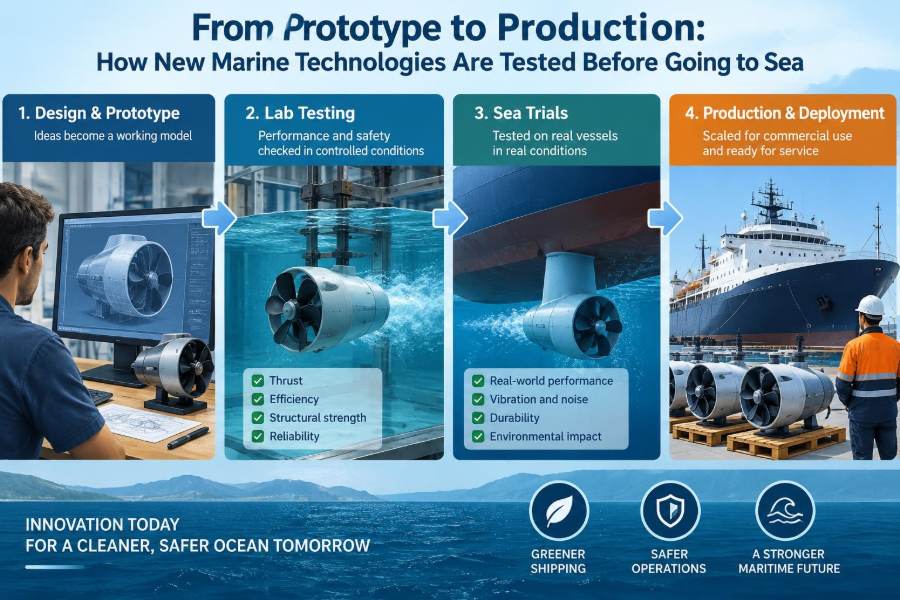

A new fuel system may look convincing in a workshop. Its pipes are neat, sensors respond on a screen, and a pump runs quietly for a few minutes. None of that yet proves it will survive vibration, salt spray, hot machinery spaces, an inattentive operator, or a rough passage far from repair facilities.
That gap between a successful demonstration and a dependable shipboard installation is where marine engineering becomes especially demanding. A vessel is not simply a laboratory that moves: it is a tightly connected safety system operating in a harsh, regulated environment.
Whether the technology is a battery bank, wind-assist rotor, autonomous navigation function, alternative-fuel engine, or hull-mounted sensor, it must earn confidence in stages. Each stage asks a different question, and passing one does not automatically answer the next.
Understanding this process helps students see why development takes time and helps working professionals judge test evidence more critically. The objective is not to eliminate every uncertainty before sailing; it is to identify, control, and communicate uncertainty well enough for safe, useful operation.
⚓ Why a Prototype Is Not Yet a Marine Product
A prototype demonstrates that an idea can work. A production-ready marine product must demonstrate that it can work repeatedly, be installed correctly, be maintained by ordinary crews, and fail without creating unacceptable hazards.
Consider a sensor that measures fuel flow accurately on a bench. At sea, electrical noise, temperature changes, pulsating flow, contamination, vibration, and imperfect cable routing may affect its output. The product also needs instructions, alarms, spare parts, calibration methods, and compatible interfaces.
Marine testing is therefore a process of reducing practical uncertainty, not merely proving a scientific principle.
🌊 The Sea Creates a Severe Test Environment
Ships encounter loads that change constantly. Hull flexing, wave impacts, propeller-induced vibration, rolling, pitching, moisture, and wide temperature ranges all influence equipment performance.
Salt water presents a further challenge. It can accelerate corrosion, create conductive paths across electrical insulation, and damage connectors that appeared reliable in dry industrial service. Equipment may also sit unused for long periods, then be expected to work immediately in an emergency.
Testing must reflect these combined conditions. A device that tolerates vibration alone and humidity alone may still struggle when both occur with heat and electrical loading.
🧭 Start With the Operational Need
Good development begins before drawings or hardware. The team defines the operational problem: reduce fuel use at a particular speed range, detect a leak earlier, improve cargo handling, or provide propulsion with lower-emission energy.
Requirements should state measurable outcomes and operating boundaries. For example, a battery-supported propulsion system may need a defined power response, safe isolation after a fault, acceptable thermal limits, and a clear operating philosophy during charging.
Vague ambitions such as “make the ship greener” cannot be tested. A clear requirement becomes the basis for design decisions, acceptance criteria, and later trials.
📝 Turn Requirements Into Testable Criteria
Requirements become useful when each one has a verification method. Engineers commonly verify by inspection, analysis, demonstration, or test. A material certificate may be inspected; structural strength may be analysed; an emergency shutdown may need a functional test.
Acceptance criteria should say what result counts as a pass, what instrumentation will be used, and which operating conditions apply. This avoids a common late-stage problem: different parties believing that “works correctly” means different things.
- Normal operating performance and efficiency
- Maximum and minimum environmental conditions
- Alarm, trip, and safe-state behaviour
- Installation tolerances and interface limits
- Inspection, maintenance, and recovery arrangements
🧩 Map the System Before Testing Components
Marine technologies rarely operate alone. A fuel cell may depend on gas storage, ventilation, cooling, power electronics, automation, and emergency response. Testing only the central machine can miss the failure paths created by its connections.
A system architecture diagram identifies energy flows, fluid flows, data links, controls, and human actions. It also makes boundaries visible: what the supplier controls, what the shipyard integrates, and what the crew operates.
This mapping supports interface management. Many commissioning faults occur not because individual equipment is defective, but because a signal, pipe, foundation, or responsibility was misunderstood at an interface.
🔍 Identify Hazards Early
Hazard identification asks what could cause harm and how the system should respond. The exercise should include foreseeable misuse and maintenance activity, not only normal operation.
For an ammonia-fuel arrangement, possible concerns include leakage, toxic exposure, incompatible materials, enclosed-space accumulation, and the consequences of a failed detector. For an autonomous function, concerns may include sensor degradation, poor data quality, cyber compromise, and unclear transfer of control to the bridge team.
The output is not simply a list of fears. It should lead to safeguards, alarms, shutdown logic, physical separation, procedures, and test cases.
📊 Use Risk Assessment to Prioritize Effort
Not every failure deserves the same test depth. Risk assessment considers consequence, likelihood, detectability, and the effectiveness of barriers. Methods vary by project, but the purpose is consistent: direct attention toward failures that are both credible and significant.
For example, a cosmetic panel defect may be inconvenient, while a cooling-water loss affecting a high-energy battery room can require layered protection. The latter needs more rigorous analysis, independent checks, and realistic functional testing.
Risk assessments are living documents. Results from later tests may expose assumptions that need revision.
🧪 Prove Materials and Chemistry First
Before full equipment is built, developers often test coupons, seals, coatings, lubricants, and fluid samples. A coupon is a small representative material specimen used to investigate corrosion, fatigue, wear, or chemical compatibility.
This matters especially for new fuels and fluids. A seal that performs well with conventional diesel may swell, harden, or lose strength in another medium. Similarly, a coating can behave differently under actual temperature, salinity, and cleaning regimes.
Small-scale testing is comparatively economical, but it must use realistic exposure conditions. Simplified tests provide screening evidence, not a complete lifetime prediction.
🛠️ Build and Test the Subsystems
Subsystem testing examines assemblies such as pumps, inverters, valve skids, cooling loops, sensor packages, and control cabinets before they become part of a larger installation. Engineers can isolate faults and use controlled conditions.
A pump test may measure flow, pressure, power draw, vibration, temperature rise, and cavitation tendency across its intended operating range. Cavitation occurs when local pressure causes vapour bubbles to form and collapse, potentially damaging surfaces and reducing performance.
Testing at this level also establishes baseline data. If the integrated system later behaves differently, the team has evidence for tracing where the change arose.
💻 Model What Cannot Be Tested Yet
Computer modelling helps engineers explore conditions that are costly, dangerous, or unavailable early in development. Examples include computational fluid dynamics for hull flow, finite-element analysis for structural loads, and simulations of electrical protection coordination.
A digital model is useful only when its assumptions are understood. Inputs such as sea state, material properties, boundary conditions, and operator actions strongly affect outputs. A precise-looking plot is not automatically a precise prediction.
The best practice is to compare models with physical measurements whenever practical, then update the model as evidence improves. This is sometimes described as validation rather than merely verification of the calculation.
🧠 Test Control Software Away From the Ship
Modern marine systems depend on programmable logic controllers, embedded software, supervisory computers, and networks. Software faults can appear only in unusual sequences, such as a sensor fault during a power transfer or a restart after an emergency shutdown.
Hardware-in-the-loop testing connects real controllers to simulated equipment signals. The controller behaves as if it is running a propulsion plant or ballast system, while the test setup safely creates normal and abnormal scenarios.
This method allows repeatable checks of timing, interlocks, alarm priorities, and fallback modes. It cannot replace sea trials, but it prevents many avoidable software discoveries from reaching the vessel.
🔌 Confirm Electrical Protection and Power Quality
New electrical technologies introduce questions beyond whether power is available. Engineers must examine voltage and frequency stability, short-circuit behaviour, insulation monitoring, harmonic distortion, earthing arrangements, and protection selectivity.
Selectivity means the protective device nearest a fault should operate first where possible, limiting the loss of power to the affected section. A poorly coordinated trip can black out healthy equipment along with the faulty circuit.
Battery and hybrid systems also need tests for contactors, pre-charge circuits, isolation detection, cooling controls, and safe de-energization. These functions must work during faults, not just during a neat planned shutdown.
🔥 Test Thermal Management and Fire Boundaries
Heat is a common hidden constraint. Engines, batteries, power electronics, compressors, and fuel-processing equipment can all lose performance or become hazardous when cooling is inadequate.
Thermal testing measures not only the hottest component but also how heat moves through a room, cabinet, or enclosure. Ventilation paths, blocked filters, failed fans, and high ambient temperatures should be considered where relevant.
Fire safety is assessed as a system of prevention, detection, containment, and response. The appropriate measures depend on the energy source and arrangement, so a solution suitable for one technology should not be copied blindly to another.
🧂 Expose Equipment to Marine Durability Tests
Environmental qualification may include vibration, shock, temperature cycling, humidity, salt-mist exposure, ingress protection, and electromagnetic compatibility tests. Ingress protection concerns resistance to entry by solids and water; it does not describe every aspect of corrosion resistance.
Accelerated tests are valuable but limited. They compress selected stresses into a shorter time, which may reveal weak coatings or seals, yet cannot perfectly reproduce years of vessel operation and maintenance.
Designers should also inspect practical details: drain paths, crevices that trap water, dissimilar metals, cable glands, access for cleaning, and the orientation of connectors. These modest choices frequently influence durability.
🏭 Use Factory Acceptance Testing Wisely
A factory acceptance test, often called FAT, is conducted before equipment leaves the manufacturer. It confirms that the supplied assembly matches agreed drawings, documents, functions, and selected performance requirements.
FAT commonly includes visual checks, wiring checks, functional operation, alarm and trip demonstrations, and review of certificates. It is a useful opportunity for the owner, yard, supplier, and sometimes a classification representative to resolve defects while access is easy.
However, a FAT does not prove shipboard performance. The factory setup may not contain actual cabling lengths, vessel motions, connected systems, or the crew’s working environment.
🚚 Protect Evidence During Transport and Installation
Equipment that passed its factory test can be damaged or altered before commissioning. Transport restraints, lifting points, storage humidity, preservation measures, and shock indicators may matter for sensitive assemblies.
At the shipyard, inspectors verify foundations, alignment, weld quality where applicable, pipe cleanliness, cable segregation, bonding, and correct identification. Foreign material left in a pipe or a reversed instrument connection can undermine an otherwise sound design.
Configuration control is essential here. Teams need to know which software version, drawing revision, sensor range, and parameter set were actually installed.
🔗 Check Interfaces During Integration
Integration testing brings subsystems together in the arrangement intended for the ship. A navigation sensor may communicate correctly with its own display but send delayed or incorrectly scaled data to another system. A battery converter may operate alone but interact unexpectedly with generator controls.
Teams should test data quality as well as data presence: units, timestamps, loss-of-signal behaviour, alarm ownership, and what each receiving system does with invalid information.
This stage is where interdisciplinary communication matters most. Mechanical, electrical, automation, naval architecture, safety, and operations personnel see different parts of the same problem.
🧱 Verify Installation Before Energizing
Pre-commissioning confirms that construction is complete enough to begin safely. Typical activities include pressure tests, flushing, cleaning, insulation resistance tests, loop checks, calibration, continuity checks, and verification of mechanical completion.
A loop check follows an instrument signal from the field device through wiring and control logic to the display, alarm, or final control element. It confirms that the measurement is correctly identified, scaled, and acted upon.
Rushing this phase creates false fault-finding later. A disciplined checklist is not bureaucracy; it separates installation defects from genuine design or control issues.
✅ Commission Functions One by One
Commissioning introduces energy, fluids, motion, or live data progressively. The team normally begins with local operation and low-risk conditions, then proves automatic sequences, permissives, alarms, and shutdowns.
A permissive is a condition that must be satisfied before an action can proceed, such as adequate cooling flow before a high-power converter starts. Interlocks prevent unsafe combinations of actions.
Functional tests should include credible failures. If a low-level alarm is tested only by changing a value on a screen, the test may not reveal a blocked impulse line, failed transmitter, or faulty wiring.
🚨 Prove Alarms, Trips, and Safe States
Protection systems deserve special scrutiny because they may remain dormant until an abnormal event occurs. Alarm tests verify that people receive understandable warning; trip tests verify that equipment moves to a safe state when defined limits are crossed.
A safe state differs by system. It may mean stopping fuel flow, opening a breaker, reducing power, closing a valve, switching to manual control, or maintaining essential services while isolating the affected part.
Designers must avoid alarm overload. Too many low-value alarms can obscure the warning that needs immediate action. Clear priorities and crew-oriented messages are as important as the sensor itself.
👥 Include the People Who Will Operate It
A technically correct system can still be difficult or unsafe to operate. Crew members need controls they can understand under time pressure, displays that show relevant status, and procedures that match the vessel’s actual work.
Human-centred trials ask practical questions: Can an operator find the emergency action quickly? Is a maintenance isolation physically accessible? Do similar controls behave consistently? Can a technician distinguish a sensor fault from a process fault?
Training should use realistic scenarios, including degraded modes. It should not imply that automation removes the need for judgment; it changes where judgment is needed.
📜 Work With Class, Flag, and Other Authorities
Marine projects operate within requirements set by classification societies, flag administrations, port and environmental authorities, insurers, and contract specifications. The exact pathway depends on vessel type, trade, technology, and jurisdiction.
Novel arrangements may require an alternative-design or risk-based approval approach rather than a direct match to a prescriptive rule. In such cases, early discussion is valuable because evidence expectations can shape the test plan and design.
Approval is not a substitute for engineering judgment, and engineering judgment is not a substitute for required approval. Both are part of making a system acceptable for service.
⚓ Conduct Harbour Acceptance Tests
Harbour acceptance tests, often called HAT, are performed after installation and commissioning, while the vessel remains in port. They demonstrate integrated functions without the added variables of open-water operation.
Typical checks may include starting and stopping sequences, load sharing, communications, steering interfaces, cargo-related functions, emergency power arrangements, and monitoring systems. The scope should reflect the technology and agreed acceptance plan.
Harbour testing is also a final chance to correct accessible defects before the vessel is committed to a trial schedule. It should be evidence-led, with results recorded rather than remembered informally.
🌬️ Take the System Through Sea Trials
Sea trials assess vessel and equipment behaviour under operating conditions that cannot be fully recreated alongside. Trials may include speed and manoeuvring runs, propulsion load changes, response to commands, vibration observations, and checks of navigation and automation functions.
Weather and sea conditions influence results. A calm-water trial may establish a useful baseline, but it cannot represent every route or season. Trial reports should state conditions and limitations rather than treating one voyage as universal proof.
For emerging technology, a phased operating envelope is sensible. The vessel may initially operate with limits on power, route, weather, fuel quantity, or supervision until confidence and data increase.
📈 Measure Performance Against a Baseline
Performance claims require a fair comparison. Fuel use, energy efficiency, emissions-related data, thrust response, or hull performance should be assessed against a defined baseline and comparable conditions where possible.
For instance, a wind-assist device may produce different benefit depending on wind angle, wind speed, vessel loading, route, and engine setting. Reporting a single favourable result without context does not describe expected operational value.
Instrumentation accuracy, sampling intervals, and data cleaning also matter. If a measurement is uncertain, the report should say so and avoid conclusions beyond what the data supports.
🗂️ Treat Documentation as Part of the Product
Drawings, test records, operating manuals, maintenance instructions, software backups, certificates, and spare-parts information are not administrative leftovers. They allow the owner and crew to operate, inspect, repair, and modify equipment safely.
A traceable record links a requirement to its design feature, test evidence, result, and any accepted deviation. This is particularly valuable years later when investigating a fault or planning a retrofit.
Documents must match the installed configuration. An excellent manual for an earlier software release can be actively misleading.
🔄 Monitor the First Months in Service
Initial service reveals realities that staged testing may not capture: crew routines, port turnaround pressure, fouling, supplier response times, seasonal conditions, and interactions with the vessel’s mission.
Condition monitoring can track temperatures, vibration, insulation status, pressures, power quality, or performance trends. The purpose is not to collect every available signal, but to identify meaningful deviation early.
Early-life issues should be handled through controlled feedback. Temporary operating limits, design changes, updated procedures, and additional training may all be appropriate depending on the evidence.
🧯 Learn From Defects Without Hiding Them
A defect report should describe what happened, under what conditions, what barriers worked, and what corrective action is needed. Blaming a single person too quickly can hide design, interface, training, or organizational factors.
Root-cause investigation distinguishes the immediate event from contributing conditions. A pump trip, for example, may stem from a blocked strainer, but the wider cause could include poor access, unclear maintenance intervals, or an alarm that did not identify the restriction.
A useful test programme treats unexpected results as information. Suppressing them may preserve a schedule briefly but transfers risk to the people who sail and maintain the vessel.
⚖️ Balance Innovation With Serviceability
Novel technology often adds components, controls, and specialist knowledge. Its benefits may be real, yet a design can disappoint if crews cannot inspect it, ports cannot support it, or spare parts have long lead times.
Serviceability should be tested deliberately: access to filters and valves, lifting arrangements, isolation points, diagnostic tools, remote support boundaries, and restoration after maintenance. A compact installation is not automatically a maintainable one.
Design choices involve trade-offs. Greater redundancy can improve availability but add cost, weight, complexity, and more maintenance. The right arrangement depends on consequence of failure and the vessel’s operating profile.
🧭 Common Shortcuts That Cause Trouble
Several shortcuts recur in complex marine projects. They are tempting because schedules are tight, but each shifts uncertainty into a later and more expensive stage.
- Testing only normal operation and not credible fault conditions
- Assuming a successful FAT proves shipboard integration
- Changing software or settings without revising test evidence
- Leaving crew involvement until the end of commissioning
- Measuring performance without recording operating conditions
- Closing defects on paper before verifying the corrective action
The remedy is not endless testing. It is a risk-based plan with clear responsibilities, suitable hold points, and honest evidence.
🛳️ A Practical Testing Sequence
The exact route differs by technology, but a robust programme usually moves from controllable conditions toward operational complexity. Later tests should build on evidence from earlier ones rather than repeat them without purpose.
| Stage | Main question | Typical evidence |
|---|---|---|
| Concept and risk review | What must the system achieve safely? | Requirements, hazard analysis, design basis |
| Component and subsystem tests | Do individual elements perform as intended? | Bench data, material tests, functional reports |
| Factory and integration tests | Do supplied assemblies and interfaces work together? | FAT records, software tests, interface checks |
| Commissioning and harbour tests | Is the installed vessel system safe and functional? | Checklists, alarm tests, HAT reports |
| Sea trials and early service | Does it perform reliably in operation? | Trial data, monitoring trends, defect feedback |
🎓 What Students and Practitioners Should Take Away
The strongest testing culture combines technical skepticism with practical curiosity. Ask what conditions the test represented, which failure modes were exercised, what assumptions remain, and whether the evidence applies to the installed vessel.
For students, this means connecting theory to interfaces, operators, maintenance, and regulation. For practitioners, it means resisting the temptation to treat a checklist as proof when the underlying scenario was unrealistic or incomplete.
The core principle is simple: new marine technology becomes trustworthy through progressive, traceable testing that reflects the real ship, real people, and real sea conditions it will face.
From the first material sample to monitored service on board, each test should answer a specific question and inform the next decision. That disciplined chain of evidence is what turns a promising prototype into equipment crews can rely on at sea. ⚓🌊🔧