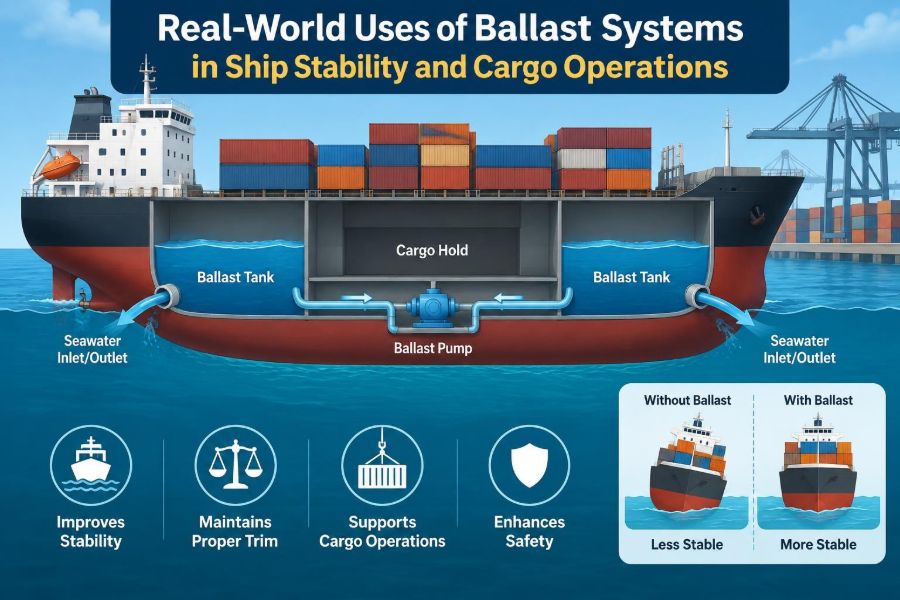

A bulk carrier leaves port after discharging its cargo. Its holds are nearly empty, but the vessel must still cross open water safely. Without the weight of cargo low in the ship, the hull may sit too high, respond sharply to waves, and lose the propeller immersion needed for efficient propulsion.
A tanker faces a different moment: cargo is being loaded into several tanks, and the loading sequence can create an unwanted list or excessive stress along the hull. The crew cannot simply add or remove water anywhere. They must decide which ballast tanks to use, in what order, and at what rate.
These are ordinary operational problems rather than rare emergencies. Ballast systems give crews a controlled way to manage a ship’s draft, trim, heel, stability, and structural loading as its weight changes.
Understanding ballast means seeing seawater as an actively managed part of the vessel’s operating condition. It affects safe navigation, cargo efficiency, fuel use, environmental compliance, and the practical decisions made on the bridge, in the control room, and at the terminal.
⚓ What a Ballast System Actually Does
A ballast system moves water into, between, and out of dedicated tanks within a ship. This water is called ballast water. By changing where weight is placed in the hull, the system changes how the ship floats and responds.
Ballast is not a substitute for sound design or correct cargo planning. It is an operational tool that lets a vessel remain within approved limits when cargo, fuel, stores, and sea conditions change.
🧭 Why Ships Need Adjustable Weight
A ship floats when the buoyant force from displaced water equals its total weight. If weight is removed, the hull rises; if weight is added, it sinks deeper. Cargo loading and discharge therefore alter draft continuously.
Adjustable ballast helps maintain a workable condition between two extremes: a lightly loaded ship that may be too shallow and lively, and an overloaded or poorly distributed ship that may have unsafe draft, trim, or hull stress.
⚖️ The Basic Stability Picture
Initial transverse stability describes a ship’s resistance to small angles of heel. It depends on the relationship between the center of gravity, the center of buoyancy, and the metacenter. A ship with a suitably low center of gravity generally develops a restoring moment when it heels.
Ballast placed low in double-bottom tanks can lower the overall center of gravity. That can improve stability, but more stability is not always better. An excessively stiff ship may roll rapidly and impose uncomfortable or damaging accelerations on structure, cargo, and equipment.
📏 Draft: More Than a Painted Scale
Draft is the vertical distance between the waterline and the lowest point of the hull, usually measured at marked locations near the bow, midship, and stern. It determines whether the vessel has enough under-keel clearance for a channel, berth, or dry-dock approach.
In ballast condition, crews may take on water to reach a minimum operating draft. This can improve directional control and protect the propeller and rudder from becoming too close to the surface.
↔️ Trim and Its Operational Value
Trim is the difference between draft forward and draft aft. A ship trimmed by the stern sits deeper aft; a ship trimmed by the bow sits deeper forward. Ballast transfer is a common way to correct or deliberately set trim.
Moderate trim can be useful for certain operating conditions, but the allowable range comes from the vessel’s approved stability and loading information. Excessive trim can reduce visibility, affect steering, increase resistance, or create loading and drainage problems.
📐 List, Heel, and Why the Difference Matters
A list is a persistent lean to port or starboard caused by an internal condition, such as uneven cargo, unequal ballast, or flooding. A heel is a temporary lean caused by an external force, such as wind, a turn, or a suspended load.
Ballast can correct a list by adding or transferring weight to the high side, provided the underlying cause is understood. Treating a developing list only with counter-ballast may conceal cargo shift or water ingress, so investigation comes before correction.
🛢️ Where Ballast Water Is Stored
Most merchant vessels use several tank locations so weight can be placed where it is useful. Typical arrangements include double-bottom tanks, wing tanks, peak tanks at the bow or stern, and dedicated side or hopper tanks.
| Tank location | Common operational purpose | Key caution |
|---|---|---|
| Double bottom | Low ballast for draft and stability | Monitor structural limits and sounding accuracy |
| Forepeak | Adjusting forward draft and trim | Rapid changes can affect trim noticeably |
| Afterpeak | Adjusting stern draft and propeller immersion | Verify steering and trim implications |
| Wing or side tanks | Managing list and hull loading | Avoid unequal filling and free-surface effects |
🔧 Pumps, Lines, Valves, and Remote Control
The ballast system includes pumps, suction and discharge lines, valves, strainers, overboard connections, tank vents, level indicators, and often remote valve controls. A ballast control station may show tank levels, valve positions, pump status, and alarms.
Systems differ widely by vessel type. The essential principle is the same: the crew must be able to direct water safely, confirm where it is going, and isolate sections when maintenance or abnormal conditions require it.
🚢 Sailing Safely in Ballast Condition
A container ship or bulk carrier returning without cargo is often described as being in ballast condition. The vessel may carry enough ballast to achieve a safe draft, adequate propeller immersion, appropriate trim, and acceptable stability.
Lightly loaded ships can be especially vulnerable to wind, wave slamming, and poor handling. The required ballast condition is therefore not just a matter of comfort; it supports maneuvering and protects hull structure in expected sea states.
📦 Supporting Cargo Loading Sequences
During cargo operations, weight may be added quickly to one area of a ship. Ballast can offset the changing distribution, keeping drafts and list within terminal and vessel limits.
Consider a hypothetical bulk carrier loading a heavy parcel into forward holds first. The loading computer may show increasing bow draft and bending moment. The plan may call for controlled ballast adjustments or a revised cargo sequence so the ship does not exceed permitted structural limits.
🏗️ Preventing Excessive Hull Stress
A ship is a long beam supported unevenly by buoyancy along its hull. Cargo, fuel, ballast, and machinery create downward weight; buoyancy pushes upward. If these forces are poorly balanced, the hull can experience excessive shear force and bending moment.
Ballast distribution is part of keeping those forces within the limits specified in the loading manual. A condition can look level at the waterline and still be structurally unsuitable, which is why visual judgment alone is not enough.
📊 The Role of the Loading Computer
Modern vessels commonly use approved loading instruments to calculate drafts, stability, trim, shear force, bending moment, and other relevant limits. The operator enters actual or planned weights and locations, including ballast quantities.
The computer supports decisions; it does not replace verification. Tank soundings, density assumptions, cargo data, and entered values must be accurate. A persuasive screen result based on incorrect inputs is still an unsafe basis for operation.
🌊 Keeping the Propeller and Rudder Effective
A lightly loaded vessel can rise enough that the propeller works near the surface. In waves, it may intermittently draw air, causing racing, vibration, reduced thrust, and possible machinery stress. A shallow rudder also loses effectiveness.
Adding ballast aft can increase stern draft and improve immersion. The exact approach depends on vessel instructions because stern ballast also changes trim, hull loads, and sometimes visibility from the bridge.
🛟 Improving Maneuvering in Wind and Swell
High-sided vessels in light condition can present a large area to the wind while having relatively little underwater lateral area. This makes berthing, unberthing, and channel transit more demanding, particularly at low speed.
Ballast increases displacement and draft, helping the hull resist wind-driven drift. It cannot eliminate wind effects or replace tug assistance, but it gives the vessel a more predictable hydrodynamic response.
🏭 Tankers and Segregated Ballast Tanks
On oil tankers, segregated ballast tanks are arranged so that ballast water is kept separate from cargo oil and fuel oil systems. This separation reduces the risk of routine ballast discharge carrying oil contamination.
For tanker operations, tank segregation, valve line-up, and contamination prevention are central duties. A wrong cross-connection can create serious safety, environmental, and commercial consequences, so independent checks matter.
🪨 Bulk Carriers and Alternate Loading Patterns
Bulk cargoes such as ore, coal, or grain may be loaded in all holds or in an approved alternate-hold pattern, depending on the ship, cargo, and loading manual. These patterns can create markedly different local and global structural loads.
Ballast tanks may be used throughout the voyage to maintain the intended loading condition. The crew must follow the ship-specific approved plan rather than assuming that a familiar pattern is suitable for every bulk carrier.
📦 Container Ships and Weight Distribution
Container ships face a variable mix of container weights, stack locations, wind area, and changing fuel and ballast quantities. Heavy containers low in the ship generally support stability, while high deck stacks can raise the center of gravity.
Ballast is used alongside the stowage plan to maintain acceptable stability and trim. It must also accommodate port restrictions, crane operations, and the evolving weight distribution as containers are loaded or discharged.
🚗 Vehicle Carriers and Sensitive Stability
Vehicle carriers have large enclosed decks and high windage. Their cargo is spread across multiple decks rather than concentrated low in holds, making careful stability management essential.
Ballast can help provide a suitable departure condition, but it is only one control. Vehicle securing, deck loading limits, watertight integrity, and awareness of free surfaces all contribute to safe operation.
💧 Free-Surface Effect: The Hidden Penalty
When a tank is partly full, liquid can move across its surface as the ship rolls. This movement effectively raises the ship’s center of gravity and reduces stability. The reduction is called the free-surface effect.
Several slack tanks can have a significant combined effect. Whenever practicable and consistent with the plan, ballast tanks are kept either pressed full or empty rather than left partly filled for long periods.
🔄 Ballast Transfer Requires a Sequence
Moving water from one tank to another changes weight distribution even though total displacement may remain nearly constant. During the transfer, intermediate conditions can be less safe than the final condition.
A proper sequence identifies pump rates, valve operations, expected tank levels, stability checks, structural limits, and stopping points. It also accounts for whether two tanks will be slack at the same time and how that affects free surface.
👀 Monitoring During Pumping Operations
Ballasting is not a “set and forget” activity. Crew members monitor tank levels, drafts, list, trim, pump pressure, valve position, and overboard discharge where applicable. Regular communication between deck personnel, the control station, bridge, and terminal prevents conflicting actions.
- Compare actual tank levels with the plan and expected pumping rate.
- Check for unexpected list, trim, leaks, or abnormal pump sound.
- Confirm that vents are clear and overflow arrangements are understood.
- Pause operations if readings disagree or a valve line-up is uncertain.
🧪 Ballast Water Treatment and Environmental Protection
Ballast water can carry organisms, sediments, and microbes from one region to another. If discharged in a different ecosystem, some organisms may survive and become harmful or disruptive. This is why ballast water management has become a major environmental responsibility.
Many ships use onboard ballast water treatment systems, which may combine filtration with physical or chemical disinfection methods. The practical challenge is ensuring that treatment, sampling, records, and equipment operation meet the applicable requirements for the voyage and port.
🌐 Exchange, Treatment, and Voyage Planning
Ballast water management cannot be left until arrival. The intended uptake and discharge locations, tank quantities, treatment capacity, weather, port limits, and voyage duration may all affect the plan.
Ballast water exchange, where applicable, is a controlled process with operational and environmental considerations. It must be performed only in accordance with the vessel’s approved plan and applicable rules; unsuitable weather or stability conditions may make a planned exchange unsafe.
🧾 Records Are an Operational Safeguard
Ballast records document uptake, transfer, treatment, discharge, exchange, and exceptional events. They support regulatory compliance, but they also give the crew a useful operational history when investigating unexpected tank levels or planning the next port call.
Good records are timely and factual. Entries made from memory after a busy operation are more likely to contain gaps, especially when several tanks and transfers are involved.
⚠️ Common Ballast Operation Mistakes
Many ballast problems begin with small assumptions: believing a valve is shut because it was shut previously, relying on a faulty level display, or transferring water without reviewing the intermediate condition.
- Using counter-ballast before identifying why a list developed.
- Leaving multiple tanks slack without accounting for free-surface effect.
- Exceeding a planned rate during cargo operations.
- Ignoring discrepancies between soundings and remote indicators.
- Overlooking structural limits while focusing only on draft and trim.
- Failing to isolate systems correctly before maintenance.
🧰 Maintenance That Preserves Control
Ballast equipment works in a corrosive environment and may remain idle between operations. Valves can seize, pipes can corrode, strainers can clog, level sensors can drift, and pump performance can deteriorate.
Planned maintenance and functional testing reduce the chance that a critical transfer fails during cargo work or heavy weather preparation. Maintenance should include practical verification: a remote indication is useful, but it should correspond to the physical valve and actual tank condition.
🚨 Ballast Systems in Damage Control
In a flooding incident, ballast arrangements may be relevant to damage control, but they are not a universal remedy. Pumping or counter-flooding can change stability, list, and structural loads quickly, sometimes making the situation worse.
Damage-control actions must follow the vessel’s emergency procedures, damage stability information, and command structure. The priority is to understand the source and extent of flooding, preserve watertight integrity, and avoid unplanned transfers that compromise survivability.
👷 Human Factors and Clear Communication
Ballast operations often involve several people performing tasks in different locations. Misheard tank names, unclear valve labels, unit confusion, and assumptions about responsibility can produce a wrong transfer even when the equipment is functioning correctly.
Closed-loop communication helps: the instruction is repeated back, the action is confirmed, and the result is checked. Clear tank identification, current drawings, and disciplined handovers are practical engineering controls, not paperwork for its own sake.
🧠 A Practical Pre-Transfer Check
Before starting a routine transfer, the responsible officer should establish the objective and the limits. The specific checklist varies by ship, but the thinking should be consistent.
- Confirm the present condition from reliable tank, draft, and loading data.
- Review the intended final and intermediate stability and stress conditions.
- Verify the valve line-up, pump suction, discharge route, and venting path.
- Agree on rate, communications, monitoring intervals, and stop criteria.
- Record the operation and reconcile actual results with the plan.
📚 Learning to Read a Ballast Plan
For students, a ballast plan becomes easier to understand when read as a weight-distribution story. Ask what has changed: cargo removed, fuel consumed, containers loaded high, draft restricted by a port, or weather expected to worsen.
Then trace the response. Which tanks gain or lose water? How does that affect the center of gravity, trim, list, free surface, and hull loads? This approach connects diagrams and calculations to the physical behavior of the ship.
✅ The Core Principle: Controlled Weight, Verified Condition
Ballast systems are used in real operations to make a ship fit for its current task: sailing empty, loading cargo, entering shallow water, maintaining propulsion and steering, meeting structural limits, or managing environmental obligations.
The core principle is not simply “add water for stability.” It is place the right amount of weight in the right tank, in the right sequence, while verifying the ship’s actual condition against approved limits. That principle explains why ballast work demands planning, monitoring, accurate data, and communication.
A well-managed ballast system turns changing ship weight from an operational hazard into a controllable engineering condition. It is one of the quiet systems that makes safe cargo operations and safe voyages possible. ⚓🌊🚢