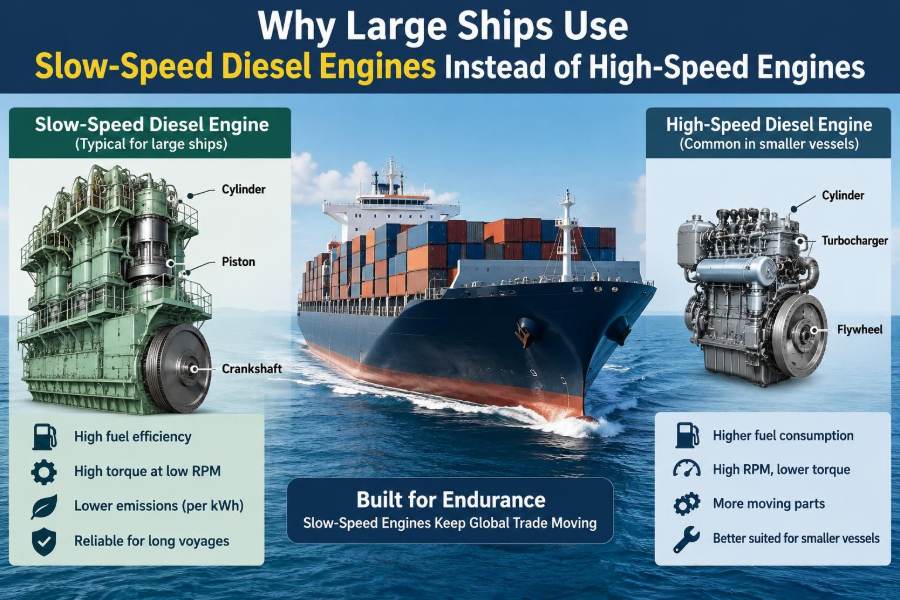

A container ship leaves port carrying thousands of boxes, each loaded with goods that must arrive on schedule. Its propeller turns steadily beneath the stern, but it is not spinning anything like a car engine. On many large cargo ships, the main engine runs at a speed that can seem surprisingly low: often only a few dozen to a little over one hundred revolutions per minute.
That slow rotation is not a sign of weak performance. It is a deliberate match between the engine, the propeller, the hull, and the long-distance work the vessel must do. A ship may operate for days or weeks at nearly constant power, where a small efficiency difference becomes a major fuel, cost, and emissions issue.
Students often first encounter engine speed as a simple performance measure: more rpm appears to mean more power. Marine propulsion shows why that shortcut fails. Power depends on both torque and rotational speed, and large ships need immense turning force delivered in the most efficient form for a large propeller.
Understanding this choice helps engineers make sense of ship layouts, fuel systems, maintenance routines, emissions technology, and the different machinery found on ferries, tugs, cruise ships, and ocean-going bulk carriers.
⚙️ The Basic Choice: Engine Speed Categories
Marine diesel engines are commonly grouped by crankshaft speed. The exact boundaries vary by reference and application, but slow-speed engines generally operate below about 300 rpm, medium-speed engines roughly in the several-hundred-rpm range, and high-speed engines above that.
Large ocean-going cargo ships often use low-speed two-stroke diesel engines directly coupled to one large propeller. By contrast, high-speed four-stroke diesels are familiar in fast craft, smaller workboats, patrol vessels, and many auxiliary applications.
The category alone does not decide whether an engine is suitable. The real question is whether its speed, torque, size, fuel use, operating profile, and transmission arrangement fit the vessel.
🌀 A Propeller Has a Preferred Speed
A ship propeller works by accelerating a large mass of water rearward. For a very large, deeply immersed propeller, efficient operation usually calls for a relatively low rotational speed. Turning it too quickly can create losses and harmful flow effects.
Think of a large ceiling fan compared with a small desk fan. The larger fan can move a great deal of air without needing extremely high speed. Similarly, a large ship propeller is designed to move enormous volumes of water with controlled loading on each blade.
A slow-speed main engine can turn such a propeller directly at its preferred speed. This direct match is the foundation of the arrangement.
🌊 Why Tip Speed Matters in Water
Blade-tip speed rises with both propeller diameter and rpm. If a large propeller turns too fast, the tips move through the water at very high speed, and the pressure distribution around the blades becomes more severe.
That can increase drag, vibration, noise, and the risk of cavitation. It also means more of the engine’s power is lost in inefficient flow rather than converted into useful thrust.
Propeller designers balance diameter, pitch, blade area, number of blades, hull clearance, vessel draft, and intended service speed. A slow-turning propeller is not automatically best in every case, but it is usually a strong solution for a large displacement cargo ship.
💥 Cavitation Is More Than a Noise Problem
Cavitation occurs when local pressure on a propeller blade falls low enough for vapor-filled cavities to form in the water. When those cavities collapse, they can produce pressure pulses and, over time, damage surfaces.
Some cavitation may be difficult to avoid at high loading, but excessive cavitation reduces propulsive efficiency and can cause vibration felt throughout the stern. It may also erode blade material and burden shaft-line components.
Keeping propeller rpm appropriately low helps designers manage blade loading and tip speed. This is one reason a direct-drive slow-speed engine suits a wide, slow propeller so well.
🔩 Torque Does the Heavy Turning Work
Power is the product of torque and rotational speed. A high-speed engine can make substantial power with less torque because it completes more revolutions each minute. A slow-speed engine must produce much more torque to deliver comparable power at lower rpm.
That high torque is exactly what a large fixed-pitch propeller requires. The crankshaft transmits powerful, steady twisting force through the shaft to turn a propeller that may be several metres in diameter.
This makes a useful distinction: high rpm is not the same as high capability. For a large ship, low rpm plus very high torque is often the more useful form of power.
🧱 Why Slow-Speed Engines Are So Large
Low-speed marine diesels have very large cylinders, long strokes, and substantial moving parts. Their physical scale allows each power stroke to act over a large piston area and a long distance, generating high torque at the crankshaft.
The long stroke also supports good expansion of combustion gases. More useful work can be extracted before exhaust gases leave the cylinder, provided the engine is correctly designed and operated.
These engines can be several storeys high in the engine room. Their size is not inefficiency; it reflects the need to produce vast continuous power at low rotational speed.
🔥 The Two-Stroke Cycle Fits Main Propulsion
Most slow-speed ship main engines operate on the two-stroke diesel cycle. They produce a power stroke on every crankshaft revolution, unlike a conventional four-stroke engine, which has one power stroke every two revolutions per cylinder.
This does not mean every two-stroke engine is automatically more efficient. It does mean the arrangement is well suited to obtaining high continuous power from a low-rpm engine with a manageable number of large cylinders.
In a crosshead engine, the piston rod connects through a crosshead to the connecting rod. This arrangement helps manage the side forces associated with the long piston stroke and separates cylinder lubrication from crankcase lubrication.
📈 Efficiency Favors Long, Steady Voyages
Fuel is one of the largest operating costs for many commercial ships, and fuel combustion is also a central source of shipboard emissions. For a vessel that travels long distances at a largely steady speed, high thermal efficiency has exceptional value.
Slow-speed diesels are designed to operate efficiently over sustained periods near their intended loading range. Their large cylinders, long expansion process, and low-speed direct-drive arrangement all contribute to the overall propulsion concept.
Engine efficiency is only part of the picture. The ship’s resistance, propeller efficiency, weather routing, hull condition, and operating speed can all strongly affect fuel use.
🔗 Direct Drive Avoids Gearbox Losses
When the engine’s crankshaft speed matches the propeller’s preferred speed, the propeller shaft can be connected directly to the engine. This eliminates the reduction gearbox that a medium- or high-speed engine would normally need.
Removing a large gearbox can reduce mechanical losses, simplify the main power path, and avoid a major item of equipment requiring its own maintenance and lubrication management. Direct drive also avoids the design challenge of transmitting very high power through reduction gears.
A gearbox is not inherently undesirable. It becomes worthwhile when it enables a more suitable engine arrangement, multiple engines, flexible machinery placement, or other vessel-specific benefits.
⚖️ Direct Drive Versus Geared Propulsion
| Feature | Slow-speed direct drive | High-speed engine with reduction gear |
|---|---|---|
| Engine-to-propeller connection | Usually direct | Gearbox reduces rpm |
| Best-known fit | Large, slow ocean-going cargo ships | Fast craft and smaller vessels |
| Propeller arrangement | One large, slow-turning propeller | Often smaller, faster propellers or waterjets |
| Machinery characteristics | Very large engine, simpler shaft power path | More compact engines, added transmission equipment |
| Operational flexibility | Strong for steady service | Often strong for variable speed and multi-engine layouts |
The comparison is a design guide, not a rulebook. Many successful ships use medium-speed engines and gears because their mission profile makes that solution more practical.
⛽ Fuel Flexibility Shaped the Design
Historically, slow-speed marine diesels became closely associated with fuels that are more viscous than the distillate fuels commonly used in road vehicles. Such fuels require heating, purification, and carefully controlled injection conditions before they can be burned safely and reliably.
Modern fuel choices are changing because of air-pollution rules, carbon-intensity goals, fuel availability, and new fuel pathways. Engines may be designed or adapted for conventional marine fuels, distillates, liquefied gases, methanol, and other options.
The key point is not that a slow-speed engine can burn every fuel without changes. It is that its large-scale fuel-handling and combustion systems have long been engineered for continuous marine service.
🛢️ Fuel Treatment Is Part of the Plant
On a large ship, the fuel system is much more than a tank and a pipe. Depending on the fuel, it can include storage tanks, settling tanks, centrifuges, filters, heaters, booster pumps, viscosity control, and return lines.
Contaminants, water, or incorrect fuel temperature can damage injection equipment or disrupt combustion. Engineers therefore treat fuel preparation as a vital reliability function, not as an administrative task performed before sailing.
This broader system helps explain why main propulsion must be evaluated as a complete plant. Engine type, fuel quality, crew procedures, and monitoring arrangements are tightly connected.
🧭 Ocean Cargo Ships Usually Need Steady Power
A bulk carrier crossing an ocean typically spends much of its voyage in a limited band of engine loads rather than repeatedly accelerating and braking. A large slow-speed diesel is optimized for this long-duration, relatively stable duty.
Its engine room layout, cooling systems, lubrication systems, and watchkeeping routines are built around sustained propulsion. The ship may slow for weather, traffic, port approaches, or commercial scheduling, but open-water operation is fundamentally different from city driving.
This operating pattern is why comparing a ship’s engine directly with a truck or car engine can be misleading.
🏎️ When High-Speed Engines Make Sense
High-speed diesels are excellent choices when compact size, low mass, rapid response, and high vessel speed matter more than extracting maximum efficiency from one huge propeller. Fast ferries, pilot boats, patrol craft, yachts, and some offshore vessels are typical examples.
These vessels may use several engines, gears, controllable-pitch propellers, waterjets, or hybrid arrangements. Their duty cycles can include frequent maneuvering, rapid changes in speed, and short voyages.
Choosing a slow-speed engine simply because it is efficient would be a mistake if it made the vessel too heavy, too large, or too slow to fulfill its mission.
🚢 Vessel Size Changes the Engineering Answer
A small coastal vessel cannot simply install the propulsion plant used on a very large container ship. The engine may be too tall, too heavy, and too powerful for the hull, while its low rpm may not suit the available propeller diameter.
Large vessels have enough draft and stern volume to accommodate a bigger propeller and a deep main engine. Their displacement and route economics also justify machinery optimized for very high continuous output.
As ships become smaller or faster, medium-speed and high-speed alternatives become progressively more attractive. The engine selection follows the whole ship, not a single efficiency figure.
📐 Hull Form and Propeller Diameter Work Together
A propeller cannot be enlarged without limit. It needs adequate clearance from the hull and water surface, and it must fit within the stern geometry without creating unacceptable vibration or uneven inflow.
Designers therefore develop hull lines and propeller geometry together. A fuller, slower cargo hull can often support a large-diameter propeller, while a shallow-draft ship or high-speed craft may face tighter geometric limits.
Good propulsion design is an exercise in matching. The engine, gearbox if fitted, shaft, propeller, wake field, rudder, and hull resistance must work as one system.
🔄 Fixed-Pitch and Controllable-Pitch Propellers
Many direct-drive slow-speed ships use a fixed-pitch propeller. Its blade angle is permanent, so thrust is controlled mainly by changing engine speed and, where applicable, reversing engine direction.
A controllable-pitch propeller changes blade angle while the shaft may continue turning in the same direction. This can be valuable for vessels requiring frequent maneuvering or rapid thrust changes, but it adds hub mechanisms, hydraulic systems, and maintenance demands.
Neither type is universally superior. A fixed-pitch propeller can be highly efficient at its design condition, while controllable pitch offers operational flexibility that some vessels need.
↩️ Reversing a Giant Propeller
Large two-stroke main engines are commonly designed to run in both ahead and astern directions. To reverse, the engine control system changes the fuel-injection and starting sequence so the crankshaft rotates the opposite way.
This is a striking consequence of direct drive: the engine itself provides reversal rather than relying on a reversing gearbox. The maneuver requires carefully managed compressed-air starting, interlocks, and control logic.
During normal operation, bridge commands are translated through the propulsion control system. Engineers must understand both the mechanical process and the operational limits, particularly during harbor maneuvers.
🛠️ Maintenance Rewards Access and Planning
Slow-speed engines are large enough for engineers to access major components through crankcase doors, scavenge spaces, and platform arrangements. That does not make maintenance easy; it makes planned inspection and overhaul physically possible aboard a working ship.
Typical attention areas include cylinder condition, piston rings, fuel injectors, exhaust valves, bearings, turbochargers, lubrication quality, and scavenge-space cleanliness. Trends in exhaust temperature, pressure, drain oil, and vibration can reveal developing faults.
Large engines reward disciplined condition monitoring. Waiting for a small imbalance to become a failure can lead to lost time, expensive repairs, or unsafe operational consequences.
🧴 Cylinder Oil and System Oil Have Different Jobs
In a crosshead slow-speed engine, cylinder lubrication and crankcase system lubrication are generally separate. Cylinder oil is fed in controlled quantities to the liner area, where it must protect surfaces and help manage corrosive products of combustion.
System oil circulates through bearings and other machinery spaces, where cleanliness and stable properties are essential. Mixing the functions would make it difficult to meet both sets of requirements.
Lubrication selection and feed rate depend on engine design, fuel characteristics, operating conditions, and manufacturer guidance. Over-lubrication wastes oil and can create deposits; under-lubrication increases wear and corrosion risk.
🌬️ Turbocharging Helps a Slow Engine Breathe
Even at low crankshaft rpm, a large diesel needs a huge mass of air. Exhaust-gas turbochargers use energy in the exhaust flow to drive compressors that supply pressurized scavenge air to the cylinders.
This improves combustion and allows greater power density than naturally aspirated operation. The air system also includes coolers, drains, filters, and scavenge spaces, each requiring attention because air leaks, fouling, or poor drainage can affect performance.
Turbocharger behavior is particularly relevant at low load, where available exhaust energy falls. Operators must follow approved operating guidance rather than assuming all loads are equally suitable for extended running.
🌡️ Low-Load Operation Has Limits
Ships sometimes operate at reduced speed to save fuel, meet arrival schedules, or respond to market conditions. Lower speed can greatly reduce the power needed to overcome hull resistance, but the main engine may then run well below its preferred load range.
Prolonged low-load operation can contribute to poorer combustion, deposits, fouling, and altered thermal conditions. The details depend on the engine, fuel, ambient conditions, and manufacturer recommendations.
Practical measures may include periodic higher-load operation where permitted, adjusted maintenance routines, and closer monitoring. “Slow steaming” describes a vessel-speed strategy; it does not mean every engine condition is automatically healthy.
🏭 Emissions Rules Add New Constraints
Marine propulsion design is no longer judged only by fuel consumption and reliability. Controls on sulfur oxides, nitrogen oxides, particulate emissions, and greenhouse-gas intensity influence fuel selection, machinery design, and voyage planning.
Possible measures include lower-sulfur fuels, exhaust-gas cleaning systems, selective catalytic reduction, exhaust-gas recirculation, engine tuning, energy-saving devices, shore-power use in port, and alternative fuels. Each option has its own operational implications.
A slow-speed diesel remains a capable platform, but compliance depends on the complete installation and how it is operated. An engine cannot be described as “clean” without specifying the fuel, controls, load, and regulatory context.
🧪 Alternative Fuels Do Not Eliminate Trade-Offs
New marine fuels can reduce particular emissions or support lower-carbon pathways, depending on how they are produced and used. They also introduce questions about storage volume, toxicity, flammability, material compatibility, crew training, bunkering infrastructure, and lifecycle emissions.
Dual-fuel slow-speed engines are increasingly relevant because large ships need practical ways to adopt new fuels without abandoning the efficiency advantages of direct propeller drive. However, the best option varies by route, ship type, fuel supply, and regulation.
Engineers should resist simple labels. A fuel transition is a system transition involving tanks, piping, ventilation, detection, procedures, emergency response, and commercial availability.
⚡ Hybrid and Electric Systems Have Different Roles
Electric propulsion can be highly useful where machinery layout flexibility, quiet operation, redundancy, dynamic positioning, or variable power demand are priorities. Diesel-electric plants are common in several vessel types, especially where propulsion and hotel or mission loads must be coordinated.
For a large ship traveling steadily across oceans, converting mechanical engine power to electricity and then back to shaft power introduces conversion equipment and losses. That often makes direct mechanical drive attractive when one large propeller is the main requirement.
Hybrid systems are not competitors in a simple race. They are tools for different duty cycles, and some future ships may combine direct-drive main propulsion with batteries, shaft generators, and energy-management systems.
🧑🔧 The Engine Room Is Designed Around the Main Engine
On a traditional large cargo ship, the main engine influences the engine room’s height, tank arrangement, exhaust uptake, shaft tunnel, workshop access, and maintenance platforms. Its foundation must transmit huge forces into the hull structure while controlling alignment and vibration.
Supporting equipment includes generators, boilers or thermal-oil systems where fitted, pumps, separators, compressors, coolers, steering gear, and automation systems. The main engine may be the largest item, but it cannot operate independently.
For cadets and junior engineers, this is a useful lesson: propulsion reliability depends on auxiliaries just as much as on pistons and crankshafts.
📊 Specific Fuel Consumption Needs Context
Specific fuel consumption expresses fuel used per unit of energy produced, often stated as mass per kilowatt-hour. It is useful for comparing engine performance, but it should not be used in isolation to predict a ship’s voyage fuel use.
A ship can have an efficient engine and still consume excessive fuel if the hull is fouled, the propeller is damaged, trim is poor, weather routing is ineffective, or the vessel is operated faster than needed. Required propulsive power rises sharply as speed increases for many displacement ships.
The meaningful measure is whole-vessel performance under real conditions. Engine-room data and bridge data must be interpreted together.
🧼 Hull and Propeller Condition Can Erase Gains
Marine growth and surface roughness increase hull resistance. Damage, roughness, or fouling on the propeller can reduce thrust efficiency and disturb the flow into the rudder.
When resistance rises, the engine must produce more power to maintain the same speed. This can increase fuel use, raise thermal loading, and move the operating point away from the intended design condition.
Regular hull and propeller management is therefore a propulsion measure, not merely a cosmetic maintenance task. Efficient machinery cannot fully compensate for an inefficient underwater body.
🚨 Common Misconceptions About Ship Engines
- “Slow-speed means old-fashioned.” Slow rpm is a purposeful engineering choice, and modern engines use sophisticated controls, monitoring, fuel systems, and emissions equipment.
- “A faster engine always gives a faster ship.” Ship speed depends on delivered propeller thrust, hull resistance, and propulsive efficiency—not engine rpm alone.
- “One engine type is best for all ships.” Fast craft, offshore vessels, ferries, tugs, and large cargo ships have different missions and constraints.
- “Direct drive means simple operation.” The power path is simpler, but the engine and its supporting systems remain complex and require skilled operation.
🧠 A Practical Selection Framework
When comparing propulsion options, start with the vessel’s mission rather than the engine catalogue. Ask what speed is required, how variable the load will be, how much propeller diameter the hull permits, and what redundancy or maneuverability is needed.
- Estimate resistance and required propulsive power across the operating profile.
- Choose feasible propeller diameter, rpm, and blade arrangement.
- Assess direct drive, geared mechanical drive, diesel-electric, and hybrid options.
- Evaluate fuel availability, emissions compliance, machinery space, maintenance capability, and lifecycle cost.
This process makes clear why a slow-speed diesel is often selected for a large cargo ship: it solves several connected design problems at once.
✅ The Core Principle: Match the Whole Propulsion System
Large ships use slow-speed diesel engines primarily because they can deliver enormous torque directly to a large, slow-turning propeller. That pairing usually offers an efficient and robust solution for vessels that carry heavy loads over long distances at relatively steady speeds.
The engine’s two-stroke design, long stroke, fuel systems, turbocharging, lubrication arrangement, and maintainable scale all support that central role. Direct drive can avoid a reduction gearbox, while low propeller rpm helps manage hydrodynamic losses and cavitation risk.
But the correct lesson is not “slow-speed is always better.” The best marine engine is the one that matches the propeller, hull, route, fuel, regulations, and operating duty of the particular ship.
For a large ocean-going cargo vessel, slow-speed diesel propulsion remains compelling because it turns the propeller at the speed the ship needs, not merely at the speed an engine can achieve. 🚢⚙️🌊