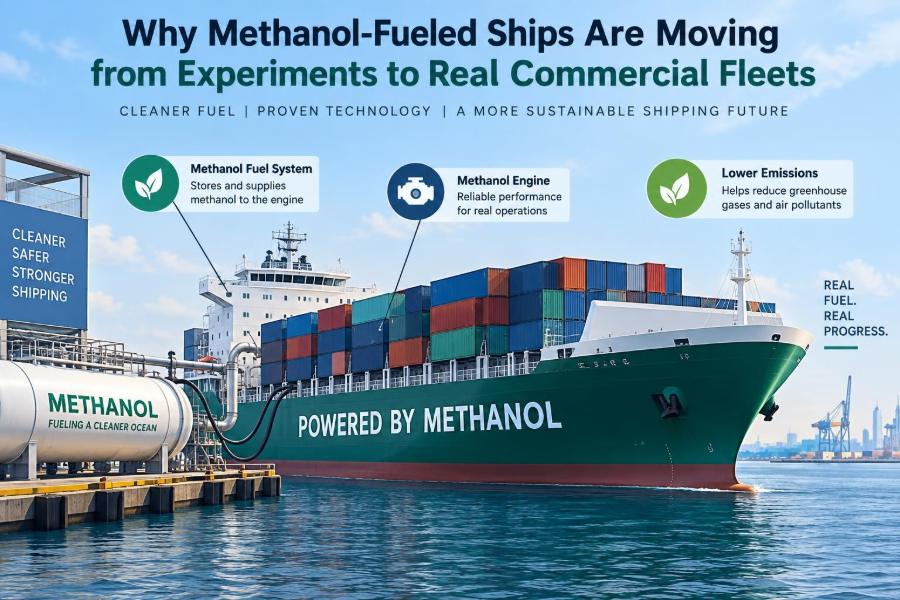

A container ship arrives alongside, tugs hold it steady, hoses are connected, and cargo operations continue around the clock. Until recently, changing the fuel in that scene meant changing almost everything: the ship’s machinery, the terminal’s equipment, crew routines, emergency procedures, and fuel supply contracts.
Methanol is beginning to make that change look more manageable. It is not a perfect fuel, and it does not automatically make a voyage low-carbon. But it offers a practical route for shipowners that need engines and fuel systems they can order, operate, and refuel within commercial schedules.
That distinction explains why methanol propulsion has moved beyond a small number of demonstrations. Large oceangoing vessels are entering service with methanol-capable machinery, while ports, fuel suppliers, classification societies, and crews are building the supporting systems around them.
For marine engineers, the story is less about a fashionable new fuel than about an engineering transition: managing different hazards, protecting machinery, proving fuel quality, and connecting a ship to a fuel supply chain that is still developing.
⚓ The Shift from Demonstration to Deployment
Early alternative-fuel vessels often proved that a concept could work. Commercial fleets must prove something harder: that the concept can be repeated across multiple ships, routes, crews, ports, and maintenance periods.
Methanol has crossed an important threshold because engines, storage arrangements, control systems, and operating guidance are increasingly available as defined commercial products. Orders alone do not guarantee widespread use, but they give suppliers and ports a clearer reason to invest.
🧪 What Methanol Actually Is
Methanol is a simple alcohol, usually handled as a liquid at ambient conditions. In shipping it is often referred to as methyl alcohol or CH3OH, although shipboard documentation and safety procedures should use the terminology required by the applicable rules.
It can be produced from fossil feedstocks, biomass, waste-derived inputs, or captured carbon combined with hydrogen. Those production routes matter greatly because the molecule alone does not reveal its full climate impact.
🌊 Why a Liquid Fuel Fits Ships Well
A major operational advantage is that methanol is a liquid at normal atmospheric pressure and typical marine ambient temperatures. It does not require the cryogenic storage used for liquefied natural gas or the high-pressure tanks associated with compressed gases.
That does not make tank design simple. It does mean designers can work with familiar liquid-fuel concepts: tanks, transfer pumps, piping, venting, sampling, leak detection, and segregated spaces.
🔥 Its Energy Density Changes the Design
Methanol contains less energy per unit volume than conventional marine fuel oil. A ship needs more tank volume to achieve the same range, so fuel capacity can compete with cargo space, ballast arrangement, machinery-room layout, or voyage flexibility.
This penalty is manageable for some trades more easily than others. A vessel with frequent calls at equipped ports can carry less fuel than a ship serving long routes with uncertain bunkering opportunities.
⚙️ Dual-Fuel Engines Reduce the Adoption Barrier
Most commercial methanol propulsion concepts use dual-fuel engines. These engines are designed to operate on methanol while retaining the ability to use a conventional fuel, subject to their approved operating limits and fuel arrangement.
That capability gives operators resilience during the early years of fuel availability. It also changes the investment decision: a ship does not necessarily become unusable when low-carbon methanol is unavailable at one port.
🛠️ How a Methanol Engine Burns Fuel
Engine details vary by manufacturer and engine type, but the central challenge is achieving controlled ignition and stable combustion with a fuel that behaves differently from heavy fuel oil and marine gas oil.
In large marine engines, a small quantity of pilot fuel may be used to initiate combustion in some configurations. Other designs use arrangements suited to their combustion process. Engineers must understand the specific engine maker’s fuel, injection, lubrication, and changeover requirements rather than treating all methanol engines as identical.
🧯 Toxicity Is a Core Safety Issue
Methanol is flammable, but its toxicity deserves equal attention. Exposure can occur through inhalation, skin contact, or ingestion, and its health effects can be serious. A crew member must never treat it like ordinary diesel because it is a familiar-looking liquid.
Safe operation depends on closed transfer systems, suitable personal protective equipment, eyewash and emergency shower provision, clear spill procedures, and training that explains symptoms and immediate response requirements. Safety data and vessel-specific procedures remain the controlling documents.
👀 A Flame May Be Hard to See
Methanol fires can produce a flame that is difficult to see in daylight. This affects firefighting tactics, access control, and emergency decision-making during bunkering or maintenance.
Detection systems, thermal imaging where provided, fixed firefighting arrangements, and practiced emergency communication are therefore not optional details. The objective is to recognize the hazard before personnel move into an apparently clear area.
🧱 Containment Starts with Tank Location
Fuel tanks are arranged with attention to damage protection, separation from accommodation and machinery spaces, structural support, venting, and inspection access. Exact requirements depend on the vessel, flag administration, class rules, and the applicable international framework.
A good arrangement also considers the whole life of the ship. Can crew safely inspect valves? Can a leaking component be isolated? Is drainage directed to a controlled location? These practical questions often determine whether a safe design is easy to operate.
🔩 The Fuel Supply System Is Not Conventional Piping
The low-flashpoint fuel supply system typically includes dedicated pumps, filters, conditioning equipment, double-wall piping or protected routing in designated areas, ventilation, gas or vapour detection, and automatic shutdown functions.
The purpose is layered protection. If a primary pipe leaks, the secondary enclosure and detection system should limit exposure and initiate a defined response before vapour can accumulate or liquid reaches an unsafe area.
🧰 Materials Compatibility Needs Verification
Methanol can be incompatible with some materials, coatings, elastomers, and non-metallic components. Material selection cannot be copied uncritically from a diesel installation.
Gaskets, seals, hoses, tank coatings, valve internals, and sampling equipment should be selected against the fuel specification and supplier guidance. Compatibility must also be maintained during repairs, when an apparently minor replacement part can create a leak or contamination problem.
🧼 Cleanliness and Water Control Matter
Methanol mixes readily with water. Water contamination can affect fuel quality and may contribute to corrosion concerns or operational problems depending on the system design.
Tank cleaning, segregation, sampling, drainage, and controlled transfer are therefore vital. A sound bunkering checklist includes verification of the ordered grade, documentation review, sample handling, communication protocols, and clear stop-work authority.
🚛 Bunkering Is Becoming a Port Operation
Methanol bunkering can be conducted by truck, barge, or terminal arrangement, depending on port infrastructure and the quantities required. Because it is liquid, many handling principles resemble chemical cargo transfer as much as traditional bunker delivery.
The crucial issue is not simply whether a port has methanol nearby. It must have an approved procedure, trained personnel, compatible transfer equipment, emergency coordination, and a dependable way to supply the intended fuel grade.
📋 Checklists Turn Hazards into Controls
A bunkering operation should define responsibilities before hoses are connected. Ship and supplier need to agree on communication channels, tank capacities, maximum transfer rates, emergency shutdown signals, weather limitations, and spill response.
- Confirm the receiving tank, available volume, and correct line-up.
- Verify product documentation and obtain representative samples.
- Establish exclusion zones and ignition control measures.
- Test agreed communications and emergency-stop arrangements.
- Monitor tank levels, pressure, transfer rate, and leakage throughout.
A checklist does not replace judgment. It gives the team a shared method for recognizing when a normal operation has become abnormal.
🌱 Grey, Blue, Bio, and E-Methanol Are Not the Same
“Methanol-fueled” describes propulsion, not necessarily climate performance. Fossil-derived methanol can reduce some local air pollutants compared with high-sulphur residual fuel, but it does not provide the same lifecycle emissions result as renewable or lower-carbon production pathways.
Bio-methanol is generally associated with biogenic feedstocks, while e-methanol is typically made using renewable electricity to produce hydrogen and a carbon source. Terms such as “blue” may refer to fossil-based production with carbon capture, but actual results depend on boundaries, energy sources, capture performance, and upstream emissions.
📊 Lifecycle Accounting Decides the Climate Value
A vessel’s exhaust emissions are only one part of the picture. Lifecycle assessment considers emissions associated with feedstock extraction or collection, fuel production, electricity, transport, storage, and use onboard.
This is why buyers increasingly seek traceable fuel attributes and recognized accounting methods. A ship can be technically ready for green methanol while the available supply is still conventional methanol; the engine readiness and the fuel’s climate value are separate questions.
💨 Air-Quality Benefits Have Boundaries
Methanol contains no sulphur, so its use can help avoid sulphur oxide emissions associated with sulphur-containing fuels. Its combustion characteristics can also support lower particulate emissions in suitable applications.
However, engines still require careful tuning and compliance monitoring. Nitrogen oxides, unburned fuel, formaldehyde, and other emissions considerations depend on engine technology, load, after-treatment where fitted, and operating condition. No fuel should be judged from one pollutant alone.
🏭 Fuel Supply Is the Real Scaling Constraint
Ships can be ordered faster than new renewable fuel production can be developed. Producing low-carbon methanol at scale requires feedstocks or renewable electricity, processing plants, carbon-source arrangements where relevant, certification, transport, storage, and long-term offtake commitments.
This is why commercial fleets often rely on fuel procurement strategies as much as engine selection. A well-designed vessel without a credible supply plan may spend much of its life operating on its backup fuel.
🗺️ Green Corridors Can Concentrate Demand
Some routes are better suited to early adoption because they connect a limited number of major ports and have predictable vessel calls. These “green corridor” concepts can focus infrastructure, purchasing agreements, and operating experience where they are most likely to be used.
A liner service calling repeatedly at the same hubs faces a different problem from a bulk carrier trading worldwide. The first can coordinate supply; the second needs flexibility, broader availability, or sufficient onboard range to manage uncertainty.
💰 The Business Case Is More Than Fuel Price
Methanol projects involve capital costs for engines, tanks, fuel preparation systems, safety equipment, design work, and crew training. They also involve fuel cost uncertainty, potential revenue effects from lost cargo volume, and the value of regulatory compliance over the vessel’s life.
Comparing only price per tonne is misleading because fuels contain different amounts of energy. A meaningful comparison considers delivered energy, consumption, storage volume, operating profile, emissions obligations, and the availability of verified lower-carbon supply.
⚖️ Regulation Creates Direction, Not Simplicity
International and regional climate measures are increasing the value of lower-emission shipping, although rules, reporting methods, and commercial consequences differ by jurisdiction. This creates a strong incentive to build fuel flexibility into new vessels.
Engineers should avoid assuming that a fuel accepted today will satisfy every future target. Regulatory compliance depends on the vessel’s route, fuel lifecycle characteristics, documented evidence, and rules in force at the relevant time.
📐 Classification and Flag Approval Shape the Design
Methanol arrangements must be reviewed against applicable safety requirements, including provisions for low-flashpoint fuels and the requirements of the selected class society and flag administration. Approval covers more than drawings; it includes hazards, system integrity, alarms, shutdown logic, testing, manuals, and crew competence.
Early engagement matters. Late changes to tank location, vent routing, fire boundaries, or machinery-space layout can be expensive and can disrupt the build schedule.
👨🔧 Crew Competence Makes Technology Operable
A modern fuel system can fail operationally if the people using it do not understand its purpose. Training should cover normal operation, fuel changeover, bunkering, leak recognition, toxic exposure, firefighting limitations, emergency shutdown, maintenance isolation, and permit-to-work controls.
Scenario-based drills are especially valuable. A low detector reading, an unexpected tank-level trend, or a smell reported near a protected enclosure may be the first sign of a defect, not a nuisance alarm to be reset.
🔧 Maintenance Requires New Discipline
Maintenance planning includes calibration of detectors, testing of shutdown valves and emergency functions, inspection of pipe containment, verification of ventilation, replacement of compatible seals, and controlled work on fuel-containing equipment.
Before opening a system, crews need positive isolation, depressurization where applicable, drainage, flushing or purging as specified, atmosphere checks, and a permit that reflects both flammability and toxicity hazards. Familiar engine-room habits must be adapted, not merely renamed.
🚨 Common Implementation Mistakes
The most costly mistakes often arise at the interfaces between departments. A technical team may specify a capable engine without confirming fuel access; a commercial team may secure fuel without checking its certification pathway; an operator may train crews only shortly before delivery.
- Treating methanol as “just another liquid fuel.”
- Designing tank capacity without route and bunkering analysis.
- Assuming a methanol label proves low lifecycle emissions.
- Leaving port emergency coordination until the first fuel delivery.
- Ordering replacement materials without compatibility control.
Each mistake is preventable when design, operations, procurement, safety, and commercial teams work from the same fuel strategy.
🔄 Methanol Is One Option in a Mixed-Fuel Future
Shipping will not necessarily converge on one universal alternative fuel. Battery systems suit some short, energy-limited routes; biofuels can be drop-in options where supply is available; ammonia, hydrogen, wind assistance, efficiency measures, and other approaches may serve different vessel types and operating patterns.
Methanol’s advantage is not that it wins every comparison. It is that its liquid form, growing engine availability, and potential renewable pathways make it a workable option for a broad set of near-term commercial decisions.
📈 What “Commercial” Will Look Like in Practice
Commercial maturity will not mean that every port stocks renewable methanol or that every voyage uses it exclusively. It will mean fleets can procure ships, arrange finance and insurance, train crews, secure approvals, schedule bunkering, and manage fuel documentation as repeatable business processes.
Progress is likely to be uneven. Major trade hubs and committed cargo owners may move first, while smaller ports and irregular trades follow only when supply, demand, and regulation align.
🧭 A Practical Decision Framework for Owners
Before selecting methanol propulsion, an owner should test the vessel against its actual trading pattern rather than a generic forecast. The key question is whether technical readiness and fuel availability can support the intended commercial operation together.
- Map expected routes, port calls, and realistic bunkering windows.
- Calculate range using methanol’s volumetric energy requirement, not fuel mass alone.
- Assess tank-space consequences for cargo, ballast, stability, and maintenance access.
- Evaluate fuel contracts, documentation, contingency supply, and lifecycle claims.
- Build crew training, port procedures, and spare-parts control into the delivery plan.
🎓 What Marine Engineers Should Watch Closely
For students, methanol systems show why marine engineering combines thermodynamics, machinery design, naval architecture, safety management, logistics, and regulation. A technically elegant engine is only one element of a working ship.
For working professionals, the useful habit is to follow interfaces: fuel quality with machinery performance, tank size with voyage planning, detector alarms with human response, and climate claims with supply-chain evidence. Most real-world problems emerge where those systems meet.
✅ The Core Takeaway: Readiness Must Be End-to-End
Methanol-fueled ships are moving into commercial fleets because the technology now addresses a practical need for deployable, liquid-fuel flexibility. Engines and ship systems are becoming established enough for repeat orders, while decarbonization requirements make waiting for a single perfect fuel increasingly difficult.
Yet the decisive test is end-to-end readiness: safe onboard design, competent operation, reliable bunkering, compatible maintenance, and genuinely lower-carbon fuel supply. Missing any one of these can weaken the value of all the others.
Methanol is becoming commercial not because it removes every challenge, but because the industry can increasingly manage its challenges as an integrated ship, port, fuel, and people system. 🚢⚙️🌱