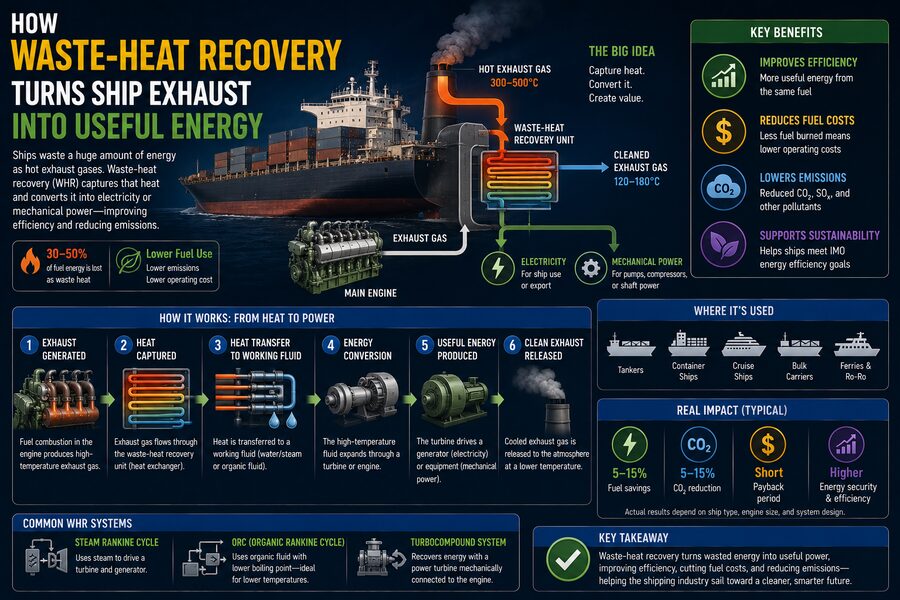

Large ships consume enormous amounts of fuel to move cargo, passengers, and equipment across the world’s oceans. Their engines convert much of that fuel’s chemical energy into mechanical power, but not all of it becomes useful propulsion. A significant portion leaves the engine as waste heat through exhaust gases, cooling water, lubricating oil, and other hot systems.
Instead of allowing all that thermal energy to disappear into the atmosphere or sea, engineers can capture part of it through waste-heat recovery systems. 🔥⚙️
These systems take heat that would otherwise be lost and use it to produce steam, generate electricity, heat water, support onboard processes, or even provide additional propulsion-related energy.
The principle is straightforward:
Hot exhaust contains usable thermal energy → recovery equipment captures that heat → the recovered energy is converted into something useful.
For large commercial ships, this can reduce fuel consumption, improve overall efficiency, lower emissions per unit of transport work, and decrease the amount of energy that auxiliary generators must produce.
🔥 Why Ship Exhaust Contains So Much Energy
Marine diesel engines are highly efficient compared with many other combustion engines, especially the enormous slow-speed two-stroke engines used on large cargo vessels.
But even a highly efficient engine cannot turn all of its fuel energy into shaft power.
Some energy leaves through:
- Exhaust gases
- Jacket cooling water
- Lubricating-oil cooling
- Charge-air cooling
- Radiation from hot machinery
- Other thermal losses
The exhaust stream is particularly attractive for energy recovery because it combines high temperature with a large mass flow rate.
A giant marine engine may continuously push a massive quantity of hot exhaust gas through its exhaust system.
That gas still contains thermal energy after combustion has finished.
Normally, the ship must discharge it through the funnel.
Waste-heat recovery tries to extract useful energy before that happens. 🌡️
🧩 The Basic Waste-Heat Recovery Process
A simplified marine waste-heat recovery system may operate like this:
Main Engine
   ↓
Hot Exhaust Gas
   ↓
Exhaust Gas Boiler / Economizer
   ↓
Steam Produced
   ↓
Steam Turbine or Ship Heating System
   ↓
Useful Energy
The hot exhaust never needs to mix directly with the water.
Instead, the exhaust passes across heat-transfer surfaces.
Water on the other side absorbs heat and may be converted into steam.
That steam can then be used elsewhere aboard the vessel.
The process resembles a conventional steam power plant, except the heat source is energy that the ship’s main engine has already produced. ♻️
🏭 Exhaust Gas Economizers
One of the most common forms of shipboard waste-heat recovery is the exhaust gas economizer or exhaust gas boiler.
An economizer is essentially a heat exchanger placed in the engine’s exhaust path.
Hot gases flow around tubes containing water.
Heat moves from:
hot exhaust → metal tube walls → water
As the water absorbs enough energy, it can produce steam.
The steam may be sent into the ship’s steam system.
On many vessels, recovered exhaust heat can provide much of the steam needed during normal sea operation.
Without this recovery system, the ship might need to burn additional fuel in a separate auxiliary boiler to create the same steam. 🔥➡️♨️
♨️ What Ships Use Steam For
Steam is useful for much more than generating electricity.
Depending on the ship type, steam can support:
- Fuel heating
- Tank heating
- Domestic hot water
- Accommodation heating
- Fuel purification systems
- Cargo heating
- Cleaning operations
- Freshwater-production systems
- Various machinery processes
Some heavy marine fuels historically required substantial heating so they could be pumped and injected properly.
Tankers may also need steam for heating certain cargoes or cleaning cargo tanks.
If waste heat produces the required steam, the ship saves fuel that an auxiliary boiler would otherwise consume. ⚓
⚡ Turning Waste Heat Into Electricity
More advanced systems go beyond steam production for heating.
They use waste heat to generate electricity.
One common configuration is a steam turbine generator.
The process works approximately like this:
1. 🔥 Exhaust heats water
An exhaust gas boiler captures thermal energy.
2. ♨️ Steam is produced
Water is converted into high-pressure steam.
3. 🌀 Steam expands through a turbine
The moving steam spins turbine blades.
4. ⚙️ The turbine drives a generator
Mechanical rotation is converted into electrical power.
5. 🔌 Electricity supplies ship systems
The recovered electricity can help power pumps, fans, lighting, refrigeration, navigation equipment, accommodation services, and other onboard loads.
This means part of the main engine’s waste energy ultimately becomes usable electrical energy.
🧮 Why This Can Save Fuel
Ships often use separate auxiliary diesel generators to produce electricity.
Suppose a vessel requires several megawatts of electrical power while underway.
If a waste-heat recovery system supplies part of that demand, the auxiliary engines do not need to produce as much power.
That reduces their fuel consumption.
The main propulsion engine still burns fuel, but the ship extracts more useful energy from every unit of fuel already consumed.
This improves overall plant efficiency.
In simplified terms:
Without recovery:
Fuel → Propulsion + Large Heat Loss
With recovery:
Fuel → Propulsion + Recovered Heat → Steam/Electricity
The same fuel input now supports more useful shipboard work. 📈
🌡️ The Importance of Exhaust Temperature
Waste-heat systems need a sufficient temperature difference to transfer heat effectively.
Very hot exhaust contains high-quality thermal energy and can potentially produce steam at useful temperatures and pressures.
As marine engines have become more efficient, however, exhaust temperatures can sometimes decrease.
That creates a design challenge.
An engine that extracts more energy directly during combustion leaves less thermal energy available in the exhaust.
Engineers therefore must optimize the entire vessel rather than simply maximizing one subsystem.
The best engine may not automatically produce the best waste-heat recovery performance unless both systems are designed together. 🧠
🚢 Slow-Speed Marine Engines Are Good Candidates
Large container ships, bulk carriers, and tankers often use low-speed two-stroke diesel engines.
These engines operate continuously for long periods at relatively stable loads.
That is valuable for waste-heat recovery.
A system works best when there is:
- A large heat source
- Consistent exhaust flow
- Long operating hours
- Significant onboard energy demand
A vessel crossing an ocean at steady power can provide relatively predictable exhaust conditions for many hours or days.
This allows recovery systems to operate efficiently for extended periods. 🌊
🔄 Combined Steam and Power Systems
Some ships use more sophisticated waste-heat recovery units that combine multiple energy streams.
A system may recover heat from:
- Exhaust gas
- Jacket cooling water
- Scavenge-air cooling
- Other engine cooling circuits
Higher-temperature sources can generate steam.
Lower-temperature heat may be used for water heating or other thermal processes.
Engineers often try to match the quality of the heat source with an appropriate use.
High-temperature heat is valuable for producing mechanical or electrical power.
Lower-temperature heat may still be useful for heating water or supporting onboard services.
This concept is sometimes described as making better use of the ship’s overall energy cascade. 🔁
⚙️ Power Turbines Can Extract Exhaust Energy Directly
Steam systems are not the only way to use exhaust energy.
Some marine waste-heat recovery arrangements include a power turbine.
Instead of transferring exhaust heat into steam first, part of the exhaust gas can expand through a turbine.
The exhaust gas spins the turbine, which can contribute mechanical power to:
- An electrical generator
- A shaft system
- Another power-transfer arrangement
The basic principle resembles a turbocharger.
A turbocharger already extracts some exhaust energy to compress the engine’s intake air.
A dedicated power turbine can recover additional energy when sufficient exhaust energy is available. 🌀
🌀 Turbochargers Are Already a Form of Energy Recovery
Modern large marine engines normally use turbochargers.
The exhaust gas leaving the cylinders still has enough energy to spin a turbine.
That turbine drives a compressor, which forces additional air into the engine.
More air helps improve combustion and engine performance.
So even before a separate waste-heat recovery system is installed, the engine is already recovering some exhaust energy through turbocharging.
Advanced systems seek to capture additional energy after or alongside the turbocharger.
This creates an engineering balance: extracting too much energy from the exhaust can interfere with the pressure and temperature conditions required for good engine operation. ⚖️
💧 Organic Rankine Cycle Systems
Not all waste-heat recovery systems use water and steam.
Another technology is the Organic Rankine Cycle, commonly abbreviated as ORC.
An ORC system operates similarly to a steam Rankine cycle, but uses an organic working fluid with a lower boiling point than water.
That allows the system to recover useful energy from lower-temperature heat sources.
A simplified ORC process is:
Waste Heat
   ↓
Working Fluid Evaporates
   ↓
Vapor Drives Turbine/Expander
   ↓
Generator Produces Electricity
   ↓
Fluid Condenses
   ↓
Cycle Repeats
ORC systems can be attractive when exhaust or cooling-system temperatures are too low for efficient conventional steam generation.
However, the choice depends on ship size, available heat, economics, maintenance requirements, and safety considerations. 🔬
❄️ Waste Heat Can Even Support Cooling
It may sound contradictory, but heat can also be used to produce cooling.
Some ships can use absorption refrigeration or absorption chillers powered by waste heat.
Instead of using large amounts of electrical energy to drive a mechanical compressor, an absorption system uses thermal energy to support the refrigeration cycle.
Potential applications include:
- Air conditioning
- Refrigeration
- Chilled-water systems
This can further reduce electrical demand on the ship’s generators.
The broader lesson is that recovered heat does not need to be converted into electricity to be useful. 🌡️➡️❄️
💧 Waste Heat Can Help Produce Fresh Water
Ships may also use thermal energy for freshwater generation.
Some marine freshwater systems evaporate seawater under reduced pressure.
Lower pressure allows water to boil at a lower temperature.
Warm water from engine cooling circuits can supply some of the heat required for evaporation.
The vapor is then condensed into freshwater.
This is another example of recovering relatively low-temperature heat that might otherwise be discharged into the sea.
By using waste heat for freshwater production, the ship reduces the amount of other energy needed for this essential onboard service. 🚰
📉 Reduced Fuel Consumption Means Lower Emissions
When recovered energy replaces energy that would otherwise come from additional fuel combustion, the ship consumes less fuel overall for the same transport activity.
Lower fuel consumption generally means reductions in:
- Carbon dioxide emissions
- Sulfur emissions, depending on fuel
- Nitrogen-oxide emissions from avoided engine operation
- Particulate emissions
- Operating cost
Waste-heat recovery therefore contributes to both economic efficiency and environmental performance. 🌍
However, the exact savings depend heavily on vessel type, engine load, route, fuel, and recovery-system design.
⚠️ Waste-Heat Recovery Is Not Free Energy
Waste-heat recovery can sometimes sound like the ship is creating energy from nothing.
It is not.
The energy was already present in the fuel.
The engine simply failed to convert all of it into propulsion.
The recovery system captures some of the remaining energy before it is lost.
There are also practical losses throughout the recovery process.
Heat exchangers do not transfer 100% of thermal energy.
Turbines have efficiency losses.
Generators have electrical losses.
Pumps consume power.
Piping loses heat.
Therefore:
Recovered useful energy < thermal energy originally available
But even partial recovery can be valuable on a vessel consuming large amounts of fuel every day. 📊
🚧 Exhaust Backpressure Must Be Controlled
Adding heat exchangers and recovery equipment to the exhaust path creates resistance to gas flow.
This increases exhaust backpressure.
Too much backpressure can reduce engine performance and increase fuel consumption.
Engineers therefore design economizers and exhaust systems to recover heat without excessively restricting gas flow.
This is a classic engineering tradeoff:
More heat-transfer surface can improve recovery, but it may also increase pressure loss.
The optimum design balances both effects. ⚙️
🧹 Soot and Fouling Reduce Heat Transfer
Marine exhaust contains particles and combustion products that can accumulate on heat-exchanger surfaces.
This fouling acts like insulation.
As deposits build up:
- Heat transfer decreases
- Exhaust resistance may increase
- System efficiency falls
- Fire risk can increase in severe cases
Waste-heat boilers may therefore require regular cleaning.
Some systems use soot blowers to remove deposits from heat-transfer surfaces.
Maintenance is essential because a heavily fouled economizer cannot recover heat effectively. 🧹
🔥 Soot Fires Are a Serious Risk
Deposits inside exhaust gas boilers can sometimes ignite.
A soot fire can produce extremely high temperatures and damage heat-transfer tubes or other components.
Operators therefore monitor:
- Exhaust temperatures
- Pressure drop
- Boiler conditions
- Cleaning schedules
- Combustion quality
Proper engine combustion also helps reduce excessive deposit formation.
Waste-heat recovery improves efficiency, but it introduces equipment that must be operated with appropriate safety procedures. 🛡️
🌊 Low Engine Loads Create Challenges
Ships do not always operate at full power.
Modern vessels may use slow steaming, where they travel at reduced speeds to save fuel.
Lower engine load generally means:
- Less fuel burned
- Lower exhaust mass flow
- Often lower exhaust temperature
- Less recoverable thermal energy
A waste-heat system designed around high-load operation may therefore produce much less steam or electricity during slow steaming.
Engineers must consider the vessel’s actual operating profile rather than only its maximum engine output. 🚢
📊 A Simplified Energy Example
Imagine a large marine engine consuming fuel energy equivalent to:
100 units
Suppose approximately:
50 units → useful shaft power
while much of the remainder leaves as:
- Exhaust heat
- Cooling-system heat
- Mechanical and other losses
Now imagine a recovery system captures enough exhaust energy to produce:
5 additional units of useful electrical or thermal energy
The ship may now obtain roughly:
55 useful units
from the same original 100 units of fuel energy, depending on how the energy balance is defined.
That is a substantial improvement at large scale.
Even a few percentage points of efficiency can represent significant fuel savings across thousands of operating hours. ⛽📉
💰 Why Economics Matter
Waste-heat recovery equipment adds:
- Capital cost
- Weight
- Machinery-room complexity
- Maintenance requirements
- Space requirements
The system therefore needs to save enough fuel or provide enough operational value to justify its installation.
Economic feasibility depends on:
- Ship size
- Engine power
- Annual sailing hours
- Fuel prices
- Operating load profile
- Electricity demand
- Remaining vessel life
- Maintenance cost
Large ships with high engine loads and long ocean passages tend to provide more attractive recovery opportunities than small vessels operating intermittently.
🏗️ Retrofitting vs. Designing From the Beginning
Waste-heat recovery can be installed on existing ships, but retrofits are challenging.
Engineers must find space for:
- Boilers
- Turbines
- Generators
- Pumps
- Piping
- Condensers
- Control systems
Existing exhaust arrangements may also require major modifications.
When a ship is designed from the beginning with waste-heat recovery in mind, naval architects can integrate the system more efficiently.
New-build integration can optimize:
- Machinery layout
- Exhaust routing
- Weight distribution
- Steam demand
- Electrical integration
This can improve both performance and economics. 🏗️
🤖 Modern Control Systems Manage Recovery Automatically
Waste-heat recovery systems must respond to changing engine loads.
A modern control system may monitor:
- Exhaust temperature
- Steam pressure
- Generator output
- Turbine speed
- Water level
- Condenser conditions
- Engine load
- Electrical demand
The controller adjusts valves, pumps, steam flow, and generator operation.
If exhaust energy falls too low, the recovery system may reduce output automatically.
If steam demand changes, the system adjusts accordingly.
Automation allows waste-heat equipment to operate safely while the ship moves through changing weather, speed, and load conditions. 💻
🔋 Waste Heat Can Complement Electrification
Modern ship designs increasingly use integrated electrical systems.
A vessel may combine:
- Main propulsion engines
- Battery systems
- Shaft generators
- Waste-heat recovery
- Auxiliary generators
- Renewable-assist technologies
Recovered electrical power can help reduce generator loading or charge energy-storage systems under suitable conditions.
Waste-heat recovery therefore fits into a broader trend toward integrated ship energy management.
Instead of treating propulsion, electricity, heating, and cooling as separate systems, engineers increasingly optimize the vessel as one interconnected energy network. 🔌
🌱 Why Waste-Heat Recovery Matters for More Efficient Shipping
International shipping moves enormous quantities of goods.
Improving ship efficiency even modestly can therefore have large cumulative effects.
Waste-heat recovery is attractive because it does not require the vessel to carry a completely separate fuel source.
It simply extracts more value from energy that is already being released during engine operation.
Combined with measures such as:
- Efficient hull design
- Optimized propellers
- Slow steaming
- Engine tuning
- Route optimization
- Cleaner fuels
- Energy-storage systems
waste-heat recovery can contribute to lower fuel use and lower emissions intensity.
🎯 Final Takeaway
Waste-heat recovery turns ship exhaust from a discarded by-product into a useful energy source.
Hot gases leaving a marine engine still contain substantial thermal energy. Engineers capture part of that energy using equipment such as exhaust gas economizers, steam boilers, steam turbines, power turbines, and Organic Rankine Cycle systems. 🚢🔥⚡
The recovered energy can be used to:
- Generate electricity
- Produce steam
- Heat fuel and cargo
- Produce freshwater
- Support heating and cooling systems
- Reduce auxiliary-generator operation
The fundamental chain is:
Fuel powers engine → engine creates hot exhaust → heat is recovered → recovered energy performs useful work.
Waste-heat recovery does not eliminate all thermal losses, and it introduces engineering challenges involving backpressure, fouling, soot fires, variable engine loads, maintenance, and system cost.
But on large ships operating for thousands of hours per year, recovering even a fraction of otherwise wasted heat can produce meaningful savings.
That is why the exhaust rising from a ship’s funnel is more than just a hot gas stream. To marine engineers, it is also an energy resource waiting to be recovered. 🚢♻️⚙️