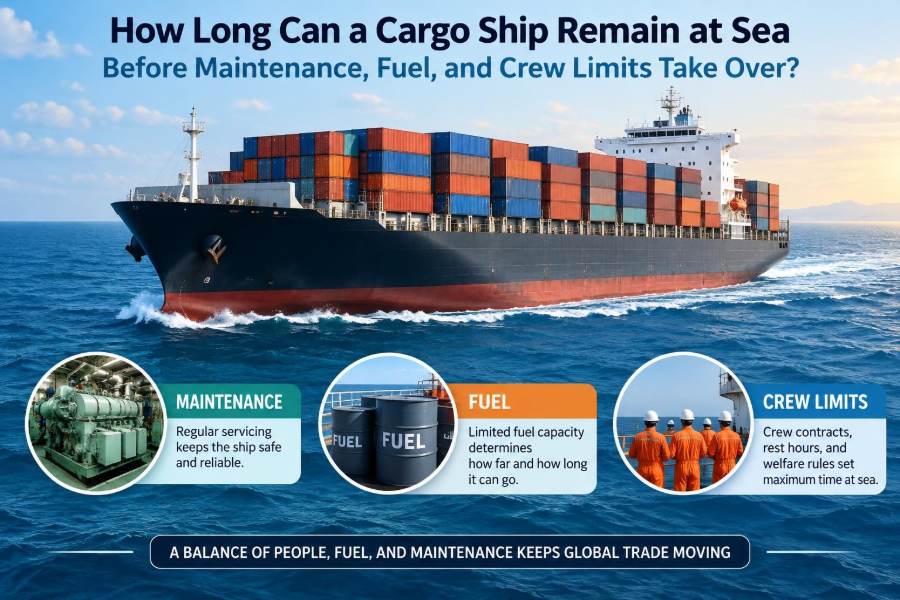

A container ship disappears beyond the horizon carrying thousands of boxes, enough fuel for a long voyage, and a crew that may not see land for weeks. It is easy to assume it can simply keep moving until the cargo is delivered.
In reality, a ship at sea is a carefully managed balance of energy, machinery condition, people, water, food, regulations, weather, and commercial schedules. The limiting factor is not always the same one.
A modern cargo vessel can often sail continuously for weeks, and in some operating patterns much longer, without a routine port call. But “able to remain at sea” is very different from “able to operate indefinitely.”
For marine engineers, deck officers, and anyone planning a voyage, the more useful question is: which limit will be reached first, and what margin remains when it is reached?
🌊 There Is No Single Endurance Number
Ship endurance is the length of time a vessel can safely and legally continue operating without replenishment, repair support, or a port visit. It is not a fixed figure printed on every ship’s specification sheet.
Two similar bulk carriers can have very different endurance on the same route. One may be lightly loaded and steaming slowly in calm weather; the other may be fighting head seas, operating cargo-related auxiliary machinery, or carrying a larger number of people.
Fuel, lubricating oil, fresh water, provisions, spare parts, crew welfare, planned maintenance, statutory inspections, and cargo requirements all create separate limits. The shortest relevant limit usually governs the voyage.
🧭 Voyage Length Is Not the Same as Time Between Ports
A ship may sail for 15 days on one ocean leg, then spend several days at anchorage, berth for cargo work, and leave again. From the machinery department’s perspective, the engine may have been running for nearly all of that period, even though the vessel has “called” at a port.
Conversely, a port call does not automatically reset every endurance limit. If bunkering is unavailable, stores are not delivered, or repairs are deferred because the berth is short, the vessel may sail with much of its previous constraint still in place.
Operational planning therefore distinguishes between sea passage duration, time since bunkering, time since crew stores were loaded, and running hours since maintenance tasks were due.
⛽ Fuel Is Usually the First Question
Fuel is often the most visible endurance constraint because propulsion consumes far more energy than most other shipboard functions. A main engine running at service speed can burn a substantial amount of fuel every day, while generators supply electrical loads for pumps, refrigeration, navigation, accommodation, and deck equipment.
Fuel endurance is calculated from usable fuel on board divided by expected daily consumption. “Usable” matters: some fuel must remain inaccessible below suction level, segregated for quality reasons, or reserved for operational contingencies.
Engineers do not plan from an optimistic average. They account for weather, currents, possible delays, machinery operating mode, and the reserve required by company procedures and voyage planning rules.
📉 Why Speed Changes Endurance So Dramatically
Water resistance rises sharply as speed increases. For many displacement ships, the power needed to gain a modest amount of speed can increase disproportionately, so fuel use may climb far faster than a simple kilometres-per-hour comparison suggests.
This is why slow steaming became a major operational tool. Reducing speed can extend fuel endurance and lower fuel cost, although it lengthens the voyage and may affect cargo schedules, charter commitments, and arrival windows.
Imagine a vessel with enough fuel for a planned crossing at economical speed. If it must increase speed to recover a schedule after bad weather, its original bunker calculation may no longer provide the same safety margin.
🌬️ Weather Can Rewrite the Bunker Plan
Headwinds, heavy seas, swell, and adverse currents increase resistance and can force the main engine to work harder. In severe conditions, a master may reduce speed for safety, yet fuel consumption can still remain high because of the added resistance.
Weather also affects auxiliary demand. Ballast pumps, heating systems for certain fuels or cargoes, extra steering activity, and longer generator operation can change the daily energy picture.
Good voyage estimates use forecast conditions rather than assuming a perfectly calm ocean. They are updated during the passage as actual consumption and remaining distance become clearer.
🛢️ Fuel Quality Is an Endurance Issue Too
A ship can have full tanks and still face an operational problem if the fuel cannot be safely used. Different fuel batches may be incompatible, contaminated, outside expected viscosity characteristics, or require careful temperature control before transfer and injection.
Marine fuel management includes settling, purification, filtration, temperature control, and sampling. These processes remove water and solids and help deliver fuel of suitable condition to the engines.
Switching between fuel types can also require planning. A vessel subject to emission-control requirements may need to change fuels before entering regulated waters, preserving enough compliant fuel for the required portion of the voyage.
🔌 Propulsion Fuel Is Not the Only Energy Supply
Most cargo ships need electrical power continuously, whether alongside or underway. Diesel generators, shaft generators, batteries in some newer arrangements, or other systems support navigation equipment, lighting, communications, pumps, refrigeration, ventilation, and accommodation services.
On some vessels, the auxiliary load is modest compared with main-engine fuel use. On others, it is a major planning item: refrigerated-container ships, gas carriers, and vessels with intensive pumping or cargo-conditioning duties can have very different energy profiles.
Engineers must consider the whole plant, not just the propeller. A main engine may have fuel remaining while generator fuel, starting-air capability, or a critical auxiliary system becomes the practical constraint.
💧 Fresh Water Sets a Human and Machinery Limit
Fresh water is needed for drinking, cooking, washing, cleaning, and some technical purposes. It may also be required for boiler feed systems, depending on the vessel’s plant design.
Many ocean-going ships make fresh water on board using an evaporator or reverse-osmosis plant. This can greatly extend endurance, but it is not a promise of unlimited supply. Production depends on machinery availability, electrical power, seawater conditions, maintenance, and, for some evaporators, adequate waste heat.
Fresh-water tanks remain essential. They provide reserve capacity when a maker is stopped for cleaning, repair, or low output.
🥫 Food and Stores Depend on Crew Size and Storage
Provisions are less frequently the first hard limit on a commercial voyage, but they are never an afterthought. Catering staff must plan food for the number of people on board, dietary needs, expected voyage duration, and a margin for delay.
Dry stores can last well when managed properly. Fresh produce, dairy items, and frozen food depend on refrigeration capacity, reliable power, hygiene, and stock rotation.
A vessel delayed by congestion, weather, canal restrictions, or a diversion needs more than enough calories. It needs a workable mix of food, potable water, medical supplies, cleaning materials, and everyday consumables.
👥 Crew Rest Cannot Be Treated as an Infinite Resource
A ship can physically keep moving while its people become progressively less able to operate it safely. Watchkeeping, maintenance, cargo work, inspections, drills, paperwork, and port operations all compete for crew time.
International work-and-rest requirements set minimum standards, while company procedures and the ship’s safety management system add planning expectations. Actual fatigue risk depends on workload distribution, alarms, weather, staffing, port turnaround pressure, and sleep quality.
Long passages can allow more predictable routines than rapid port-to-port trading. But an extended voyage with repeated machinery defects or heavy-weather watches can exhaust the available margin quickly.
🕒 Watchkeeping Keeps the Ship Safe Around the Clock
Bridge and engine-room watchkeeping ensures that navigation, propulsion, electrical systems, alarms, and machinery parameters are monitored continuously. Automation changes the tasks, but it does not remove the need for competent people to assess abnormal conditions.
On an unattended machinery space vessel, engineers may not stand a traditional night watch in the engine room. They still respond to alarms, perform rounds, prepare equipment, maintain systems, and remain accountable for machinery readiness.
The practical endurance question is therefore not only “how many crew are carried?” It is whether the available crew can continue meeting operational, maintenance, and rest demands safely.
🧰 Planned Maintenance Runs on Hours and Calendar Dates
Shipboard equipment is maintained according to a planned maintenance system, often called a PMS. Tasks may be triggered by running hours, calendar intervals, condition-monitoring results, or manufacturer instructions.
Filters, lubricating-oil checks, purifier overhauls, pump inspections, generator services, and safety-device tests do not wait politely for the next convenient harbor. Many are designed to be completed at sea.
A long passage is manageable when the crew has time, spares, tools, and safe conditions to do the work. It becomes riskier when several major jobs fall due at once or weather prevents safe maintenance.
⚙️ The Main Engine Rarely Receives a Full Overhaul at Sea
Large slow-speed marine diesel engines are built for long continuous operation, and routine inspection or limited component work can be done on board. Yet major overhauls, extensive crankcase work, alignment checks, and some repairs need dockyard support, specialist attendance, or prolonged stoppage.
Condition monitoring helps engineers decide whether components can remain in service. Trends in temperatures, pressures, vibration, drain oil, exhaust readings, and cylinder condition can reveal deterioration before a failure becomes severe.
Endurance is therefore partly a condition-based judgment. A well-maintained engine with stable trends may safely continue; an engine showing abnormal wear may require a change of plan despite having ample fuel.
🔩 Spare Parts Define What Can Be Repaired
Ships carry critical spares for predictable failures: seals, gaskets, filters, injector components, pump parts, bearings, electrical items, and repair materials. The inventory reflects the vessel’s machinery, trading pattern, class expectations, and company policy.
However, no ship can carry every possible part. A failed specialized electronic module, a damaged large shaft component, or an unavailable maker-specific item can create a limit that stock levels cannot solve.
Engineers protect endurance by identifying critical equipment, tracking spares accurately, preserving parts correctly, and ordering replacements before the last usable unit is consumed.
🧪 Lubricating Oil Needs Monitoring, Not Just Topping Up
Lubricating oil separates moving surfaces, carries heat away, controls deposits, and helps protect machinery from corrosion and wear. Its condition changes with contamination, oxidation, water ingress, fuel dilution, and additive depletion.
Regular onboard checks and laboratory analysis, where used, allow engineers to monitor trends. Purifiers and filters can extend oil life, but they cannot correct every problem, especially if contamination has an underlying mechanical cause.
Running short of the correct grade of oil, or continuing with degraded oil, can turn an otherwise manageable long voyage into a serious machinery risk.
🧯 Safety Equipment Has Its Own Service Schedule
Lifeboats, fire pumps, extinguishers, fixed firefighting systems, breathing apparatus, emergency generators, alarms, and communication equipment must be ready whenever needed. Some inspections are routine shipboard tasks; others require approved servicing at defined intervals.
A ship may remain legally operational between service opportunities if its certificates and equipment status are valid. But defects in safety-critical systems can require restrictions, temporary measures, repair at the next port, or in serious cases a halt to the voyage.
Safety equipment is not merely a compliance checklist. Far from assistance, the crew must rely on it immediately if an emergency develops.
📜 Certificates and Surveys Create Calendar Boundaries
Commercial vessels operate within a framework of flag-state, port-state, classification-society, and international requirements. Certificates, surveys, audits, and statutory inspections have due dates and conditions attached to them.
Some surveys can be scheduled within an allowable window or completed afloat. Others require dry docking, special examination, or access that is not practical during a normal sea passage.
These dates may not dictate a ship’s next port call, but they strongly influence dry-dock planning and trading routes. Missing a requirement can affect insurance, class status, legal operation, and charter commitments.
🏗️ Dry Docking Is a Major Long-Term Limit
No cargo ship stays permanently afloat without periodic dry docking or equivalent approved underwater inspection arrangements. The hull, propeller, rudder, sea valves, sea chests, coatings, anodes, and other underwater components need inspection and maintenance.
Hull fouling increases resistance and fuel consumption. Coating damage and corrosion can become more serious over time, while underwater defects may remain hidden from normal onboard observation.
Dry-dock intervals depend on vessel type, class arrangements, flag requirements, age, condition, and approved survey programs. This is a lifecycle limit measured in years, not the day-to-day endurance limit of a single passage.
🧱 Cargo Can Dictate the Next Port Call
The cargo may impose stricter limits than the ship. Refrigerated cargo needs continuous temperature control, chemicals may need monitoring or heating, grain may require ventilation management, and some bulk cargoes demand careful moisture or gas control.
Container ships also face schedule and connection pressure: cargo is often intended for a particular terminal, onward feeder, rail service, or customer delivery window. A slow diversion may be technically possible but commercially disruptive.
For ships carrying dangerous goods, cargo documentation, segregation, firefighting provisions, and port acceptance conditions add further operational boundaries.
🧊 Refrigerated Containers Change the Electrical Picture
Refrigerated containers, commonly called reefers, draw power continuously to maintain their set temperatures. Their total electrical load varies with the number carried, ambient conditions, cargo settings, container condition, and defrost cycles.
A large reefer load increases generator duty and makes electrical redundancy particularly important. Losing a generator is not only an engineering problem; it may threaten cargo quality and create urgent operational decisions.
This is a clear example of why vessel endurance cannot be calculated from propulsion fuel alone.
⚖️ Ballast, Stability, and Draft Also Limit Freedom
A ship must maintain adequate stability, trim, propeller immersion, and structural loading throughout its voyage. Fuel consumption changes displacement and can alter trim, especially on smaller vessels or vessels with particular tank layouts.
Ballast water may need to be transferred to maintain safe conditions, subject to the vessel’s ballast water management arrangements and local requirements. In some trades, draft restrictions at the destination also limit how much fuel can be carried initially.
More bunker fuel extends range, but it adds weight. The engineering solution must fit stability calculations, cargo intake, load-line limits, and port draft constraints.
🗺️ Route Choice Changes Every Endurance Calculation
A direct ocean route may be shorter in distance but expose the vessel to harsher weather. A sheltered route, canal passage, or bunkering detour can reduce one risk while adding time, fees, restrictions, or congestion exposure.
Route planning incorporates safe navigation, forecast weather, fuel availability, political and security conditions, emission-control areas, piracy risk where relevant, and the vessel’s performance characteristics.
The “nearest port” is not always the best support option. It must be safe to enter, able to provide suitable fuel or repairs, acceptable for the cargo, and operationally available.
🚨 Breakdowns Turn Endurance into Emergency Planning
When a main engine, generator, steering system, fuel system, or cooling system fails, the question changes from normal endurance to survivability and recovery. The crew may need to restore propulsion, drift safely, seek shelter, arrange towage, or divert to a repair port.
Redundancy buys time. Multiple generators, duplicate pumps, cross-connections, emergency steering, and alternative communication arrangements reduce the chance that one defect immediately ends the voyage.
But redundancy is not unlimited. A common-cause problem—contaminated fuel, flooding, fire, loss of cooling water, or incorrect operation—can affect several systems at once.
🛟 Emergency Reserves Are Not Spare Operating Fuel
Prudent bunker planning includes reserve fuel beyond the expected consumption for the planned passage. This margin is intended for uncertainty: weather avoidance, waiting, diversion, reduced efficiency, or unexpected route changes.
A common planning mistake is to regard the reserve as fuel available for routine speed increases or commercial convenience. Once it is used without a compelling reason, the ship loses resilience against the next problem.
The same principle applies to fresh water, critical spares, and crew workload. A reserve only protects the voyage if it remains protected until genuinely needed.
📡 Condition Monitoring Extends Safe Operating Time
Modern ships increasingly use sensors, trend data, oil analysis, performance records, thermal imaging, vibration monitoring, and remote technical support to identify deterioration early. These tools help crews make better maintenance decisions, but they do not replace inspection and engineering judgment.
For example, a gradual rise in exhaust temperature on one cylinder may prompt checks of fuel injection, compression, scavenge condition, or cooling. Finding the cause early can avoid a larger defect during a remote passage.
Reliable data also improves voyage forecasting. If hull fouling or machinery inefficiency raises fuel consumption, the plan can be revised before the remaining margin becomes uncomfortable.
🧑🏭 Good Recordkeeping Makes Long Voyages Manageable
Engine logs, tank soundings, running-hour records, defect reports, maintenance histories, and consumption data turn a complex vessel into something that can be managed methodically. Without accurate records, an apparently minor shortage can remain hidden until it becomes urgent.
Clear handovers are especially important when a problem evolves slowly across several watches. The next engineer needs to know not just that a pump is noisy, but how the noise has changed, what checks were made, and which spare parts remain.
Records also support communication with shore management, class, makers, charterers, and repair teams when technical advice or parts must be arranged ahead of arrival.
⚓ A Hypothetical Endurance Calculation
Consider a hypothetical cargo vessel preparing for a long ocean crossing. The engineering team estimates daily fuel consumption at the intended economical speed, then adds expected generator use, forecast weather allowance, and a protected contingency reserve.
They separately confirm fresh-water production and tank capacity, provisions for the crew and a delay margin, maintenance tasks due by running hours, availability of critical spares, and the validity of surveys and safety equipment servicing.
If fuel supports the route but a generator overhaul will fall due before arrival and the required parts are unavailable, the vessel’s practical endurance may be limited by maintenance rather than bunkers. This is why a single “range” number can mislead.
📊 The Limits Work as a System
| Potential limit | What usually drives it | Typical management response |
|---|---|---|
| Fuel | Speed, weather, distance, auxiliary load | Reforecast, reduce speed, bunker, reroute |
| Fresh water and provisions | Crew size, production capacity, delay | Conserve, repair water maker, replenish stores |
| Machinery condition | Running hours, wear, contamination, defects | Maintain, monitor, derate, divert for repair |
| Crew capacity | Workload, fatigue, emergencies, port activity | Adjust work plan, protect rest, seek support |
| Certificates and dry dock | Survey cycle and regulatory status | Schedule survey, dry dock, approved inspection |
| Cargo condition | Temperature, ventilation, safety requirements | Maintain systems, revise route, call suitable port |
The table shows why endurance is a systems problem. One strong area cannot compensate indefinitely for a weak one.
🚢 Different Ship Types Reach Different Limits
Container ships often focus on schedule reliability, reefer power, and frequent port operations. Bulk carriers may undertake long ballast or laden passages where fuel, weather, and machinery maintenance dominate the planning.
Tankers and gas carriers have specialized cargo systems, stricter operational procedures, and cargo-related energy demands. Ro-ro vessels may have different accommodation loads and port turnaround patterns, while offshore-support vessels may be constrained by mission equipment and client operations.
The basic principles remain the same, but the most critical variable changes with ship design and trade.
❌ Common Mistakes in Thinking About Ship Endurance
- Assuming fuel capacity equals usable range: reserves, tank accessibility, fuel quality, and changing consumption matter.
- Ignoring auxiliaries: generators and cargo systems may materially affect the fuel plan.
- Treating maintenance as optional: deferred work can accumulate into a reliability problem.
- Planning for average weather only: a passage needs margin for conditions that are worse than average.
- Equating a port call with full replenishment: a short call may not provide fuel, stores, repairs, or rest recovery.
These mistakes share one cause: viewing the vessel as a single engine and fuel tank rather than an interconnected operating system.
🧠 What Marine Engineers Should Check Before a Long Passage
The chief engineer and engineering team translate the voyage plan into machinery readiness. That means confirming not only what is working today, but what will still be reliable after weeks of continuous operation.
- Verify bunker quantity, segregation plan, expected consumption, and protected reserve.
- Review generator availability, fuel treatment capacity, cooling systems, and electrical load risks.
- Check planned maintenance due during the voyage and prepare tools, permits, and spares.
- Confirm lubricants, chemicals, filters, and critical spare-part stock.
- Assess fresh-water maker condition, tank levels, and treatment arrangements.
- Record active defects and identify conditions that would require speed reduction or diversion.
This preparation is not paperwork for its own sake. It gives the ship options when conditions depart from the original plan.
✅ The Core Principle: Endurance Is Managed Margin
A cargo ship does not remain at sea until one tank suddenly runs dry or one maintenance date appears on a calendar. Professional operation continuously compares what remains—fuel, time, equipment condition, crew capacity, and compliance margin—with what the voyage may still demand.
The safest ships preserve options: extra fuel when forecasts change, spare generating capacity when cargo loads rise, time to complete maintenance, and crew rest before workload becomes excessive. Port calls, bunkering, repairs, and dry docking are not interruptions to endurance; they are part of how endurance is sustained.
For students, this is a useful engineering lesson beyond ships. Complex systems last not because one component is oversized, but because their interacting limits are monitored, maintained, and planned with realistic margins.
A cargo ship can stay at sea for weeks or longer, but its true endurance is determined by the first critical resource, condition, or obligation that can no longer be safely managed. 🚢⚙️🌊