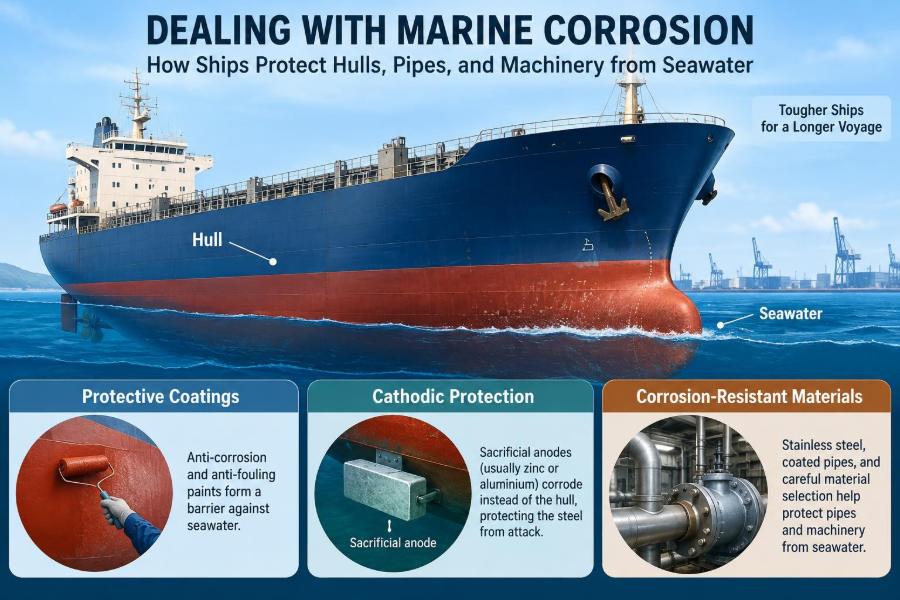

A ship can look immaculate from the quay while corrosion is quietly advancing beneath paint, inside a seawater pipe, or around a flange in the engine room. The visible rust streak is often only the clue, not the whole problem.
For seafarers, corrosion shows up in practical ways: a seized valve, a thinning ballast-tank plate, cooling-water leaks, contaminated systems, unexpected steel repairs, or a dry-docking job that grows far beyond its original scope. These are reliability and safety issues as much as cosmetic ones.
Seawater is a particularly demanding environment because it conducts electricity, carries dissolved oxygen and salts, moves continuously, and reaches equipment through spray, condensation, ballast, and cooling systems. A ship is therefore not protected by one treatment but by several layers of defence.
Understanding why metal corrodes makes those defences easier to inspect, operate, and maintain. It also helps engineers recognise the difference between harmless surface staining and damage that needs urgent attention.
🌊 Why Seawater Is So Aggressive
Corrosion is the gradual deterioration of a material through chemical or electrochemical reaction with its environment. Most marine steel corrosion is electrochemical: small areas on the metal surface behave differently, creating a tiny electrical cell.
Seawater is an effective electrolyte, meaning it allows electric current to pass between those areas. Chloride salts are especially troublesome because they can disrupt protective oxide films on metals such as stainless steel and aluminium.
Oxygen, water temperature, flow velocity, biological deposits, and pollution all influence the rate and form of attack. Conditions vary sharply between a dry deck, a splash zone, a ballast tank, and a warm seawater cooler.
⚡ The Basic Electrochemical Cell
For corrosion to proceed, there is usually an anode, a cathode, an electrical path through the metal, and an electrolyte such as seawater. At the anodic area, metal atoms leave the surface as ions; this is where metal loss occurs.
At the cathodic area, a reduction reaction consumes electrons, commonly involving dissolved oxygen in aerated seawater. Rust is a collection of iron corrosion products, but it does not form a tight, durable barrier like the oxide layer on some other metals.
A useful analogy is a battery spread across a piece of steel. Remove or control one part of the circuit—water, oxygen, electrical driving force, or exposed metal—and corrosion can be slowed substantially.
🧂 Chlorides and Broken Passive Films
Some metals protect themselves by forming a very thin, adherent oxide film. Stainless steels and aluminium rely heavily on this passive film. It can reform after minor damage if the environment is suitable.
Chloride-rich seawater can penetrate weak points in the film, particularly where oxygen is restricted or deposits are present. The result may be a deep local pit even when most of the surface still appears bright and sound.
This is why “stainless” does not mean “immune to seawater.” Alloy selection, water temperature, crevice design, flow conditions, and maintenance all matter.
🔩 General Corrosion and Localized Attack
General corrosion removes metal relatively evenly across a broad surface. It is often predictable enough to be managed through coating systems, inspections, and corrosion allowances in structural design.
Localized corrosion is harder to manage because it concentrates damage in small regions. A pipe may retain most of its wall thickness yet fail from a single perforating pit near a support, gasket, or deposit.
| Form of attack | Typical feature | Marine example |
|---|---|---|
| Uniform corrosion | Broad, fairly even metal loss | Exposed uncoated carbon-steel surface |
| Pitting | Small, deep cavities | Stagnant chloride-bearing water in stainless equipment |
| Crevice corrosion | Attack in shielded gaps | Under gaskets, clamps, deposits, or lap joints |
| Galvanic corrosion | Attack caused by dissimilar metals | Steel connected to a more noble metal in seawater |
| Erosion-corrosion | Accelerated loss where flow strips films | Pump elbows, impellers, and high-velocity pipe bends |
🕳️ Why Pitting Can Be More Dangerous Than Rust
Pits can be narrow at the opening and much deeper below the surface, making them easy to underestimate during a quick visual inspection. Their depth creates stress concentration and can rapidly reduce pressure containment in thin-walled piping.
Stagnant conditions often encourage pitting because local chemistry inside a pit becomes increasingly aggressive as corrosion progresses. Once established, the pit environment may remain active even if the surrounding water is less severe.
For this reason, inspection should not stop at “there is only a small spot.” Engineers assess pit depth, distribution, remaining wall thickness, location, and the consequence of failure.
🧷 Crevices Hide Their Own Chemistry
A crevice is any narrow shielded space where seawater can enter but does not circulate freely. Gasket faces, fastener heads, overlapping plates, pipe clamps, deposits, and marine growth can create such environments.
Oxygen inside the crevice is consumed faster than it is replenished. This difference between the oxygen-rich outer surface and oxygen-poor interior can establish a corrosion cell, while chloride ions concentrate within the crevice.
Good design avoids unnecessary water traps, permits drainage and cleaning, and selects gasket, fastener, and joint arrangements with the local environment in mind.
🔗 Galvanic Corrosion Between Dissimilar Metals
When two dissimilar metals are electrically connected and wetted by seawater, they form a galvanic couple. The less noble, or more active, metal becomes anodic and may corrode faster; the more noble metal is protected.
The area ratio is critical. A small steel fastener attached to a large copper-alloy component can be severely exposed because the small anode must supply current to a large cathodic area.
Isolation can interrupt the circuit. Practical measures include nonconductive bushes, sleeves, washers, gaskets, suitable coatings, and avoiding incompatible material combinations where long-term wetting is expected.
🎨 Coatings: The First Defensive Barrier
Marine coatings work primarily by separating steel from water, oxygen, and salts. A well-applied coating system is one of the most economical ways to reduce corrosion over large hull, tank, and deck areas.
But paint is a system, not simply a coloured layer. Surface preparation, specified dry-film thickness, compatibility between coats, edge treatment, curing conditions, and repair quality determine whether it performs as intended.
A coating defect does not automatically mean immediate failure. However, damage that exposes steel can become an initiation point for underfilm corrosion, especially if water penetrates beneath poorly bonded paint.
🧹 Surface Preparation Determines Coating Life
Coatings adhere poorly to salt, oil, loose rust, mill scale, and condensation. Abrasive blasting, mechanical cleaning, solvent cleaning, and fresh-water washing are selected according to the surface condition and coating specification.
Sharp edges deserve special attention. Paint naturally pulls away from an acute edge during application, leaving a thinner film that is vulnerable to early breakdown. Edge rounding and stripe coats help compensate for this.
Before painting, inspectors commonly check surface cleanliness, profile, dust, ambient conditions, and steel temperature relative to the dew point. Painting over a condensing surface can trap moisture at the steel-coating interface.
🖌️ Choosing Coatings for Different Zones
No single coating is ideal for every marine location. External hull coatings face immersion, abrasion, and fouling; decks face sunlight, foot traffic, and weather; tanks face cargoes, ballast water, or chemicals.
- Epoxy coatings are widely used for their adhesion and chemical resistance, but many need protection from ultraviolet degradation when exposed.
- Polyurethane topcoats are often valued for weathering and colour retention on exposed areas.
- Tank coatings must be compatible with the intended liquid and cleaning regime.
- Heat-resistant coatings may be needed around hot machinery, exhaust systems, or thermal equipment.
The correct choice follows the service environment and the approved specification, not simply what is already in the paint locker.
🛡️ Cathodic Protection Changes the Electrical Balance
Cathodic protection deliberately makes the protected steel act as a cathode, reducing its tendency to dissolve. It is commonly used on immersed hull areas, sea chests, ballast tanks, offshore structures, and buried or submerged piping.
It complements coatings rather than replacing them. Coatings reduce the exposed area requiring protection, while cathodic protection assists at coating defects and areas that are difficult to coat perfectly.
Too little protection leaves corrosion active. Excessive protection can create other problems, including coating disbondment in some conditions and hydrogen-related risks for susceptible high-strength materials. Design and monitoring matter.
🔋 Sacrificial Anodes and Impressed Current Systems
Sacrificial anodes, commonly made from zinc or aluminium alloys for marine use, are more active than steel. They corrode preferentially and supply protective current without an external power source.
Impressed current cathodic protection uses inert or slowly consumed anodes connected to a controlled power supply. Reference electrodes and control equipment help regulate the protective potential.
Sacrificial anodes are simple and robust but have finite mass. Impressed systems can be adjusted and may suit larger installations, yet they depend on sound controls, electrical integrity, and routine checks.
🚢 Hull Protection Below the Waterline
The underwater hull combines several corrosion-control challenges: continuous immersion, changing salinity, mechanical damage, biofouling, and contact with quay structures or floating debris. Coatings, anodes or impressed current, and planned dry-dock inspections are typically used together.
Damage around welds, bilge keels, sea inlets, thruster tunnels, and areas exposed to abrasion needs close attention. These locations may experience coating loss earlier than broad, smooth shell plating.
Hull protection also has hydrodynamic consequences. Roughness from fouling or coating breakdown can increase resistance through the water, so preserving a smooth system supports both integrity and operating efficiency.
🌬️ The Splash Zone Is Especially Demanding
The splash and tidal zones alternate between wetting, drying, oxygen exposure, wave impact, and salt deposition. This cycling often creates more aggressive conditions than constant immersion.
On ships, analogous zones include boot-topping areas, exposed decks, hatch coamings, bulwarks, and external pipework. Salt remains on the surface after water evaporates, then is reactivated by humidity or fresh spray.
Frequent fresh-water washing can remove deposited salts from accessible external surfaces. It is a simple measure, but it does not replace sound coating maintenance or proper drainage.
🧱 Ballast Tanks Need Planned Attention
Ballast tanks repeatedly experience filling, emptying, condensation, and limited access. Their upper regions may be exposed to humid air and condensation, while lower regions remain wetted for longer periods.
Structural complexity adds difficulty. Stiffeners, brackets, weld toes, drain paths, and inaccessible corners create edges and water-retaining details where coating defects are likely to develop.
Effective tank care includes cleaning where practical, prompt repair of accessible coating breakdown, anode condition checks where fitted, and inspection planning that focuses on known high-risk details rather than only flat plating.
🚰 Seawater Pipes Corrode From the Inside Out
External pipe corrosion is easy to see, but internal corrosion can be more consequential because it directly threatens flow and containment. Fire mains, cooling systems, ballast lines, bilge arrangements, and general service lines may all handle seawater.
Material selection varies by duty. Carbon steel may be protected by coatings or linings and managed through corrosion allowance; copper alloys, stainless steels, non-metallic piping, and composite systems can be suitable in particular services when properly specified.
Dead legs—short branches with little or no regular flow—are common internal trouble spots. They allow deposits, stagnant water, and differential oxygen conditions to develop.
🌪️ Flow Velocity Can Help or Harm
Moderate, well-distributed flow can limit stagnation and deposit build-up. Yet excessive velocity, turbulence, entrained sand, or sharp directional changes can remove protective films and coatings.
This combined mechanical and electrochemical damage is often called erosion-corrosion. It commonly appears at pump impellers, valve trims, elbows, reducers, tees, and seawater cooler inlets.
Designers reduce risk by selecting suitable materials, controlling velocities, avoiding abrupt geometry where possible, and ensuring pumps operate near their intended duty rather than persistently under damaging conditions.
❄️ Sea Chests, Strainers, and Coolers
Sea chests admit seawater to essential systems, making them high-consequence corrosion locations. Their coatings, gratings, valves, sacrificial anodes, and internal cleanliness should receive systematic attention.
Strainers protect pumps and coolers from debris, but a neglected strainer can restrict flow and create uneven conditions downstream. During maintenance, technicians should look beyond blockage to corrosion around covers, studs, gasket seats, and internal surfaces.
Heat exchangers add another complication: different alloys may sit close together in conductive seawater. Correct tube, tube-sheet, bonnet, gasket, and anode arrangements are essential to prevent an unintentionally harmful galvanic couple.
⚙️ Machinery Is Vulnerable Beyond the Engine Room
Corrosion affects machinery through cooling circuits, seawater pumps, shafts, fasteners, hydraulic connections, electrical enclosures, and condensation on inactive equipment. It can impair fit, sealing, heat transfer, and moving parts long before a dramatic leak occurs.
Salt-laden air is also damaging. A motor terminal box or control panel near a poorly ventilated, humid space may suffer corrosion even without direct seawater contact.
Preservation of standby machinery matters because equipment that rarely runs may not reveal a problem until it is required. Draining, drying, inhibiting, exercising, and recording condition are practical reliability measures.
🔧 Fasteners, Flanges, and Small Details
Small items can control the reliability of a large system. Corroded bolts may prevent safe disassembly of a seawater valve; a damaged flange face may turn a routine gasket change into a larger repair.
Specify fasteners for the actual exposure, not only the parent material. Threads should be protected where appropriate, and assemblies should avoid trapping water against mixed metals.
Over-tightening is not a corrosion solution. It can damage coatings, distort flanges, overload bolts, and make later maintenance more difficult. Correct tightening procedures and clean mating faces are more dependable.
🦠 Microbes and Marine Growth Complicate Control
Marine organisms can foul sea inlets, strainers, pipework, and heat-exchanger surfaces. Fouling restricts flow, creates deposits, and establishes sheltered zones where localized corrosion may occur.
Microbiologically influenced corrosion describes corrosion associated with microbial activity and biofilms. It is not simply “bacteria eating steel”; microbes can alter local oxygen levels, acidity, and chemical conditions in ways that support corrosion processes.
Control may involve cleaning, filtration, suitable materials, operational flushing, and treatment systems where approved for the vessel and service. Chemical treatment must be managed carefully because it can introduce safety, environmental, and material-compatibility concerns.
🔍 Inspection Looks for Patterns, Not Just Rust
A good inspection combines visual observation with an understanding of where the system is likely to fail. Rust staining may originate above the visible mark, and a clean surface may still conceal thinning below a coating or inside a pipe.
Useful observations include blistering, cracking, coating delamination, pitting, anode wastage, deposits, leaks, wet insulation, corrosion at supports, and changes in colour or texture around joints.
Trend records are valuable. Repeated photographs from the same location, thickness readings, coating-repair histories, and anode replacement records help turn isolated observations into a maintenance decision.
📏 Thickness Measurements Have Limits
Ultrasonic thickness measurement is widely used to assess remaining wall thickness without cutting into the component. It is especially useful for hull structure and accessible piping, but readings must be taken on suitable prepared surfaces and interpreted correctly.
A single reading can miss localized pits. Inspection plans should use grids, targeted checks at known vulnerable locations, and complementary examination where the consequence of failure is high.
Acceptance limits and repair decisions depend on the component’s design, service, classification requirements, and approved procedures. A measurement tool informs engineering judgement; it does not make the decision by itself.
🧪 Corrosion Monitoring in Operating Systems
Some systems use coupons, probes, water chemistry checks, or sample inspections to identify corrosive conditions before widespread damage is visible. A corrosion coupon is a small test piece exposed in a representative location and later examined.
Monitoring is most useful when the result leads to action: adjusting treatment, investigating a leak, changing flushing practice, improving filtration, or scheduling inspection. Collecting data without defining a response can create false confidence.
Conditions can change with route, water source, temperature, lay-up, maintenance work, and operating pattern. Monitoring should therefore be interpreted alongside what the vessel has actually been doing.
🧰 Repairing Damage Without Creating New Problems
Before repair, identify the mechanism. Repainting a blistered area without removing salts or addressing a leak may only conceal the same problem until the next inspection.
For piping, a temporary clamp may be appropriate only under approved procedures and for a defined period. It does not restore original material condition, and it can hide continuing deterioration around the damaged area.
Permanent repairs should restore pressure integrity, material compatibility, support arrangements, drainage, coating protection, and inspection access. After any repair, check whether nearby areas share the same root cause.
⚠️ Common Corrosion-Control Mistakes
- Painting over poor preparation: the new coating may fail early because contamination remains beneath it.
- Ignoring small coating defects: a small holiday can grow into broad underfilm corrosion.
- Mixing metals without considering galvanic effects: seawater completes the electrical circuit.
- Leaving stagnant seawater in laid-up systems: deposits and differential aeration can accelerate localized attack.
- Replacing anodes by appearance alone: anode condition must be assessed against the protection design and service history.
- Focusing only on visible external surfaces: internal pipe walls, crevices, and insulated areas can be more severely affected.
📋 A Practical Corrosion-Control Routine
Corrosion management works best as a routine rather than a response to failure. The exact programme depends on vessel type, trading pattern, materials, and regulatory requirements, but the basic cycle is consistent.
- Identify high-risk zones and systems from drawings, prior findings, and operating experience.
- Inspect at planned intervals, with extra attention after damage, lay-up, flooding, or unusual operating conditions.
- Record location, extent, likely mechanism, measurements, and photographs where useful.
- Remove the cause where possible: standing water, salt deposits, damaged coating, incompatible connection, poor flow, or leakage.
- Repair with approved materials and methods, then verify the result and update the history.
👷 People and Procedures Are Part of the Protection System
The best coating specification cannot compensate for unsafe surface preparation, rushed curing, incorrect anode installation, or incomplete inspection records. Corrosion control depends on crew, repair teams, surveyors, and shore staff sharing accurate information.
Work planning must also account for hazards. Tank entry, blasting dust, solvent vapours, high-pressure water jetting, electrical cathodic-protection equipment, and hot work all require proper risk controls and vessel-specific procedures.
Clear defect descriptions are especially valuable during handovers. “Rust at seawater pump” is less useful than a note identifying the component, exact location, extent, leakage status, material condition, and temporary controls in place.
🧭 Selecting Materials Is a Life-Cycle Decision
A more corrosion-resistant alloy or non-metallic material may cost more initially, but it can reduce maintenance in a harsh, difficult-to-access service. Conversely, a premium material chosen without regard to crevices, flow, welding, or galvanic coupling can still perform poorly.
Selection should consider temperature, chloride concentration, pressure, velocity, mechanical loads, fabrication, repairability, fire performance, applicable rules, and compatibility with connected components.
The practical question is not “what never corrodes?” It is “what material and protection system will provide acceptable, inspectable performance in this exact duty?”
✅ The Core Principle: Break the Corrosion Circuit
Marine corrosion cannot be eliminated completely because ships operate in an environment built around water, salt, oxygen, and changing conditions. It can, however, be controlled by understanding the mechanisms and applying several defences together.
Keep seawater away from metal with sound coatings. Use cathodic protection where appropriate. Prevent stagnant pockets and incompatible metal combinations. Select materials for the actual environment, inspect likely weak points, and repair the cause rather than merely the symptom.
The strongest corrosion programme is not the one with the most expensive product. It is the one that consistently connects design, operation, inspection, maintenance, and accurate records.
Ships stay reliable when corrosion is treated as a managed engineering process, not as an unavoidable layer of rust. That approach protects structural strength, essential systems, maintenance time, and the people who depend on the vessel every day. ⚓🔧🌊