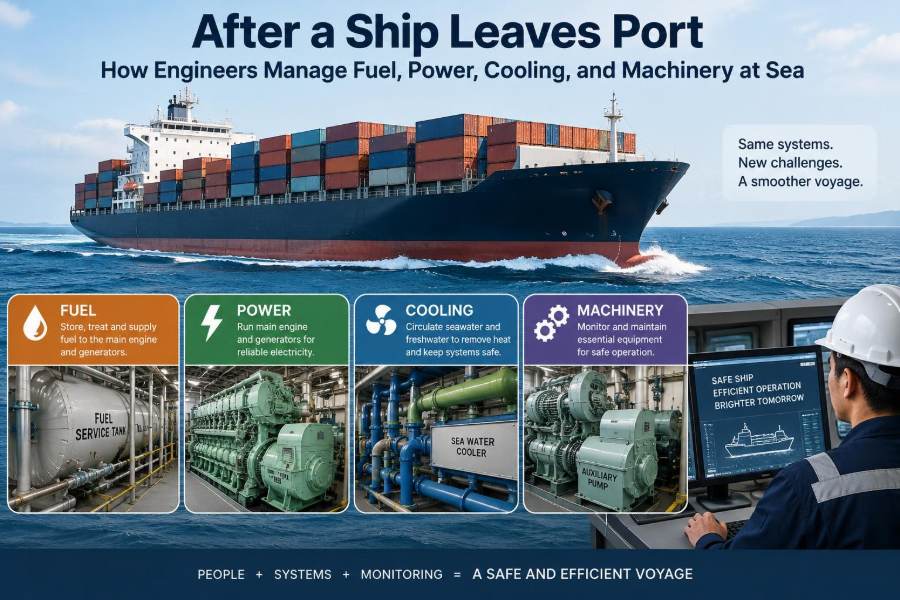

A ship can look settled and self-sufficient once the lines are cast off. From the shore, it simply moves toward the horizon. Below deck, however, that departure starts a tightly managed engineering operation that continues every hour of the voyage.
Fuel must reach the engines cleanly and at the right pressure. Electrical power must remain available for navigation, steering, pumps, lighting, accommodation, cargo systems, and safety equipment. Heat produced by machinery has to be carried away before it becomes damage.
None of these jobs happens in isolation. A change in speed affects fuel demand, cooling load, electrical balance, vibration, and maintenance planning. Heavy weather can change how tanks are managed and how engineers inspect equipment.
This is the practical side of marine engineering at sea: not merely making an engine run, but keeping an entire connected plant safe, stable, efficient, and ready for the next demand.
⚓ The Engine Room Becomes a Living System
After departure, the engine room is best understood as a living system of flows. Fuel, lubricating oil, cooling water, air, electricity, exhaust gas, and information all move through different routes while engineers watch their condition.
The main engine may provide propulsion, but it cannot work alone. Pumps supply fluids, compressors provide starting and control air, generators produce electricity, and automation systems report pressures, temperatures, levels, alarms, and trends.
A failure in one support system can quickly limit another. For example, a seawater pump problem may reduce cooling capacity; reduced cooling can force a reduction in engine load even when the fuel system is healthy.
🧭 The Departure-to-Sea Changeover
Port operation and sea operation are often different modes. In port, a vessel may use shore power, auxiliary generators, tugs, thrusters, cargo equipment, and a relatively high number of pumps. At sea, the propulsion plant becomes the dominant consumer of energy.
Engineers follow vessel-specific procedures during changeover. They confirm machinery line-ups, place standby equipment in the correct condition, check tank levels, and ensure required cooling and lubrication systems are operating before load rises.
The essential principle is simple: critical systems should already be stable before the ship relies on them. A rushed changeover can create alarms at the worst possible time, when maneuvering space is limited.
🛢️ Fuel Is a Supply Chain, Not Just a Tank
Marine fuel does not usually travel directly from a storage tank to an engine. It moves through a chain designed to store it safely, remove water and solids, control temperature, and deliver a consistent fuel supply.
Typical stages include storage tanks, transfer pumps, settling tanks, purifiers or separators, service tanks, booster pumps, filters, and the engine’s injection equipment. The exact arrangement depends on vessel type and fuel choice.
Each stage has a purpose. Storage provides endurance; settling allows heavier contamination and water to separate; purification removes contaminants; final filtration protects finely machined engine components.
🧪 Fuel Quality Can Shape the Entire Watch
Fuel quality varies, particularly among residual fuels that may contain water, sediment, or abrasive catalytic fines. Even distillate fuels require careful handling because contamination, poor compatibility, or incorrect temperature can affect performance.
Engineers monitor separator discharge, filter differential pressure, fuel temperature, viscosity where applicable, and signs of unstable combustion. A rising filter pressure drop is not just a nuisance; it can indicate that contamination is reaching a critical part of the system.
When problems appear, the response depends on the vessel’s procedures and equipment. It may involve changing filters, adjusting purification settings, investigating tank water, or reducing load if reliable fuel delivery cannot be maintained.
🌡️ Heating Heavy Fuel for Correct Viscosity
Some fuels become too thick to pump or atomize properly when cold. Heating lowers viscosity, allowing the fuel to pass through pumps and filters and form a fine spray at the injector.
Atomization matters because fuel burns most effectively when it mixes well with air. Fuel that is too viscous may form poor droplets, leading to incomplete combustion, deposits, smoke, and unstable engine behavior.
Overheating is also undesirable. It can reduce viscosity too far, stress equipment, and create handling risks. Engineers therefore use temperature and viscosity control as a coordinated process rather than treating heat as a universal solution.
🔄 Switching Fuels Requires a Controlled Transition
Changing from one fuel grade to another is not a simple valve movement. Different fuels can have different temperature, viscosity, lubricity, and compatibility characteristics. A rapid change can disturb the fuel system or cause thermal stress.
During a controlled changeover, engineers gradually adjust temperature and fuel routing while monitoring pressures, engine response, and leakage. The planned timing matters because some operating areas require the vessel to use a particular compliant fuel.
Compatibility is a practical concern. If unsuitable fuels are mixed, asphaltenes in one fuel may become unstable in another, producing sludge that can overload filters and separators.
⛽ Tank Soundings Turn Consumption Into Decisions
Engineers and officers track fuel inventory through tank soundings, remote level readings, transfer records, and consumption data. A sounding is a measurement of liquid level in a tank, converted to volume using the tank calibration table.
Inventory is more than bookkeeping. It supports voyage planning, verifies whether consumption appears reasonable, identifies unexpected losses, and helps maintain safe tank levels and trim.
A mismatch between expected and measured consumption deserves investigation. It may arise from measurement conditions, transfers, temperature effects, a recording error, or potentially a leak. The correct response is to verify methodically rather than assume one explanation.
⚙️ Propulsion Load Sets the Energy Budget
The main engine’s power demand rises sharply as ship speed increases. Resistance through water grows with speed, so a modest speed increase can require substantially more power and fuel.
That relationship explains why voyage planning involves commercial, operational, and engineering choices. Running faster may protect a schedule, but it can increase consumption, thermal load, and machinery stress.
Conversely, lower-load operation is not automatically ideal. Engines are designed for operating ranges, and prolonged low load can create combustion and fouling issues in some arrangements. Good operation means selecting an appropriate load, not simply the lowest possible one.
⚡ Electrical Power Has No Warehouse
Unlike fuel, electrical energy on most ships is produced at nearly the same moment it is consumed. Generators must continuously match the electrical load, with enough reserve for expected changes and essential equipment.
Load includes navigation systems, engine-room pumps, steering gear, ventilation, accommodation services, refrigeration, deck machinery, and cargo equipment where fitted. Large motors can create sudden demand during starts.
If demand exceeds available generation, frequency can fall and protective systems may act. At the extreme, a blackout can remove power from many services at once. That is why generator availability is treated as a core safety issue.
🔌 Generator Sharing Keeps Frequency Stable
When generators run in parallel, they share active power and reactive power. Active power performs useful work, such as turning a motor. Reactive power supports magnetic fields in equipment such as motors and transformers.
Synchronizing a generator means matching voltage, frequency, and phase before connecting it to the busbar. Automation can assist, but engineers still need to understand what the system is doing and recognize abnormal sharing.
Poor load sharing can overload one generator while another remains lightly loaded. It may also cause unstable frequency or voltage, trips, and unnecessary wear. Trend displays are useful, but verification of actual machinery condition remains essential.
🧯 Blackout Prevention Starts Before the Alarm
Blackout prevention depends on anticipation. Engineers consider upcoming load changes: a thruster request, a large pump start, cargo operation, rough-weather demand, or transfer from one operating mode to another.
- Keep a suitable generator or emergency-ready arrangement available.
- Confirm standby generators can start automatically where required.
- Avoid unnecessary switching during critical maneuvering.
- Investigate recurring overload, underfrequency, or voltage alarms.
Load shedding systems may disconnect non-essential consumers to protect the busbar. They are valuable safeguards, but they are not a substitute for adequate planning and maintained generating equipment.
🚨 Emergency Power Is a Separate Safety Layer
Ships have emergency sources of power intended to support specified vital services if normal generation fails. The precise arrangement and required services depend on vessel design and applicable rules.
An emergency generator is generally arranged separately from the main machinery space and has independent starting capability. It may supply emergency lighting, communications, navigation aids, fire detection, and other essential loads through an emergency switchboard.
Its value lies in separation and reliability. A fault that disables the main switchboard should not automatically remove the ship’s ability to communicate, find exits, assess the situation, and begin recovery.
💧 Cooling Is How Machinery Survives Its Own Heat
Combustion engines convert only part of fuel energy into propulsion or electrical work. Much of the remainder becomes heat in exhaust gas, cooling water, lubricating oil, and surrounding components.
The cooling system removes heat at controlled rates. Without it, metal parts expand beyond design clearances, lubricating oil loses useful properties, seals deteriorate, and protective shutdowns may occur.
Cooling is not about making machinery cold. Engines need stable operating temperatures for efficient combustion, suitable lubrication, and controlled thermal expansion. The engineering goal is temperature control, not maximum cooling.
🌊 Freshwater and Seawater Usually Work Together
Many ships use a closed freshwater circuit around engines and a seawater circuit to reject heat overboard through coolers. Freshwater protects internal machinery surfaces from direct seawater corrosion and fouling.
A central cooling arrangement may use high-temperature and low-temperature freshwater loops. The high-temperature loop commonly serves engine jacket cooling, while the lower-temperature loop can serve lubricating-oil coolers, charge-air coolers, and auxiliary machinery.
Seawater is effective as a final heat sink, but it brings salt, marine growth, suspended solids, and corrosion risk. It is therefore kept on the external side of heat exchangers where possible.
🧊 Heat Exchangers Need Clean Flow Paths
A heat exchanger transfers heat across metal surfaces without mixing the two fluids. Plate, shell-and-tube, and other designs are used depending on duty and vessel arrangement.
Fouling reduces heat transfer. On the seawater side, scale, shells, slime, and debris can restrict passages. On the freshwater side, corrosion products or poor water treatment can create deposits.
Warning signs include a rising temperature difference, reduced pressure, frequent high-temperature alarms, or a need to open cooling valves farther than usual. Cleaning solves some problems, but engineers should also identify why fouling developed.
🧫 Water Treatment Protects the Closed Loop
Freshwater cooling circuits are not filled once and forgotten. Untreated water can promote corrosion, scale, and microbiological activity, all of which reduce reliability.
Shipboard water treatment aims to maintain chemistry within the limits specified by the engine or chemical supplier. Routine testing may check properties such as inhibitor concentration, alkalinity, chloride contamination, and pH, according to the treatment program.
Adding chemicals without testing can be as unhelpful as adding none. Incorrect concentration may damage materials or obscure the underlying condition. Records and consistent sampling are part of preventive maintenance.
🛢️ Lubricating Oil Does More Than Lubricate
Lubricating oil separates moving surfaces, carries away heat, helps seal between piston rings and liners, suspends contamination, and protects components from corrosion. In engines, it is a working fluid as well as a lubricant.
Oil condition changes with contamination, oxidation, fuel dilution, water ingress, and wear particles. Filters and purifiers remove some contaminants, while laboratory analysis can reveal trends that are not visible during a routine round.
Low pressure, abnormal temperature, or rapid level change requires prompt assessment. Continuing to operate with inadequate lubrication can turn a manageable defect into severe bearing or machinery damage.
🌬️ Air Systems Support Starting and Combustion
Compressed air serves several roles aboard ship. Starting air turns large diesel engines for starting, control air operates pneumatic valves and automation equipment, and service air supports tools and general use.
For combustion, engines also need clean intake air. Turbochargers use exhaust-gas energy to compress intake air, allowing more oxygen into the cylinders and improving the engine’s ability to burn fuel efficiently.
Air coolers reduce the temperature of compressed intake air before it enters the engine. If they foul, air density can fall and engine temperatures may rise. Drain arrangements also matter because condensed water must not enter the cylinders.
🔥 Exhaust Temperatures Tell a Useful Story
Individual cylinder exhaust temperatures offer a fast window into combustion balance. A cylinder that is consistently hotter or cooler than its neighbors may indicate an issue with fuel injection, air supply, compression, valve condition, or measurement equipment.
No single reading proves a diagnosis. Engineers compare trends, load, cylinder pressures where available, turbocharger behavior, and maintenance history before deciding what to inspect.
A sudden deviation deserves attention sooner than a small stable difference. Trend awareness is often what separates early correction from an unexpected stoppage.
🌀 Pumps Are the Quiet Workforce
Pumps keep nearly every fluid system alive: cooling water, lubricating oil, fuel transfer, bilge, ballast, fire main, and hydraulic circuits. Their importance is easy to overlook because a healthy pump often works quietly in the background.
Engineers check suction and discharge pressures, motor current, vibration, seal leakage, bearing temperature, and standby readiness. A pump with reduced flow may not immediately trigger a dramatic alarm, yet it can slowly undermine cooling or lubrication margins.
Valve position matters as much as pump condition. A perfectly good pump cannot overcome an incorrectly lined-up system, blocked strainer, air lock, or closed suction valve.
🧱 Bilge Management Prevents Small Leaks Becoming Big Problems
The bilge is the lowest collection area in machinery spaces, where water, oil, condensation, and minor leakage can gather. Keeping it clean helps engineers detect the source of new leakage quickly.
Bilge water cannot simply be pumped overboard. Ships use approved treatment and monitoring arrangements, and discharge is controlled by applicable environmental requirements and vessel procedures.
A rising bilge level is a symptom, not merely a pumping task. The team should locate its source: a leaking cooler, seal, pipe joint, drain line, or overflow. Good housekeeping makes that investigation much easier.
⚖️ Ballast, Trim, and Machinery Conditions Interact
Ballast water helps control draft, stability, trim, and structural loading. Its management is primarily a deck-and-stability function, but it affects engineering through pump demand, electrical load, tank operations, and the vessel’s motion.
Trim can influence how liquids settle in tanks and whether pump suctions remain adequately covered. In heavy seas, sloshing and changing heel can complicate level readings and fuel transfers.
Engineers therefore need practical awareness of the ship’s condition, not only the equipment in the machinery space. A system may behave differently at sea than it did alongside a calm berth.
🌧️ Heavy Weather Changes Operating Priorities
Heavy weather increases motion, vibration, and the chance of intermittent suction problems in tanks. It can make inspection rounds harder and can expose weak pipe supports, loose fittings, and marginal tank levels.
Before expected rough conditions, crews may secure loose equipment, verify tank levels, check bilges, prepare standby pumps, and postpone non-essential maintenance that opens critical systems.
The right response is proportionate. Not every weather forecast requires the same action, but the engineering watch should understand which machinery vulnerabilities are relevant to that vessel and loading condition.
👀 Watchkeeping Means Detecting Change
Modern ships may operate with automated or periodically unattended machinery spaces, but automation does not remove the need for disciplined watchkeeping. Sensors report selected parameters; people interpret combinations of evidence.
A good round uses sight, sound, smell, touch where safe, and instrument readings. An unusual bearing sound, a hot smell, a small drip, or an unfamiliar vibration can appear before a formal alarm threshold is reached.
Log entries should record meaningful conditions and actions, not just repeat routine values. Useful records allow the next watch to see what changed, what was tried, and what still needs attention.
📈 Trends Matter More Than Isolated Numbers
A pressure or temperature can be technically within its normal limit while still moving in an unhealthy direction. For example, a gradual rise in jacket-water temperature at the same load may indicate declining cooler performance.
Trend monitoring turns data into early warning. Engineers compare current readings with previous watches, expected load, ambient conditions, and maintenance events.
| Observed trend | Possible area to examine |
|---|---|
| Rising filter differential pressure | Contamination, bypass condition, filter capacity |
| Increasing cooling temperature at steady load | Cooler fouling, flow reduction, air lock, water treatment |
| Generator load instability | Governor response, changing consumers, fuel supply, controls |
| Growing vibration | Alignment, bearings, foundations, rotating equipment condition |
These are investigative starting points, not automatic diagnoses. Machinery faults often have multiple possible causes.
🔧 Planned Maintenance Preserves the Safety Margin
Planned maintenance schedules inspections, servicing, testing, and replacement around running hours, calendar intervals, condition data, and manufacturer guidance. It reduces the chance that essential work is forgotten during a busy voyage.
However, a schedule is not a substitute for judgment. A pump may need attention before its planned date if performance changes, while a task may require adjustment after consultation with responsible personnel if operating conditions make immediate work unsafe.
Maintenance quality includes cleanliness, correct reassembly, torque control, testing after work, and accurate records. A poorly completed repair can create a new fault even when the original defect is removed.
🧰 Spare Parts Need More Than a Shelf
A spare part only helps if it is correct, preserved, traceable, and available when needed. Ships commonly carry critical spares for machinery whose failure would restrict operation or compromise safety.
Inventory management includes checking part numbers, storage conditions, seals, shelf life, and compatibility with the actual equipment version. Consumables such as filters, gaskets, treatment chemicals, and lubricants require similar attention.
A practical question during planning is: if this item fails at sea, can the crew safely restore function with what is onboard? The answer shapes procurement and maintenance priorities.
🗣️ Clear Handover Prevents Invisible Failures
Many machinery problems become worse during watch changes because a developing issue was known informally but not communicated clearly. A proper handover identifies alarms, equipment out of service, temporary line-ups, abnormal trends, permits, and jobs in progress.
Specific language is better than vague reassurance. “No. 2 seawater pump is running, standby pump has a suction-valve issue, cooler outlet temperature rose slightly over four hours” gives the next watch something actionable.
Handover is also a chance to challenge assumptions. The receiving engineer should ask questions until the actual plant condition is understood, especially before maneuvering, fuel transfers, or maintenance.
🧯 Alarms Demand Understanding, Not Just Acknowledgment
An alarm indicates that a measured condition crossed a set point or that a monitoring system detected a fault. Acknowledging it silences the audible signal; it does not correct the cause.
Engineers first establish what is affected, whether the reading is credible, and whether immediate protective action is needed. They then follow procedures, use redundancy where available, and investigate without creating a second hazard.
Repeated nuisance alarms deserve attention too. If crews become accustomed to ignoring a known alarm, a genuine escalation can be missed. Alarm management is partly technical and partly a matter of disciplined culture.
🧑🏫 Procedures Guide Action, Competence Explains It
Checklists and operating procedures provide repeatable safeguards, particularly for high-risk tasks such as starting machinery, transferring fuel, isolating equipment, and recovering from abnormal conditions.
Yet procedures cannot list every combination of weather, cargo condition, equipment age, and fault symptoms. Competence allows engineers to understand why a step exists and recognize when a result does not make physical sense.
The strongest practice combines both: follow the approved method, verify the expected response, and stop to seek support when conditions fall outside the procedure’s assumptions.
🛡️ Environmental Control Is Part of Plant Operation
Fuel efficiency, emissions control, bilge handling, sewage treatment, ballast-water operation, refrigerant management, and waste segregation all place demands on the engineering department. Environmental compliance is not separate from machinery management; it relies on machinery being correctly operated and maintained.
For example, poor combustion can increase visible smoke and deposits, while neglected oily-water equipment can create operational and legal risk. Accurate records are also vital because they show what was transferred, treated, consumed, or discharged.
Engineers should never treat environmental equipment as secondary. It is part of the vessel’s operating plant and deserves the same technical discipline as propulsion machinery.
🧠 The Core Principle: Manage Margins Before They Disappear
At sea, reliable engineering is rarely about reacting heroically to a sudden failure. It is about preserving margins: clean fuel before filters block, available generator capacity before demand peaks, cooling performance before temperatures alarm, and standby machinery before the duty unit fails.
That mindset connects every system on board. Fuel management protects combustion; combustion affects temperature; temperature affects cooling demand; pumps and electrical power support cooling; monitoring and maintenance keep those supports dependable.
The engineer’s task is therefore to see the ship as an interconnected plant, make measured changes, and recognize small deviations while there is still time to act safely.
Once a ship leaves port, safe operation depends on engineers continually balancing energy, heat, fluids, equipment condition, and human judgment—not simply keeping the main engine turning. 🚢⚙️🌊