
A shipowner ordering a vessel today is making a decision that may shape operations for two decades or more. The engine room arrangement, fuel tanks, bunker connections, crew training, and port choices all follow from one question: what will power the ship?
The answer is no longer simply heavy fuel oil versus marine gas oil. Liquefied natural gas (LNG), methanol, ammonia, batteries, shore power, and hybrid arrangements are moving from design studies into real fleets. Yet each option solves one problem while creating others.
A coastal ferry that returns to the same terminal each evening has a very different energy problem from a bulk carrier crossing oceans without a fixed schedule. Treating both ships as if they need the same fuel would produce expensive and impractical designs.
Modern shipping therefore needs less fuel tribalism and more system thinking. The useful question is not which fuel is universally best, but which propulsion approach fits a vessel’s route, operating profile, safety case, and likely fuel supply.
🧭 Start With the Transport Task
Fuel selection begins with the work the ship must do. Designers need to understand voyage distance, time alongside, cargo space, power demand, speed variation, and whether the vessel returns to predictable ports.
A harbour tug needs bursts of high power and may recharge between jobs. A container ship needs sustained propulsion power for days. These requirements determine whether batteries, liquid fuels, or a combination can work.
🌍 Why the Choice Has Become Urgent
Shipping faces tightening pressure to reduce greenhouse-gas emissions and local air pollution. Efficiency measures help, but slower steaming and cleaner hulls cannot by themselves remove the carbon associated with conventional fossil fuel.
At the same time, shipyards and owners must avoid investing in equipment that becomes difficult to fuel, regulate, or finance. A technically sound ship can still struggle if its chosen fuel is unavailable along its trading route.
⚖️ Separate Tank-to-Wake From Well-to-Wake
Tank-to-wake emissions occur on board, from fuel use in the engine or fuel cell to exhaust at the funnel. Well-to-wake emissions also include producing, processing, transporting, and bunkering the fuel.
This distinction changes comparisons. Methanol and ammonia contain no carbon at the point of use in a combustion system, but their full climate value depends heavily on how they were made. Electricity used to charge a battery has the same question behind it.
🧪 Fuel Labels Do Not Tell the Whole Story
Names such as “green,” “blue,” “renewable,” and “low-carbon” are useful shorthand, not complete technical descriptions. A fuel’s origin, energy source, conversion process, and supply chain losses must be assessed.
For example, methane made from renewable feedstocks differs from fossil natural gas, even if both are used as LNG. Likewise, methanol produced with renewable hydrogen and captured biogenic or atmospheric carbon differs from methanol made from fossil feedstocks.
🛢️ LNG in Practical Terms
LNG is natural gas cooled to a liquid state for transport and storage. It is already used in marine engines and has an established, though uneven, bunker network in several regions.
Its principal attraction is operational familiarity compared with newer fuels. LNG can reduce sulphur oxides, particulate matter, and, in suitable engine arrangements, nitrogen oxides relative to conventional fuel oil. Its climate performance, however, requires closer examination.
🔥 LNG Engine Pathways Matter
Not all LNG engines behave alike. Some use low-pressure gas admission, while others use high-pressure systems; their combustion characteristics and methane release profiles differ.
Methane slip is unburned methane escaping from engines or fuel systems. Because methane is a potent greenhouse gas, even relatively small releases can materially affect lifecycle climate results. The specific engine, operating load, maintenance condition, and fuel supply chain all matter.
📦 LNG’s Space and Storage Penalty
LNG has lower volumetric energy density than conventional liquid fuel once tank design and insulation are considered. Cryogenic tanks take space and can complicate layout, particularly on vessels where cargo capacity is valuable.
Boil-off gas also needs management. Heat entering a cryogenic tank causes a small amount of LNG to vaporize over time, so systems must consume, reliquefy, or safely manage this gas rather than treating storage as a passive task.
🧯 LNG Safety Is an Engineering Discipline
LNG is not inherently unmanageable, but it introduces cryogenic temperatures, gas detection, ventilation, hazardous-zone design, and emergency shutdown requirements. A release can create a flammable vapour cloud when mixed with air in the relevant concentration range.
Safe operation depends on properly designed double-wall piping where required, ventilated spaces, segregation, trained personnel, and clear procedures. These are design and operational commitments, not accessories added after delivery.
🍶 Methanol as a Liquid Marine Fuel
Methanol is a liquid at ordinary ambient conditions, making it easier to store and transfer than cryogenic fuels. It can be handled through tank and piping systems that are conceptually closer to conventional liquid-fuel arrangements, although the materials and safety details are different.
Its simpler physical handling is one reason it has gained attention for newbuildings. Methanol engines and dual-fuel conversions are increasingly available, but availability of lower-carbon methanol remains a central commercial constraint.
📉 Methanol’s Energy Density Challenge
Methanol carries significantly less energy per litre than conventional marine fuel. A vessel needs larger fuel tanks, more frequent bunkering, reduced range, or a combination of these responses.
For a liner service with regular port calls, this may be manageable. For a long-haul vessel with irregular port access, the volume penalty can affect cargo capacity and route flexibility. Physical convenience does not remove the energy-storage trade-off.
☠️ Managing Methanol Hazards
Methanol is flammable and toxic if swallowed, inhaled in significant vapour concentrations, or absorbed through the skin. It requires controlled transfer, leak detection, suitable personal protective equipment, compatible materials, and emergency response planning.
A common mistake is to call it “easy” because it is liquid. A better description is familiar in handling form but demanding in chemical safety practice. Crews need to understand exposure routes as well as fire hazards.
🌱 When Methanol Can Deliver Climate Value
The lifecycle result depends on production. Renewable methanol can be made using renewable hydrogen and an appropriate carbon source, while other production routes may retain substantial fossil emissions.
Buyers should seek credible, traceable fuel documentation and understand what environmental attribute is actually being purchased. An engine capable of burning methanol does not automatically guarantee a low-emission voyage.
⚗️ Why Ammonia Draws Attention
Ammonia contains hydrogen but no carbon. When used without carbon-containing pilot fuel, it does not produce carbon dioxide at the point of use. This makes it a prominent candidate for deep-sea decarbonisation discussions.
It is also already traded globally as a chemical commodity. That existing industrial experience is useful, though marine bunkering at scale requires purpose-built standards, procedures, equipment, and trained people.
☢️ Toxicity Is Ammonia’s Central Challenge
Ammonia is toxic, corrosive in certain conditions, and hazardous to people and aquatic environments when released. Unlike a fuel debate focused only on carbon, ammonia places acute emphasis on preventing exposure.
Fuel containment, double barriers, ventilation, detection, drainage, protective equipment, emergency isolation, and escape arrangements must be integrated into the ship from the earliest design stage. The crew’s emergency response capability is central to the safety case.
🌫️ Combustion Products Need Careful Control
Ammonia combustion can create nitrogen oxides, and poor combustion control may allow unburned ammonia to escape. Depending on engine technology, nitrous oxide also requires attention because it has a strong warming effect.
These issues do not rule out ammonia, but they show why “zero carbon” is not the same as “zero impact.” Exhaust after-treatment, combustion development, monitoring, and verified operating performance are part of the proposition.
🏭 The Production Question for Ammonia
Most ammonia production has historically relied on hydrogen from fossil sources. Lower-carbon ammonia requires lower-carbon hydrogen and, where applicable, effective control of upstream emissions.
As with methanol, a vessel’s fuel specification should distinguish physical fuel quality from lifecycle environmental attributes. The fuel molecule alone cannot reveal the emissions associated with making it.
🔋 What Hybrid Propulsion Actually Means
Hybrid propulsion combines more than one energy source or conversion method. A common arrangement uses engines with batteries, power electronics, and an energy-management system; another combines a conventional or alternative fuel engine with shore power capability.
Hybrid is not a single fuel pathway. It is an operating strategy that uses each energy source where it performs best: batteries for rapid response and low-load operation, engines for endurance, and shore connection while alongside.
⚡ Batteries Fit Some Duty Cycles Extremely Well
Batteries are especially useful where voyages are short, charging is reliable, and power demand changes quickly. Ferries, offshore service vessels, tugs, and port craft can often use battery capacity to reduce generator running and improve response.
Battery systems also support spinning reserve and can let generators operate nearer efficient load ranges. But marine batteries are heavy and occupy space, so they are generally not a stand-alone answer for long ocean passages with current technology.
🔌 Shore Power Extends the Hybrid Benefit
Shore power allows a compatible ship to shut down auxiliary engines at berth and draw electricity from the local grid. This can reduce noise and exhaust emissions around ports, particularly where electricity supply is relatively low carbon.
The benefit depends on terminal equipment, connection standards, berth time, grid capacity, and electricity origin. A ship cannot create shore power by itself; it requires coordinated port investment.
🧠 Energy Management Makes or Breaks Hybrids
A hybrid vessel needs controls that decide when to charge batteries, start generators, absorb load peaks, and preserve reserve capacity. Poor control can cause unnecessary cycling, fuel consumption, or a battery that is unavailable when the vessel needs redundancy.
Think of the battery as a buffer in an electrical system, not simply a fuel tank. Its value often comes from smoothing power demand and reducing inefficient engine operation rather than from replacing every engine hour.
📊 Comparing the Main Options
| Approach | Key operational advantage | Main design challenge | Best early-fit examples |
|---|---|---|---|
| LNG | Established marine experience and lower local air pollutants | Cryogenic storage and methane-slip management | Routes with dependable LNG supply |
| Methanol | Ambient liquid storage and handling | Lower energy per tank volume; fuel origin matters | Regularly bunkered liner services |
| Ammonia | No carbon in the fuel molecule | Toxicity, emissions control, and immature fuel ecosystem | Future-oriented deep-sea designs with robust safety planning |
| Hybrid | Efficient response to variable loads and port operations | Charging access, battery mass, and control integration | Short-sea, port, ferry, and offshore duties |
This table is a screening tool, not a selection result. Every project needs vessel-specific energy modelling, hazard analysis, and commercial assessment.
🗺️ Route Geography Can Decide the Fuel
A fuel that is available in one major hub may be absent at the next practical bunker port. Ships with fixed routes can build their strategy around known supply points; tramp vessels need far more flexibility.
Before ordering, operators should map realistic bunkering locations, backup ports, expected port stays, transfer capability, and the operational consequences of a missed delivery. Fuel availability is an operational risk, not merely a procurement detail.
🏗️ Newbuilds Have More Freedom Than Retrofits
A newbuild can place tanks, cofferdams, ventilation trunks, electrical rooms, and safety zones into the initial arrangement. Retrofitting an existing ship often means working around cargo holds, accommodation, stability margins, and installed machinery.
That does not make retrofit unattractive. A hybrid battery addition, shore-power connection, or dual-fuel conversion may be effective for the right vessel. The key is to assess lost capacity, downtime, structural work, and remaining vessel life honestly.
💰 Look Beyond the Fuel Price
Total cost includes tanks, engines, converters, safety systems, port infrastructure, crew training, maintenance, insurance implications, cargo displacement, and fuel price risk. A cheap fuel can lead to an expensive ship, while a higher-priced fuel may simplify operations on a particular route.
Scenario analysis is more useful than a single forecast. Test several fuel availability and price assumptions, then examine whether the business remains workable when conditions differ from the preferred case.
📜 Regulation and Class Shape the Design
International requirements, flag-state rules, port rules, class requirements, and charterer expectations influence what can be installed and how it must be operated. Rules for emerging fuels continue to develop, so early engagement with class, flag, engine makers, and port authorities is sensible.
Compliance should not be treated as a final documentation exercise. It affects tank location, ventilation, firefighting, hazardous areas, alarms, machinery-space arrangement, and crew procedures.
👩🔧 Crew Competence Is Part of the Machinery
A new fuel system only performs as intended when the people operating it understand it. Bunkering, isolation, gas detection, leak response, firefighting, personal protection, and maintenance all need fuel-specific competence.
Training should include realistic abnormal situations, not only normal checklists. A crew that can recognize an ammonia detector alarm, an LNG pressure issue, or an electrical fault early gives the vessel more safety margin than hardware alone.
🧩 Fuel Flexibility Has Limits
Dual-fuel capability can reduce dependence on one fuel, but it is not free flexibility. Two fuel systems add weight, complexity, maintenance tasks, training needs, and potential failure points.
It can be sensible where alternative-fuel supply is developing or where a ship needs a transition pathway. It is less sensible when the backup system undermines the cargo, cost, or safety case without solving a real operating risk.
🚫 Common Selection Mistakes
- Choosing from a headline: “zero carbon,” “drop-in,” or “available now” never replaces lifecycle and route analysis.
- Ignoring tank volume: range and cargo capacity can change the economics more than engine efficiency does.
- Assuming ports will adapt: bunker and charging infrastructure must be confirmed, not hoped for.
- Underestimating safety integration: fuel hazards influence the whole ship arrangement.
- Buying technology without operational data: load profiles, port stays, and weather margins should drive sizing.
🧮 A Practical Selection Workflow
- Define the duty cycle using real voyage, power, and port-call data.
- Set emissions boundaries and determine which lifecycle attributes matter to the operator and charterer.
- Screen fuels for energy volume, bunkering access, safety implications, and regulatory maturity.
- Develop at least two ship arrangements rather than comparing fuels only at engine level.
- Run cost and availability scenarios, including disruption and fallback operation.
- Complete hazard identification with designers, class, crew representatives, and port interfaces.
- Choose a pathway with a credible operating plan, not merely an attractive presentation.
🔭 The Likely Future Is a Portfolio
Shipping is unlikely to converge quickly on one universal replacement fuel. Different vessel classes, trades, and regions have different constraints, while fuel production and port infrastructure will develop at different speeds.
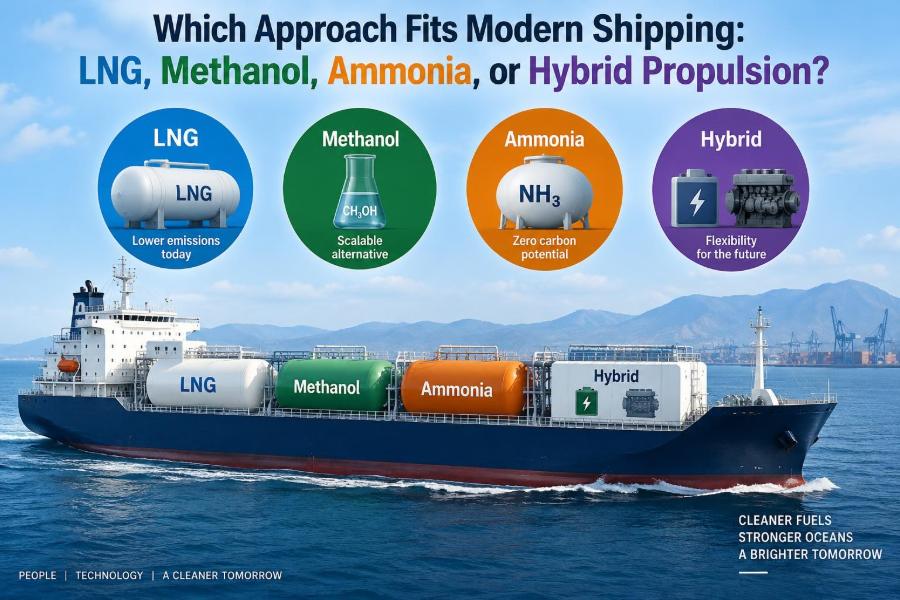
LNG may remain relevant in some transition cases, methanol may suit routes that can accept its volume requirement, ammonia may serve parts of deep-sea shipping once safety and supply mature further, and hybrid systems will continue to expand where charging and variable loads make them valuable.
🏁 The Core Principle: Fit the Whole System
The strongest propulsion decision connects fuel chemistry to ship design, voyage pattern, infrastructure, emissions accounting, economics, and human operation. Evaluating only the engine, only the fuel price, or only the exhaust pipe gives an incomplete answer.
Modern shipping needs choices that can be operated safely every day, supplied reliably at real ports, and evaluated honestly over their full lifecycle. The best pathway is the one whose compromises are understood and manageable for the vessel’s actual job.
LNG, methanol, ammonia, and hybrid propulsion are not competing answers to one identical question; each is a tool whose value depends on where, how, and by whom the ship is operated. A well-matched system beats a fashionable fuel choice every time. 🚢⚡🌍