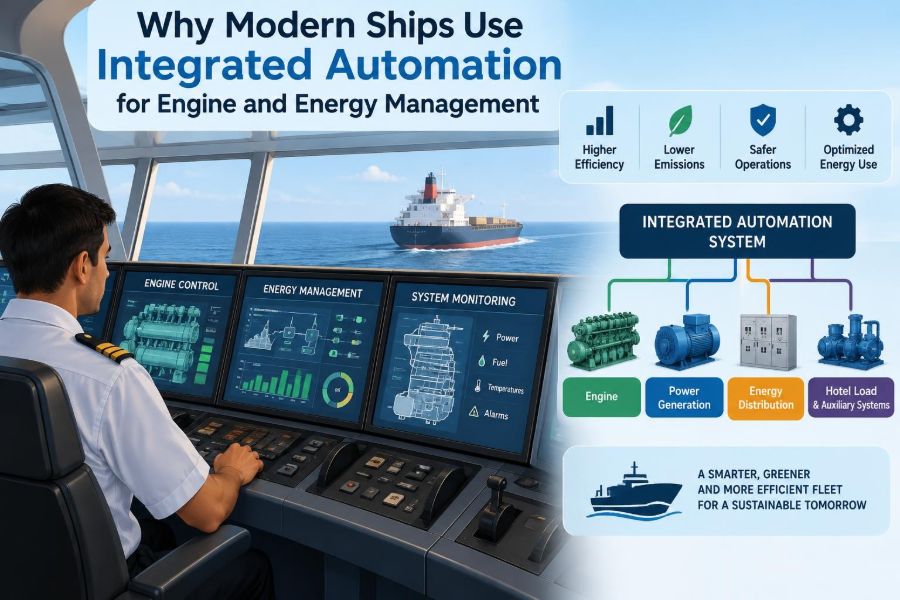

A vessel is approaching port after several days at sea. The hotel load is rising as more systems come online, a bow thruster will soon demand substantial power, one generator is nearing a maintenance limit, and the main engine must begin slowing down. None of these changes happens in isolation.
On an older ship, engineers may coordinate much of this work through separate local panels, routines, phone calls, and careful watchkeeping. On a modern ship, an integrated automation system can assemble the same operational picture in seconds and help the crew make controlled, timely decisions.
This is not about removing engineers from the engine room. It is about giving them a connected view of propulsion, electrical power, auxiliary machinery, and energy use—while retaining safe manual control when it is needed.
Integrated automation has become a practical response to tighter operating margins, more complex machinery, environmental requirements, and the simple fact that a ship is an energy system moving through an unpredictable environment.
⚙️ What Integrated Automation Means on Board
Integrated automation connects multiple shipboard control and monitoring functions so they can exchange relevant information and coordinate actions. It commonly brings together propulsion control, power management, machinery alarms, monitoring systems, and sometimes cargo or vessel-management functions.
The key word is integrated. A main-engine controller can still operate well by itself, and a generator controller can still regulate voltage and frequency locally. Integration allows their information to be viewed and used together, rather than remaining in separate technical islands.
The result is usually a shared operational picture available from locations such as the engine control room, bridge, and approved workstations.
🔌 Why Engine Management and Energy Management Belong Together
A ship’s engine plant and electrical plant affect each other constantly. Propulsion demand influences fuel use and machinery loading; electrical demand affects which generators should run; pumps, fans, compressors, and treatment plants all consume power needed to keep propulsion and hotel services available.
For example, a vessel reducing speed may need less propulsion power, but the electrical load may remain high because refrigeration, cargo pumps, or accommodation services continue operating. Treating propulsion and electricity as unrelated systems can lead to unnecessary generator operation or poor loading of running machinery.
Integrated control does not make these physical links appear. It makes them visible and manageable.
🧭 The Limits of Isolated Control Systems
Separate control systems often provide local information very well. Their weakness appears when the crew needs to understand a chain of events across the plant: a cooling-water issue affects engine availability, which changes electrical reserve, which limits thruster use during manoeuvring.
With isolated panels, a watchkeeper may need to compare several displays, logbooks, and alarms before establishing the cause and consequence. That process depends heavily on experience and can be slowed by noise, workload, or a developing fault.
Integration reduces the time spent collecting routine information. It does not remove the need to interpret it correctly.
🧠 The Automation System as a Coordinating Layer
It is useful to think of integrated automation as a coordinating layer above individual machinery controllers. Local controllers still handle fast tasks such as fuel injection control, governor action, voltage regulation, or pump sequencing.
The integrated layer supervises the wider operating condition. It can display trends, compare demand with available capacity, issue alarms, initiate permitted sequences, and report status to other ship systems.
This layered arrangement matters for resilience. Critical equipment should not become uncontrollable merely because a higher-level network display or supervisory computer is unavailable.
⚡ Understanding the Power Management System
The power management system, often called the PMS, is a central part of electrical automation. Its role is to keep generation and demand in balance while preserving sufficient reserve for safe operation.
Typical PMS functions include starting and stopping generator sets, synchronizing generators before paralleling them, sharing load between units, shedding non-essential loads during a shortage, and restoring loads when capacity returns.
A PMS must be configured for the vessel’s actual electrical arrangement. A system designed around conventional diesel generators will not behave identically on a ship with batteries, shaft generators, fuel cells, or high-voltage distribution.
📈 Load Sharing Protects Generators
When generators operate in parallel, they must share real power, measured in kilowatts, and reactive power, commonly linked to voltage support. Poor sharing can overload one machine while another carries too little load.
Automation continuously compares generator output and adjusts governor and excitation references within the control philosophy. The aim is stable frequency, acceptable voltage, and loading that respects each machine’s limits.
Running a generator at a very low load for extended periods can also be undesirable for some diesel engines. The exact acceptable operating range depends on the engine maker, emissions equipment, duty profile, and vessel procedures; automation should support those limits rather than replace them with a generic rule.
🛟 Spinning Reserve Is a Safety Margin
Spinning reserve is generating capacity already online and able to respond quickly if demand rises or a running generator fails. It is especially relevant during manoeuvring, dynamic positioning, cargo operations, or operation of large intermittent loads.
Suppose two generators are online and a large thruster starts. The PMS can assess whether the remaining unused capacity is adequate. If not, it may start an additional generator before the next expected demand change, subject to the vessel’s operating mode and configured logic.
Too little reserve increases blackout risk. Excessive reserve means more machinery running than necessary, with associated fuel consumption, wear, and maintenance. Integration helps the crew balance these competing concerns.
🚨 Preventing Blackouts Through Fast Logic
A blackout can interrupt propulsion-related auxiliaries, steering support equipment, navigation services, cargo systems, and accommodation loads. The consequences vary by vessel and operating situation, but recovery can be demanding and hazardous in confined waters.
Automation helps prevent blackouts through rapid actions that are difficult to coordinate manually at the same speed. These may include preferential tripping of defined non-essential consumers, generator start commands, bus-tie control, and alarm escalation.
Load shedding is not a failure of the system. When correctly designed, it is a controlled sacrifice of lower-priority demand to preserve essential power.
🔄 Automatic Generator Sequencing
Starting a standby generator involves more than pressing a start button. The unit must start correctly, build stable voltage and frequency, synchronize with the bus if required, close its breaker at the proper conditions, and accept its share of load.
Integrated systems can sequence these steps and report where a sequence has stopped. That diagnostic visibility is valuable: “generator unavailable” is less useful than knowing whether the issue is a start permissive, low air pressure, breaker interlock, synchronizing condition, or protective trip.
Crews must still periodically test standby arrangements. An automatic sequence that has not been tested under realistic conditions is an assumption, not proven readiness.
🛠️ Machinery Automation Extends Beyond the Main Engine
Engine and energy management depend on support systems: fuel supply, lubrication, cooling, compressed air, bilge arrangements, boilers, separators, and treatment equipment. A propulsion engine cannot deliver power safely if its cooling or lubrication conditions deteriorate.
Integrated machinery monitoring connects these dependencies. It can show, for example, that a rising main-engine temperature is accompanied by a reduced seawater-pump performance indication and an alarm on a strainer differential pressure transmitter.
That does not diagnose every fault automatically. It gives engineers a clearer starting point and preserves a time-stamped record for investigation.
📡 Sensors Turn Physical Conditions into Decisions
Automation is only as reliable as the measurements it receives. Temperature, pressure, level, flow, speed, power, vibration, valve position, and tank data become digital inputs that controllers and operators use.
A faulty sensor can create a dangerous mismatch between display and reality. A tank-level transmitter may drift, a pressure impulse line may block, or a position feedback signal may indicate a valve has moved when it has not.
For this reason, good automation includes plausibility checks, alarm limits, redundancy where justified, and procedures for comparing instrumentation with local indications.
🖥️ Human-Machine Interfaces Make Complexity Usable
The human-machine interface, or HMI, is the screen, panel, or workstation through which personnel view and interact with the system. A good HMI does not merely display every available point; it helps the operator identify what needs attention now.
Useful displays show plant status, active operating mode, alarm priority, equipment availability, trends, and control authority. Clear colours, consistent symbols, and sensible navigation reduce the chance of an operator selecting the wrong pump or misunderstanding a breaker state.
Screen design is therefore a safety issue, not a cosmetic preference.
🔔 Alarm Management Prevents Information Overload
During an abnormal condition, poor alarm design can generate hundreds of messages from one initiating fault. The operator then faces alarm flooding precisely when concentration is most needed.
Integrated automation can group consequential alarms, prioritize the initiating condition, and present related equipment states in context. For example, a cooling-pump trip may be shown alongside the standby pump’s start attempt and the resulting temperature trend.
Alarm rationalization requires engineering judgement. If alarms are silenced, delayed, or grouped without understanding the process, a genuinely urgent warning can be obscured.
🧩 Operating Modes Encode the Vessel’s Intent
Ships do not operate in one steady condition. Sea passage, harbour approach, cargo work, dynamic positioning, anchorage, emergency operation, and maintenance each place different demands on the plant.
An integrated system can use defined operating modes to apply suitable reserve margins, equipment priorities, and automatic sequences. In manoeuvring mode, for instance, the system may keep more generation available than during an economical sea-passage mode.
Modes must be explicit and visible. A sophisticated automation system becomes risky if the crew cannot readily confirm which mode is active and what it permits.
🚢 Propulsion Control Benefits from Shared Plant Awareness
Modern propulsion arrangements may include controllable-pitch propellers, azimuth thrusters, diesel-electric drives, shaft generators, hybrid batteries, or conventional direct-drive engines. Their control needs differ, but all depend on knowing what the wider plant can support.
If electrical power is limited, a propulsion control system may need to respect a power limit to avoid collapsing the bus. In a hybrid arrangement, a battery may briefly cover a fast power increase while an engine-generator starts and loads.
The system should communicate limits clearly to the bridge. A commanded thrust level and an achievable thrust level are not always the same.
🔋 Batteries Add Speed and Flexibility
Battery energy storage can respond rapidly to changes in power demand. On suitable vessels, it may smooth load peaks, provide reserve, support harbour operation, or reduce the need to run an additional generator during short periods of variable demand.
Integration is essential because battery operation must account for state of charge, temperature, power limits, cooling, protection status, charging opportunities, and the rest of the electrical plant. A battery is not simply another generator with a different fuel tank.
Its useful role depends on the vessel’s duty cycle and design. Energy storage also introduces dedicated safety, fire protection, ventilation, and maintenance requirements.
🌱 Fuel Efficiency Comes From Better Decisions, Not One Button
Automation can support fuel efficiency by matching active machinery to demand, avoiding unnecessary idling, managing generator loading, and revealing waste such as pumps running against closed valves or avoidable hotel loads.
However, “minimum fuel” cannot be the only objective. A generator lineup that appears economical may leave inadequate reserve, increase starts and stops, or conflict with maintenance requirements.
The practical target is safe, stable, and appropriately efficient operation. Crew judgement, voyage plan, weather, equipment condition, and manufacturer guidance remain part of that decision.
🌍 Emissions Systems Need Coordinated Control
Many vessels operate equipment intended to reduce air emissions, such as exhaust-gas treatment systems, selective catalytic reduction arrangements, or engines able to use alternative fuels. These systems have operating limits and consume energy or consumables.
Integration can coordinate status signals, pumps, heaters, reagent supply, bypass conditions where permitted, and alarms with the engine plant. It also helps record operating data needed for onboard management and reporting workflows.
Automation does not by itself ensure compliance. Correct fuel selection, maintenance, crew procedures, calibration, and applicable regulatory requirements still determine whether the plant is operated properly.
📊 Trend Data Changes Maintenance Planning
Single readings show current condition. Trends show direction. A slowly rising bearing temperature, longer pump run time, declining heat-exchanger performance, or increasingly frequent generator starts can indicate a developing issue before a shutdown alarm occurs.
Integrated systems can retain histories for selected values and events, allowing engineers to compare current performance with earlier operation. This supports condition-based maintenance, where work is informed by observed condition rather than calendar time alone.
Trend interpretation needs context. A temperature change after switching fuel, entering warm water, or changing load may be expected; it becomes meaningful when assessed with operating conditions and local checks.
📝 Event Logs Support Diagnosis and Accountability
After a trip or disturbance, recollection is often incomplete. Time-stamped event logs can establish sequence: which alarm occurred first, whether a standby unit received a start command, when a breaker opened, and what load was present.
This information helps troubleshoot faults and improve procedures. It can also distinguish an equipment malfunction from a command that was blocked by an interlock or unavailable mode.
Logs are valuable only if system clocks are synchronized and records are retained sensibly. Engineers should know how to retrieve data before an incident, not while responding to one.
🔐 Connectivity Creates Cybersecurity Responsibilities
Integration often relies on industrial networks, remote support arrangements, gateways, and shared data systems. These connections can improve diagnostics and reduce unnecessary travel, but they also expand the cyber attack surface.
Basic safeguards include network segmentation, controlled user access, strong account management, approved removable-media practices, patch planning, backups, and clear rules for remote access. The appropriate controls depend on the vessel, equipment, and operator’s risk assessment.
Cybersecurity must not undermine availability. Updates and configuration changes should be tested and managed so that a security measure does not unexpectedly affect a critical control function.
🧯 Manual Control and Redundancy Still Matter
Automation is designed to assist normal and abnormal operation, but ships need arrangements for degraded conditions. Local controls, independent protective devices, emergency shutdown functions, and alternate operating procedures remain essential.
Redundancy is not simply installing two of everything. Effective redundancy avoids common points of failure, such as both channels relying on one power supply, network switch, cooling circuit, or incorrectly copied configuration.
Crews should practise operating with reduced automation. Manual competence is easiest to lose when systems work well for long periods.
👩🏭 The Engineer’s Role Is Changing, Not Disappearing
Integrated automation shifts some work away from repetitive watchkeeping and toward supervision, diagnosis, verification, and planning. Engineers need to understand process behaviour as well as controllers, networks, sensors, and alarm logic.
The most valuable operator is not someone who blindly accepts an automatic sequence, nor someone who rejects all automation. It is someone who understands what the system is trying to do, recognizes when its assumptions are wrong, and intervenes safely.
Bridge and engine teams also benefit from a shared language about available power, propulsion limits, and operating modes.
🎓 Training Must Include Failure Scenarios
Routine operation teaches button sequences. Effective training also explores failures: a generator that will not synchronize, an unavailable standby pump, incorrect sensor feedback, a bus-tie interlock, or a load-shedding event during manoeuvring.
Simulators, vendor training, onboard drills, and supervised familiarization can all help. The goal is not memorizing every screen but building a mental model of the plant and its protections.
A useful exercise asks three questions: What initiated this action? What conditions must be true for it to continue? What safe fallback exists if it fails?
⚠️ Common Implementation Mistakes
Integrated automation projects can disappoint when integration is treated as a display upgrade rather than a control and operational change. Common problems are usually found in interfaces, procedures, testing, and training—not only in hardware.
- Adding automatic functions without clearly assigning control authority.
- Using inconsistent equipment tags or misleading mimic diagrams.
- Setting alarm thresholds without considering normal operating variation.
- Failing to test transitions between operating modes and degraded states.
- Assuming networked data is correct without verifying sensor quality.
- Allowing undocumented software or logic changes after commissioning.
These issues are manageable when identified early, with operators involved in design reviews and acceptance testing.
🧪 Commissioning Proves the Whole System
Factory testing can confirm that individual panels and controllers perform their intended functions. Shipboard commissioning must prove that the complete installation works with real machinery, cabling, power supplies, interlocks, and operating constraints.
Testing should include normal sequences, alarm handling, loss of communications, failed starts, protection actions, restoration sequences, and transfer of control between locations. The exact programme should follow the vessel design, class requirements, manufacturer documentation, and approved test procedures.
A well-documented test result becomes a future troubleshooting reference and helps crews understand expected system behaviour.
⚖️ Automation Has Limits and Trade-Offs
More integration can improve coordination, but it also increases system complexity. Fault finding may require software knowledge, configuration control, and access to specialist support in addition to traditional mechanical and electrical skills.
Automation can also hide activity. If the system repeatedly starts a standby pump or sheds a load without attracting meaningful review, an underlying maintenance problem may persist unnoticed. Intelligent alarms and regular trend review are necessary countermeasures.
The right level of automation is therefore vessel-specific. It should match the risk profile, operational pattern, crew competence, maintainability, and availability requirements of the ship.
🔭 The Next Step Is Better Decision Support
Future systems are likely to combine more condition data, operational forecasting, and shore-side analysis. They may help predict demand peaks, identify equipment performance drift, or recommend generator lineups based on planned operations.
These capabilities should be treated as decision support unless their reliability, authority, and failure behaviour are fully understood. A recommendation is not the same as a verified operating instruction.
The enduring design principle remains simple: the crew must be able to understand, supervise, and safely override the system when circumstances demand it.
✅ The Core Principle: Coordinate Energy Without Losing Control
Modern ships use integrated automation because propulsion, electrical generation, auxiliary machinery, and energy storage are interdependent. Coordinated control helps maintain power quality, preserve reserve, reduce avoidable waste, respond faster to faults, and give crews better operational awareness.
Its value is not that it makes engineering automatic. Its value is that it turns scattered measurements and separate actions into a managed picture of the whole plant—while retaining independent protection, manual capability, and informed human oversight.
For students, the lesson is to learn both the machinery and the information paths connecting it. For working professionals, the challenge is to keep those paths accurate, tested, secure, and understandable throughout the vessel’s life.
Integrated automation works best when it strengthens engineers’ decisions rather than asking engineers to surrender them. That balance is what makes a complex ship plant safer, more responsive, and more practical to operate. ⚙️🌊🚢