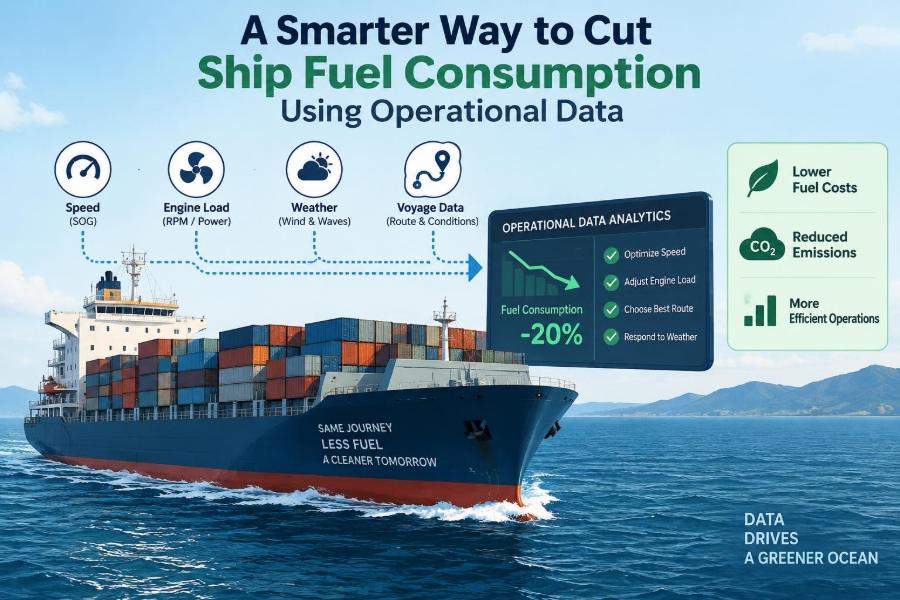

A vessel can leave port with a sound engine, a clean hull, and a carefully prepared voyage plan, yet still burn more fuel than expected before the next berth. The reason is often not one dramatic defect. It is a series of small operational mismatches: a little too much speed in head seas, an avoidable trim condition, generator loading that is slightly inefficient, or a route that no longer suits the weather.
For shipboard teams, these losses can be frustrating because fuel consumption is visible in daily reports but the cause is not always visible on deck or in the engine room. A noon report may show a disappointing figure, but it cannot by itself explain whether the difference came from current, hull condition, machinery performance, cargo constraints, or simply a different operating profile.
Operational data offers a more practical way forward. When crews, superintendents, and shore analysts combine trustworthy measurements with the vessel’s real operating context, they can identify where energy is being used and which changes are genuinely worth making.
The goal is not to chase a single “perfect” fuel number. It is to make repeatable decisions that reduce consumption without compromising safety, machinery limits, schedule commitments, cargo care, or the people operating the ship.
⚓ Fuel Efficiency Is an Operational System
Ship fuel consumption is the result of an interacting system rather than a single engine-room variable. Main-engine load, propeller condition, hull resistance, sea state, draft, trim, auxiliary demand, weather routing, and port delays all affect the final figure.
This is why a simple comparison between two voyages can be misleading. A ship consuming more fuel on one passage may have encountered stronger wind and waves, carried a different cargo, or operated at a different speed profile. Good analysis begins by separating normal operating variation from losses that can be controlled.
📊 What Operational Data Actually Means
Operational data is information created while the vessel is trading, manoeuvring, waiting, loading, and sailing. It includes measured signals from onboard systems and reported context from the crew, voyage planning tools, and port operations.
Useful data does not need to begin as a complex “big data” project. A consistent set of fuel, power, speed, position, draft, weather, and engine-condition records can answer many practical questions when the entries are complete and time-aligned.
🧭 Start With a Decision, Not a Dashboard
A common mistake is collecting every available signal before deciding what problem must be solved. This produces an impressive dashboard but not necessarily a useful action.
Start with a decision such as: Should the vessel reduce speed earlier before arrival? Is the main engine using more power than expected at a given speed? Are auxiliary generators being run inefficiently in port? Each question determines the data resolution, comparison method, and people needed to act on the result.
⛽ Build a Dependable Fuel Baseline
A baseline is a realistic reference for expected fuel consumption under stated conditions. It is not merely the consumption recorded during a previous voyage. It should describe the vessel’s expected behaviour across a range of drafts, speeds, weather conditions, and operational modes.
For example, a laden bulk carrier in calm water may have a different speed-power relationship from the same vessel in ballast. Treating both cases as one baseline hides useful information. Separate baselines for major operating conditions create more meaningful comparisons.
🧪 Check the Quality of the Inputs First
Bad data can create confident but wrong conclusions. Fuel flow meters may drift, manual tank soundings may be affected by trim and temperature, and timestamps from separate systems may not match. A sudden efficiency “gain” can sometimes be a reporting change rather than a physical improvement.
Basic data assurance should include range checks, missing-value checks, unit consistency, and comparison between independent sources where possible. If mass-flow readings and bunker-accounting trends disagree persistently, investigate the measurement chain before making operational changes.
🕒 Align Time, Position, and Operating Mode
Data becomes far more useful when it is aligned to the same time basis. Fuel rate, shaft power, speed through water, speed over ground, wind, and position should refer to comparable intervals.
Operating mode matters just as much. Averages should distinguish sea passage, manoeuvring, anchorage, cargo work, canal transit, and port stay. Mixing them into one daily value can conceal high-consumption periods that are operationally manageable.
🚤 Separate Speed Through Water From Speed Over Ground
Speed over ground includes the effect of current. It is essential for arrival planning, but it is not by itself a direct measure of hull and propeller performance. A favourable current can make a ship look efficient even when the machinery is producing unusually high power.
Speed through water is generally more useful for examining the relationship between propulsion power and vessel resistance. Both measures belong in the analysis: one for voyage progress, the other for understanding how hard the ship is working.
🌊 Read Weather as a Cause, Not an Excuse
Wind, waves, swell, current, and water temperature affect resistance and propeller behaviour. Ignoring them can unfairly label a voyage as inefficient; using them as a blanket explanation can hide avoidable losses.
Weather-adjusted analysis asks a more useful question: given the conditions encountered, was the vessel operated near a sensible power and speed combination? The answer requires caution because weather observations and forecast products have limitations, especially in complex sea states.
📈 Understand the Speed–Power Curve
As speed rises, required propulsive power rises sharply. The exact relationship depends on hull form and conditions, but the practical lesson is consistent: small increases in speed can require disproportionately more fuel.
Operational data helps teams observe the vessel’s own speed-power behaviour rather than relying only on design or trial information. Sea trials are performed under controlled conditions; a trading vessel operates with fouling, weather, varied loading, and real schedule constraints.
🐢 Use Slow Steaming With a Whole-System View
Reducing speed can lower main-engine fuel use substantially, but it is not automatically the best answer. A slower passage may increase voyage duration, alter auxiliary consumption, affect charter-party obligations, or create arrival and berth-window complications.
Data supports a balanced calculation: compare expected propulsion savings against the cost and operational effects of additional time. The best speed is often a required arrival speed, not the highest speed the vessel can sustain or the lowest speed it can technically achieve.
🗓️ Turn Just-in-Time Arrival Into an Energy Tool
When a berth is unavailable, sailing fast only to wait at anchor wastes energy and can increase emissions near congested ports. Better exchange of estimated arrival, berth readiness, and terminal constraints allows a vessel to adjust speed earlier.
This is not solely a bridge decision. It requires coordination among chartering, port, terminal, agent, and vessel. Operational data provides the factual basis for showing how much time and fuel may be affected by avoidable waiting.
⚖️ Make Trim a Measured Experiment
Trim changes hull resistance and propeller immersion, but the best trim varies with draft, speed, hull form, sea condition, and loading restrictions. A rule such as “always trim by the stern” is too broad to be dependable.
Compare repeatable operating periods at similar draft, speed, and weather, then test practical trim changes within safe stability, visibility, structural, and cargo limits. The result should be a vessel-specific guidance range, not a rigid instruction applied in every condition.
🛳️ Detect Hull and Propeller Deterioration
Marine growth and surface roughness increase resistance. Propeller fouling or damage can also reduce propulsion efficiency. These changes usually appear gradually, making them difficult to detect from a single daily report.
A trend of increasing shaft power for comparable speed-through-water and draft conditions is a useful warning signal. It does not prove fouling by itself, since weather and machinery factors also matter, but it can support timely inspection, cleaning, or repair planning.
🔧 Compare Machinery Performance Fairly
Main-engine performance should be assessed against load, ambient conditions, fuel properties, and operating limits. A rise in specific fuel oil consumption may reflect engine condition, but it may also reflect low-load operation, measurement uncertainty, or changed fuel characteristics.
Engine monitoring becomes valuable when it connects a deviation to a maintenance question: Is turbocharger performance changing? Is cylinder balance worsening? Is scavenge air behaviour abnormal? Trend evidence helps prioritize investigation; it should not replace manufacturer guidance or onboard diagnostic procedures.
⚙️ Watch the Low-Load Zone
Operating a large propulsion engine for long periods at very low load can create efficiency and maintenance concerns depending on the engine design and operating guidance. It may affect combustion quality, fouling tendencies, and the effectiveness of auxiliary systems.
Fuel-saving decisions therefore need engineering review. The lowest instantaneous fuel rate is not necessarily the best lifecycle choice if it increases maintenance risk or conflicts with approved operating envelopes.
💡 Manage Auxiliary Loads, Not Just Main Engine Fuel
Auxiliary engines, boilers, pumps, fans, reefer loads, cargo systems, and hotel services can represent a meaningful share of energy use, particularly in port or during cargo operations. Their profile is often less visible than main-engine consumption.
Load monitoring can reveal generators running lightly loaded in parallel, pumps left on after a task, or steam demand that could be scheduled differently. The aim is not indiscriminate shutdown; redundancy, cargo requirements, and safety margins must remain intact.
🔌 Match Generator Configuration to Demand
Diesel generators generally have operating ranges where fuel conversion is more favourable. Running too many sets at low load can waste fuel, while overloading a single set can threaten reliability and power quality.
A practical review compares actual demand patterns with generator load sharing, start-stop logic, spinning reserve requirements, and maintenance constraints. The suitable configuration may change between sea passage, manoeuvring, cargo work, and accommodation peak demand.
🔥 Treat Boiler and Steam Demand as Data
On ships with significant steam systems, boiler fuel can be affected by insulation condition, steam leaks, tank heating practice, cargo requirements, and poor coordination between users. Boiler consumption should be allocated to an operating purpose where feasible.
For example, a sustained rise in steam demand during a similar cargo operation may justify checks of valves, traps, heating coils, or operating sequence. Such checks require ship-specific procedures because steam systems involve high-temperature and high-pressure hazards.
🧮 Use Energy Indicators That Fit the Question
Tonnes of fuel per day is easy to understand but can be misleading when speed or cargo changes. Other indicators may include fuel per nautical mile, fuel per tonne-mile, fuel per hour in port, or kilowatts per unit of throughput.
There is no universally best indicator. A voyage manager may focus on fuel per mile; a cargo team may need energy per tonne handled; an engineer may examine specific fuel consumption. Choose metrics that connect directly to a controllable decision.
🧾 Keep Noon Reports Useful
Noon reports remain valuable because they bring operational observations together, but their usefulness depends on consistent definitions. A reported wind force, average RPM, distance, consumption figure, and delay reason should be recorded in the same way from voyage to voyage.
Automation can reduce manual workload, yet crew knowledge remains essential. A sensor cannot always identify fishing-gear avoidance, restricted-water manoeuvring, heavy rolling, or an operational constraint that explains an unusual data point.
🧠 Combine Automated Signals With Human Context
Algorithms can identify anomalies, clusters, and long-term trends quickly. They are less reliable when they interpret incomplete context as a performance problem. A sudden power increase could be a deteriorating hull, but it could also be a deliberate safety response to weather.
The strongest process is a review loop: automated screening identifies a deviation, a technically competent person checks the conditions, and vessel staff contribute operational explanation. This avoids treating crews as data-entry points rather than knowledgeable operators.
🧭 Build a Practical Voyage Review
A voyage review should be short enough to use and detailed enough to learn from. It can compare planned and actual route, speed profile, weather exposure, fuel by operating mode, waiting time, and notable machinery or cargo events.
- Identify the largest deviation from the expected fuel profile.
- State the likely causes and the confidence in that assessment.
- Separate controllable actions from unavoidable conditions.
- Assign any follow-up to a named operational or technical owner.
This turns data from a retrospective report into a learning process for the next passage.
🧩 Use a Simple Example Without False Precision
Consider a hypothetical container vessel expected to arrive after a congested port period. If berth information shows that the terminal cannot receive the vessel at the originally planned time, the team may choose an earlier speed reduction rather than maintaining speed and waiting outside port.
The analysis would compare revised passage fuel, auxiliary use during any expected waiting period, weather exposure, and the operational consequences of the new arrival time. The useful result is not a universal saving figure; it is a documented decision based on the vessel’s actual constraints.
🚨 Protect Safety and Compliance Boundaries
Fuel efficiency must never override safe navigation, collision avoidance, minimum power requirements, stability criteria, machinery instructions, emissions obligations, or master’s authority. Data can inform a decision, but it does not remove professional judgement.
Any speed, trim, generator, or maintenance measure needs to fit the vessel’s approved procedures and applicable requirements. When conditions deteriorate, the safe operating choice may consume more fuel—and that is the correct outcome.
👥 Clarify Roles Between Ship and Shore
Performance improvement fails when everyone receives the data but no one owns the action. The bridge may control speed within voyage instructions, the engine department manages machinery condition, and shore teams influence routing, maintenance planning, and commercial coordination.
Define who validates data, who reviews deviations, who can authorize a change, and how lessons return to the vessel. Shared goals are especially important because a fuel decision can shift workload or risk between departments.
🧱 Avoid the Most Common Analytics Mistakes
Several errors repeatedly weaken fuel-efficiency projects:
- Comparing voyages without normalizing for draft, weather, and operating mode.
- Assuming a sensor value is correct because it is digitally recorded.
- Using a fleet average to judge a vessel with a different design or trade.
- Focusing on monthly totals that hide high-use events.
- Issuing recommendations that crew cannot safely or practically apply.
- Claiming causation when the evidence shows only a correlation.
Each mistake can lead to misplaced maintenance, unrealistic targets, or reduced trust in the entire programme.
🔍 Prioritize Opportunities by Value and Control
Not every deviation deserves the same effort. A useful prioritization considers fuel impact, frequency, confidence in the data, safety implications, investment required, and whether the vessel or shore team can actually control the cause.
A recurring avoidable waiting pattern may be easier to address than a small theoretical trim gain. Likewise, a suspected hull-performance decline may justify investigation because it affects many future voyages, even if the exact cause is initially uncertain.
🛠️ Run Small, Controlled Operational Trials
When testing an improvement, change one meaningful variable where possible and document the conditions. A trim trial, generator-configuration review, or revised arrival-speed practice should have a clear period, comparable data, and defined operational limits.
Do not declare success from one favourable observation. Look for consistency across suitable operating periods, and stop or revise the trial if safety, reliability, cargo, or crew workload concerns emerge.
📚 Turn Findings Into Usable Guidance
Analysis has limited value if its output is a report that no one can use at sea. The best guidance is concise, conditional, and linked to a decision: for example, a recommended speed range for a known arrival window, or a checklist for reviewing auxiliary configuration in port.
Guidance should also state its boundaries. A note that applies in open-water passage at a particular draft should not be interpreted as an instruction for restricted waters or adverse weather.
🌱 Measure Improvement Over the Long Term
Fuel performance changes slowly as trading patterns, weather seasons, fuel types, maintenance state, and cargo mix evolve. Long-term tracking is more informative than a short campaign because it can distinguish a sustained shift from ordinary voyage variation.
Keep a record of interventions such as propeller polishing, hull cleaning, machinery tuning, routing changes, and reporting-process improvements. This makes later performance trends easier to interpret and supports better maintenance timing.
🤝 Create a Learning Culture Around Performance
Data should not become a tool for blaming a vessel after a difficult voyage. If crews expect every deviation to be treated as failure, they may lose trust in reporting or spend time defending reasonable decisions.
A better culture recognizes sound seamanship and engineering judgement while examining recurring losses constructively. Ask what conditions occurred, what information was available, what could be changed next time, and what support is needed from shore.
🏁 The Core Principle: Context Turns Data Into Fuel Savings
Operational data becomes valuable when it links a measured deviation to a realistic action. Fuel flow alone is a number; fuel flow combined with speed, draft, weather, machinery state, route, and port timing becomes evidence for a decision.
The most effective programmes are usually not built around one sophisticated model. They depend on reliable data, fair comparisons, clear responsibilities, safe operating boundaries, and repeated feedback between ship and shore. That combination makes fuel reduction a disciplined operating practice rather than a one-time campaign.
A smarter way to cut ship fuel consumption is to use trustworthy operational data in context, then act on the few decisions that crews and shore teams can safely control. Over time, those informed adjustments can improve efficiency while preserving the priorities that matter most at sea: safety, reliability, and sound judgement. 🚢📊🌊