
A chief engineer notices that the main engine has been consuming slightly more fuel on a familiar route. Nothing has crossed an alarm limit. Exhaust temperatures appear reasonable, the logbook contains no obvious clue, and the vessel must keep its schedule. Investigating by trial and error at sea is slow, costly, and sometimes risky.
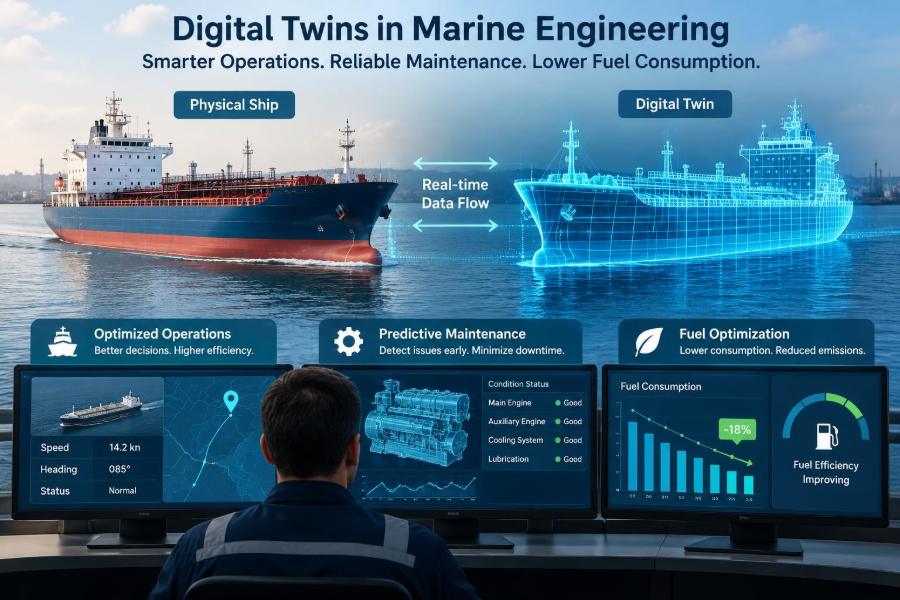
Now imagine a virtual model that combines the ship’s design data with live measurements from the engine room, bridge, weather services, and maintenance records. It can compare the vessel’s current behaviour with expected behaviour, test operating choices before they are made, and point engineers toward likely causes of lost performance.
That model is commonly called a digital twin. It is not simply a 3D ship on a screen, nor is it a replacement for competent officers and engineers. Its value comes from connecting a model of a physical asset to trustworthy operational data and using that connection to support decisions.
For ship operators facing fuel costs, emissions requirements, equipment reliability concerns, and tighter voyage planning, digital twins offer a practical way to turn scattered data into operational understanding. The technology is useful only when its assumptions, data quality, and limits are understood.
🧭 What a Digital Twin Actually Is
A digital twin is a digital representation of a physical vessel, system, or component that is updated using data from the real asset. Depending on its purpose, it may represent an entire ship, a propulsion train, a centrifugal pump, a cargo refrigeration plant, or even a single diesel-generator cylinder.
The twin combines one or more models with observed data. A model might be physics-based, using known relationships such as power, speed, resistance, pressure, and heat balance. It may also use statistical or machine-learning methods to detect patterns in historical data.
The essential distinction is the feedback loop. A static design model describes what was intended. A digital twin is intended to reflect what the asset is doing now, or what it is likely to do under specified conditions.
🖥️ More Than a 3D Visualization
A detailed 3D model can be valuable for familiarization, planning access, and training, but visual realism alone does not make it a digital twin. A useful twin may have a simple interface if it can accurately estimate a pump’s efficiency, predict fouling effects, or identify an abnormal operating trend.
Conversely, a visually impressive dashboard can mislead users if its inputs are incomplete or its calculations cannot be explained. For engineering decisions, the important question is not “Does it look like the ship?” but “Does it represent the behaviour that matters for this decision?”
🔄 The Connection Between Physical Ship and Virtual Model
The physical vessel supplies measurements: shaft power, fuel flow, speed through water, engine temperatures, vibration, tank levels, valve positions, and many other signals. The twin processes these signals, compares them with its expected state, and produces insights or recommendations.
That loop should also include human verification. Engineers inspect machinery, officers check conditions at sea, and maintenance teams confirm faults. Their observations can correct a model that has encountered sensor error, an unusual operating mode, or a condition it was not designed to represent.
A twin therefore works best as a disciplined cycle: measure, validate, model, decide, act, and learn.
📦 Different Scopes of Ship Digital Twins
Not every application needs a vessel-wide twin. Narrow, well-defined twins often deliver value sooner because their data requirements and operating goals are clearer.
| Scope | Typical representation | Useful decisions |
|---|---|---|
| Component | Pump, purifier, bearing, cylinder | Condition assessment and maintenance timing |
| System | Fuel system, cooling circuit, propulsion plant | Set-point tuning and fault diagnosis |
| Ship | Hull, machinery, loading condition, route | Speed, trim, voyage and energy planning |
| Fleet | Comparable ships and operating profiles | Benchmarking and fleet-wide improvement |
A fleet platform may compare sister vessels, but it should not assume they behave identically. Hull condition, equipment modifications, loading patterns, and crew practices can create real differences.
📡 Data Sources That Give the Twin Its Value
Shipboard automation systems provide much of the raw material, including data from the integrated automation system, engine control system, power-management system, navigation equipment, and cargo controls. Flowmeters, torque meters, temperature sensors, pressure transmitters, and vibration instruments add further detail.
External information is equally relevant for many use cases. Weather and sea-state data, route information, port schedules, fuel properties, docking records, class surveys, and planned-maintenance history can all help explain why a vessel is performing as it is.
Data availability is not the same as data usefulness. A twin needs signals that relate directly to the physical mechanism or operating decision being examined.
🧹 Data Quality Comes Before Smart Analytics
A fuel-flow meter with a drifting calibration, a missing shaft-power signal, or a time stamp that is out of sync with GPS data can create confident-looking but incorrect conclusions. Sensor validation is therefore an engineering task, not just an information-technology task.
Useful checks include range limits, rate-of-change checks, comparison with redundant instruments, and mass or energy balance checks. For example, a sudden change in calculated specific fuel consumption may be a real engine issue, but it may also be caused by a faulty flowmeter or an incorrect density value.
A sophisticated model cannot reliably compensate for unknown bad data. It can flag questionable inputs, but the measurement system still needs inspection, calibration, and sensible maintenance.
⚙️ Physics-Based Models and Data-Driven Models
Physics-based models use engineering relationships. A propulsion model may combine calm-water resistance, propeller characteristics, shaft losses, and engine performance. These models are often easier to interpret because their variables correspond to physical causes.
Data-driven models learn a normal relationship from operational history. They can be effective where the system is complex and heavily instrumented, but their reliability depends on whether the training data covers the operating conditions later encountered.
Many practical twins are hybrid systems. Physics provides structure and sensible boundaries; measured data calibrates the model and captures effects that are difficult to calculate exactly.
🧪 Calibration Turns a Model Into an Operational Tool
Before a twin can judge deterioration, it needs a credible baseline. Calibration aligns model parameters with observed behaviour during known operating conditions. For a ship-performance twin, this may involve separating the effects of draft, trim, weather, current, and speed from the underlying hull and propeller condition.
Calibration should not be treated as a one-time commissioning exercise. A vessel changes after dry docking, propeller polishing, machinery overhaul, sensor replacement, and operational changes. The baseline may need controlled updates, with records of why a change was made.
🚤 Voyage Performance and Speed Decisions
A ship-level twin can estimate the power required to achieve a selected speed under expected loading and environmental conditions. This supports realistic voyage plans rather than treating speed as an isolated bridge setting.
For example, a hypothetical bulk carrier approaching a berth window may find that a modest speed reduction early in the passage avoids high-power operation later without arriving late. The twin can compare fuel consequences across candidate speed profiles while considering forecast weather and draft.
It should not override navigational judgment. Traffic separation schemes, safe speed, charter-party requirements, machinery limits, and weather avoidance remain operational constraints that a performance calculation must respect.
🌊 Separating Weather Effects From Hull Fouling
Rough seas, wind, waves, current, shallow water, and steering activity all affect fuel consumption. If these effects are not normalized, ordinary environmental variation can be mistaken for hull fouling or propeller damage.
A well-designed performance twin compares like with like. It may identify suitable reference conditions, use validated weather corrections, and report uncertainty where conditions cannot be separated cleanly. The objective is not to claim perfect precision but to make a more defensible comparison over time.
This distinction matters because cleaning a hull is expensive and operationally disruptive, while ignoring genuine fouling can allow avoidable fuel loss to continue.
🛳️ Trim Optimization in Real Operating Conditions
Trim is the difference between a vessel’s forward and aft draft. Small trim changes can alter hull resistance, propeller immersion, and wake flow; the best condition varies with vessel type, displacement, speed, sea condition, and loading arrangement.
A twin can evaluate actual voyages and suggest trim ranges that have historically produced lower required power under comparable conditions. It can also account for practical limits such as stability, longitudinal strength, visibility, cargo requirements, and ballast-transfer capability.
Trim advice should be presented as a controlled recommendation, not a universal rule. A “best trim” identified at one draft and speed may be unsuitable at another.
🌀 Propeller Condition and Shaft Performance
Propeller roughness, marine growth, surface damage, and changes in blade condition can increase the power needed to maintain speed. Shaft torque, revolutions, speed through water, and vessel condition can help a twin identify deviations from an expected propulsion relationship.
However, propeller diagnosis is rarely certain from operational data alone. Hull fouling, weather correction error, engine derating, and instrument problems can produce similar patterns. The twin is most useful when it helps prioritize inspection during port stay or dry dock rather than declaring a defect without confirmation.
🔥 Main Engine Efficiency Monitoring
For a slow-speed two-stroke or medium-speed four-stroke engine, efficiency depends on load, ambient conditions, fuel characteristics, tuning, turbocharger condition, combustion quality, and the health of supporting systems. A twin can combine these variables into a performance baseline for normal operation.
Deviation analysis may reveal that a given load now requires more fuel than expected, or that exhaust-temperature balance has shifted between cylinders. Such signals are prompts for investigation, perhaps leading to checks of injectors, air supply, scavenge spaces, cooling, fuel treatment, or instrumentation.
The twin does not remove the need for engine-maker guidance and onboard diagnostic procedures. It helps crews direct those procedures toward the most relevant evidence.
🌡️ Detecting Heat-Balance Anomalies
Machinery converts fuel energy into useful work and unavoidable losses through exhaust, cooling, lubrication, and radiation. A heat-balance view can identify patterns that a single temperature reading might miss.
If exhaust energy rises while delivered shaft power does not, engineers may investigate combustion quality or air-path performance. If jacket-water temperatures or cooling demand change unexpectedly, they may examine valves, pumps, coolers, sensor accuracy, and operating configuration.
Heat-balance models require careful assumptions. Incomplete measurements can make the calculated balance approximate, so results should be interpreted as trends and diagnostic clues rather than exact proof.
💨 Air Systems, Turbochargers, and Scavenge Performance
The air side of an engine strongly influences combustion. Fouled air coolers, restricted filters, turbocharger degradation, leaking ducting, or unsuitable operating conditions can affect scavenge pressure, charge-air temperature, exhaust temperatures, and fuel consumption.
A twin can compare relationships among engine load, turbocharger speed, air pressure, and temperatures. A gradual departure from the established pattern may justify inspection before it becomes a larger efficiency or reliability issue.
Engine operation near low-load limits requires particular caution. Digital guidance must remain consistent with maker instructions for minimum load, auxiliary blowers, lubrication, and avoidance of prolonged unsuitable running.
🔌 Power Management for Auxiliary Engines
Auxiliary engines and generators often operate across changing hotel, cargo, pump, and reefer loads. Running too many sets lightly loaded can reduce efficiency, while running too few can compromise redundancy and response to a sudden load increase.
A power-system twin can forecast demand, compare generator loading combinations, and identify unnecessary running hours. On a vessel with variable-speed drives or a shaft generator, it can also examine how propulsion and electrical choices interact.
The correct operating point is not always the lowest immediate fuel rate. Safety margins, blackout prevention, equipment wear, emission-control needs, and planned activities must be included in the operating decision.
❄️ Refrigeration and Cargo Plant Optimization
Refrigerated cargo systems, liquefied-gas cargo plants, and air-conditioning systems consume substantial energy on some ships. Their performance depends on ambient conditions, insulation, load, compressor staging, condenser cleanliness, suction pressure, and control settings.
A system twin can identify unstable cycling, unusual temperature approaches across heat exchangers, or compressors operating away from efficient ranges. In a reefer vessel or container ship, it may help explain electrical demand changes without compromising cargo temperature requirements.
Cargo quality and safety remain the governing priorities. Optimization must never encourage operation outside cargo instructions, approved procedures, or equipment limits.
🛠️ From Calendar Maintenance to Condition-Based Maintenance
Traditional planned maintenance is often calendar- or running-hour-based. It provides structure and supports compliance, but it may not reflect the actual condition of every component. A digital twin can add condition indicators that help determine whether attention is needed earlier or whether an inspection can be planned more intelligently.
Condition-based maintenance does not mean postponing mandatory tasks simply because a model reports normal behaviour. It means using evidence to improve fault detection, spare-parts planning, job scope, and the timing of non-mandatory interventions.
📈 Detecting Degradation Before an Alarm Limit
Alarm systems are designed to identify potentially unsafe or unacceptable conditions. A twin can serve a different purpose: recognizing gradual deterioration while the value remains inside an alarm band.
For instance, a seawater pump may still maintain adequate pressure, but its power draw and pressure-flow relationship may indicate declining hydraulic efficiency. Early awareness gives the vessel or shore team time to arrange a spare, plan cleaning, or coordinate a repair window.
This is a decision-support benefit, not a guarantee of failure prediction. Some failures occur suddenly, and no trend model can reliably foresee every mechanism.
🧭 Fault Isolation Instead of Alarm Flooding
Modern vessels can generate large numbers of alarms, especially when one initiating fault affects several downstream systems. A twin can use system relationships to rank plausible causes rather than presenting every symptom as equally important.
Consider a cooling-system upset: changes in pump pressure, cooler temperature difference, valve command, and engine temperature may help distinguish a blockage, pump issue, control-valve problem, or sensor fault. The output should show the evidence and confidence level, allowing engineers to challenge the conclusion.
Clear prioritization is valuable during busy operations, but the final diagnosis still requires competent personnel and approved troubleshooting methods.
🧰 Planning Repairs, Spares, and Port Calls
When a twin indicates emerging degradation, shore teams can assess whether the vessel can operate safely until the next suitable port, which parts may be required, and what repair duration is realistic. This can reduce rushed purchasing and unnecessary off-hire exposure.
The model may also help define the work package. Rather than sending a technician to “inspect poor performance,” the team can arrive with a suspected subsystem, relevant data history, and likely spare requirements.
These plans must incorporate class requirements, manufacturer instructions, port access, permits, isolation procedures, and the vessel’s actual operational schedule.
🧑✈️ Supporting Crew Decisions Without Replacing Crew
Digital twins are sometimes described as if they can run a ship autonomously. In normal marine engineering practice, their nearer-term role is more grounded: give crews better context, earlier warning, and clearer comparisons.
A recommendation should explain its basis in practical language. “Fuel deviation increased after correcting for draft and weather; check air cooler differential pressure and fuel-meter validation” is more actionable than an unexplained red score.
Human factors matter. If a system produces frequent false alerts or hides uncertainty, crews will reasonably stop trusting it. Good design respects workload, local knowledge, watchkeeping routines, and the authority of the master and chief engineer.
🧑🏫 Training With a Safe Virtual Vessel
A digital twin can support training by allowing engineers and officers to explore equipment behaviour without placing the ship at risk. Trainees may observe how a change in cooling-water flow influences temperatures, or how a fuel-saving speed plan changes arrival margin.
Scenario training is especially useful when linked to realistic operating boundaries. A simulator-like twin can demonstrate the difference between an efficiency adjustment and an unsafe reduction in redundancy.
Training models should state where they simplify reality. A simplified model is valuable for learning principles, but it should not create false confidence that every real-world response will match the simulation.
🌱 Fuel Optimization and Emissions Reporting
Fuel consumption is directly related to carbon dioxide emissions for a given fuel, while other emissions depend on fuel type, combustion, and after-treatment arrangements. By improving speed planning, machinery efficiency, trim, and energy management, a twin can support lower fuel use and more consistent operational records.
It can also help reconcile data used in performance and emissions reporting by exposing gaps, inconsistent timestamps, or unexpected consumption patterns. This does not make compliance automatic; reported figures still require the methods, verification, and documentation applicable to the ship and its trading requirements.
The strongest environmental benefit usually comes from sustained, verified operational improvements rather than a single software recommendation.
🧮 Measuring Savings Fairly
Claimed fuel savings should be compared against an appropriate baseline. A before-and-after comparison that ignores route, weather, draft, speed, cargo condition, and fuel quality may credit the twin for changes caused by ordinary operational variation.
A fair method defines the baseline, records interventions, normalizes relevant conditions where possible, and states uncertainty. For example, following propeller polishing, a trend may show an improvement in required power under comparable conditions, but the analysis should avoid implying a level of certainty the data cannot support.
This discipline protects both operators and crews from unrealistic targets.
🔐 Cybersecurity and Data Governance
Connecting operational technology to onboard or shore-based analytics creates cybersecurity considerations. Data paths, remote access, user permissions, software updates, backups, and network segmentation need to be designed and managed carefully.
Data governance also addresses ownership, retention, quality responsibility, and access rights. A shipowner, manager, charterer, equipment maker, and platform provider may all have legitimate interests, but unclear arrangements can delay useful deployment.
Cybersecurity is not an add-on after the twin is built. It is part of safe lifecycle management for connected ship systems.
⚠️ Model Limits, Uncertainty, and False Confidence
Every twin has a valid operating domain. A model calibrated for steady sea passages may perform poorly during maneuvering, heavy weather, emergency operation, unusual fuel changeover, or after a major hardware modification.
Users need visibility of data freshness, missing signals, model confidence, and conditions outside the model’s intended range. A system that can say “insufficient confidence for recommendation” is safer than one that always supplies an answer.
The purpose of a digital twin is to improve judgment, not to manufacture certainty.
🚧 Common Implementation Mistakes
Many projects disappoint because they begin with a broad promise rather than a specific operational problem. Installing more sensors or buying a dashboard does not automatically produce a useful maintenance or fuel decision.
- Starting with an entire fleet before proving one high-value use case.
- Ignoring sensor calibration, metadata, and time synchronization.
- Building models without involvement from shipboard users.
- Presenting recommendations with no explanation or confidence indicator.
- Measuring benefits against an unfair or poorly documented baseline.
- Treating the platform as a substitute for maintenance procedures and engineering review.
These are manageable problems, but they require ownership shared between operations, engineering, information technology, and vessel personnel.
🗺️ A Practical Adoption Path
A sensible first project focuses on a recurring, measurable decision: identifying propulsion-performance loss, monitoring a critical pump group, optimizing auxiliary-generator loading, or detecting refrigeration inefficiency. The team should define what action will be taken when the twin identifies a deviation.
- Select a use case with an operational owner and a clear decision point.
- Map the physical system, existing data, missing measurements, and known limitations.
- Validate data quality before setting performance targets.
- Build and calibrate the simplest model capable of supporting the decision.
- Run it alongside existing practice and compare its outputs with inspections and logs.
- Refine alert logic, workflow, and reporting before expanding scope.
This phased approach makes it easier to earn crew trust and distinguish genuine value from attractive visualizations.
🤝 Collaboration Between Ship and Shore
The vessel has direct knowledge of machinery sounds, weather, operating constraints, and workarounds that may not appear in a data stream. Shore teams can bring analytical capacity, fleet context, vendor coordination, and longer-term planning.
A productive twin workflow connects these perspectives. Shore analysts should be able to ask why a trend changed; crews should be able to record contextual observations and challenge an implausible result. Feedback from completed inspections is particularly valuable because it tests whether model alerts corresponded to physical reality.
🔭 Where Ship Digital Twins Are Heading
As onboard data quality improves, twins are likely to become more integrated across voyage planning, energy systems, maintenance, cargo operations, and shore support. Better interoperability may reduce the effort needed to combine equipment data from different suppliers.
Progress will not be uniform. Older vessels may have limited instrumentation, communications constraints, and data gaps, while newbuildings may have abundant data but still require careful integration. The useful future is not necessarily a fully virtual ship; it is a ship where digital evidence makes everyday engineering decisions more timely and transparent.
✅ The Core Principle: Better Decisions From Better Context
Digital twins have practical applications across ship operations, maintenance, and fuel optimization because they connect observations that are otherwise separated across logbooks, control systems, weather data, and maintenance records. They can reveal performance drift, test options, prioritize investigations, and support planning.
The technology works when its scope is clear, its data is trustworthy, its assumptions are visible, and its recommendations fit established safety and operational responsibilities. Starting with one well-chosen problem is usually more valuable than attempting to model everything at once.
A digital twin earns its place onboard when it helps people make safer, more efficient, evidence-based decisions about the real ship. Used with sound engineering judgment, it can turn routine operational data into a practical advantage for crews, managers, and the vessel itself. ⚙️🌊🚢