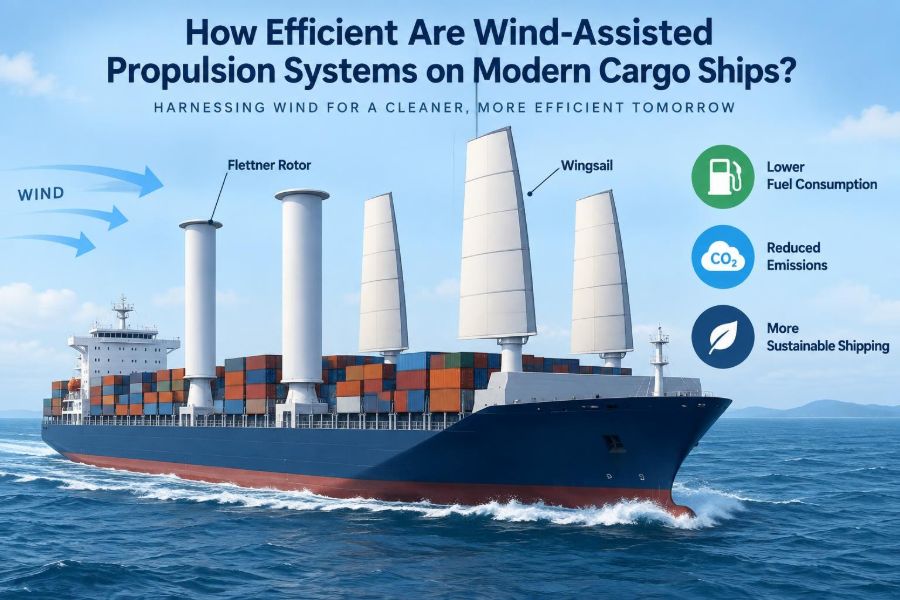

A cargo ship leaving port may look much as it did decades ago: steel hull, diesel or dual-fuel engines, containers or bulk cargo stacked inside. Then, farther along the voyage, tall rotating cylinders or rigid wing-like sails begin to work above the deck.
For the crew, this is not a return to the age of square-rigged sailing ships. It is another source of propulsion, managed alongside engines, weather routing, cargo operations, and strict safety procedures. The question is not whether wind can move a ship—it plainly can—but how much useful work it can do on a modern commercial route.
That matters because fuel is one of a ship operator’s largest operating costs, while greenhouse-gas emissions from international shipping are under increasing scrutiny. A technology that reduces engine load on suitable voyages can improve both fuel use and emissions performance.
Wind-assisted propulsion is promising, but its results vary sharply with ship type, route, weather, speed, and onboard design. Understanding those conditions is more useful than treating sails as either a miracle solution or a novelty.
🌬️ What Wind-Assisted Propulsion Actually Means
Wind-assisted propulsion uses wind energy to supplement a ship’s main propulsion plant. The vessel still normally relies on its engine and propeller for schedule keeping, harbour manoeuvring, and periods of light or unfavourable wind.
This distinction matters. Most current systems are not intended to make a cargo ship fully wind-powered. They reduce the shaft power or fuel required to maintain a planned speed when the available wind creates useful aerodynamic force.
Think of it like a cyclist receiving a helpful push from a tailwind. The rider still pedals and controls the bicycle, but less effort is needed to maintain the same pace.
⚓ Why Cargo Shipping Is Looking at Wind Again
Shipping must move large quantities of cargo reliably, often over long distances. Even a modest reduction in daily fuel consumption can become meaningful over a vessel’s annual operating pattern.
At the same time, operators are evaluating many decarbonisation measures: improved hull coatings, propeller upgrades, voyage optimisation, lower-carbon fuels, batteries for selected duties, and new machinery concepts. Wind assistance fits this broader efficiency toolkit rather than replacing it.
Its special advantage is that wind is available at sea without being bunkered. Its special limitation is that it cannot be ordered on demand.
🧭 The Central Efficiency Question
Asking whether a wind-assist system is “efficient” can mean several different things. It may refer to aerodynamic efficiency, fuel savings, emissions reduction, financial return, or the system’s ability to fit normal cargo operations.
A highly efficient rotor or wing does not automatically deliver the best vessel-level result. A device needs usable wind, sufficient deck space, acceptable structural loads, compatible operating procedures, and a route where its contribution occurs often enough.
The practical measure is usually the reduction in fuel or engine power for a given voyage and service requirement, compared with a credible baseline under comparable conditions.
📐 Wind Direction Matters More Than Wind Strength Alone
Strong wind is not always helpful. What matters is the wind experienced by the moving vessel, called apparent wind. It combines the true wind over the sea with the wind created by the ship moving forward.
A ship travelling into a headwind experiences stronger apparent wind, but the aerodynamic force may include substantial resistance rather than useful forward thrust. Winds approaching from the side or from a forward-quarter angle can often be especially productive for certain systems.
System controls adjust the device angle, rotation, or camber to create a force with a forward component. The unwanted sideways component must then be balanced by the hull, rudder, and course-keeping system.
🌀 Rotor Sails and the Magnus Effect
Rotor sails are tall vertical cylinders driven to rotate by electric motors. Air moving around the spinning cylinder produces the Magnus effect, creating a force largely perpendicular to the apparent wind direction.
By selecting rotation direction and speed, the control system can orient the useful component of that force to assist propulsion. Rotor sails are visually distinctive, mechanically robust, and can be automated, but they consume some electrical power to spin.
That electrical demand must be included in any honest performance assessment. The system is worthwhile only when the propulsive benefit exceeds the energy and operational costs associated with running it.
🪽 Rigid Wings and Wing Sails
Rigid wing sails resemble vertical aircraft wings adapted for marine use. Their shaped profiles can generate lift efficiently, and many designs can rotate, reef, fold, or lower to suit wind conditions and port restrictions.
Unlike a conventional fabric sail, a wing has a controlled aerodynamic shape. Sensors and software can set its angle of attack—the angle between the wing and apparent airflow—to avoid excessive drag or stalled flow.
The engineering challenge is not only aerodynamic. Large wings affect visibility, loading arrangements, stability calculations, access routes, and clearance below cranes, bridges, or loading equipment.
⛵ Suction Wings, Kites, and Other Concepts
Some wing systems use fans to draw air through internal passages, helping maintain attached airflow over the surface. This can improve controllability over a wider range of wind angles, although the fan’s electrical consumption is part of the energy balance.
Towing kites operate high above the vessel, where winds may differ from those near deck level. They pull the ship from a long line and can be recovered when conditions are unsuitable. Their operation requires careful automation and clear procedures for deployment and recovery.
Other concepts include soft sails, telescopic rigs, and hybrid arrangements. Their relative suitability depends less on novelty than on whether they can survive, operate, and be maintained reliably in the vessel’s actual trade.
🔋 Where the Energy Savings Come From
A propeller needs shaft power to overcome hull resistance, appendage drag, waves, wind resistance, and the energy lost in the propulsion chain. When a wind device supplies forward thrust, the main engine can produce less shaft power for the same speed.
Fuel savings are often nonlinear because ship power demand rises steeply as speed rises. A useful wind contribution may permit a lower engine setting, but the actual fuel effect depends on the engine’s fuel-consumption curve and the required arrival time.
If the vessel keeps engine power unchanged, wind assistance may instead increase speed. That may be operationally valuable, but it does not automatically create the maximum fuel saving.
📊 Why Reported Savings Have a Wide Range
It is common to see widely differing performance claims because installations operate under different conditions. A favourable route with consistent crosswinds and long sea passages will not resemble a short service with frequent port calls and sheltered waters.
| Factor | Why it changes performance |
|---|---|
| Route and season | Wind speed and direction vary by region and time of year. |
| Ship speed | Speed changes apparent wind and the engine power available to offset. |
| Device size and number | More sail area can create more thrust but adds weight, cost, and constraints. |
| Hull and loading condition | Draft, trim, resistance, and stability affect the vessel-level result. |
| Operating strategy | Weather routing and power management determine whether thrust becomes fuel saving. |
For this reason, a single percentage without its baseline, route, and operating assumptions is incomplete. Annual performance should be assessed across representative voyages, not selected windy passages.
🗺️ Route Suitability Is Often Decisive
Long ocean passages generally offer more opportunity than short, congested routes. The equipment needs enough time in open water to produce useful thrust and offset the capital, maintenance, and operational burden.
Consistent wind patterns can make a trade more attractive, but ships rarely experience identical conditions throughout a year. Seasonal shifts, diversion ports, ballast voyages, and changing cargo patterns all affect the expected benefit.
A vessel with varied trading may still benefit, but the evaluation should use its likely operational envelope rather than an idealised route map.
🚢 Ship Type Changes the Design Problem
Bulk carriers and tankers may have broad, relatively open deck areas, although tank arrangements, pipe runs, hatch covers, and hazardous-area requirements can complicate positioning. Their long voyages can be favourable for wind assistance.
Container ships face a different problem: cargo stacks, cranes, and line-of-sight requirements can limit where tall structures can stand. Ro-ro ships, general cargo vessels, and offshore vessels each bring their own deck-access and clearance constraints.
There is no universally “best” ship type. The best candidate is one where the device can create frequent thrust without obstructing its core job: carrying, loading, and safely delivering cargo.
🏗️ Retrofit Versus Newbuild Installation
A retrofit must work around an existing vessel. Engineers survey deck strength, internal structure, cabling routes, equipment foundations, access paths, radar sight lines, and interference with cargo gear before selecting a configuration.
Newbuild designs can integrate foundations, control systems, cable routes, bridge visibility arrangements, and deck layout from the start. This may reduce compromises, but it still depends on the owner committing to a technology before future trading patterns are fully known.
Retrofit decisions therefore require careful engineering rather than simply placing devices wherever deck space appears empty.
⚖️ Stability, Heeling, and Structural Loads
Wind devices add weight high above the ship’s centre of gravity, which can reduce stability margin. More importantly, their aerodynamic force can create a heeling moment: a turning effect that pushes the vessel sideways and causes it to lean.
Naval architects evaluate these loads across loading conditions, wind strengths, wave states, and device operating modes. Foundations and local deck structures must also carry the forces transmitted from tall rigs into the hull.
Safe designs include limits and automatic reduction or shutdown modes. A propulsion benefit never justifies operating outside approved stability or structural criteria.
🛞 Steering and Side Force Cannot Be Ignored
A sail or rotor commonly creates both forward thrust and sideways force. The hull generates hydrodynamic side force to resist leeway, while the rudder may need to work harder to maintain course.
That correction can add drag, reducing the net benefit. The true answer is therefore not the device’s gross aerodynamic force, but the net propulsive gain after hull, rudder, and control effects.
Placement, control logic, and vessel heading all influence this balance. A well-integrated system avoids creating so much side force that much of its apparent gain is spent correcting it.
🌊 Waves and Sea State Affect the Outcome
Wind systems are evaluated in the real ocean, not in smooth-air laboratory conditions. Waves increase hull resistance, alter speed through water, and can require extra engine reserve for safety and schedule control.
Heavy weather may also trigger operational limits for the wind device, especially where motions, roll response, structural loading, or visibility become concerns. A windy day is not necessarily a productive day.
Performance modelling should combine wind data with expected wave conditions and voyage speed, rather than treating wind as an isolated input.
🧠 Automation Turns Wind into Usable Thrust
Modern systems use wind sensors, motion data, heading, speed, and equipment status to choose a safe and useful setting. Automation can start, stop, rotate, feather, or reduce a device according to predefined operating limits.
That does not remove the crew from the process. Officers need to understand the equipment’s status, its effect on manoeuvring, alarm conditions, and the circumstances in which manual intervention is required.
Good automation reduces workload during routine operation. Poorly understood automation can introduce risk precisely when weather and traffic demand clear situational awareness.
👷 What Changes for the Bridge Team
Wind assistance affects passage planning and watchkeeping. The bridge team may consider opportunities for beneficial headings, but must never compromise collision avoidance, traffic separation requirements, under-keel safety, or the voyage plan merely to gain wind thrust.
Bridge visibility is a major design and approval issue. Tall devices must not create unacceptable blind sectors or obscure critical navigation lights, signals, or approaching traffic.
Training should cover normal modes, shutdown criteria, emergency stops, effects on turning behaviour, and communication with the engine room and deck department.
🧰 Maintenance Is Part of Efficiency
A stationary sail has different maintenance needs from a rotating cylinder, fan-assisted wing, or towing kite. Bearings, motors, hydraulic equipment, sensors, control cabinets, coatings, seals, and structural connections all require inspection and planned maintenance.
Marine salt, vibration, ultraviolet exposure, and repeated loading are unforgiving. A system that produces excellent thrust but suffers frequent downtime will have a weaker annual result than its design calculation suggests.
Owners should ask practical questions: Can crew safely access the equipment? Are spare parts available? Can repairs be completed during normal port stays or dry docking?
🏭 Cargo Operations Can Be the Hidden Constraint
Deck equipment must not obstruct hatch covers, pipelines, loading arms, grabs, cranes, lashing work, lifeboat access, or emergency escape routes. On many vessels, operational interference is a larger barrier than the aerodynamics.
Some systems can fold, lower, or park for port operations. These features improve compatibility, but add mechanisms, maintenance demands, and failure modes that must be considered.
The best layout is usually developed with input from masters, chief officers, terminal users, naval architects, and cargo planners—not only aerodynamic designers.
🏗️ Ports, Bridges, and Clearance Limits
A tall sail may be acceptable at sea but incompatible with fixed bridges, gantry cranes, shore loading equipment, or port approach rules. Air draft—the height of the ship above the waterline—must be checked along the complete trading route.
Retractable equipment can address some limits, yet it needs reliable stowage procedures and sufficient time to transition between modes. An unexpected need to lower equipment during a busy approach must be manageable without distracting the bridge team.
Port compatibility should be verified early. It is expensive to install a system that can only be fully used on part of the intended service.
💨 Weather Routing Multiplies or Limits Value
Weather routing already helps ships avoid severe conditions and manage fuel use. With wind assistance, routing software can also identify courses where the expected apparent wind provides useful net thrust.
However, a route that looks aerodynamically favourable may be longer, encounter more waves, conflict with traffic constraints, or alter arrival timing. The decision is an optimisation problem, not a simple instruction to sail toward stronger wind.
Practical routing balances safety, charter-party commitments, fuel, emissions, machinery limits, and predicted weather uncertainty.
⏱️ Speed Management Makes a Major Difference
Wind assistance delivers its largest operational value when the ship can convert the contribution into lower engine power. This often pairs naturally with speed management, including slow steaming where commercially acceptable.
By contrast, if a tight schedule forces a ship to maintain high speed in all conditions, the system may mostly provide a small speed increment rather than a large fuel reduction. That can still have value, but it is a different business case.
The operator must decide in advance what the wind-derived energy is for: saving fuel, protecting schedule margin, increasing speed in selected conditions, or a combination of these.
🧪 Measuring Performance Fairly
Ships operate in changing wind, waves, currents, draft, trim, fouling condition, and engine states. Comparing one voyage with equipment active against another voyage without it can be misleading.
More credible assessment uses logged operational data and models that account for these variables. The system’s own electrical use, added resistance when inactive, and any speed or routing changes should be included.
Transparency about assumptions is essential. A calculated potential is useful for design, while verified in-service performance is useful for operational decision-making; they should not be confused.
💰 The Business Case Goes Beyond Fuel
Capital cost, installation downtime, financing, maintenance, insurance considerations, crew training, and potential cargo-operation impacts all influence economic value. Fuel savings are central, but they are not the sole variable.
Compliance strategies and emissions reporting can also matter. Depending on the applicable framework and the vessel’s operation, lower fuel consumption may help an owner meet efficiency or carbon-intensity objectives.
Yet regulations and commercial arrangements evolve. A sound business case should test several assumptions about fuel cost, utilisation, route changes, and equipment availability instead of relying on one optimistic scenario.
🌍 Emissions Benefits Depend on the Fuel Displaced
When wind assistance allows a main engine to burn less fuel, it generally reduces the associated carbon dioxide emissions and many other combustion-related emissions. The scale depends on how much fuel is actually displaced over time.
It does not eliminate emissions from the ship’s remaining engine operation, auxiliary power, equipment manufacture, or maintenance. It is best understood as an efficiency measure that can support, rather than replace, a transition to lower-emission energy sources.
This distinction is especially relevant for vessels expected to operate for many years while alternative-fuel infrastructure develops at different rates across ports.
🚧 Common Mistakes in Evaluating a System
- Using peak conditions as annual performance: exceptional wind passages do not represent a full trading year.
- Ignoring parasitic loads: motors, fans, hydraulic systems, and control equipment consume energy.
- Overlooking deck operations: cargo access and safety routes can outweigh theoretical thrust.
- Assuming a route never changes: chartering and market conditions may alter the vessel’s trade.
- Counting gross force as net thrust: rudder correction and added drag reduce usable benefit.
A disciplined feasibility study treats these as design inputs, not inconvenient details to be handled after installation.
🔍 A Practical Screening Process for Owners
A sensible first review starts with operational data: historical routes, speed profiles, loading conditions, port calls, weather exposure, fuel use, deck plans, and planned dry-docking dates. This reveals whether there is a credible opportunity before detailed design cost is incurred.
- Define the vessel’s likely future trading pattern, including ballast legs.
- Screen wind availability against headings, speeds, and sea-state exposure.
- Check deck space, air draft, visibility, cargo operations, stability, and structure.
- Compare suitable technologies using net energy and operational compatibility.
- Develop an installation, training, maintenance, and performance-monitoring plan.
The result may be a strong candidate, a candidate requiring design changes, or a vessel better served by another efficiency measure.
🧭 How Crews Can Get the Most from Installed Systems
Crews should treat wind-assist equipment as part of the ship’s integrated machinery and navigation system. Clear standing orders, familiarisation, checklists, and communication routines help turn theoretical capability into reliable use.
Useful operational habits include recording device status, noting abnormal vibration or noise, verifying stowage before port approaches, and reporting performance issues with enough context for shore teams to investigate.
Most importantly, crews should not feel pressured to operate equipment outside limits to meet a savings target. Safe navigation and safe cargo operations remain the first priority.
🔮 Where the Technology Is Headed
Future improvements are likely to focus on lighter structures, better automated control, more accurate weather-performance models, easier stowage, and ship designs that reserve space for wind devices from the outset.
Integration may also improve. A vessel can coordinate wind assistance with propeller control, shaft generators, batteries, weather routing, and engine operating points to use available energy more intelligently.
Progress will not make wind predictable. Instead, it can make the ship better at capturing favourable conditions while limiting penalties when conditions are poor.
✅ The Core Takeaway: Efficient When the System Fits the Ship
Wind-assisted propulsion systems can be genuinely effective on modern cargo ships, but their value is conditional. They work best where route winds, vessel geometry, trading pattern, speed strategy, and operational procedures all allow the generated aerodynamic force to become net fuel-saving thrust.
They are not a universal bolt-on answer to maritime decarbonisation. A poorly matched installation can create clearance, cargo, stability, maintenance, or crew-workload problems that weaken its benefits.
The strongest projects evaluate the whole vessel: energy balance, hydrodynamics, structure, navigation, cargo work, finance, and human operation. That systems approach is the difference between an impressive deck feature and a useful engineering investment.
Wind assistance is most efficient not when the wind is simply strong, but when a ship is designed and operated to turn that wind into safe, repeatable reductions in engine demand. For suitable trades, it can be a practical part of a lower-emission fleet. 🌬️🚢⚓