
A vessel may leave port with a carefully calculated fuel plan, a clean weather forecast, and a steady service speed. A few hours later, the wind rises, the bow begins to pitch, spray crosses the deck, and daily fuel consumption starts climbing.
To someone watching from shore, the ship may still appear to be moving at nearly the same speed. In the engine room, however, the propulsion plant is working against a very different environment. The sea is no longer just carrying the ship; it is repeatedly slowing, lifting, turning, and loading it.
This matters for voyage planning, charter performance, machinery operation, emissions, cargo schedules, and safety. Understanding the extra fuel used in heavy weather helps engineers and deck officers make better decisions than simply demanding more revolutions from the main engine.
Rough-sea fuel consumption is not caused by one single resistance. It is the combined result of hull motions, added resistance, propeller behaviour, wind, steering corrections, and the operational choices made to keep the ship safe.
🌊 The Short Answer: More Resistance, Less Useful Thrust
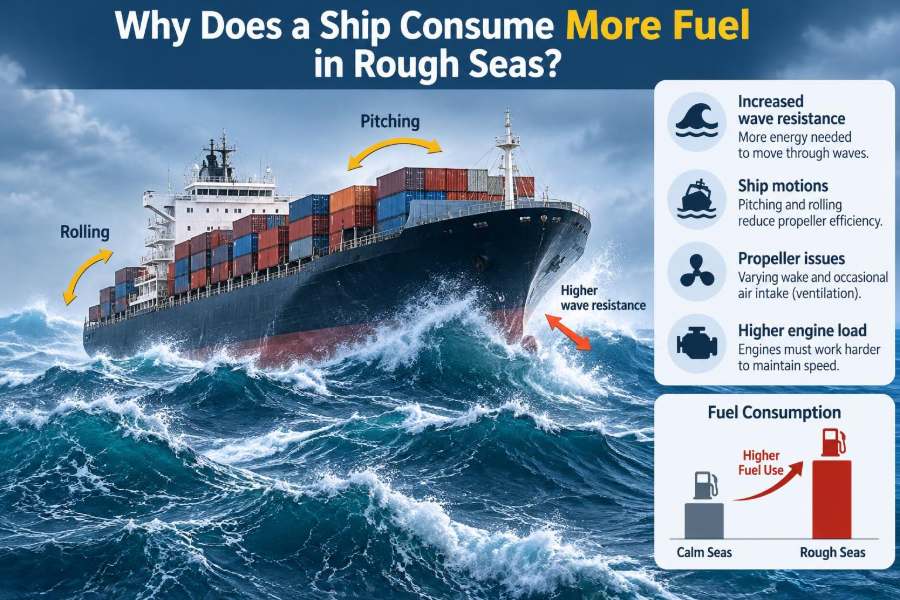
A ship consumes more fuel in rough seas because it needs more power to achieve the same progress over the ground. Waves and wind add resistance, while the propeller often converts engine power into thrust less efficiently.
Some of the delivered power moves the ship ahead. In heavy weather, more of it is spent making the hull rise over waves, driving water aside, correcting its heading, and overcoming repeated losses of momentum.
The result is simple but operationally significant: the same shaft power may produce less speed, and maintaining the same speed may require substantially more shaft power.
⚙️ Start with the Calm-Water Power Balance
In calm water, a ship experiences resistance mainly from friction along the wetted hull, pressure effects around the hull form, wave-making, and appendages such as rudders and shaft brackets. The propeller produces thrust to balance that resistance.
At a steady speed, engine power passes through the shaft and propeller to the water. Not all of it becomes useful forward motion; losses occur in the machinery, shafting, propeller wake, and hull-propeller interaction.
Rough weather changes nearly every part of this balance. It increases the resistance side and may reduce propulsive efficiency at the same time.
📈 Why a Small Speed Demand Can Need Much More Power
Resistance does not rise in a simple one-to-one relationship with speed. For many displacement ships, required propulsion power increases sharply as speed rises, especially near the vessel’s usual service-speed range.
That means a ship already using high power in calm water has limited margin when head seas arrive. Attempting to hold schedule speed can push fuel consumption upward quickly and may bring the engine close to operating limits.
A practical analogy is cycling into a strong headwind: adding a little speed feels disproportionately harder. A ship faces the same principle, but with wave-induced motions and propeller effects added to the problem.
🌫️ Added Resistance Is the Central Hydrodynamic Effect
Added resistance in waves is the extra force opposing forward movement when a vessel travels through a seaway. It exists even if the average water level and the ship’s average forward speed appear unchanged.
As waves meet the hull, the vessel must accelerate surrounding water, create additional wave patterns, and react to changing pressures over the bow and underwater body. Those actions require energy.
Added resistance depends on wave height, wave length, encounter angle, ship speed, loading condition, bow shape, and hull geometry. It cannot be represented accurately by wave height alone.
🛳️ Head Seas Usually Create the Largest Penalty
In head seas, the ship repeatedly meets wave crests with its bow. This tends to produce strong pitching, vertical motion, bow immersion changes, and large variations in resistance.
The vessel also encounters waves more frequently than it would in following seas because the relative speed between ship and oncoming waves is higher. This is called the encounter frequency.
For a hypothetical ship on a route, reducing speed slightly or altering course by a modest angle may lower the frequency and severity of impacts enough to improve the overall fuel-and-time outcome.
↗️ Bow Quartering Seas Bring a Different Set of Losses
A bow-quartering sea may reduce direct bow impacts compared with a pure head sea, but it often introduces yawing and rolling. The vessel may need frequent rudder corrections to hold its intended track.
Every steering correction creates rudder drag. More importantly, a rudder held at an angle redirects water flow rather than allowing the hull and propeller system to run at its most efficient condition.
This route can be operationally preferable in some conditions, but it is not automatically fuel-efficient. Stability, slamming risk, cargo restraints, traffic, and available sea room must all be considered.
🌬️ Wind Adds Aerodynamic Drag Above the Waterline
Wind acts on the exposed hull, accommodation block, deck cargo, containers, cranes, and superstructure. A headwind adds aerodynamic drag directly; a crosswind can also cause leeway and increase steering demand.
Container ships, vehicle carriers, and vessels with tall deck equipment can have substantial windage. A ship’s underwater hull may be in good condition, yet a strong wind can still impose a meaningful power penalty.
Wind and waves often occur together, but they should not be treated as the same force. Wind direction, gusts, loading condition, and exposed area influence the aerodynamic part of the total loss.
🧭 Waves Can Push a Ship Off Its Intended Track
A vessel’s heading is the direction its bow points; its course over ground is the direction it actually travels over the seabed. Wind, waves, and current can make those directions differ.
In rough seas, the ship may crab into the weather to maintain its planned track. This means part of the propeller thrust is effectively being used to resist sideways drift rather than produce forward progress.
Fuel analysis should therefore look at both speed through water and speed over ground. A favourable or adverse current can otherwise hide the true hydrodynamic effect of the weather.
↕️ Pitching Turns Forward Motion into Vertical Motion
Pitching is the rotation of a ship about its transverse axis: the bow rises and falls relative to the stern. In head seas, pitching can become pronounced when wave timing interacts unfavourably with the ship’s natural motion characteristics.
Energy is required to move the ship vertically and rotate it. More importantly, pitching changes the way the hull enters each wave and alters the immersion and inflow conditions near the propeller.
A heavily pitching vessel does not move through water as a stable, level body. Its varying attitude causes continuously changing resistance and propulsion conditions.
🛢️ Heaving and Surging Consume Energy Too
Heave is vertical translation of the whole vessel, while surge is fore-and-aft motion around the average forward movement. In waves, the ship alternately gains and loses forward momentum.
The propulsion system must restore speed after each period of increased resistance. These repeated accelerations and decelerations are less efficient than steady progress in calm water.
Even when the average speed looks acceptable on a bridge display, the instantaneous load on the hull and propeller may be fluctuating greatly beneath that average.
🔄 Rolling Can Indirectly Raise Fuel Use
Roll is rotation about the ship’s longitudinal axis. It is often associated with beam and quartering seas, and it may not add as much direct resistance as heavy head-sea pitching.
However, rolling can disrupt propeller inflow, increase rudder activity, reduce crew comfort, and create cargo-securing concerns. Operationally, the master may reduce speed or alter course to limit excessive roll.
For some ships, particularly those with a wide beam or sensitive deck cargo, the fuel decision is therefore inseparable from the safety decision.
💥 Slamming Wastes Energy and Threatens Structure
Slamming occurs when part of the hull, commonly the forward bottom, emerges and then re-enters the water forcefully. The impact produces high local pressures, vibration, noise, and a noticeable loss of forward momentum.
Repeated slamming is not simply uncomfortable. It can increase structural loading, damage coatings or fittings, and impose fatigue concerns over time. Reducing speed is a common response when slamming becomes severe.
The prudent objective is not to overpower the sea. It is to operate below a condition where impacts become unacceptable for the hull, machinery, cargo, or people aboard.
🌪️ Green Water on Deck Signals Severe Conditions
Green water refers to solid water shipped onto deck, rather than spray. It can occur when a ship’s bow meets steep seas and water runs over the forecastle or exposed deck areas.
Besides the immediate damage risk to deck equipment and fittings, green water indicates that the vessel is experiencing energetic wave encounters. Continuing at high speed may amplify both the loads and the fuel penalty.
Design features such as flare, freeboard, breakwaters, and protected equipment help manage exposure, but they do not eliminate the need for sound heavy-weather handling.
🌀 Propeller Ventilation Reduces Thrust
A propeller needs a stable supply of water. In heavy pitching or stern lifting, the propeller may approach the surface and draw air or exhaust gases into the blades. This is known as ventilation.
Ventilation can cause a sudden drop in propeller thrust and a rapid change in shaft load. The engine may race if the governor and control system cannot immediately compensate.
Fuel is then being supplied under unstable conditions while the propeller is producing less useful thrust. Persistent ventilation is a reason to reconsider speed, trim, or heading.
🫧 Cavitation Is Not the Same as Ventilation
Cavitation occurs when local pressure on parts of a propeller blade falls low enough for vapour cavities to form and collapse. It can happen in calm water as well as rough water, but unsteady inflow can make it worse.
Unlike ventilation, cavitation involves vapour formation in the water rather than air being drawn from the surface. Both phenomena can reduce efficiency and create vibration, but their causes and signatures differ.
Severe or prolonged cavitation may contribute to noise, vibration, and blade-surface damage. It is not something that should be diagnosed from sound alone; operating data and inspection matter.
📉 Propeller Slip and Wake Become Unsteady
The water arriving at the propeller is called its inflow or wake. In waves, stern motion, hull immersion, and local flow around the aft body change continually, so the propeller does not see a uniform stream.
This can change effective propeller slip, blade loading, torque, and thrust from one wave encounter to the next. A fixed-pitch propeller and a controllable-pitch propeller will respond differently, but neither is immune to poor inflow.
Engineers should avoid interpreting a single momentary slip or load value as the whole story. Trend data over a representative period is far more useful.
🔥 Main Engine Load Becomes Cyclic
In calm water, a well-matched propulsion plant usually operates with relatively smooth torque demand. In rough seas, resistance changes rapidly and the main engine can experience cyclic load fluctuations.
For diesel engines, this may appear as varying fuel index, exhaust temperatures, turbocharger response, scavenge-air conditions, and shaft speed. The exact behaviour depends on engine type, governor setting, propeller, and control mode.
Large load swings can reduce combustion quality at some operating points and may place limits on how aggressively power should be increased. Manufacturer guidance and the vessel’s operating procedures remain essential.
🧰 Turbocharger Response Has a Time Lag
A turbocharger does not instantly supply more air whenever wave resistance rises. During a sharp load increase, fuel demand may rise before the turbocharger speed and scavenge-air pressure fully respond.
Modern engines and control systems are designed to manage this within defined limits, but repeated transient loading is still different from stable service operation. Smoke, elevated exhaust temperatures, or poor acceleration can indicate that the system is being pushed unfavourably.
Heavy-weather operation should therefore consider the engine as a complete air, fuel, exhaust, and propeller system—not merely a source of extra kilowatts.
🛞 Rudder Corrections Create Drag
A rudder develops a sideways force by operating at an angle to the water flow. That force helps control heading, but it also creates drag and alters the wake reaching the propeller.
Autopilot settings that work well in calm conditions may lead to excessive hunting in rough weather: frequent, alternating rudder movements around the desired heading. This can waste energy and add wear to steering gear.
Appropriate weather settings, realistic track-keeping tolerance, and skilled manual steering when necessary can reduce unnecessary corrections without compromising safe navigation.
🤖 Autopilot Tuning Is a Fuel Decision
Autopilot tuning is sometimes viewed only as a navigation issue. In fact, it has a direct relationship with fuel use because poor course control creates added rudder resistance.
Too-sensitive settings may chase every yaw disturbance. Settings that are too loose may allow large deviations, longer distance sailed, or unsafe behaviour in confined waters. The right balance depends on sea state, vessel response, traffic, and route constraints.
A useful practice is to monitor rudder angle trends alongside speed, power, and heading error. It reveals whether the ship is spending excessive energy on steering.
⚓ Loading Condition Changes the Weather Penalty
Draft, trim, displacement, and stability influence how a ship meets waves. A ballast voyage can produce very different motions and propeller immersion from a loaded voyage on the same route.
A lightly loaded ship may have more exposed windage and may experience stronger vertical motions. An excessively stern-light condition can also increase the risk of propeller emergence in some sea states.
There is no universal “best trim” for every weather condition. Safe trim must comply with stability, strength, visibility, propeller immersion, and vessel-specific guidance.
🏗️ Hull Form Determines How the Ship Meets Waves
Fine bows, fuller bows, bulbous bows, flare, bow height, and underwater volume distribution all affect wave interaction. A form that is efficient in calm water does not necessarily have the smallest added resistance in every wave condition.
For example, a bulbous bow is designed around a particular range of drafts and speeds. In severe waves or off-design conditions, its contribution to total resistance may differ from the calm-water expectation.
Designers use model tests, numerical methods, and operational data to understand these trade-offs. On board, crews work with the vessel they have and focus on operating it sensibly.
🧼 Hull Fouling Multiplies the Problem
Marine growth and a roughened hull increase frictional resistance in any sea state. When rough weather adds wave resistance on top of fouling, the required power margin becomes smaller.
A fouled propeller can further reduce efficiency and worsen vibration or cavitation tendencies. It may be tempting to attribute all poor performance to the weather, even when hull condition is a major contributor.
Good performance analysis compares weather, draft, trim, speed, current, and hull condition. Rough seas expose inefficiencies that calm-water operation may hide.
🗺️ Weather Routing Balances Distance, Time, and Fuel
The shortest geographic route is not always the route requiring the least fuel. A longer path that avoids persistent head seas or severe winds may permit steadier propulsion and reduce the chance of damaging motions.
Weather routing uses forecasts, wave information, vessel characteristics, operational limits, and navigational constraints to recommend safer and more economical options. Forecasts have uncertainty, so they support judgement rather than replace it.
A route change must also account for traffic separation schemes, shallow water, piracy concerns, port arrival windows, fuel reserves, and charter requirements.
🐢 Slow Steaming Can Save Fuel—But Not Always Time
Reducing speed in heavy weather usually lowers instantaneous engine power and can reduce slamming, propeller emergence, and structural loads. It is often the safest response when conditions become severe.
However, lower speed increases voyage time. Auxiliary generators, hotel loads, cargo requirements, and contractual schedules continue during that extra time. The best decision is based on total voyage consequences, not only tonnes of fuel per day.
There are also minimum-power considerations: the ship must retain adequate steerage, manoeuvrability, and reserve power for the conditions. Slowing down is a controlled operational choice, not a reflex.
📊 Measuring Performance Requires Good Data
Fuel performance in rough seas should be evaluated using a period long enough to smooth short-term wave-to-wave variation. Essential data commonly include fuel flow, shaft power or torque, rpm, speed through water, speed over ground, draft, trim, wind, wave direction, current, and rudder activity.
The following comparison shows why one measurement is not enough:
| Observation | Possible interpretation | What else to check |
|---|---|---|
| Lower speed over ground | Head current, wave resistance, or both | Speed through water and current estimate |
| Higher fuel flow at same rpm | Added resistance or hull/propeller condition | Weather, draft, trim, shaft power |
| Frequent rpm fluctuations | Unsteady propeller loading | Pitching, ventilation, governor response |
| Large rudder angles | Course-keeping losses | Autopilot settings, wind, sea direction |
Data quality matters. A poor wind estimate or uncorrected current can lead to confident but incorrect conclusions about vessel performance.
🧠 A Common Mistake: Treating Weather as One Number
“Sea state 5” or “three-metre waves” does not fully describe the operational challenge. Wave period, direction, steepness, swell versus wind sea, wind force, current, and vessel loading can make two apparently similar conditions behave very differently.
Long swells may create large pitching motions without looking especially steep. Short, steep seas can cause hard impacts and rapid load fluctuations. A current opposing the waves can make wave faces steeper and conditions more difficult.
Good decisions use the full observed picture, including how the particular ship is responding—not only a forecast label.
⚠️ Another Mistake: Chasing Schedule with Excess Power
Increasing power may recover some speed, but it may also intensify bow impacts, cyclic machinery loading, vibration, and fuel use. There is a point at which more power produces a poor return in speed gained.
Engine limits, shaft limits, propeller behaviour, cargo safety, and structural considerations can all constrain the response. The master and chief engineer need a shared understanding of these limits before heavy weather arrives.
Sound seamanship sometimes means accepting a slower passage to preserve the ship, crew, cargo, and machinery.
👷 Bridge–Engine Room Communication Makes a Difference
The bridge sees the vessel’s motions, heading, traffic situation, and developing weather. The engine room sees machinery temperatures, load fluctuations, exhaust trends, lubrication conditions, and control-system response.
Neither perspective alone gives the complete picture. Regular communication allows course or speed changes to be matched with realistic propulsion capability and machinery monitoring.
- Report persistent slamming, racing, heavy vibration, or steering difficulty promptly.
- Agree on power margins and any engine operating limitations before conditions worsen.
- Record significant operational changes and the reasons for them.
- Review performance after the event to improve future planning.
🧪 A Simple Hypothetical Example
Imagine a cargo vessel maintaining a normal service setting in calm water. It enters head seas and loses speed despite the same rpm. Increasing rpm restores part of that speed, but fuel flow rises sharply, the bow begins to slam, and the propeller occasionally ventilates as the stern lifts.
Maintaining the higher setting may look attractive if only arrival time is considered. But if it produces irregular loading, more rudder drag, and unacceptable motion, a moderate speed reduction and altered heading may deliver a safer, more stable passage.
The lesson is not that one response always wins. It is that the fuel question must be assessed with the ship’s dynamic behaviour in mind.
✅ Practical Heavy-Weather Efficiency Checklist
Before and during rough weather, crews can improve decision quality by focusing on controllable factors:
- Use forecast and observed wind, wave, and current information together.
- Check draft, trim, stability, and propeller immersion against vessel guidance.
- Monitor shaft power, fuel flow, rpm, exhaust temperatures, and vibration trends.
- Adjust autopilot or steering practice to avoid unnecessary rudder activity.
- Consider course and speed together rather than changing only one variable.
- Maintain safe power reserve and comply with machinery operating limits.
- Document conditions accurately for later performance review.
These actions do not remove weather resistance. They help ensure that unavoidable fuel use is not increased by poor control or incomplete information.
🏁 The Core Principle: Power Must Overcome the Whole Environment
A ship in rough seas is not merely pushing against more water. It is operating in a moving environment that changes hull resistance, vessel motion, propeller inflow, steering demand, and engine load at the same time.
The most effective response is rarely a single instruction such as “increase speed” or “slow down.” It is a balanced decision using weather, route, vessel condition, machinery behaviour, safety margins, and the cost of delay.
Rough seas consume more fuel because they make every stage of propulsion less steady: the hull loses energy to waves, the propeller produces thrust less efficiently, and the ship needs more control effort to make useful progress.
When bridge and engine-room teams understand that chain of effects, fuel management becomes part of good seamanship rather than a number checked only after arrival.
The sea state may be beyond human control, but the way a ship responds to it can be planned, monitored, and improved. 🚢🌊⚙️