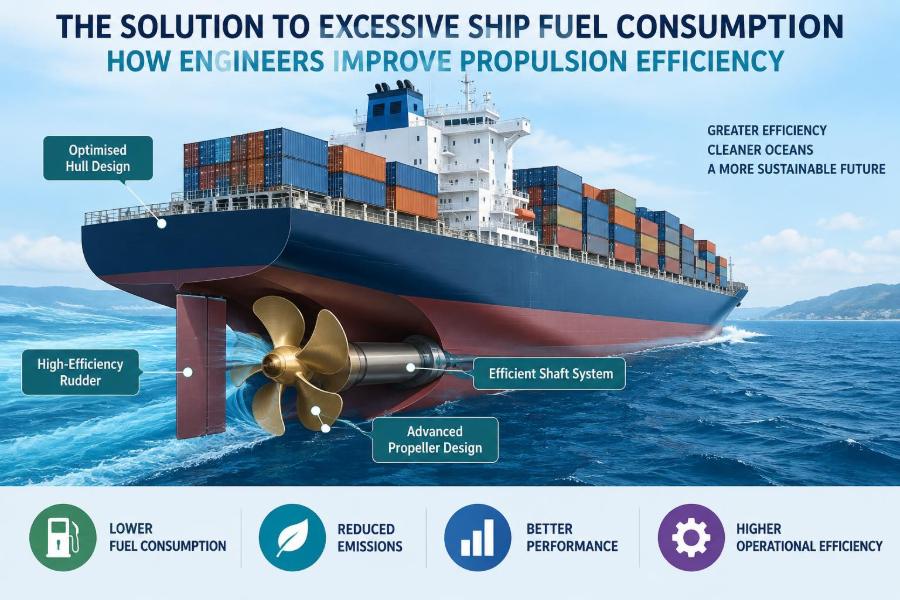

A vessel can leave port with clean hull records, a recently serviced engine, and a voyage plan that appears reasonable—then still burn far more fuel than expected. The daily report shows a small loss of speed, increased shaft power, or a main engine that seems to work harder than it did a few months ago.
For the crew, this is not an abstract efficiency problem. It affects bunker planning, voyage schedules, machinery loading, maintenance workload, emissions, and operating cost. For engineers, the useful question is not simply “How can fuel use be reduced?” but “Where is useful propulsive power being lost?”
Ship propulsion is a chain. Chemical energy in fuel becomes engine power, shaft power, propeller thrust, and finally ship motion through water. Losses at any link—combustion, transmission, hull resistance, propeller flow, or operational control—can raise fuel consumption.
The solution is rarely one expensive device or a single adjustment. It is a disciplined process of measuring performance, identifying the dominant loss, and selecting improvements that suit the vessel’s condition and operating profile.
⚓ Propulsion Efficiency Begins with the Energy Chain
Propulsion efficiency describes how effectively fuel energy is converted into movement of the ship. A marine diesel engine produces brake power at its crankshaft; the shafting delivers much of that power to the propeller; the propeller converts it into thrust; and that thrust must overcome the ship’s resistance.
Each stage has its own losses. A highly efficient engine cannot fully compensate for a fouled hull, and a polished propeller cannot solve poor combustion or unsuitable trim. Engineers therefore examine the complete engine–shaft–propeller–hull system, rather than treating components in isolation.
📈 Why Small Power Increases Matter So Much
A ship’s resistance generally rises sharply as speed increases, particularly near the higher end of its normal operating range. The exact relationship changes with hull form, displacement, sea condition, and speed, but the practical result is familiar: gaining a little speed can demand noticeably more power.
That is why a modest increase in resistance from roughness, trim, or weather can create a meaningful fuel penalty. It also explains why reducing speed, where the schedule allows it, can be one of the most direct ways to reduce fuel consumption.
🧭 Start with a Reliable Performance Baseline
No engineer can diagnose excessive consumption from a single noon report. Fuel rate, speed, shaft power, draft, trim, wind, waves, current, water temperature, and vessel condition all influence the result.
A baseline should represent the vessel in known condition and reasonably comparable weather. It commonly includes fuel consumption, engine load, rpm, shaft power where available, speed through water, speed over ground, draft, trim, and hull or propeller maintenance dates.
- Speed through water helps assess hydrodynamic performance.
- Speed over ground is useful for voyage progress but is affected by current.
- Shaft power is often more revealing than rpm alone when comparing resistance changes.
Good data does not eliminate uncertainty at sea, but it prevents a current-assisted passage from being mistaken for an efficiency improvement.
🌊 Hull Resistance Is the Propeller’s Workload
The hull is not merely carried by the propulsion plant; it determines the load that the plant must overcome. Resistance includes friction between water and the wetted surface, wave-making effects, air resistance, appendage drag, and disturbances around the stern.
At lower and moderate speeds, frictional resistance is often a major contributor for displacement ships. At higher speeds, wave formation may become more influential. This distinction matters because the best remedy depends on the source of the added resistance.
🦠 Biofouling Can Turn into a Continuous Fuel Penalty
Slime, algae, barnacles, tube worms, and other marine growth increase surface roughness. Even a thin slime layer can disrupt the smooth flow of water along the hull, while heavier fouling adds much greater drag and may disturb flow into the propeller.
Fouling risk depends on coating condition, water temperature, vessel activity, port stays, and operating route. A ship that spends extended periods at low speed or at anchor may experience a different fouling pattern from a vessel in continuous service.
Routine underwater inspection is valuable because it replaces assumption with evidence. The appropriate response may be cleaning, coating repair, revised maintenance timing, or a review of whether the coating system matches the actual trading pattern.
🎨 Coatings Are Part of the Propulsion System
Hull coatings are often discussed as a corrosion-control topic, but their hydrodynamic role is equally relevant. A smooth, intact antifouling coating helps maintain lower frictional resistance by discouraging biological attachment and preserving surface condition.
Coating selection involves trade-offs. Durability, docking interval, application quality, operating speed, idle time, and environmental restrictions all matter. A coating that performs well for one route may not be the best fit for another, so selection should be based on service conditions rather than a generic claim of efficiency.
⚖️ Draft and Trim Change the Shape Seen by Water
Draft determines displacement and wetted surface, while trim describes the difference between forward and aft draft. Both alter resistance, propeller immersion, and flow around the hull.
There is no universal “best trim.” The efficient condition varies by hull form, speed, loading condition, and sea state. A small trim adjustment that improves flow on one vessel may worsen resistance or reduce propeller performance on another.
Trim optimization is therefore a controlled comparison exercise. Engineers need accurate draft data, similar loading conditions, and enough repeated observations to separate a genuine trend from weather variation.
🛠️ Appendages and Damage Deserve Close Attention
Bilge keels, rudders, brackets, thruster tunnels, sea chests, stabilizer fittings, and shaft supports all add drag. Their condition matters because damaged fairings, protruding edges, corrosion, or marine growth can create turbulence and increase resistance.
A bent or rough appendage may seem minor during a visual inspection, yet it can alter local flow near the stern. Dry-dock surveys should therefore consider hydrodynamic condition as well as structural integrity.
🌀 The Propeller Converts Shaft Power into Thrust
The propeller accelerates water aft to generate forward thrust. It does not operate in undisturbed water: the hull, rudder, wake field, draft, and sea state all affect the flow entering the propeller disc.
Propeller efficiency depends on diameter, pitch, blade area, rpm, blade shape, immersion, and the match between propeller characteristics and vessel operating conditions. In simple terms, the propeller must absorb engine power without producing unnecessary losses through poor flow or excessive slip.
🔍 Propeller Condition Is a High-Value Inspection Item
Fouling, corrosion, pitting, blade-edge damage, deformation, and surface roughness reduce propeller performance. These defects disturb the water flow over the blades and can increase torque demand for the same useful thrust.
Propeller polishing may restore a smoother surface, but it is not a cure for every performance problem. If the underlying issue is hull fouling, damaged blades, shaft misalignment, or an unsuitable operating point, polishing alone will not produce a lasting correction.
💨 Cavitation Wastes Energy and Can Damage Equipment
Cavitation occurs when local pressure around a propeller blade falls enough for vapor bubbles to form and then collapse. It can cause noise, vibration, erosion, and reduced thrust efficiency.
Some cavitation can be difficult to avoid in high-load conditions, but severe or newly developing cavitation deserves investigation. Contributing factors can include propeller damage, overloaded operation, poor wake quality, inadequate immersion, incorrect pitch settings, or changes in vessel trim.
Persistent vibration should never be treated as only a comfort issue. It may be evidence that propulsive energy is being lost and that blades, bearings, shafting, or hull structures are being subjected to avoidable stress.
🧩 Propeller–Hull Interaction Determines Real Performance
A propeller tested in open water behaves differently when fitted behind a hull. The hull slows and redirects water entering the propeller, while the propeller changes pressure and flow around the stern. These interaction effects influence the power needed to move the vessel.
Devices such as ducts, pre-swirl fins, hub caps, and wake-conditioning arrangements aim to improve this interaction. Their benefit is vessel-specific: a device must suit the stern form, propeller, operating draft, and speed range. Installation without a sound hydrodynamic assessment can create limited benefit or introduce new maintenance concerns.
⚙️ Match Engine Load to the Operating Profile
Main engines have operating regions where fuel consumption per unit of power is more favorable, but the most efficient engine point is not automatically the most efficient voyage condition. Hull resistance, propeller demand, required arrival time, and auxiliary loads must all be considered.
Long-term operation at very low load can create concerns for some engine types, including poorer combustion conditions and fouling. Conversely, consistently running near maximum continuous rating leaves limited reserve for weather and may increase thermal and mechanical stress.
The practical objective is stable, manufacturer-approved loading that supports the voyage plan while avoiding unnecessary speed and unsuitable prolonged operating conditions.
🔥 Combustion Quality Affects Specific Fuel Consumption
Specific fuel consumption expresses fuel used to produce a unit of power. It is influenced by engine design, load, fuel properties, injection condition, charge-air supply, combustion timing, cylinder condition, and ambient conditions.
When combustion deteriorates, the engine may need more fuel to provide the same output. Signs can include unusual exhaust temperatures, increased smoke, unstable cylinder pressure indications, rising scavenging air losses, or a change in fuel index at comparable load.
These signs are diagnostic clues, not final conclusions. Correct interpretation requires trend data and, where fitted, reliable monitoring equipment.
🌡️ Air, Cooling, and Exhaust Systems Need to Breathe Freely
Turbochargers, charge-air coolers, air filters, exhaust gas passages, and scavenging spaces strongly influence the oxygen available for combustion. Restrictions or fouling can reduce air supply, raise exhaust temperatures, and impair engine efficiency.
Charge-air cooler performance is particularly sensitive to cleanliness on both air and cooling-water sides. Poor heat transfer raises charge-air temperature and reduces air density, which can affect combustion quality under load.
Maintenance should follow maker guidance and condition evidence. Unnecessary dismantling also has risks, so the aim is planned, competent inspection rather than maintenance performed only by calendar habit.
🧪 Fuel Quality Must Be Managed, Not Assumed
Marine fuels vary in properties that affect handling and combustion. Correct heating, viscosity control, filtration, purification, and compatibility management help ensure that fuel arrives at the engine in an appropriate condition.
Poor fuel treatment can allow water, abrasive particles, or incompatible residues to reach sensitive equipment. The result may include injector wear, pump problems, unstable combustion, and increased maintenance—not merely a change in daily fuel figures.
Fuel-related troubleshooting should be systematic. Sampling records, purifier performance, filter condition, temperature and viscosity trends, and machinery symptoms should be reviewed together.
🔧 Injection Equipment Requires Precise Condition Control
Fuel pumps, injectors, valves, and electronic control components determine when and how fuel enters the cylinder. Wear or malfunction can affect atomization, injection timing, fuel distribution, and combustion completeness.
For example, an injector with poor spray characteristics may create local rich zones and uneven combustion. The remedy is not guesswork at sea; it is condition assessment using approved procedures, monitored parameters, and the engine maker’s limits.
📐 Shafting Losses Are Usually Small but Still Relevant
Between the engine and propeller, power passes through couplings, bearings, seals, gearboxes where fitted, and the shaft line. Friction, misalignment, bearing distress, lubrication problems, or gearbox issues can consume power and threaten reliability.
Shaft power measurement, bearing temperatures, vibration trends, lubricating-oil analysis, and stern-tube monitoring can reveal emerging losses. The efficiency gain from correcting a shaft-line issue may be secondary to the larger benefit: preventing serious damage or loss of propulsion.
🧭 Steering Practice Can Add Avoidable Resistance
Rudder angle creates drag. Frequent corrections, persistent off-centre steering, or poor autopilot tuning can make the rudder act like a brake while the engine continues to supply power.
Autopilot settings should be appropriate for the vessel, weather, loading condition, and sea room. An overly sensitive system may “hunt” from side to side; a sluggish setting may allow large heading errors before correction. The best adjustment balances track keeping with minimum unnecessary rudder movement.
🌦️ Weather Routing Reduces Demand Rather Than Creating Power
Wind, waves, swell, and current influence resistance and achievable speed. Weather routing uses forecast information and vessel characteristics to select a route or speed plan that can reduce exposure to adverse conditions while maintaining safety and schedule requirements.
A longer route is not automatically wasteful if it avoids sustained heavy weather that would require much higher power, cause slamming, or create safety risks. Equally, a route selected only for fuel economy is unacceptable if it compromises safe navigation or operational constraints.
🐢 Speed Management Is Often the Largest Operational Lever
When arrival time is flexible, reducing speed can lower required propulsion power substantially. This is commonly called slow steaming, although the practical approach may simply be operating at the lowest speed that safely meets the schedule.
Speed reduction has limits. It can affect charter commitments, cargo requirements, engine health, voyage duration, and exposure to weather. It may also shift auxiliary fuel use over a longer passage. A sound decision compares total voyage consequences rather than focusing only on main-engine fuel per day.
🗓️ Just-in-Time Arrival Avoids Racing to Wait
A vessel that sails at high speed only to anchor outside a congested port has used fuel without improving the final arrival outcome. Better coordination between vessel, operator, terminal, and port can allow speed to be adjusted so that arrival aligns more closely with berth availability.
This approach depends on trustworthy schedules and clear communication. It cannot remove delays caused by weather, cargo readiness, pilotage constraints, or port operations, but it can reduce the habit of treating maximum practicable speed as the default plan.
📊 Use Digital Monitoring Carefully
Modern performance systems can combine flow-meter data, engine parameters, weather information, position, draft, and shaft power into trends and alerts. They can reveal gradual degradation that is difficult to see in daily reports.
However, a dashboard is only as good as its inputs and assumptions. A fouled speed log, incorrectly calibrated fuel meter, unreliable draft entry, or poor weather correction can generate confident-looking but misleading conclusions.
Data systems should support engineering judgment. When a trend appears, verify it against machinery observations, maintenance history, and independent measurements before committing to a costly intervention.
🧮 Compare Like with Like When Analysing Voyages
Raw fuel consumption is a weak comparison if voyages differ in displacement, weather, current, speed, or cargo condition. Performance analysis should normalize data as far as practical and exclude periods that are clearly unrepresentative.
| Observation | Possible interpretation | Useful check |
|---|---|---|
| Higher shaft power at similar speed through water | Increased hull resistance or propeller deterioration | Review hull and propeller condition, draft, trim, and weather |
| Higher fuel rate at similar shaft power | Engine or fuel-system efficiency issue | Check engine trends, combustion indicators, and fuel treatment |
| Lower speed over ground only | Adverse current may be the main cause | Compare speed through water and route current data |
| Increasing vibration with changed load | Propeller, cavitation, shafting, or hull-flow concern | Inspect trends and investigate under safe conditions |
🧰 Build a Condition-Based Maintenance Plan
Fuel efficiency improves when maintenance addresses the loss mechanism at the right time. Condition-based maintenance uses inspections, measurements, oil analysis, vibration data, performance trends, and operating experience to guide action.
This does not mean ignoring planned maintenance. It means combining scheduled tasks with evidence of actual equipment condition. The result can be better timing for hull cleaning, propeller work, cooler cleaning, injector attention, and machinery overhaul.
🚫 Avoid the “One Cause” Diagnosis
Excessive fuel consumption is often blamed immediately on the main engine, the crew, or the fuel. That shortcut can waste time and money. A vessel may have several smaller losses occurring together: light hull fouling, unfavorable trim, a dirty charge-air cooler, and conservative steering behavior.
Another common error is changing several variables at once. If the crew adjusts trim, cleans filters, alters rpm, and changes autopilot settings in the same period, it becomes difficult to identify what actually helped.
🧑🔧 Crew Practice Turns Technical Potential into Results
Engineers and deck officers need shared visibility of performance. The engine room sees fuel treatment, temperatures, loads, and maintenance condition; the bridge sees weather, speed, route execution, steering, and draft changes. Propulsion efficiency improves when these observations are discussed rather than stored in separate logs.
Useful routines include reviewing daily deviations, recording abnormal vibration or smoke early, confirming fuel-meter plausibility, and noting hull-condition changes after long idle periods. Clear records make later analysis far more credible.
💼 Evaluate Retrofits by Whole-Life Value
Energy-saving devices, propeller modifications, air-lubrication systems, advanced coatings, waste-heat solutions, and monitoring packages can all be worthwhile in the right application. Their value depends on vessel age, remaining service life, dry-dock timing, route, speed profile, maintenance capability, and installation constraints.
A retrofit proposal should ask practical questions: What problem does it solve? Under what operating conditions is benefit expected? How will performance be verified? What are the maintenance, reliability, and off-hire implications? A technically interesting device is not automatically the best investment.
🛡️ Efficiency Must Never Override Safety
Fuel-saving measures must operate within manufacturer limits, class requirements, environmental rules, company procedures, and safe-navigation principles. Reducing rpm is not appropriate when power is needed for manoeuvring, weather avoidance, traffic separation, or maintaining safe control.
Likewise, deferred maintenance may appear to save immediate cost but can increase fuel use and create failure risk. The most effective efficiency program is one that protects machinery condition and operational resilience.
🧭 A Practical Troubleshooting Sequence
When a vessel appears to be consuming excess fuel, a structured sequence avoids premature conclusions:
- Confirm the data: fuel measurement, speed reference, draft, trim, and time periods.
- Compare similar operating conditions, using speed through water and shaft power where possible.
- Check recent changes: docking date, idle periods, fuel change, repairs, weather, and loading pattern.
- Inspect likely high-impact causes: hull, propeller, air path, fuel treatment, and engine trend data.
- Choose one or two well-supported corrective actions and monitor the outcome.
- Document findings so future deviations can be recognized earlier.
This process is deliberately methodical. A correct diagnosis is usually more valuable than a fast but poorly targeted intervention.
🏁 The Core Principle: Reduce Losses Across the Whole System
Efficient propulsion does not come from asking the engine to work harder. It comes from reducing the resistance and internal losses that force it to work harder in the first place.
A clean hull and propeller, suitable trim, healthy air and fuel systems, sound shafting, disciplined steering, realistic speed planning, and reliable performance data all reinforce one another. The best improvement is the one that addresses the vessel’s actual bottleneck, not the one that merely sounds advanced.
For students, this is a useful engineering lesson: system performance is shaped by interactions. For working professionals, it is a reminder that everyday observations—an rpm change, a vibration note, a draft difference, or an unusual exhaust trend—can be the beginning of a valuable diagnosis.
Lower ship fuel consumption is achieved most reliably by treating propulsion as one connected system, measuring its condition carefully, and removing the losses that matter most. That approach saves energy while supporting safer, more dependable operation. 🚢⚙️🌊