
A vessel leaves port with a clean hull, a recently serviced engine, and a propeller that appears undamaged. Yet, as speed rises, the crew notice a change: vibration increases, a low rumble develops aft, and fuel consumption no longer matches the expected passage plan.
One possible cause is propeller cavitation. It is often described simply as “bubbles on the propeller,” but its consequences can extend from a slight efficiency loss to severe blade erosion, noise, vibration, and damage to nearby machinery.
For deck and engine personnel, cavitation can be confusing because it may occur even when the propulsion plant is operating normally. The problem lies in the interaction between propeller geometry, water pressure, vessel condition, loading, and operating point.
Understanding that interaction helps crews recognize warning signs early, operate the ship more intelligently, and communicate useful evidence to designers, surveyors, and repair teams.
🌊 What Propeller Cavitation Actually Is
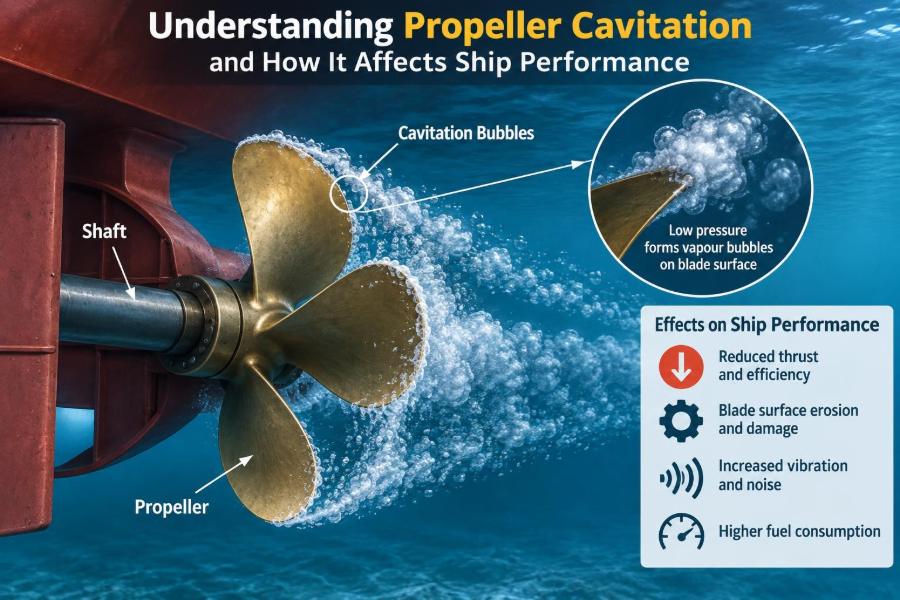
Cavitation occurs when local pressure in water falls below its vapour pressure. The water then forms vapour-filled cavities, often called bubbles, near the propeller blade.
As those cavities move into a higher-pressure region, they collapse rapidly. The collapse itself—not merely the presence of bubbles—creates pressure pulses, noise, and potentially damaging impact loads on nearby metal surfaces.
Cavitation is therefore a local pressure phenomenon. It does not mean the sea is boiling, and it is not the same as air being drawn into the propeller.
⚙️ Why a Propeller Creates Low Pressure
A propeller produces thrust by accelerating water astern. Like an aerofoil, each blade has a pressure difference between its two sides: relatively high pressure on the pressure face and lower pressure on the suction face.
That low pressure is necessary for thrust production. Trouble begins when it becomes too low for the available water conditions, particularly around heavily loaded areas of the blade.
The blade tip is especially vulnerable because water tends to flow around it from the pressure side to the suction side, creating a concentrated swirling flow called a tip vortex.
🫧 Cavitation Versus Ventilation
Cavitation and ventilation are often confused, but they have different origins. Cavitation involves vapour cavities created by low local pressure within the water.
Ventilation occurs when atmospheric air or exhaust gas is drawn into the propeller stream. This can happen in rough seas, during sharp turns, with shallow submergence, or when the stern lifts and the propeller approaches the surface.
Both conditions can reduce thrust and cause racing, but the corrective action may differ. A ventilating propeller may recover when immersion improves; a cavitating propeller may require a change in speed, loading, trim, or design.
🔍 The Main Forms of Propeller Cavitation
Cavitation has several recognizable forms. Their appearance and severity depend on blade shape, loading, wake conditions, and the vessel’s operating point.
| Type | Typical location | Practical concern |
|---|---|---|
| Sheet cavitation | Broad area on suction face | Thrust loss, vibration, erosion if collapse is severe |
| Tip-vortex cavitation | Blade tip vortex | Noise and possible tip erosion |
| Bubble cavitation | Scattered blade regions | Noise, surface pitting, fluctuating loads |
| Root cavitation | Near blade root or hub | May contribute to pressure pulses and vibration |
| Cloud cavitation | Unsteady separated flow regions | Potentially intense collapse and erosion |
Not every visible cavity is equally harmful. Designers may accept limited, stable cavitation at some operating conditions, while unstable or collapsing cavitation demands closer attention.
📉 Why Cavitation Reduces Propulsive Efficiency
A propeller is most efficient when it transfers shaft power into a controlled acceleration of water. Cavitation disrupts that flow and changes the effective loading of the blade.
When a large part of the suction side is covered by vapour, the blade cannot maintain its intended pressure distribution. The engine may continue delivering power, but less of that power becomes useful thrust.
This is why simply adding rpm does not always increase speed proportionally. In a severe case, the vessel consumes more fuel while gaining little speed.
📈 The Relationship Between Speed, RPM, and Blade Loading
Cavitation risk generally rises when propeller loading rises. Higher rpm, greater torque, increased vessel resistance, or a fouled hull can all demand more work from the propeller.
Consider a hypothetical vessel making a schedule in adverse weather. If the operator increases rpm to maintain speed, the propeller may enter a condition where blade loading increases sharply while inflow becomes irregular. Cavitation, vibration, and slip can then grow together.
The practical lesson is that an rpm increase should be assessed against speed, fuel rate, weather, shaft vibration, and engine limits—not treated as a guaranteed route to higher performance.
🚢 Propeller Slip and What It Can Indicate
Propeller slip compares the theoretical distance a propeller would advance in one revolution with the vessel’s actual advance through the water. Some slip is normal because a propeller must accelerate water to create thrust.
An unexpected increase in slip can point to hull fouling, heavy displacement, rough weather, ventilation, cavitation, or propulsion problems. It is an indicator rather than a diagnosis.
Reliable interpretation requires consistent data: accurate shaft rpm, vessel speed through water where available, draft, trim, weather, and machinery condition.
🔊 Noise: The First Clue Many Crews Notice
Collapsing cavities produce broadband noise and, in some cases, distinctive crackling or rumbling sounds. Underwater noise is a major concern for naval and research vessels, but commercial ships also experience operational consequences.
A change in aft-end noise may be noticed by crew in accommodation spaces, steering gear rooms, or engine-room monitoring trends. It becomes more meaningful when it appears at repeatable rpm or speed ranges.
Noise alone cannot confirm cavitation, since gearbox, shafting, bearing, and structural issues can produce similar symptoms. It should trigger investigation, not assumptions.
📳 How Cavitation Causes Vibration
As cavities form and collapse, they create fluctuating pressures. These pressure pulses can act on the propeller, stern frame, hull plating, rudder, and shaft line.
If the forcing frequency approaches a natural frequency of a structure, vibration may become disproportionately noticeable. This is one reason a vessel can feel smooth at one rpm and uncomfortable only slightly above or below it.
Repeated vibration is more than a comfort issue. It can accelerate fatigue in brackets, pipe supports, foundations, and other components exposed to cyclic loading.
🔨 Cavitation Erosion and Its Characteristic Appearance
The collapse of a cavity near metal can produce a very small, high-intensity impact on the surface. Repeated events remove protective coatings and eventually form pits in the blade material.
Cavitation erosion commonly appears as a rough, pitted, or sponge-like surface, often near leading edges, tips, or areas of persistent cavitation. Its pattern can help a specialist distinguish it from ordinary corrosion or mechanical damage.
Once a surface becomes rough, it can disturb local flow further. Early inspection and repair can prevent a small damaged patch from becoming a larger efficiency and reliability problem.
🧭 Wake Field: The Water Reaching the Propeller
The propeller does not receive uniform water flow. Hull shape, boundary layer growth, appendages, shaft brackets, and rudder geometry create a non-uniform inflow called the wake field.
As each blade rotates through slower and faster parts of that wake, its loading changes. This periodic loading can produce cavitation and pressure pulses even if the propeller performs well in uniform-water calculations.
For this reason, propeller design is inseparable from hull and stern design. A suitable propeller on one vessel may be unsuitable on another with a different wake pattern.
⚓ Draft, Trim, and Propeller Immersion
Draft and trim directly affect the pressure available at the propeller. A deeply immersed propeller experiences greater surrounding hydrostatic pressure than one operating close to the surface.
Aft trim can improve immersion in some vessels, while excessive stern lift or a light ballast condition can make the propeller more vulnerable to ventilation and cavitation. The effect is vessel-specific.
Loading plans should therefore consider propulsion behaviour as well as stability, structural limits, and operational requirements. A technically safe draft may still be a poor condition for sustained high-power operation.
🌦️ Sea State and Ship Motions
In waves, the stern may heave and pitch. The propeller’s depth and inflow can change from one moment to the next, producing intermittent cavitation or ventilation.
Following seas can be particularly challenging for some hull forms because stern emergence and racing may occur as the vessel moves over wave crests. Reducing speed or altering course slightly may improve propeller immersion and reduce violent load changes.
There is no single rule that fits every ship. The operating response should follow the vessel’s manoeuvring information, experience, weather limits, and the judgement of the master and engineering team.
🧼 Hull Fouling Can Trigger a Propulsion Problem
Marine growth and roughness increase hull resistance. To maintain the same speed, the engine must deliver more power and the propeller must generate more thrust.
That additional demand can move the propeller toward a cavitation-prone condition. Fouling does not alter blade geometry, but it changes the operating environment around the entire propulsion system.
A clean hull and propeller are therefore not only fuel-efficiency measures. They help preserve the intended loading balance of the propulsor.
🪸 Blade Condition Matters More Than Appearance Suggests
Minor dents, bent edges, rough repairs, coating loss, and surface deposits can disturb water flow over a blade. Even a small local imperfection may create a low-pressure region that promotes cavitation.
Damage also creates imbalance. A propeller may then generate unequal blade forces, increasing vibration and imposing additional stress on shaft bearings and stern gear.
During dry-dock inspections, observations should be recorded by blade number and location. Clear photographs and measurements give repair teams a better basis for deciding whether polishing, blending, welding, or full reconditioning is appropriate.
🛠️ Propeller Geometry and Design Trade-Offs
Diameter, pitch, blade area, skew, rake, section shape, and blade count all affect cavitation behaviour. Designers balance these features against efficiency, draft limits, strength, manufacturing practicality, vibration, and noise.
Increasing blade area can reduce average loading, but it may also increase drag or alter other performance characteristics. More blades can smooth loading, yet they add surface area and may change the excitation pattern.
There is no universally “anti-cavitation” propeller. The goal is a geometry matched to the vessel’s hull, duty cycle, power range, and operating restrictions.
🌀 Skewed Blades and Their Purpose
A skewed propeller has blade tips swept circumferentially rather than arranged in a more radial outline. The geometry can distribute the change in blade loading as each blade passes through a non-uniform wake.
This may reduce pressure pulses and vibration at the hull. It does not eliminate cavitation, and highly skewed blades may involve structural and manufacturing considerations.
When evaluating a replacement propeller, copying diameter and pitch alone is insufficient. Blade planform and the vessel’s wake environment also matter.
🎛️ Fixed-Pitch and Controllable-Pitch Propellers
A fixed-pitch propeller is optimized around a selected operating range. Changes in vessel speed are largely managed through shaft rpm, so the propeller’s loading can vary widely across the voyage profile.
A controllable-pitch propeller can alter blade pitch while shaft speed remains relatively steady. This offers operational flexibility, but unsuitable pitch commands can still overload the blades and promote cavitation.
The control strategy matters. Running at high pitch and low rpm is not automatically superior to lower pitch and higher rpm; the correct setting depends on the propulsion system’s approved operating envelope.
🧮 The Cavitation Number in Simple Terms
Naval architects use non-dimensional parameters to compare pressure conditions around propellers. One commonly used measure is the cavitation number, which relates the pressure available in the water to the pressure reductions associated with flow velocity.
A lower available pressure, higher local velocity, or higher blade loading tends to make cavitation more likely. The parameter helps translate model tests and calculations into design decisions.
For shipboard personnel, the useful operational meaning is simpler: reduced immersion, increased speed through the water, and increased propeller demand can narrow the margin before cavitation begins.
🧪 How Cavitation Is Predicted Before Construction
Designers may use model-basin testing, computational fluid dynamics, empirical design methods, and full-scale experience. Each method has strengths and limitations.
Model tests can reveal cavitation patterns and pressure fluctuations in controlled conditions. Computational tools allow detailed exploration of hull-propeller interaction, but results depend on assumptions, mesh quality, turbulence modelling, and validation.
Full-scale performance remains valuable because real vessels encounter varying drafts, waves, fouling, loading, and machinery behaviour. Predictions guide design; they do not remove the need for sea-trial and service data.
📡 Monitoring Symptoms During Service
Routine machinery logs can reveal a changing propulsion picture before damage becomes obvious. Useful trends include shaft rpm, engine power or fuel index, vessel speed, draft, trim, vibration readings, and weather conditions.
Where fitted, shaft-power meters, torsional vibration monitoring, hull vibration sensors, and acoustic systems can provide additional evidence. The most useful monitoring is repeatable and compared against a known baseline.
- Record the rpm range where vibration begins or intensifies.
- Note draft, trim, speed, sea state, and course at the time.
- Compare fuel consumption and speed with clean-hull reference conditions.
- Report sudden changes after grounding, debris contact, repair work, or dry-docking.
🧰 Inspection Methods and What They Reveal
Dry-dock inspection remains the clearest opportunity to examine blade surfaces, edges, hub condition, and coatings. Divers and remotely operated vehicles can provide useful in-water observations when docking is not immediately possible.
Inspection should distinguish among erosion, corrosion, impact damage, fouling, coating failure, and manufacturing or repair defects. Treating all pitting as cavitation can lead to an ineffective repair plan.
When erosion is found, engineers should also ask why it occurred. Repairing the metal without addressing operating condition, wake disturbance, or blade damage may only postpone recurrence.
🚨 When Cavitation Becomes an Operational Risk
Some degree of cavitation may be tolerable in certain service conditions, especially at high output. The concern increases when there is persistent vibration, a marked performance change, blade surface damage, abnormal noise, or evidence of machinery distress.
Escalate the issue when symptoms are sudden, worsen quickly, follow an impact event, or occur with shaft-line temperature, bearing, or seal abnormalities. Cavitation may be one part of a wider stern-gear problem.
Operational decisions must remain within manufacturer guidance, class requirements, company procedures, and the vessel’s approved limitations. A local workaround should never bypass safety or machinery protection systems.
🧑✈️ Practical Actions for Watchkeepers
Watchkeepers cannot redesign a propeller at sea, but they can avoid unnecessarily severe operating conditions. Good practice starts with recognising abnormal trends rather than chasing a target speed at any cost.
- Avoid prolonged operation at a known heavy-vibration rpm band where safe and practical.
- Use gradual power changes in rough conditions to observe the vessel’s response.
- Check whether a modest speed or course adjustment reduces racing and stern emergence.
- Maintain clear communication between bridge and engine room when weather affects propulsion.
- Log observations precisely enough for the next watch and shore team to use.
These actions are not a substitute for formal instructions. They are disciplined ways to gather evidence and protect the machinery while operating within approved limits.
❌ Common Misdiagnoses and Unhelpful Responses
A frequent mistake is to label every vibration complaint as cavitation. Shaft misalignment, damaged bearings, loose structure, gearbox defects, rudder vibration, and machinery imbalance can have overlapping symptoms.
Another mistake is treating increased rpm as the universal solution to lost speed. If the propeller is already overloaded, more power may increase fuel use, noise, and blade damage without delivering the expected gain.
Equally unhelpful is dismissing a recurring aft-end noise because the vessel still reaches port. Repeated symptoms are operational data, and early reporting is usually easier than repairing advanced erosion.
🔧 Repair, Refinishing, and Rebalancing
Repair methods depend on material, defect type, blade thickness, class requirements, and manufacturer limits. Typical work may include edge blending, controlled welding, surface finishing, pitch correction, and static or dynamic balancing.
Good finishing matters because a rough repair can become a new flow disturbance. Repair quality should be verified using appropriate measurements rather than judged only by appearance.
After significant work, performance and vibration should be monitored during return to service. This helps confirm that the repair has improved the condition and has not introduced an unintended imbalance.
🌱 Cavitation, Efficiency, and Environmental Performance
Cavitation-related efficiency loss can increase fuel demand for a given voyage speed. Higher fuel use also means greater exhaust emissions for conventional propulsion systems.
Underwater noise is another environmental consideration. Cavitating propellers can add to the acoustic footprint of a vessel, although the actual impact depends on vessel type, operating condition, route, and surrounding environment.
Reducing cavitation is therefore often aligned with efficient, quieter operation, but the best solution must still account for safety, cost, maintainability, and the vessel’s actual duty cycle.
🧭 A System View of Propeller Performance
The propeller should not be treated as an isolated rotating component. Its performance depends on the engine or motor, shaft line, hull resistance, wake field, draft, trim, sea state, and operating decisions.
For example, poor speed performance may begin with hull fouling, become visible as higher engine load, and then appear at the stern as cavitation and vibration. Addressing only the final symptom may miss the original cause.
A system view encourages better troubleshooting: collect data, compare with baseline conditions, inspect physical evidence, and involve the appropriate design or service specialists when needed.
✅ The Core Takeaway for Marine Engineers
Propeller cavitation is not simply a defect to eliminate at all costs. It is a flow phenomenon that must be managed through informed design and operation.
The central question is whether the cavitation is stable and acceptable for the vessel’s duty, or whether it is causing unacceptable losses in thrust, vibration, noise, erosion, or machinery risk. Answering that question requires evidence rather than guesswork.
The most effective response combines a well-matched propeller, clean and sound underwater surfaces, sensible operating choices, and careful monitoring of changes over time.
When crews understand what cavitation is telling them, they can turn an unsettling vibration or unexplained fuel trend into useful operational knowledge—and protect both performance and equipment life. 🚢🌊⚙️