
Most people imagine that a ship changes direction in the same way a car does: if the vessel needs to move backward, the engine simply runs in reverse. That can happen in some marine propulsion systems, but many ships use a far more sophisticated solution. ⚙️🌊
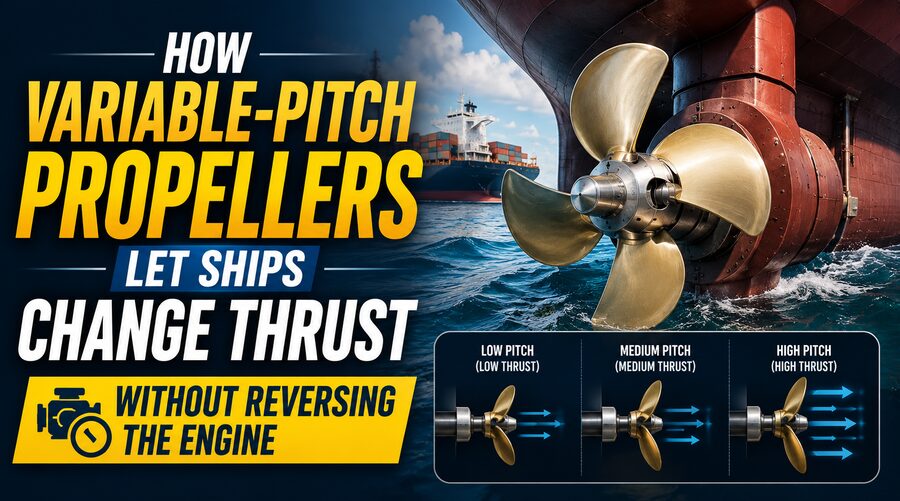
With a variable-pitch propeller, also called a controllable-pitch propeller (CPP), the engine and propeller shaft can continue rotating in the same direction while the propeller blades change their angle.
By rotating each blade around its own axis, the propeller can produce:
- Forward thrust 🚢➡️
- Reduced thrust
- Zero or nearly zero thrust
- Reverse thrust ⬅️🚢
without requiring the main engine itself to reverse direction.
This capability gives ships much finer control during maneuvering, improves response time, and can be especially valuable for ferries, tugboats, offshore vessels, naval ships, and other vessels that frequently change speed or direction.
⚙️ What Is Propeller Pitch?
A marine propeller works by rotating blades through water.
Each blade is angled so that its motion pushes water in one direction and creates thrust in the opposite direction.
The term pitch describes how aggressively the blades are angled relative to their rotational plane.
A simplified way to imagine pitch is to think of a screw.
A screw with a steep thread would move farther forward with each rotation than one with a shallow thread.
A propeller behaves somewhat similarly.
Higher positive pitch generally creates more forward thrust for a given rotational speed, while a lower pitch creates less thrust.
If the blade angle is rotated far enough through zero and into negative pitch, the water is accelerated in the opposite direction and the propeller generates reverse thrust. 🔄
🚢 Fixed-Pitch vs. Controllable-Pitch Propellers
Marine propellers can broadly be divided into two categories.
🔹 Fixed-Pitch Propeller
A fixed-pitch propeller has blades permanently attached to the hub at one angle.
The blade pitch cannot change during operation.
To reverse thrust, the propulsion system generally needs to reverse the propeller’s rotational direction.
This may require:
- Reversing the main engine
- Reversing a gearbox
- Using another transmission arrangement
Fixed-pitch propellers are mechanically simpler and are widely used.
🔹 Controllable-Pitch Propeller
A controllable-pitch propeller has blades that can rotate inside the hub.
The shaft can continue rotating in one direction while blade angle changes.
The ship’s control system can therefore vary thrust by adjusting pitch instead of constantly changing engine speed or direction.
That makes CPP systems especially flexible. ⚙️
🧭 How Can the Blades Rotate While the Propeller Is Spinning?
This is the clever part.
Each blade is mounted into the propeller hub through a mechanism that allows it to rotate around its own longitudinal axis.
Inside the hub is a pitch-changing mechanism.
Depending on the design, this may involve:
- Hydraulic pistons
- Sliding rods
- Crank mechanisms
- Crossheads
- Blade carriers
- Linkages
A hydraulic control system moves the internal mechanism.
That movement rotates all of the blades by a coordinated amount.
Because every blade changes pitch together, the propeller maintains balanced thrust around the shaft.
The adjustment can happen while the propeller is spinning at full operational speed. 🔧🌊
💧 Hydraulic Pressure Does the Heavy Work
Large ship propeller blades experience enormous hydrodynamic forces.
A human could never physically rotate them while the propeller is operating.
Hydraulic pressure provides the force required.
A typical system may include:
- Hydraulic pumps
- Oil reservoirs
- Control valves
- Servo mechanisms
- Pitch feedback sensors
When the bridge or engine-control system commands a new pitch, valves direct pressurized oil to the propeller’s pitch actuator.
The actuator moves the internal linkage, which changes blade angle.
The system then holds the blades at the commanded pitch.
This allows precise control despite the huge loads acting on the propeller. 💪⚙️
➡️ How Forward Thrust Is Produced
In normal forward operation, the blades are set to positive pitch.
As the propeller rotates, the blades accelerate water toward the stern.
According to Newton’s third law:
Water pushed backward ➡️ Ship pushed forward
Increasing positive pitch generally causes the blades to push more water backward.
This increases thrust, assuming the engine has enough power available.
A ship can therefore accelerate by increasing blade pitch even if propeller rpm changes very little.
⏸️ How the Propeller Produces Almost Zero Thrust
One of the most useful features of controllable-pitch propulsion is the ability to reduce blade angle toward zero pitch.
At or near zero pitch, the blades still rotate, but they produce relatively little net axial thrust.
The engine and shaft therefore remain spinning while the vessel receives little forward or reverse propulsion.
This is useful during:
- Docking
- Waiting for maneuvering commands
- Dynamic positioning
- Rapid transitions between forward and reverse
The propulsion machinery remains ready to respond without needing to stop and restart. 🚦
⬅️ How Reverse Thrust Is Created
To reverse the ship’s thrust, the control system rotates the blades beyond neutral into negative pitch.
The shaft still rotates in the same direction.
But the changed blade angle causes water to be accelerated in the opposite axial direction.
Now:
Water pushed forward ➡️ Ship pushed backward
This creates astern thrust without reversing the engine. 🔄🚢
The ability to move from positive to negative pitch rapidly is one of the main advantages of CPP systems.
🛑 Why This Helps Ships Stop Faster
Imagine a ferry approaching a harbor.
With a fixed-pitch system, stopping might involve:
- Reducing engine power.
- Disengaging or slowing the shaft.
- Reversing the propulsion machinery or gearbox.
- Building reverse rpm.
- Producing astern thrust.
With a controllable-pitch system, the shaft may keep rotating continuously.
The operator can simply move the blades through:
Forward pitch → neutral pitch → reverse pitch
Reverse thrust becomes available quickly.
This improves stopping and maneuvering response. ⚓
🛳️ Why Ferries Often Benefit From CPP Systems
Ferries frequently:
- Enter harbors
- Stop
- Maneuver near docks
- Reverse direction
- Depart again
They may repeat these operations many times per day.
A propulsion system that can rapidly switch between ahead and astern thrust is therefore extremely useful.
Keeping the engines operating at a relatively steady speed while changing propeller pitch can also reduce delays during maneuvering.
This is one reason controllable-pitch propellers are commonly associated with vessels that require frequent thrust changes. 🚢
🚤 Tugboats Need Fine Thrust Control
Tugboats operate in tight spaces around much larger ships.
They need extremely precise propulsion.
A small change in thrust can significantly affect positioning.
A CPP system allows the operator to alter thrust continuously without large engine-speed changes.
This can improve control during:
- Harbor assistance
- Ship escort
- Towing
- Berthing
- Emergency maneuvering
Some tugboats use other advanced propulsion systems, but variable-pitch technology remains valuable where precise thrust control is required.
🏗️ Offshore Vessels and Dynamic Positioning
Offshore support ships may need to remain almost motionless despite:
- Wind
- Waves
- Currents
This is known as dynamic positioning.
Computers continuously monitor the vessel’s position and adjust thrusters and propellers.
A controllable-pitch propeller can respond quickly to these commands.
For example:
Small forward disturbance → slight reverse pitch
Current changes → increased forward pitch
Because blade angle can change rapidly, thrust can be adjusted without repeatedly accelerating and decelerating massive rotating machinery. 🎯
🌀 Engine Speed and Propeller Pitch Can Be Controlled Separately
In a fixed-pitch system, thrust is strongly tied to propeller rpm.
To substantially change thrust, the engine usually changes speed.
With a controllable-pitch propeller, thrust can also be changed through blade angle.
This creates two major control variables:
Engine rpm
and
Propeller pitch
The propulsion control system can choose combinations that provide the required thrust efficiently.
For example, the engine might remain near a preferred operating speed while pitch changes according to vessel demand.
⚡ Why Constant Engine Speed Can Be Useful
Some ships use engines not only for propulsion but also indirectly to support electrical generation or other machinery.
Operating at relatively constant speed can simplify certain system arrangements.
A diesel engine may also have operating regions where combustion efficiency is better.
A CPP system can allow the engine to remain close to a favorable rpm while the propeller changes how much power it absorbs.
This can be useful in vessels where propulsion demand changes frequently. 🔋
📈 Pitch Controls How Much Torque the Propeller Absorbs
Increasing blade pitch generally makes the propeller “bite” more strongly into the water.
This increases resistance against rotation.
The engine must therefore supply more torque.
If pitch is increased too aggressively, the engine could become overloaded.
Modern propulsion-control systems coordinate:
- Fuel input
- Engine rpm
- Propeller pitch
to prevent this.
The objective is to obtain the requested thrust without exceeding safe engine limits.
🧠 What Is Combinator Control?
Many CPP vessels use a control strategy sometimes described as combinator control.
Instead of the operator independently controlling engine rpm and blade pitch, a single lever commands desired propulsion.
The automation system chooses the appropriate combination of:
- Shaft rpm
- Propeller pitch
For low-speed maneuvering, the engine may remain at steady rpm while pitch changes considerably.
At higher speeds, both rpm and pitch may increase according to an optimized control curve.
This simplifies operation from the bridge. 🎛️
🛢️ Can CPP Systems Save Fuel?
They can improve efficiency in applications with widely varying operating conditions, but the answer depends on the vessel.
A fixed-pitch propeller can be extremely efficient when optimized for one particular cruising condition.
A controllable-pitch propeller has additional mechanical complexity and a larger hub, which can introduce some hydrodynamic losses.
However, CPP lets engineers optimize blade pitch across a wider range of speeds and engine operating conditions.
For vessels that spend much of their time away from one fixed design point, this flexibility can provide significant operational advantages.
📐 The Importance of Blade Angle
A small pitch change can have a large effect on:
- Thrust
- Torque
- Engine loading
- Cavitation behavior
- Efficiency
The relationship is not simply linear.
Hydrodynamic forces depend on factors including:
- Propeller diameter
- Blade area
- Vessel speed
- Water density
- Shaft rpm
- Pitch angle
This is why CPP control systems require careful calibration.
💥 What Is Cavitation?
Propeller blades can experience cavitation when local water pressure falls low enough for vapor bubbles to form.
These bubbles can later collapse violently.
Cavitation may cause:
- Noise 🔊
- Vibration
- Reduced efficiency
- Surface erosion
- Damage to blades
Poor combinations of pitch, rpm, and vessel speed can increase cavitation risk.
Controllable-pitch systems can help avoid undesirable operating points, but they must be controlled correctly.
🔊 Why Ships Can Become Noisy Under Heavy Propeller Load
When propeller blades operate at high pitch and high rpm, they create strong pressure variations in the water.
If cavitation occurs, noise can increase dramatically.
This is particularly important for:
- Passenger comfort
- Naval vessels
- Research ships
- Marine wildlife considerations
Engineers optimize blade shape, pitch schedules, and rpm to reduce vibration and underwater noise.
⚓ Maneuvering Near a Dock
Imagine a ship approaching a berth.
The operator might command:
Forward
The blades are at positive pitch.
Slow Ahead
Pitch is reduced.
Neutral
Pitch approaches zero.
Astern
The blades rotate into negative pitch.
The entire sequence can happen while the shaft continues spinning in the same direction.
This gives the bridge team very direct control of thrust magnitude and direction. 🚢↔️
⏱️ Faster Response Than Reversing Large Machinery
Large diesel engines and propulsion shafts have substantial rotational inertia.
Stopping them, reversing their direction, and accelerating them again takes time.
A controllable-pitch propeller avoids much of that delay.
Instead, the much smaller blade-pitch mechanism changes thrust while the heavy rotating components continue moving in the same direction.
This can provide much faster propulsion response.
🧰 Why CPP Systems Are Mechanically Complex
The flexibility comes at a cost.
A fixed-pitch propeller is mechanically simple.
Its blades are permanently attached to the hub.
A CPP hub contains moving parts and hydraulic mechanisms.
Possible components include:
- Blade bearings
- Seals
- Hydraulic pistons
- Linkages
- Control oil passages
- Feedback sensors
These components require inspection and maintenance.
A failure in the pitch-control system can affect propulsion even if the engine itself is operating normally. ⚠️
🛡️ Fail-Safe Pitch Design
Because propulsion is safety-critical, CPP systems are designed with failure scenarios in mind.
Depending on the vessel and system, designers may provide:
- Backup hydraulic pumps
- Emergency pitch control
- Mechanical pitch indicators
- Redundant sensors
- Local control stations
- Alarm systems
Some designs may be able to move the blades toward a predetermined safe pitch if normal control is lost.
The exact arrangement depends on the vessel’s classification and operating requirements.
🔍 How Does the Bridge Know the Actual Pitch?
The commanded pitch and actual blade pitch are not always assumed to be identical.
Sensors monitor the pitch mechanism and send feedback to the control system.
A bridge display may show values such as:
Pitch: +65%
or:
Pitch: 0%
or:
Pitch: −40%
This allows operators to confirm that the blades have actually reached the requested position.
Feedback is also used in the automatic control loop. 🔄
🧱 The Propeller Hub Is Much More Than a Simple Center
On a fixed-pitch propeller, the hub primarily connects blades to the shaft.
On a CPP, the hub is also a precision mechanical machine.
It must:
- Carry enormous propeller loads
- Hold each blade securely
- Allow blade rotation
- Prevent seawater leakage
- Contain hydraulic mechanisms
- Transfer torque from shaft to blades
All of this must operate reliably underwater for long periods.
The engineering challenge is substantial. 🌊⚙️
🚢 CPP With Gearboxes
Many controllable-pitch systems operate through reduction gearboxes.
A medium- or high-speed diesel engine may rotate faster than the ideal propeller speed.
The gearbox reduces engine rpm before delivering torque to the propeller shaft.
Because thrust reversal is achieved through pitch, the gearbox may not need to reverse shaft direction during normal maneuvering.
This can simplify certain propulsion arrangements.
🔄 CPP vs. Reversible Diesel Engines
Large slow-speed marine diesel engines can sometimes operate in either rotational direction.
With a fixed-pitch propeller:
Engine ahead rotation → forward thrust
Engine astern rotation → reverse thrust
Such engines are common in very large commercial ships.
However, reversing a massive engine requires a sequence of operations.
CPP systems avoid this by maintaining one engine rotational direction while changing blade pitch.
The best approach depends on vessel size, mission, cost, efficiency, and operational needs.
🛳️ Why Not Put CPP on Every Ship?
Despite their advantages, controllable-pitch propellers are not ideal for every vessel.
Disadvantages can include:
- Higher initial cost 💰
- Greater mechanical complexity
- More maintenance
- Larger hub diameter
- Hydraulic system requirements
- Potential efficiency penalties at certain operating points
A large cargo ship spending most of its voyage at one steady cruising speed may gain less benefit from CPP than a ferry maneuvering dozens of times daily.
Propulsion design is always mission-specific.
⚖️ Fixed Pitch vs. Controllable Pitch
A simplified comparison looks like this:
Fixed-Pitch Propeller
✅ Simpler
✅ Lower cost
✅ Potentially highly efficient at design condition
✅ Fewer moving hub components
Controllable-Pitch Propeller
✅ Rapid thrust reversal
✅ Fine maneuvering control
✅ Flexible thrust at constant shaft direction
✅ Good performance over changing operating conditions
✅ Useful for dynamic positioning and frequent maneuvering
Neither system is universally superior.
🌊 How Water Actually Creates Thrust
Propellers create thrust by changing the momentum of water.
A rotating blade acts somewhat like a hydrofoil.
Its geometry creates pressure differences between its surfaces.
These forces combine into:
- Axial thrust
- Rotational torque
Changing pitch changes the blade’s effective angle of attack and therefore changes these hydrodynamic forces.
At positive pitch, the net axial force drives the ship forward.
At negative pitch, the axial force reverses.
The shaft’s direction of rotation can remain unchanged throughout.
📉 What Happens at Zero Pitch?
At exactly zero geometric pitch, it might seem that the propeller should generate absolutely no thrust.
In practice, fluid dynamics is more complicated.
Blade shape, vessel motion, shaft rotation, wake flow, and local angles can produce residual forces.
Therefore, “zero pitch” may not always mean exactly zero thrust.
Control systems and operators account for the actual behavior of the vessel.
⚡ Transitioning Quickly From Ahead to Astern
Moving rapidly from positive to negative pitch creates substantial transient loads.
The propeller must suddenly change the direction in which it accelerates water.
This can place significant forces on:
- Blades
- Hub
- Shaft
- Gearbox
- Bearings
- Engine
Control systems therefore limit how quickly pitch changes under some operating conditions.
Fast response is valuable, but mechanical protection is equally important. 🛡️
📊 Engine Load Protection
Suppose the bridge suddenly commands maximum forward pitch while the engine is at low speed.
The propeller could demand more torque than the engine can provide.
This might cause engine speed to collapse.
Modern control systems therefore use load control or load limiting.
The system may restrict pitch until sufficient engine power becomes available.
Conceptually:
Bridge demands thrust
⬇️
Controller checks engine capability
⬇️
Pitch increases only within safe load limits
This prevents propulsion commands from overloading machinery.
🔋 Hybrid and Electric Ships
Variable-pitch propellers can also be used with electric propulsion.
An electric motor may drive the shaft through a gearbox or directly.
Even though electric motors can reverse direction relatively easily, CPP can still offer useful benefits such as:
- Precise thrust control
- Efficient operating-point management
- Rapid response
- Integration with hybrid systems
In some ships, electric motor speed and propeller pitch are optimized together by automated energy-management systems. ⚡🚢
🤖 Automated Propulsion Control
Modern vessels increasingly integrate CPP control with:
- Autopilot
- Dynamic positioning
- Engine management
- Navigation systems
- Energy management
A computer may continuously calculate the required thrust and determine the most efficient combination of engine power, shaft rpm, and blade pitch.
This reduces workload for operators and can improve fuel economy.
🛠️ Maintenance of CPP Systems
Routine maintenance may involve inspection of:
- Hydraulic oil
- Seals
- Blade bearings
- Pitch actuators
- Control valves
- Feedback sensors
Oil samples can reveal wear or contamination.
Divers or dry-dock crews may inspect blade condition.
Because the internal hub mechanism operates underwater and under heavy loads, seal integrity is especially important.
Preventive maintenance helps avoid costly propulsion failures.
🌍 Where Controllable-Pitch Propellers Are Used
CPP systems can be found on many types of vessels, including:
- Passenger ferries 🚢
- Tugboats
- Offshore supply ships
- Research vessels 🔬
- Icebreakers ❄️
- Fishing vessels
- Naval ships
- Dredgers
- Some cruise ships
- Specialized cargo vessels
The common feature is usually a need for flexible propulsion rather than constant operation at one fixed cruising condition.
🧠 A Simple Analogy
A useful comparison is a ceiling fan with adjustable blade angles.
Imagine the motor continues spinning clockwise.
If the blades could rotate so their aerodynamic angle reversed, the fan could push air in the opposite direction without reversing the motor.
A controllable-pitch ship propeller does something similar in water—but at vastly greater power and with much stronger forces. 🌬️➡️🌊
🚀 Final Thoughts
Variable-pitch, or controllable-pitch, propellers allow ships to change both the magnitude and direction of thrust without reversing the main engine.
The shaft can continue rotating in one direction while hydraulic mechanisms inside the propeller hub rotate the blades.
With:
Positive pitch → forward thrust
Near-zero pitch → little thrust
Negative pitch → reverse thrust
This gives a vessel rapid and precise control during docking, maneuvering, dynamic positioning, towing, and other demanding operations. ⚓
The technology also allows engine speed and propeller loading to be controlled somewhat independently, which can help operators keep propulsion machinery within efficient and safe operating ranges.
The trade-off is complexity.
A CPP requires hydraulic actuators, moving blade bearings, seals, sensors, and sophisticated controls that a fixed-pitch propeller does not need.
Yet for vessels that frequently change thrust, the operational benefits can easily justify that additional engineering.
The essential principle is remarkably elegant:
The engine does not need to reverse because the propeller blades reverse the direction of their hydrodynamic action instead. 🔄🌊
By changing only the angle of the blades, a ship can go from ahead thrust to astern thrust while massive engines, shafts, and gearboxes continue rotating in the same direction.
That ability turns the propeller from a simple rotating device into an actively controlled underwater machine—and gives modern ships a level of maneuverability that would be impossible with a permanently fixed blade angle. 🚢⚙️✨