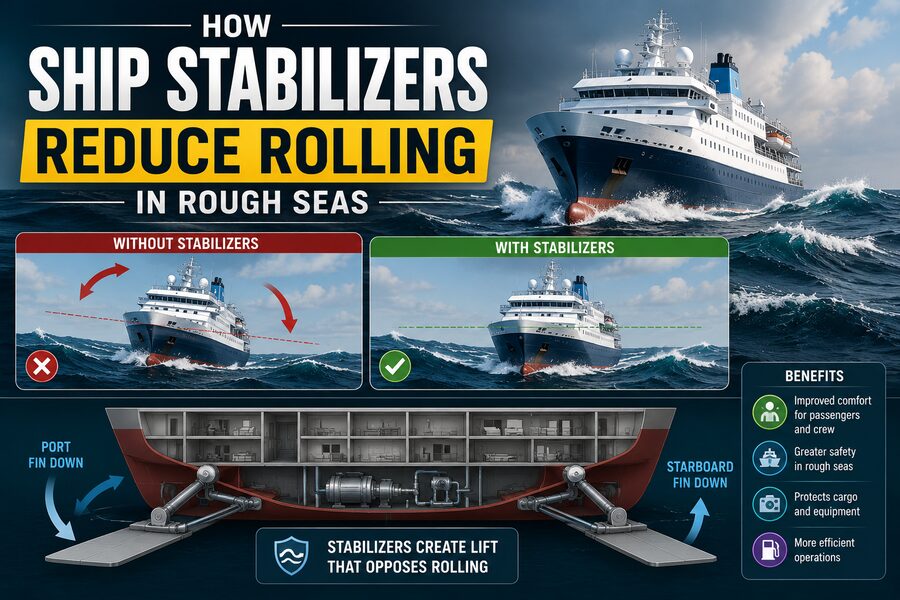

Anyone who has traveled on a ship in rough weather has experienced one of the most noticeable motions at sea: rolling. As waves pass beneath and around a vessel, the ship can rotate from side to side around its longitudinal axis. On a small boat, the movement may simply be uncomfortable. On a large passenger ship, naval vessel, research ship, or offshore support vessel, excessive rolling can affect passenger comfort, crew safety, cargo security, equipment operation, and even the ability to perform certain missions. 🌊
To reduce this motion, many ships use systems called stabilizers.
Ship stabilizers do not eliminate waves or make a vessel completely motionless. Instead, they generate forces or moments that oppose the ship’s rolling motion. By counteracting the roll at the right time, stabilizers can dramatically reduce how far and how quickly the ship swings from side to side.
Several stabilization technologies exist, but one of the most familiar is the active fin stabilizer—a pair of underwater fins extending from the sides of the hull. These fins automatically change angle as the ship moves, producing hydrodynamic forces that oppose the roll.
The principle resembles aircraft wings, but instead of controlling an airplane in air, the stabilizer fins work underwater. ⚙️🌊
🔄 What Is Ship Roll?
A ship can move in six basic ways.
Three are translational motions:
- Surge — forward and backward
- Sway — sideways
- Heave — up and down
Three are rotational motions:
- Roll — rotation from side to side
- Pitch — bow and stern moving up and down
- Yaw — turning left and right
Stabilizers are primarily designed to reduce roll.
Imagine looking at a ship from behind. If the deck tilts toward port, returns upright, then tilts toward starboard, the vessel is rolling.
In calm water, this movement may be small. In irregular seas, repeated wave forces can create much larger oscillations. 🌊↔️🚢
⚖️ Why Ships Naturally Return Upright
A properly designed ship generally has positive stability, meaning it develops a restoring tendency when it tilts.
When the ship heels to one side, the relationship between its center of gravity and center of buoyancy changes.
This creates a righting moment that tends to push the vessel back toward upright.
However, the ship does not necessarily stop when it reaches the vertical position.
Like a swinging pendulum, it can continue moving due to inertia, roll toward the opposite side, and oscillate repeatedly.
Waves can add energy to this motion.
Under certain conditions, wave timing can even reinforce the vessel’s natural roll, making the movement much larger. 📈
🌊 Why Rough Seas Cause Severe Rolling
Ocean waves produce changing pressure and buoyancy forces along the ship’s hull.
If waves approach from the side, they can create significant rolling moments.
The amount of roll depends on factors including:
- Wave height
- Wave direction
- Wave period
- Vessel speed
- Hull shape
- Ship loading
- Center of gravity
- Natural roll period
A ship may respond particularly strongly when the wave encounter period is close to its natural rolling period.
This is similar to pushing a playground swing at just the right rhythm.
Each push adds energy, causing the swing to move farther.
Ship stabilizers help remove or counteract some of that roll energy. 🛡️
🪽 What Are Fin Stabilizers?
Fin stabilizers are underwater control surfaces mounted on the sides of the ship.
A typical system uses a fin on the port side and another on the starboard side.
The fins may be:
- Fixed in extension while operating
- Retractable into the hull when not required
- Foldable on some designs
When active, hydraulic or electric actuators rotate the fins through small angles.
Water flowing past each fin generates lift.
By controlling the direction of this lift, the stabilization system creates a moment that opposes the ship’s roll.
✈️ The Underwater-Wing Principle
A stabilizer fin works in a way similar to an aircraft wing.
As water flows around the fin, its angle relative to the flow changes the pressure distribution across its surfaces.
This creates a force approximately perpendicular to the incoming water flow.
Because the fin is located away from the ship’s centerline, that force produces a turning moment.
Suppose the ship begins rolling toward port.
The control system adjusts the fins so they produce a moment toward starboard.
That opposing force slows the roll.
When the ship begins rolling in the opposite direction, the fins reverse their angles.
This process repeats continuously. 🔄
🧠 How the Ship Knows It Is Rolling
Modern stabilizers depend on sensors.
The control system may use information from:
- Gyroscopes
- Angular-rate sensors
- Accelerometers
- Ship-speed sensors
- Motion reference units
A roll-rate sensor measures how quickly the ship is rotating.
Other sensors may estimate roll angle and acceleration.
The controller analyzes these measurements many times per second and calculates how much corrective force is needed.
The system must not merely react after the ship has already reached a large angle.
Effective stabilization often depends on predicting the developing motion and applying corrective fin force with the correct timing. ⏱️
⚙️ The Control Loop
A simplified active stabilization process looks like this:
- Waves create a rolling moment.
- The ship begins rotating.
- Sensors detect roll rate and motion.
- The controller calculates the required correction.
- Actuators rotate the fins.
- Water flowing over the fins generates lift.
- The lift creates an opposing roll moment.
- Sensors measure the new response.
- The controller updates the fin angle again.
This happens continuously while the system is operating.
It is a classic closed-loop control system. 🔁
📐 Why Fin Location Matters
The force generated by a fin becomes more effective at creating a roll moment when it acts farther from the ship’s roll axis.
The stabilizers are therefore typically mounted low and outward on the hull.
Think about opening a door.
Pushing near the hinge produces relatively little turning effect.
Pushing near the handle produces much more.
The same idea applies to stabilizers.
A force acting farther from the ship’s centerline creates a larger moment for the same force. 🚪➡️⚙️
🚢 Why Stabilizers Work Better When the Ship Is Moving
Traditional fin stabilizers depend on water flowing over them.
The faster the ship travels, the greater the hydrodynamic force a fin can generally create for a given angle.
At very low speed—or when the ship is stopped—traditional fins become much less effective.
That is because there is little relative water flow across the control surfaces.
This limitation is especially important for:
- Cruise ships at anchor
- Yachts
- Offshore vessels
- Ships operating slowly
To address it, some modern systems use zero-speed stabilization techniques.
⚓ Zero-Speed Fin Stabilization
Certain active fin systems are designed to reduce rolling even when the ship is stationary or moving very slowly.
Instead of relying mainly on forward water flow, the fins move more aggressively back and forth through the surrounding water.
The motion itself generates hydrodynamic forces.
This can help stabilize:
- Yachts at anchor
- Passenger vessels
- Offshore support ships
The control strategy differs from ordinary underway stabilization because the fins must create their own relative flow.
Zero-speed systems can significantly improve comfort when a vessel is not making headway. ⚓🌊
🌀 Gyroscopic Stabilizers
Not all ships use fins.
Another stabilization technology uses gyroscopes.
A gyroscopic stabilizer contains a rapidly spinning rotor.
A spinning mass resists changes in its orientation due to angular momentum.
When controlled appropriately, gyroscopic precession can create a torque opposing the ship’s roll.
One advantage is that gyroscopic stabilizers can work even when the vessel is stationary because they do not depend on water flowing past external fins.
They are particularly popular on some:
- Yachts
- Smaller commercial vessels
- Recreational boats
🌀
However, gyroscopic systems can be heavy and require substantial power, space, and cooling.
💧 Anti-Roll Tanks
Another approach uses water inside specially designed tanks.
These are known as anti-roll tanks or stabilizing tanks.
Water moves from side to side as the ship rolls.
If the tank geometry and water motion are properly tuned, the moving liquid can create forces that oppose the vessel’s roll.
Some systems are passive.
Others actively pump or control the water.
The physics is somewhat similar to a tuned mass damper in a building, where an internal moving mass reduces structural oscillation.
Anti-roll tanks can be effective, but they occupy valuable internal volume and add weight. 💧🏗️
🔧 Bilge Keels: Simple Passive Stabilizers
One of the simplest roll-reduction devices is the bilge keel.
Bilge keels are long plates fitted along both sides of the hull near the turn of the bilge.
Unlike active fins, they do not rotate or require a control system.
As the ship rolls, the bilge keels resist the movement of water around the hull.
This creates hydrodynamic damping.
Bilge keels:
- Are relatively simple
- Require little maintenance
- Use no active power
- Work at various vessel speeds
However, they generally cannot provide the same active roll reduction as large controlled fins.
Many ships use bilge keels alongside other stabilization measures.
🔄 Active vs. Passive Stabilization
Ship stabilization methods can broadly be divided into two categories.
⚙️ Active Systems
These use sensors, controllers, and powered actuators.
Examples include:
- Active fin stabilizers
- Controlled anti-roll tanks
- Some gyroscopic systems
They adapt continuously to sea conditions.
🧱 Passive Systems
These work mainly through their physical shape or natural dynamics.
Examples include:
- Bilge keels
- Passive anti-roll tanks
- Hull-form design
Passive systems are usually simpler but cannot actively adjust their response to every wave condition.
🧮 How Much Roll Can Stabilizers Remove?
The performance of a stabilization system depends heavily on operating conditions.
Under suitable conditions, active stabilizers can reduce roll amplitude substantially.
However, it would be misleading to say that a stabilizer always eliminates a fixed percentage of rolling.
Performance depends on:
- Vessel speed
- Wave direction
- Wave period
- Wave height
- Fin size
- Control algorithms
- Hull characteristics
- Loading condition
The goal is usually to reduce the roll response, not eliminate all vessel motion.
Even a highly stabilized ship will continue to experience heave, pitch, yaw, and some residual roll in rough seas. 🌊
🛳️ Why Cruise Ships Use Stabilizers
Passenger comfort is a major reason stabilizers are installed on cruise ships.
Repeated rolling can cause motion sickness.
It can also make daily activities difficult:
- Walking
- Eating
- Sleeping
- Using pools
- Attending entertainment venues
Modern cruise ships therefore often use large retractable fin stabilizers.
When rough seas are encountered, the fins can extend from the hull and begin actively counteracting roll.
When they are unnecessary, retracting them can reduce drag.
⛽ Stabilizers Create Drag
Active fins are useful, but they are not free from an energy perspective.
A fin extending into the water creates hydrodynamic drag.
The ship’s propulsion system must overcome that additional resistance.
This can increase fuel consumption.
The stabilizer controller therefore tries to achieve sufficient roll reduction without using excessive fin angle or movement.
Retractable systems allow the fins to be stored inside the hull when conditions do not require them.
This improves efficiency. ⛽
⚠️ Cavitation and Fin Loading
Stabilizer fins can experience very high hydrodynamic loads.
If pressure around the fin becomes too low, cavitation can occur.
Cavitation involves the formation and collapse of vapor bubbles in water.
It can:
- Create noise
- Produce vibration
- Reduce fin effectiveness
- Damage surfaces over time
Engineers therefore carefully design:
- Fin shape
- Maximum angle
- Operating speed
- Actuator limits
The control system may limit stabilizer commands under certain high-speed or extreme conditions.
🌊 Stabilizers Cannot Defeat Every Sea Condition
A ship’s stabilizers have finite capacity.
Very large waves can produce rolling moments greater than the system can fully counteract.
Certain combinations of:
- Wave direction
- Vessel speed
- Natural roll period
can also create difficult operating conditions.
The ship’s master may therefore alter:
- Speed
- Heading
- Route
to reduce dangerous motion.
Stabilization equipment complements good seamanship; it does not replace it. 🧭
🧳 Protecting Cargo
Roll reduction matters beyond passenger comfort.
Cargo can shift if a ship rolls excessively.
Containers, vehicles, machinery, and bulk cargo are secured according to strict procedures, but reducing roll lowers the dynamic forces acting on them.
Stabilization can therefore help reduce:
- Cargo movement
- Lashing loads
- Equipment damage
This can be particularly important for vessels carrying sensitive or high-value cargo. 📦
🏥 Specialized Ships Need Stable Platforms
Some ships need precise motion control because of their mission.
Examples include:
- Research vessels 🔬
- Hospital ships
- Offshore construction vessels
- Cable-laying ships
- Survey vessels
- Naval ships
A research vessel may need stable conditions for scientific instruments.
A naval vessel may require a more stable platform for sensors or aircraft operations.
An offshore vessel may need reduced motion while handling equipment over the side.
For these applications, stabilization can directly affect operational capability.
🚁 Stabilizers and Helicopter Operations
Ships that operate helicopters benefit from reduced deck motion.
Large roll angles can make landing and takeoff more difficult.
Although ship motion cannot be eliminated, stabilizers can reduce one important component.
Naval and offshore vessels may combine stabilization with careful operational limits based on:
- Roll angle
- Pitch
- Wind
- Sea state
This helps create safer conditions for flight operations. 🚁🚢
🔍 Why Roll Rate Matters
It is tempting to focus only on roll angle.
But how quickly the ship moves is also important.
A vessel rolling slowly by several degrees may feel less severe than one moving rapidly through smaller angles.
Therefore, stabilization controllers often pay close attention to roll rate and sometimes acceleration.
Reducing angular velocity can significantly improve passenger comfort and equipment stability.
📉 Damping the Motion
From a physics perspective, stabilization adds effective damping to the ship’s roll.
An uncontrolled oscillating system can continue swinging because energy remains in the motion.
A stabilizer generates forces that remove energy from the roll cycle.
This is similar to a shock absorber on a car.
A spring alone allows the vehicle to bounce repeatedly after hitting a bump.
A damper dissipates the oscillation.
Ship stabilizers perform a related function for rotational motion. 🚗➡️🚢
🧠 Control Algorithms Are Crucial
Simply moving fins opposite to the current roll angle is not necessarily enough.
There are delays between:
- Detecting motion
- Moving the actuator
- Generating hydrodynamic force
- Changing ship behavior
If the timing is wrong, a stabilizer could theoretically worsen the motion instead of reducing it.
Control algorithms therefore consider the dynamics of:
- The vessel
- The fin actuators
- The sea state
- Sensor signals
Modern systems may use advanced filtering and adaptive control strategies to optimize performance.
⚡ Hydraulic and Electric Actuators
Large stabilizer fins require powerful actuators.
Traditional systems often use hydraulic machinery.
Hydraulic pressure can rotate large fins against substantial water loads.
More modern systems may also use electromechanical solutions in some applications.
The actuator must respond:
- Quickly
- Smoothly
- Reliably
because the stabilizer may make continuous adjustments for hours during rough weather.
🛠️ Maintenance Requirements
Because fins operate outside the hull, they are exposed to harsh seawater conditions.
Maintenance may involve:
- Bearings
- Shaft seals
- Hydraulic systems
- Corrosion protection
- Sensors
- Actuators
- Fin surfaces
Retractable stabilizers also require reliable mechanisms for extending and retracting the fins.
Leaks or mechanical failures can affect both performance and vessel safety, so regular inspection is important.
🌱 Fuel Efficiency vs. Comfort
Ship operators sometimes face a tradeoff.
More aggressive stabilization can improve comfort but create greater drag.
Less stabilization saves energy but allows more motion.
Modern control systems attempt to optimize this balance.
For passenger ships, comfort may justify additional fuel consumption in rough seas.
For commercial vessels, operators may choose stabilization settings based on cargo safety, crew comfort, schedule, and efficiency.
🔬 Model Testing Before Construction
Naval architects evaluate stabilization systems before a ship is built.
They may use:
- Computer simulations
- Hydrodynamic models
- Scale-model testing
- Computational fluid dynamics
- Sea-trial measurements
Engineers estimate how the ship will respond to different wave conditions and how much control authority the stabilizers require.
Fin size and placement are therefore selected as part of the vessel’s broader hydrodynamic design.
🧩 A Simple Analogy
Imagine standing on a balance board.
When the board begins tilting left, you instinctively shift your body to the right.
When it begins tilting right, you correct in the opposite direction.
You are creating a counteracting moment.
An active ship stabilizer does something similar.
Sensors detect the vessel’s roll.
The controller determines the correction.
The fins generate underwater forces in the opposite direction.
This happens repeatedly and automatically. ⚖️🚢
✅ Conclusion
Ship stabilizers reduce rolling by generating forces that oppose the rotational motion caused by waves. 🌊🚢
The most familiar systems use active fins extending from the sides of the hull. As water flows over these fins, changing their angle generates hydrodynamic lift. Because the fins are positioned away from the ship’s centerline, the lift produces a powerful counteracting roll moment.
Sensors continuously monitor the vessel’s movement, while a control system commands the fins to respond at precisely the right time.
When the ship begins rolling one way:
Stabilizers create a moment the other way.
Repeated continuously, this process removes energy from the roll and reduces the amplitude and speed of the motion. ⚙️🔄
Other technologies—including gyroscopic stabilizers, anti-roll tanks, and passive bilge keels—use different physical principles to achieve the same broad goal.
No stabilizer can make a ship completely immune to rough seas. Extreme waves can exceed the available control force, and active fins often become less effective at very low vessel speeds unless specially designed for zero-speed operation.
Even so, stabilization systems can dramatically improve passenger comfort, cargo security, crew safety, and operational capability.
From cruise liners carrying thousands of passengers to research and naval vessels that need stable working platforms, ship stabilizers demonstrate how sophisticated sensors, fluid dynamics, and control engineering can make even a massive vessel behave more calmly in an unpredictable ocean. 🌊⚙️🛳️