
A vessel has sailed for several days with fuel consumption above the voyage estimate. The immediate suggestion from shore is familiar: reduce speed. The chief engineer checks the daily figures, the master considers the arrival window, and the chartering department asks what the delay will cost.
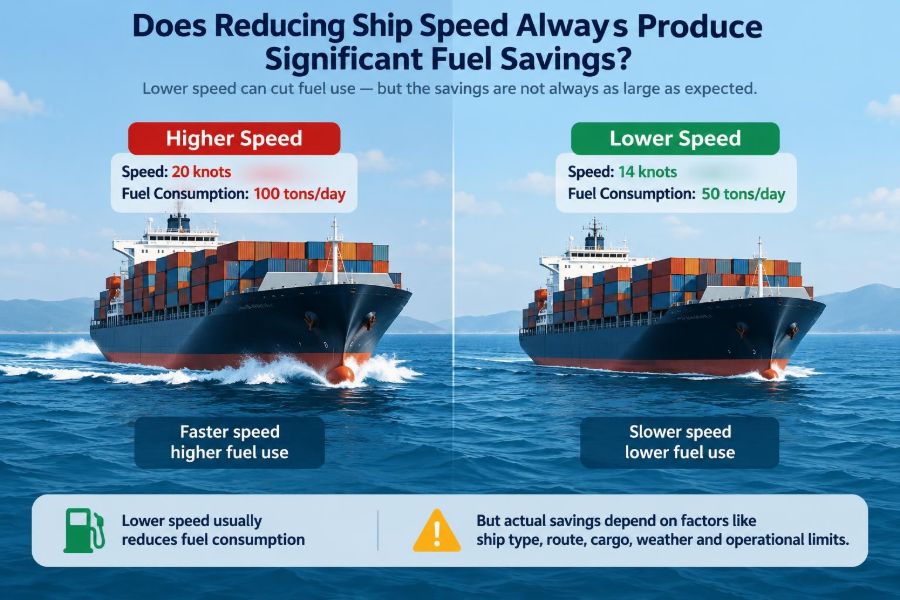
At first glance, slow steaming seems like an easy answer. A ship moving more slowly usually needs less propulsive power, so the main engine burns less fuel per day. But a ship also takes longer to complete the voyage, and many costs continue while it is at sea.
That distinction matters to everyone from cadets learning propulsion principles to engineers interpreting noon reports. A lower daily fuel figure is not automatically the same as lower fuel per voyage, lower emissions per cargo tonne, or lower total operating cost.
The real question is not whether speed reduction can save fuel. It often can. The better question is: what speed produces the best result for this particular ship, route, weather pattern, machinery condition, cargo commitment, and commercial schedule?
⚓ The Short Answer: Usually, but Not Always
Reducing speed normally lowers the power required to drive a displacement ship through water. Because propulsion power rises sharply as speed increases, even a modest speed reduction can produce a large fall in main-engine fuel use per day.
However, the saving is not unlimited and is not universal. If a vessel must spend substantially more time at sea, auxiliary loads operate for longer, hull fouling worsens performance, or the engine enters an unsuitable low-load range, the expected benefit can shrink considerably.
A sound decision therefore compares the whole voyage, not just the fuel consumed during one 24-hour period.
📉 Why the Speed-Power Relationship Matters
For many conventional displacement vessels operating near their normal service condition, required propulsive power is often approximated as proportional to the cube of speed. This is commonly called the cube law.
In simplified form, if speed changes from V₁ to V₂, the corresponding power ratio is roughly:
P₂ / P₁ ≈ (V₂ / V₁)³This is an operational approximation, not a universal physical law. Hull form, draught, trim, sea state, currents, propeller condition, and engine-propeller matching all affect the actual curve.
🧮 A Simple Illustrative Calculation
Consider a hypothetical ship requiring 20 MW at 20 knots in comparable calm-water conditions. If it reduces speed to 18 knots, the cube-law estimate gives:
(18 / 20)³ = 0.729The estimated propulsive power becomes about 14.6 MW rather than 20 MW. That looks compelling: a 10% reduction in speed produces roughly a 27% reduction in propulsive power.
But the voyage time rises by about 11%. The vessel therefore burns less fuel each day, but it is burning that fuel for more days. That is why daily consumption and voyage consumption must be kept separate.
🗺️ Daily Fuel Use Is Not Voyage Fuel Use
Fuel consumption per day is useful for engine-room monitoring and short-term operational control. It tells the crew whether the machinery is performing as expected at a selected speed and load.
For planning, the more revealing measure is fuel used over the full sea passage. A lower speed may reduce tonnes per day while the longer voyage partly offsets the saving.
In broad terms:
- Main-engine fuel per day usually falls sharply as speed falls.
- Days at sea increase as speed falls.
- Auxiliary fuel, lubricants, crew time, and some operating exposures continue during those additional days.
The net result can still be favourable, but it needs calculation rather than assumption.
🔌 Hotel Load Keeps Consuming Energy
A ship does not stop using energy when main-engine power is reduced. Generators may still supply accommodation services, navigation equipment, pumps, refrigeration, ventilation, deck machinery, cargo-related systems, and other electrical consumers.
This is often described as the vessel’s hotel load, although the term covers far more than accommodation. On a container vessel, refrigerated containers can make the auxiliary load particularly significant. On a passenger vessel, hotel demand can be substantial by design.
Since hotel load persists for each extra day at sea, it weakens the fuel-saving benefit of slower transit. The effect varies greatly by ship type and operating condition.
🧊 Refrigerated Cargo Changes the Equation
A reefer cargo or refrigerated containers require continuous cooling. Their electrical demand depends on ambient conditions, insulation, cargo temperature settings, loading arrangement, and plant performance.
If a speed reduction adds several days to a voyage, the refrigeration plant runs for several more days. The additional generator fuel is not directly tied to propeller speed, so it does not follow the cube-law reduction.
This does not mean slow steaming is unsuitable for reefer trades. It means the analysis should include actual auxiliary consumption rather than treating the main engine as the vessel’s only fuel user.
🛠️ Main Engines Have Preferred Operating Ranges
Large marine diesel engines are designed to operate efficiently and reliably across a defined load range, but performance is not identical at every point. Specific fuel oil consumption, commonly expressed as grams of fuel per kilowatt-hour, changes with load.
At very low loads, combustion quality and thermal efficiency may deteriorate. Engine makers provide operating guidance, including load limits, maintenance considerations, and in some cases recommended measures for prolonged low-load running.
The practical message is simple: slow steaming must stay within approved machinery operating limits. A voyage plan should never use a theoretical fuel curve as a reason to override manufacturer instructions or the ship’s safety management procedures.
🔥 Low-Load Operation Has Maintenance Consequences
Long periods of low engine load can affect cylinder temperatures, turbocharger performance, exhaust-gas conditions, and deposit formation. The exact risks depend on engine type, tuning, fuel, ambient conditions, and operating profile.
For some engines, controlled periodic loading or other maker-approved practices may be used to support healthy operation. These actions themselves consume fuel and should be recognized in performance planning.
Ignoring maintenance effects can create a false economy. Fuel saved during a passage is not the full result if the operating mode increases cleaning requirements, component wear, or future downtime.
🌀 The Propeller Must Still Be Properly Matched
The main engine, shaft, and propeller operate as a system. When speed falls, propeller revolutions, torque, and engine load shift together along a propeller curve.
A fixed-pitch propeller and a controllable-pitch propeller respond differently to changes in demand. Shaft-generator arrangements, power take-in systems, and hybrid configurations can introduce further constraints or opportunities.
Engineers should therefore use the vessel’s approved speed-power and engine-propeller information rather than relying solely on a generic rule of thumb.
🌊 Calm-Water Curves Are Not Sea-Passage Curves
Most basic speed-power explanations assume calm water, clean hull, steady draught, and no current. Real voyages rarely look like that.
Head seas increase resistance. Wind creates aerodynamic drag and can alter wave conditions. Swell direction affects motion and added resistance, while steering corrections and rudder activity can consume more energy than a simple model assumes.
A schedule built around a calm-water speed may force the engine to work much harder in adverse weather. Conversely, a favourable current can allow a lower through-water speed while maintaining the required speed over ground.
🧭 Speed Through Water and Speed Over Ground
Speed through water is the ship’s speed relative to the surrounding water. Speed over ground is its movement relative to the seabed, usually derived from satellite navigation.
The difference is the current. For passage planning and arrival time, speed over ground matters. For hull resistance and propeller demand, speed through water is the more direct physical driver.
A vessel facing a strong adverse current may increase power but gain little speed over ground. In that situation, simply ordering a target ground speed can lead to unexpectedly high fuel use.
🌬️ Weather Routing Can Beat a Fixed Speed Order
Reducing speed is only one efficiency lever. A route that avoids severe head seas or uses favourable currents may reduce fuel consumption and machinery stress without sacrificing as much arrival time.
Weather routing must always respect navigational safety, cargo constraints, charter-party requirements, local restrictions, and the master’s authority. It is not a fuel-saving exercise conducted separately from safe seamanship.
When route and speed are optimized together, the objective is often a smoother power profile rather than the lowest possible speed at every moment.
🧽 Hull Fouling Can Erase Expected Savings
Marine growth and slime on the underwater hull increase frictional resistance. Propeller roughness, damage, or fouling can similarly reduce propulsive efficiency.
A fouled ship may need noticeably more power to achieve the same speed through water. If planners use an old clean-hull curve, they may overestimate the fuel benefit available from speed reduction.
Trend monitoring is valuable here. Comparing performance over time at similar draught, trim, weather, and speed conditions helps distinguish a genuine operational change from a deteriorating hull or propeller condition.
⚖️ Draught and Trim Affect Resistance
Displacement changes resistance. A laden vessel and a ballast vessel can have very different speed-power characteristics, even when sailing at the same nominal speed.
Trim also matters. The best trim for resistance is vessel-specific and may change with draught, speed, sea state, and loading condition. An apparently small adjustment can sometimes improve performance, but it must remain within stability, structural, propeller immersion, visibility, and operational limits.
Speed reduction works best when it is part of a broader efficiency plan that includes correct loading and trim management.
📦 Cargo Commitments Set a Practical Lower Limit
A bulk carrier with a flexible arrival window may have considerable scope to reduce speed. A liner service with fixed port windows, connecting cargo, and berth allocations may have much less.
Perishable cargo, just-in-time industrial supply, project cargo, and contractual delivery terms can make late arrival costly or unacceptable. In those cases, a lower speed may reduce bunker consumption but create larger commercial losses elsewhere.
The engineering assessment should identify this constraint clearly rather than assuming fuel is the only objective.
🏗️ Port Waiting Can Change the Best Strategy
Suppose a ship is likely to wait outside port because a berth is unavailable. Maintaining high speed only to anchor for days may waste fuel that could have been avoided through a coordinated later arrival.
This is the principle behind just-in-time arrival: adjusting passage speed so that a vessel reaches port closer to the time when berth, pilotage, cargo handling, and terminal resources are ready.
It requires reliable information and cooperation across the port call. Simply slowing down without a confirmed arrival window can shift waiting time rather than eliminate it.
⛽ Fuel Price Is Only One Economic Variable
Higher fuel cost makes fuel-saving measures more attractive, but it does not make every reduction in speed economically optimal. Charter hire, crew costs, insurance exposure, inventory value, port windows, maintenance, and revenue consequences may also matter.
The relevant comparison is often the marginal change: what additional cost or saving occurs if the ship travels one knot slower for this passage? That question is more useful than treating fuel cost in isolation.
Commercial teams and ship operators may use different accounting boundaries. A technically efficient plan should be checked against the contract and the party that bears each cost.
📜 Charter Parties Can Create Conflicting Incentives
Under some charter arrangements, one party controls speed and voyage orders while another bears fuel cost. That separation can discourage decisions that minimize total system cost.
Speed and consumption warranties, performance claims, emission clauses, and off-hire provisions can further shape the decision. Their interpretation depends on the specific contract and applicable legal context.
Engineers do not need to resolve contractual questions alone, but they should provide accurate operational data. Clear records of weather, speed, rpm, power, draught, fuel use, and machinery condition are essential.
🌱 Emissions Usually Fall, but the Metric Matters
Burning less fuel generally reduces carbon dioxide emissions from the voyage, because carbon dioxide output is closely linked to fuel consumption. Lower power can also reduce certain air emissions, though the relationship is influenced by fuel type, engine condition, control equipment, and operating mode.
Yet claims should specify the metric. Emissions per day, per voyage, per nautical mile, and per tonne of cargo moved are different measures. A longer voyage may improve one measure more than another.
Environmental performance is strongest when speed reduction is evaluated alongside cargo carried, route, waiting time, and total energy used.
📊 Measuring Performance Requires Good Data
A noon report is useful, but one day’s result is rarely enough to define a vessel’s true performance. Wind, waves, current, draught changes, manoeuvring, and fuel-transfer timing can distort a short observation period.
Useful performance monitoring brings together several inputs:
- Fuel flow or carefully reconciled tank soundings
- Main-engine power, rpm, and load data
- Speed through water and speed over ground
- Draught, displacement, trim, and cargo condition
- Wind, waves, swell, current, and sea temperature where available
- Hull, propeller, and machinery maintenance status
The aim is not perfect certainty. It is a decision model that is transparent about its assumptions and improves as reliable data accumulates.
🧠 Avoid Comparing Unlike Conditions
A common mistake is to compare fuel consumption from a laden voyage in winter with ballast performance in calmer summer conditions, then attribute the entire difference to speed.
Another is to compare average daily fuel figures while ignoring manoeuvring, port approaches, generator configuration, or time spent in heavy weather. These comparisons can produce confident but misleading conclusions.
Normalize data where possible. Compare similar draughts, conditions, routes, and machinery configurations, or apply a recognized correction method used by the operator.
🚫 The “Slowest Is Best” Mistake
There is a point at which further speed reduction brings smaller benefits and larger operational penalties. The main engine may approach an undesirable load range, hotel load becomes more influential, and the added voyage time may exceed the fuel saved.
The slowest feasible speed also may not provide enough schedule resilience. A vessel with no recovery margin can be forced into high-power steaming later if weather, port delay, or navigational restrictions disrupt the passage.
Good optimization seeks an appropriate speed, not automatically the minimum possible speed.
⏱️ Recovery Speed Can Undo Earlier Savings
A ship that slows early in a voyage but later accelerates aggressively to protect an arrival time can consume much of the fuel it saved. The cubic nature of the speed-power relationship makes late high-speed recovery particularly expensive.
This is why realistic voyage planning matters. If the schedule cannot accommodate slow steaming for the whole passage, a modest and sustainable reduction may outperform a dramatic reduction followed by a sprint.
Early coordination between the vessel, operator, and port is more valuable than repeated changes to speed orders at short notice.
⚙️ Variable-Speed Generator Strategies Need Review
On some vessels, auxiliary engines and power-management systems can be configured in different ways as propulsion demand changes. The most efficient generator combination may not be the same at every hotel load.
Running one generator at an efficient load can be preferable to running several lightly loaded sets, but redundancy, maintenance, electrical stability, and operational readiness remain essential considerations.
Any changes in generator operation must follow the vessel’s approved procedures. Energy efficiency never justifies compromising blackout prevention or emergency response capability.
🔧 Energy-Saving Devices Work Alongside Speed Reduction
Hull coatings, propeller polishing, duct systems, fins, air-lubrication arrangements, waste-heat recovery, shaft generators, and improved machinery controls may reduce energy demand or improve conversion efficiency.
These measures do not make speed irrelevant. Instead, they shift the vessel’s real-world performance curve. A clean propeller and properly maintained engine make every chosen speed more efficient.
Before estimating benefits, confirm that the device is suitable for the ship, route, operating profile, and maintenance capability. Performance claims should be checked against onboard data after installation.
🧪 A Hypothetical Voyage Comparison
Imagine two plans for the same route, weather window, cargo condition, and clean-hull assumption. Plan A uses a higher speed and reaches port earlier, but the berth is not expected to be ready. Plan B uses a lower speed and arrives close to the planned berthing time.
Plan B may save significant main-engine fuel and reduce anchorage waiting. Yet its final value still depends on generator consumption, the accuracy of berth information, engine load limits, and whether the reduced speed leaves adequate safety and schedule margin.
This example illustrates a method rather than a universal answer: compare complete operating profiles, not only a single speed value.
🧾 A Practical Decision Sequence
Before changing speed for fuel efficiency, the operator and vessel can work through a structured sequence:
- Confirm the safe navigational route, weather limits, and arrival requirement.
- Establish the likely berth or operational readiness time, not merely the nominal ETA.
- Use vessel-specific performance data for the current draught, trim, hull condition, and machinery arrangement.
- Check main-engine and generator operating limits with approved documentation.
- Estimate total passage fuel, including auxiliary demand and likely manoeuvring or waiting.
- Assess schedule margin and identify whether later speed recovery could be required.
- Monitor actual results and revise the plan when conditions change.
This approach turns “slow down” from a vague instruction into a controlled operational decision.
👷 The Chief Engineer’s Role in Speed Decisions
The master retains authority for safe navigation, while commercial and operational teams may set voyage objectives. The chief engineer contributes by explaining what the machinery can deliver efficiently and reliably under the proposed plan.
That includes reporting fuel trends, load limitations, generator requirements, maintenance concerns, propeller or hull condition, and the likely effects of prolonged low-load operation. Clear communication prevents unrealistic expectations from becoming machinery problems.
For junior engineers, this is a useful lesson: performance data is not just paperwork. It connects engineering condition directly to voyage economics, safety, and environmental performance.
🛡️ Safety and Reliability Remain Non-Negotiable
Speed optimization must never reduce the vessel’s ability to respond to deteriorating weather, traffic, restricted waters, equipment faults, or emergency instructions. The required margin depends on the voyage and should be assessed by competent personnel using the ship’s procedures.
Likewise, machinery should not be operated outside approved limits merely to achieve a target consumption figure. A low daily fuel number is not an achievement if it is obtained by increasing operational risk.
The best efficiency plan is one that remains safe, compliant, technically sustainable, and commercially credible.
🎯 The Core Principle: Optimize the Voyage, Not Just the Speed
Reducing ship speed can produce substantial fuel savings because resistance and propulsive power rise rapidly at higher speeds. This remains one of the most useful principles in marine energy management.
But the actual result depends on the whole system: passage duration, auxiliary demand, engine load, propeller performance, weather, currents, hull condition, cargo obligations, port readiness, and recovery-speed risk.
The right question is therefore not “How slowly can the ship sail?” It is “What operating plan moves this cargo safely and reliably with the lowest justified total energy use and cost?”
Slow steaming is powerful when it is planned as voyage optimization rather than treated as an automatic fuel-saving rule. A ship’s most efficient speed is always tied to the conditions in which it is asked to perform. ⚓🌊📉