
Imagine waiting at a windswept harbor for a sailing vessel that cannot leave because the wind is wrong. For most of human history, that uncertainty shaped trade, migration, naval strategy, and everyday travel. A ship could have a capable crew and a sound hull, yet still spend days waiting for favorable weather.
Steam power did not make the sea calm or eliminate danger. What it changed was something more fundamental: it gave vessels a dependable source of propulsion that could work against a headwind, follow a schedule, and move along rivers where sailing was difficult.
That shift altered the meaning of distance. Inland towns became connected to ports, ocean crossings became more predictable, and naval forces gained a new kind of mobility. Modern marine engineering still carries the imprint of this transition in its machinery spaces, operating practices, and design trade-offs.
The story of steam navigation is therefore not simply about an engine placed in a boat. It is about a linked system of fuel, boilers, hulls, crews, ports, maintenance, and economics that changed global transportation.
⚓ What “Steam Navigation” Actually Means
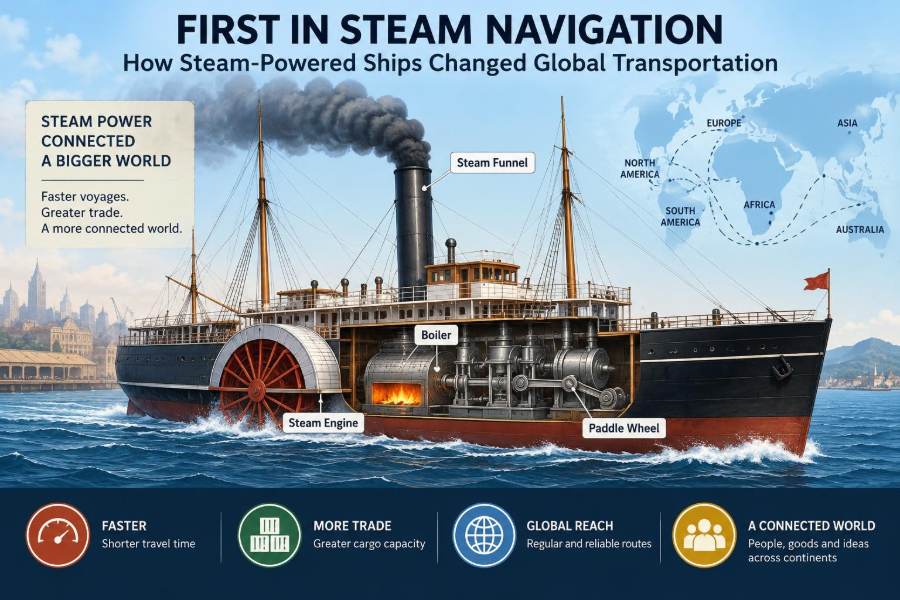
Steam navigation is the propulsion of a vessel by an engine powered by steam. Fuel heats water in a boiler; the resulting high-pressure steam expands in an engine and converts heat energy into mechanical motion.
That motion turns paddle wheels or, later, a propeller. Unlike a sail, the machinery does not rely directly on wind direction. Steamships still had to manage currents, waves, storms, and fuel limits, but their propulsion was far more controllable.
🌬️ Why Sail Power Had Real Limits
Sailing ships were sophisticated machines, not primitive ones. Skilled sailors could use winds from different angles, and large sailing fleets supported worldwide commerce for centuries.
Yet wind is variable. A voyage could be delayed by calms, contrary winds, or the need to take a long route to find favorable conditions. River navigation was especially restrictive because a vessel moving upstream often faced both current and unsuitable wind.
- Arrival times were uncertain.
- Routes were shaped by seasonal wind patterns.
- Ports and cargo owners had to tolerate long delays.
- Upstream transport could be slow, labor-intensive, or dependent on towing.
🔥 The Basic Steam Cycle at Sea
A marine steam plant begins in the furnace, where coal, wood, oil, or another fuel releases heat. The boiler transfers much of that heat to water, producing steam under pressure.
The steam enters cylinders in a reciprocating engine, pushing a piston back and forth. Connecting rods and a crankshaft change this reciprocating movement into rotary motion for a paddle shaft or propeller shaft.
After doing work, steam is often condensed back into water. Condensing improves efficiency by creating a low-pressure outlet for the engine and allows valuable feedwater to be reused.
🧪 Why the Engine Had to Develop First
Early steam engines were mainly stationary machines used for pumping water from mines. Adapting them to ships required machinery that was compact enough, reliable enough, and efficient enough to carry its own fuel without consuming the vessel’s entire payload.
Marine machinery also had to endure vibration, corrosion, rolling, pitching, and continuous operation. A successful steam vessel was never just an engine demonstration; it was an engineering balance between power, weight, space, and endurance.
🛶 Early Experiments Were Not Yet a Revolution
Inventors experimented with steam-driven boats in the eighteenth century, particularly on rivers and sheltered waters. These trials demonstrated the principle, but many were limited by weak engines, poor fuel economy, unreliable boilers, or lack of financial support.
Priority can be misleading in this history. The “first” boat to move under steam, the first commercially useful boat, and the first regularly scheduled service are different achievements. Progress came through repeated improvement rather than one isolated moment.
🏞️ Robert Fulton and the Clermont
Robert Fulton’s North River Steamboat, widely known as the Clermont, began a commercially significant regular service on the Hudson River in 1807. It operated between New York City and Albany, showing that a steam-powered route could be dependable enough for passengers and freight.
Fulton did not invent every component of steam navigation. His importance lies in combining available technology, business organization, route selection, and operation into a service that proved commercially influential.
🏴 Henry Bell and the Comet
In Britain, Henry Bell’s Comet began service on the River Clyde in 1812. It helped demonstrate the value of steam transport on Scottish coastal and river routes.
The Clyde became an influential center for shipbuilding and marine engineering. Its experience shows a recurring pattern: steam navigation developed fastest where routes had regular demand, repair capability, fuel access, and operators willing to invest.
🗺️ Rivers Were Steam Power’s Ideal Early Market
Rivers offered concentrated traffic between cities, farms, mines, and ports. They also made steam’s advantage immediately visible: a vessel could travel upstream with purpose rather than wait for a usable wind.
On waterways such as the Mississippi system, steamboats reshaped regional movement of people and goods. Their shallow-draft hulls and sternwheels or sidewheels were adapted to local conditions, although river hazards such as snags, shoals, and changing channels remained serious.
🔄 Paddle Wheels: A Practical Starting Point
Paddle wheels were a logical early solution because a reciprocating steam engine could drive them through simple mechanisms. Side paddles were common on broad vessels, while sternwheels suited some shallow rivers.
They had drawbacks. A paddle entering and leaving waves does not work evenly, and a deeply loaded or rolling ship can immerse one side differently from the other. Side paddles also occupy valuable hull space and can be vulnerable in rough seas.
🌀 The Propeller Changes Ship Design
The screw propeller became increasingly important in the nineteenth century. Positioned below the waterline at the stern, it was better protected from waves and did not take up the ship’s sides.
A propeller allowed designers more freedom in arranging hulls and cargo space. It also proved well suited to ocean-going vessels and warships, though early propeller design required careful experimentation with blade shape, diameter, shafting, and engine speed.
⚙️ From Beam Engines to Compact Machinery
Early steamboats often used large beam engines, recognizable by their prominent rocking beams. They worked effectively on some river and harbor vessels but occupied considerable space above deck.
Marine engine design gradually moved toward more compact arrangements, including oscillating and compound engines. The objective was not simply to make engines smaller; it was to improve power delivery while preserving room for cargo, passengers, fuel, and crew.
📈 Compound Expansion Improved Fuel Economy
In a compound engine, steam expands in more than one cylinder. It first works in a high-pressure cylinder and then expands further in a larger low-pressure cylinder.
This extracts more useful work from the same steam than a simple single-expansion arrangement can typically achieve. Better fuel economy mattered enormously because coal bunkers competed directly with commercial cargo and constrained a vessel’s range.
🪨 Coal Created a New Operating Geography
Coal powered much of the nineteenth-century steam fleet. It offered concentrated energy and could sustain regular operation, but it was bulky, dirty, labor-intensive, and required a network of coaling stations.
A steamship route was viable only when fuel could be obtained at useful intervals. This made ports, colonial stations, mining regions, and naval bases strategically significant in ways that purely sailing routes often were not.
🏗️ Iron Hulls Matched the New Machinery
Wooden hulls carried many early steam engines, but iron construction increasingly complemented steam propulsion. Iron could support heavier machinery and allow different structural arrangements, although it introduced new problems involving corrosion, fabrication, and magnetic effects on compasses.
Iron did not instantly replace wood everywhere. Material choice depended on local shipbuilding capability, cost, intended route, and regulation. Still, the combination of stronger hulls and mechanical propulsion expanded what designers could attempt.
🌊 Crossing Oceans Was a Different Test
River success did not automatically mean ocean success. An ocean steamer had to carry enough fuel for a long voyage, survive heavy weather, maintain machinery far from repair yards, and retain space for paying cargo or passengers.
Early transatlantic steam voyages demonstrated possibility, but commercial ocean service required steady improvements in machinery efficiency, hull strength, boiler reliability, and operating networks. Hybrid arrangements using both sails and steam were common during the transition.
⛵ The Savannah and the Meaning of “First”
The American vessel Savannah crossed the Atlantic in 1819 with steam machinery and sails. It is often associated with the first steam-assisted Atlantic crossing, but it used steam for only part of the voyage and was not a regular commercial steam packet.
This distinction matters. Historical claims should specify whether they refer to a vessel equipped with steam power, a voyage made mostly under steam, or the start of a sustained scheduled service. Clear definitions prevent impressive stories from becoming inaccurate ones.
📅 Scheduled Service Changed Commercial Expectations
The deepest commercial impact of steam was not always higher speed. It was greater predictability. Operators could publish departures, coordinate connections, and build repeat traffic around an expected timetable.
For merchants, predictable arrival supported inventory planning and contracts. For passengers, it made travel more practical. For postal systems, it enabled more regular communication between regions separated by water.
📨 Steamships Shrunk Communication Delays
Before electronic communication networks, letters, newspapers, instructions, and market intelligence had to travel physically. A more reliable ship service therefore changed the effective speed of information.
The benefit was uneven and never absolute: storms, mechanical failures, quarantine, port congestion, and political events could still disrupt a schedule. Even so, regular steam routes reduced some of the uncertainty that had defined long-distance exchange.
🏭 Ports Became Industrial Systems
A sailing port needed docks, warehouses, pilots, and labor. A steamship port needed all of those plus coal supply, water, engineering workshops, boiler repair capacity, spare parts, and often more organized timetables.
Ports consequently became more integrated with railways, factories, and urban infrastructure. Steam navigation did not act alone, but it became part of a broader nineteenth-century transport system based on industrial energy and coordinated logistics.
👨🏭 New Jobs and New Skills Below Deck
Sailing vessels relied heavily on seamanship: rigging, sail handling, navigation, and hull maintenance. Steamships added engine-room occupations, including engineers, firemen or stokers, oilers, and fitters.
The engineering department had to monitor water levels, pressures, lubrication, bearings, fires, pumps, and valves. A steamship’s performance depended on cooperation between deck officers who navigated the vessel and engineers who kept propulsion available.
⚠️ Boilers Brought Serious New Hazards
A boiler stores energy in pressurized hot water and steam. If its structure fails, the release can be violent. Early marine operations suffered from explosions and fires, especially where design quality, inspection, crew training, or maintenance were inadequate.
Safe operation required disciplined routines rather than confidence alone:
- Maintaining correct water level to prevent overheating of heating surfaces.
- Checking pressure-control and safety devices.
- Managing feedwater quality to reduce scale and corrosion.
- Inspecting boilers, pipes, valves, and machinery for deterioration.
- Training crews to respond to leaks, fires, and abnormal pressures.
🧂 Saltwater Made Maintenance Harder
Marine engineers work in an environment that attacks equipment. Saltwater promotes corrosion, while vibration and repeated heating and cooling can loosen fastenings and stress metal components.
Boiler feedwater treatment was especially consequential. Dissolved salts can form scale on heated surfaces, reducing heat transfer and increasing the risk of local overheating. Condensers and freshwater systems helped, but they also added equipment that needed care.
🛑 Steam Was Not Automatically Safer Than Sail
Steam power gave ships maneuverability and reduced dependence on wind, which could improve control near ports and in confined waterways. It also introduced machinery failures, boiler hazards, coal fires, and a need for highly competent technical crews.
The correct comparison is not “old unsafe, new safe.” Each propulsion system has its own failure modes. Good marine engineering identifies those modes, provides margins and safeguards, and builds operating procedures around realistic human behavior.
⚔️ Naval Power Took on a New Character
Steam propulsion allowed warships to maneuver independently of wind, a major advantage in tactical situations and narrow waters. It also supported heavier machinery and, eventually, changes in armor, guns, and hull form.
Early naval vessels often retained sails because coal consumption limited range. The transition was gradual: navies had to establish fuel depots, train engineering personnel, and rethink strategy around logistics as well as fighting power.
🌍 Trade Networks Became More Connected
Regular steam routes linked coastal cities, river towns, islands, and continents more tightly. Perishable or time-sensitive cargoes could sometimes move under more predictable conditions, while passenger travel became less dependent on long weather delays.
However, steam navigation did not distribute benefits equally. It could reinforce the power of industrial states and trading companies with capital, coal supplies, shipyards, and access to strategic ports. Technology changes networks, but it also changes who controls them.
♻️ The Environmental Cost Cannot Be Ignored
Coal-fired steamships released smoke, soot, ash, and carbon dioxide. Coaling also affected port labor and waterfront environments. The industrial expansion enabled by steam brought economic connections alongside substantial environmental burdens.
This history is relevant to current decarbonization efforts. Marine engineers must evaluate propulsion not only by speed and range, but also by fuel lifecycle, emissions, infrastructure, safety, and the practical needs of particular trades.
🔧 What Modern Marine Engineers Still Learn from Steam
Most commercial ships now use diesel engines, gas turbines, electric propulsion systems, or combinations of these technologies. Yet the engineering questions posed by steam remain familiar: How is energy converted? Where does waste heat go? How much fuel must be carried? What happens when a critical component fails?
Steam plants also remain relevant in specialized contexts, including some naval applications and systems where turbines use steam generated from nuclear reactors or recovered heat. Understanding boilers, turbines, condensers, pumps, and heat balance remains valuable engineering knowledge.
🧭 A Useful Way to Analyze Any Propulsion Change
When assessing a new marine technology, avoid focusing only on the prime mover. A better approach is to examine the complete operating system.
- Identify the energy source and its availability.
- Measure the space, mass, and maintenance burden of the machinery.
- Consider range, refueling, and port infrastructure.
- Map likely failure modes and required crew skills.
- Compare lifecycle cost and environmental effects for the intended route.
This framework explains why a technically impressive invention may still fail commercially, while a less dramatic design succeeds on the route it was built to serve.
🧠 Common Mistakes in Telling the Steamship Story
One mistake is treating a famous vessel as if it single-handedly transformed world transport. The transition depended on many inventors, shipbuilders, engineers, laborers, financiers, port authorities, and crews.
Another is assuming that steam immediately replaced sail. For decades, sails and engines operated side by side, often on the same vessel. Adoption followed the economics and conditions of each route, not a simple calendar date.
📚 Reading Historical “Firsts” Carefully
Claims about first steamships deserve a few questions: first where, first under what definition, and first to do what consistently? A harbor trial, a river passenger service, and an ocean-going commercial line are not equivalent milestones.
This habit is useful beyond maritime history. Engineering development is usually iterative. A technology becomes transformative when it is reliable, maintainable, affordable enough, and embedded in the infrastructure needed to use it repeatedly.
🔗 Steam Navigation as a Systems Revolution
Steam navigation changed global transportation because it connected mechanical power with an entire industrial ecosystem. Engines provided thrust, but fuel stations enabled range; trained crews enabled reliability; ports enabled turnaround; and schedules enabled economic value.
That systems view also explains its limitations. A vessel without coal, spare parts, safe boilers, or repair support was not truly independent. Mechanical propulsion reduced reliance on wind while creating reliance on new networks.
🚢 The Core Takeaway
The arrival of steam-powered ships marked a turning point because it made water transport more controllable and more schedulable. It was especially powerful on rivers and short routes at first, then increasingly influential on coastal and ocean services as engines, hulls, fuels, and infrastructure improved.
Its legacy is both technical and social: steam reshaped ship design, created the marine engineering profession, reorganized ports, accelerated exchange, and introduced industrial safety and environmental challenges that still inform maritime decisions.
Steam navigation changed transportation not by conquering the sea, but by making movement across it more predictable through engineering, energy, and organized infrastructure. That principle still guides every effort to build cleaner, safer, and more dependable ships. ⚓🌊🔧